Sustainable development and co-design advocate. sharing insights on collaboration, social learning, MEL, systems thinking, adaptive management, & facilitation.
Biodiversity loss isn’t a side issue for sustainability teams.
It’s a systemic economic risk.
The new IPBES Business & Biodiversity Assessment makes that clear.
What it really implies is a shift in governance and organisational capability.
Indicators are often treated as neutral measures of progress.
In complex settings, numbers don’t speak for themselves.
• Indicators support judgement, they don’t replace it
• They need revisiting as conditions change
A quick takeaway: A clear prompt has a purpose. I often start by deciding whether I need to explore, clarify, develop, improve, or prepare for engagement. It helps keep the AI in a supportive role rather than leading the thinking.
I’ve just shared a new post on using AI in more reflective and collaborative ways. A light approach to prompting that keeps judgement and relationships at the centre.
https://t.co/576R7EdR5D
I’ve updated the Learning for Sustainability page on systems thinking. The revised intro highlights its relevance for tackling complexity in environmental management, healthcare, and climate change. Links offer guidance and tools for sustainable change. https://t.co/BmGAbDmMO1
🌍 Breaking the silos: The latest IPBES reports reveal why tackling biodiversity, climate & social crises in isolation isn’t working—and what we can do instead.
🔗 https://t.co/9Jhs9eaIc2
#IPBES#SystemsThinking#Sustainability
Collaboration & co-creation are not the same thing.
Collaboration means working with others - who often have their own goals & agendas. These goals have to be matched & if they're not, one person’s gain can be another person’s loss.
Co-creation is about jointly creating something new with input from everyone involved. If we want to do things differently in future, collaboration isn't enough. People need to be near the creation process (co-creation) to work in creative ways.
Research from Google shows that to co-create we need to:
- have a shared vision
- think in questions instead of problems & solutions,
- work in ways that level the playing field so the loudest voices don’t get the most attention,
- create psychological safety for people to open up
- offer good guidance/coaching to facilitate the process in a way that manifests the values of co-creation
- make stuff & not just talk:
https://t.co/O6sYd4n0mM. By @dhambeukers.
I’ve updated the Learning for Sustainability page on systems thinking. The revised intro highlights its relevance for tackling complexity in environmental management, healthcare, and climate change. Links offer guidance and tools for sustainable change. https://t.co/BmGAbDmMO1
How can participatory action research address complex challenges? My latest post explores collaboration, reflection action and co-design to empower groups for meaningful change. https://t.co/hylDKukVCI
#Collaboration#SystemsThinking#AdaptiveManagement#ActionResearch
In a distracted world, the most underrated leadership skill is listening.
144 studies, 155k people: Good listeners have deeper bonds and better results. We feel valued, and they get smarter.
Great leaders are devoted learners. A key to learning is to listen more than you talk.
How can co-design & facilitation drive sustainable change? In my latest Medium post, I explore how bringing diverse voices together can foster innovation & systemic change. https://t.co/GtoL1euAoF
#Sustainability#CoDesign#Facilitation#Collaboration#SystemsThinking
How can co-design & facilitation drive sustainable change? In my latest Medium post, I explore how bringing diverse voices together can foster innovation & systemic change. https://t.co/GtoL1euAoF
#Sustainability#CoDesign#Facilitation#Collaboration#SystemsThinking
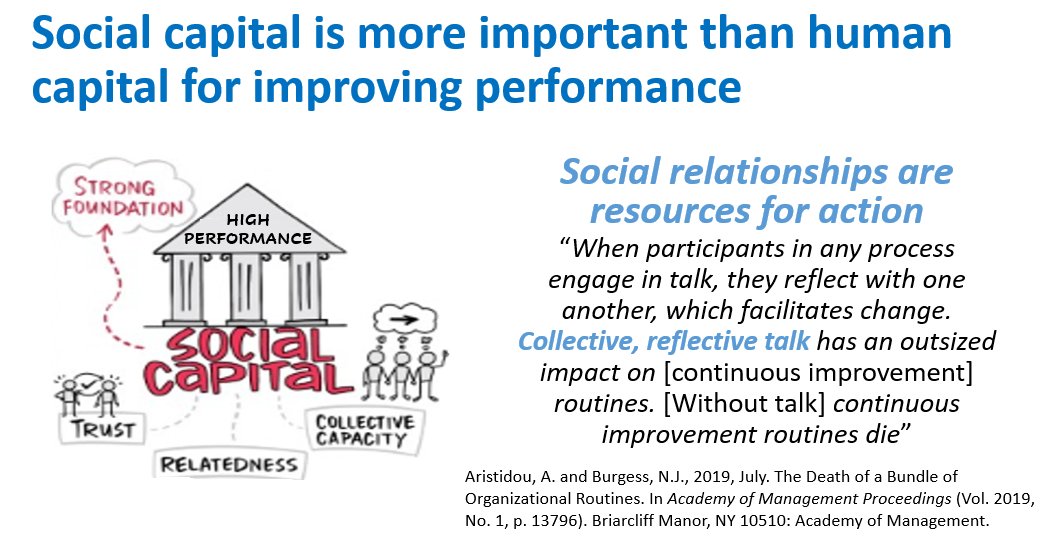
High levels of ‘social capital’ (the value gained when people work well together) create the conditions for high performance in health & care. The evaluation of 5 NHS organisations that undertook whole system transformation showed that social capital is more important than human capital (the skills, knowledge & experience people possess) when it comes to improving performance. Now, research newly published in @HarvardBiz concludes that social capital is at least, or more important, than human capital OR financial capital for high performance in healthcare organisations.
If we want to improve performance & productivity, we need to get serious about:
- understanding social capital (relational co-ordination & social network analysis)
- providing the time, space, focus & leadership support for relationships & connections
- building it into our improvement routines & nurturing & measuring its growth as a key component of our performance strategy.
https://t.co/30h5nDpMYc. Article via @ThomasHLeeMD. Material for graphic from @DrNicolaBurgess
Great interview by @emilypont with Andy Reisinger, he points to the need for a more nuanced approach to reducing greenhouse gas emissions, integrating diverse mitigation strategies and equity considerations, to truly meet the goals of the Paris Agreement. https://t.co/bIZv0Xt1St
Driving constructive change is a strategic battle against the status quo for a new vision, requiring a shift in power, not mere persuasion. Greg Satell provides evidence-based insights for supporting change https://t.co/1drc78Khix
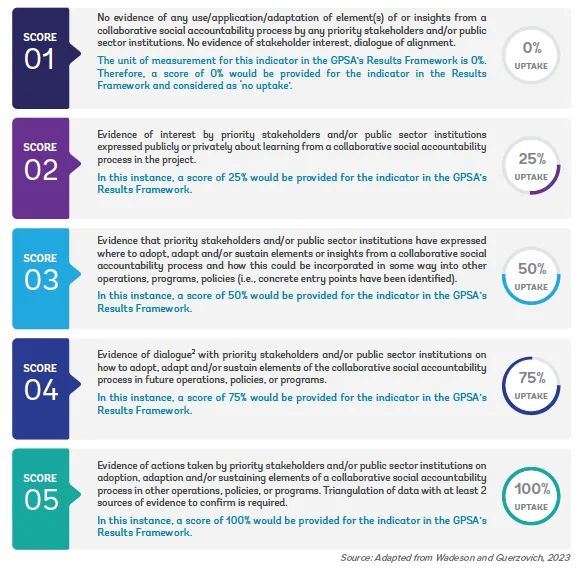
This useful post by @Guerzovich and @Alexwaden on developing a sequential, relational rubric is worth a read. It's a great resource for practitioners to track and evaluate the scaling of social accountability interventions, focusing on sustainability. https://t.co/VeVTOF7r4w