AI will transform the practice of law.
The law firms best capable of meeting this new world are those that can fully harness the power of AI.
This means the winners are likely either (a) major firms with nine-figure retained earnings to invest in AI or (b) firms that can harness the power of third-party capital to invest in AI.
I recently joined John Coogan and Jordi Hays to discuss why AI will fundamentally reshape legal practice, from how work is performed to how clients expect to be charged.
Thanks again to @johncoogan and @jordihays for having me on the @tbpn podcast.
Why would law firms sell part of their firm to PE? Three key reasons:
1. Capital to invest in long-term projects. All "firms" need third-party capital to grow. That's why capital markers flourish. Law firms are largely cut off from those markets. That may be ending.
2. Recognize future value of the firm. Company shares sell at a multiple of earnings. Today's law firm partners can pocket today part of the future revenue stream.
#2 creates a potential conflict between senior partners closer to retirement and junior partners who aren't.
3. Third-party expertise. Investors bring specialized expertise that law firms may lack in-house. Those third parties can help the firm grow.
FT Exclusive: Paul Weiss, Quinn Emanuel and Proskauer have had conversations about taking outside capital without triggering rules that bar ownership by non-lawyers. How could this reshape their industry? https://t.co/nsqinpOvBB
@FordhamNYC Law School is hosting a CLE on litigation finance on September 9, 2026.
The event starts at 3:30pm at Fordham Law School. Professors Susanne Augenhofer, Susan Block-Lieb, and Martin Gelter will speak.
I'll be there and hope to see others interested in the space.
Registration link in the comments.
An interesting trend in law-and-AI news:
The first wave of news focused on AI hallucinations and the dangers of leaning into AI.
The second (and latest) wave focuses on law firms like Kercher's and the dangers of NOT leaning into AI.
Perhaps for the first time, to excel as a lawyer you need expertise both in law and technology. The lawyers who succeed will be those who can balance the tensions between the first and second waves.
Quinn Emanuel Vet Launches AI-Powered Firm For High-Stakes Cases
Chris Kercher is building the law firm of the future—betting that while AI will transform the production aspects of litigation, clients still need human judgment.
LINK: https://t.co/FQEjS9Z56k
@zackbshapiro Can hourly feel lawyers earn significant revenue in an AI-first legal world? Or will litigation firms move increasingly to plaintiff-side contingent fee work?
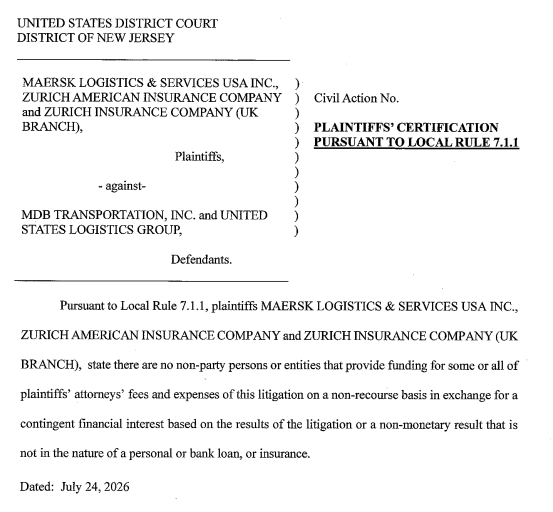
An insurance company is funding litigation on behalf of an insured in D.N.J.
Yet the insurance company can disclose that there is no third-party funding because D.N.J's disclosure rule explicitly carves out insurance third-party funders from the definition of third-party funders.
As I've written elsewhere, this is a clear example of existing disclosure rules being vastly underinclusive relative to their stated goals, and of the favorable treatment given to some forms of third party funding over others.
@WSJ Note the pairing of (a) a software company with (b) an AI-native law firm.
Why? Because law firms cannot raise traditional third-party capital, but software companies can.
This structure is inefficient. Rule 5.4 reform is needed to help preserve law firms in the future.
Pay close attention to the structure of AI-native law firms that are trying to compete at all levels of the legal market.
They frequently pair -- as Fox is pairing -- (a) a software company with (b) an AI-native law firm.
Why? Because law firms cannot raise traditional third-party capital, but software companies can.
This structure is inefficient. Rule 5.4 reform is needed to help preserve law firms in the future.
David Fox upended the legal industry once before. He hopes to do it again with a newly launched law firm, called Irving, which employs only a handful of lawyers and primarily relies on artificial intelligence. https://t.co/iKFvhLj5Bf
An excellent op-ed in Bloomberg about how the disclosure of litigation funding -- like Uber's effort to require disclosure by contract -- can discourage meritorious litigation.
Useful insight for the broader disclosure debate.
Opinion: Uber’s revised terms requiring access to documents exchanged with third-party litigation funders are likely unlawful but could effectively discourage lawsuits. https://t.co/UL2FXTkxQ4
In 2025, a bankruptcy judge found that a trustee failed to get proper court approval for a litigation funding transaction.
Just yesterday, the District Court affirmed the decision, ruling that the Trust has no further obligation to the funder and removing the trustee.
The case is Litchfield Ventures v. Jones, No. 25-cv-2282 (N.D. Tex.).
A bankruptcy judge voided GLS Capital’s $2.3 million litigation funding agreement, a setback for the investor’s role in the case. https://t.co/Ndx26F0SUN
Institutional investors are increasingly investing directly into law firms and portfolios.
What types of cases do they invest in?
Primarily (though not entirely) (a) mass tort cases and (b) monetizations of large corporate claims.
Why?
These are cases where many claimants are victim of the same wrongdoing. Those opportunities can usually be sourced without a dedicated litigation finance sourcing network, and a single underwrite can support investments across many different claimants.
Investors who seek financial returns from litigation are increasingly putting money directly into law firms and case portfolios rather than relying on intermediaries to direct their decisions. https://t.co/XFn2wAU2SS
Two things about Legal AI are true:
1. Today's law firms have no choice but to use AI.
2. Today's law firms have no choice but to use AI responsibly.
I'm hosting a conversation next week between @MikeJShowalter and @SunealBedi on how law firms can do be #1 and #2.
Link in the comments to sign up for this free evet.
Ohio just enacted new a litigation finance regulation. The statute:
1. Imposes registration requirements on both commercial and consumer funders;
2. Bars funders from financing foreign plaintiffs;
3. Bars funders from investing foreign money into cases;
4. Funders may not “make any decision, have any influence, or direct any decisions with respect to the course of a legal claim, including decisions in appointing or changing counsel, choice or use of expert witnesses, litigation strategy, and settlement or other resolution.”
5. Requires the disclosure of funding agreements to the state AG when the case has resolved.
Link to the bill in the comments.
Uber now requires drivers and customers to disclose if they use litigation funding.
Note that it's a one-way rule: Uber doesn't have to disclose its own financing.
This effort is designed to insulate Uber from liability and impede access to justice. It will ultimately harm Uber's drivers and consumers.
Uber Technologies Inc. has moved to thwart lawsuits funded by outside investors by requiring customers and drivers who sue the company to disclose details of any such arrangements. https://t.co/lgqMhGfAPK
@BLaw This effort is designed to insulate Uber from liability and impede access to justice. It will ultimately harm Uber's drivers and consumers, not funders.