Yes, Cancel the Long End and Start YCC.
Let’s give some context and be explicit.
Cancel the long-end auctions and bring on targeted yield-curve control. Buy time, focus the strategy, rebuild America.
Reagan’s rule was “Trust, but verify.”
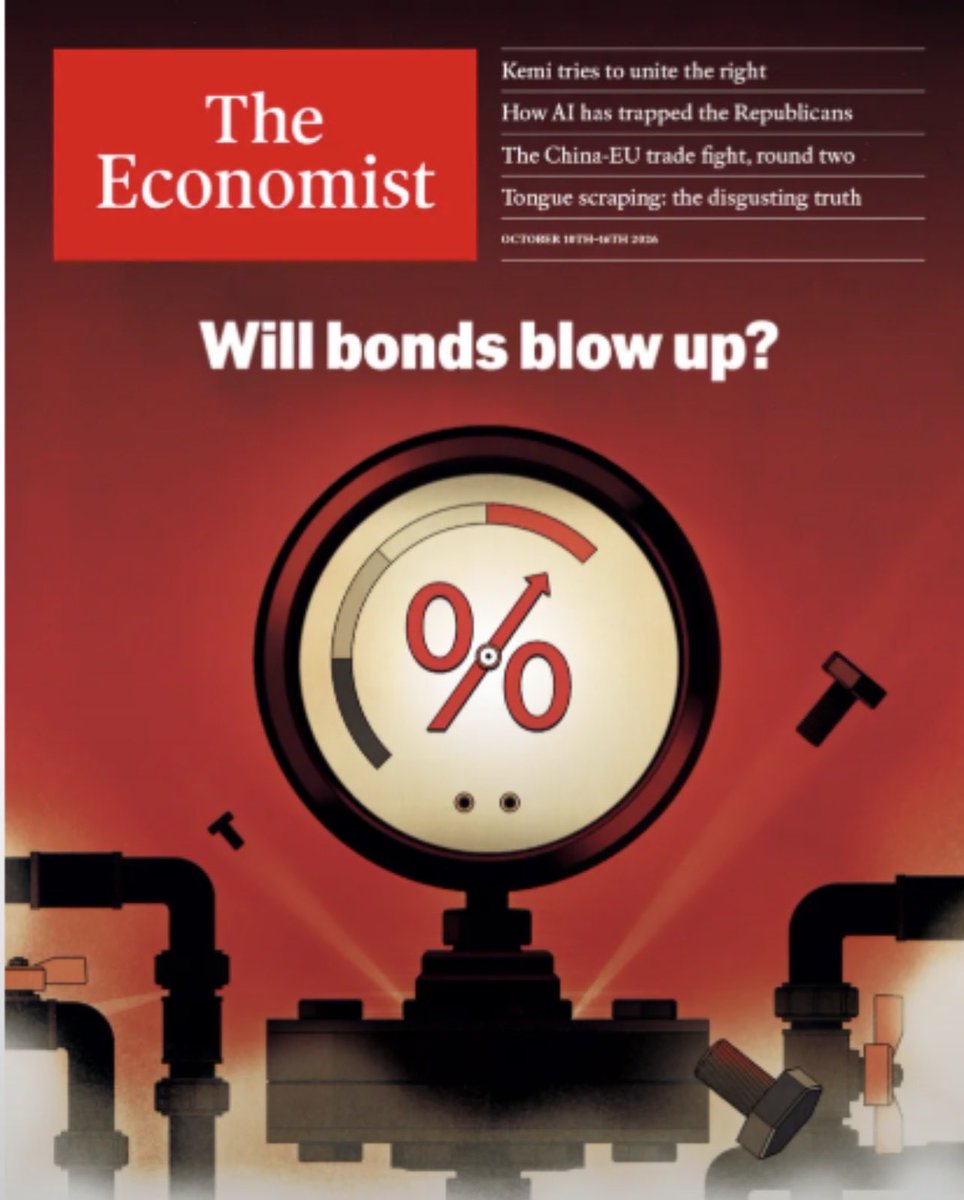
But, the bond vigilantes have skipped the first half. They don’t trust the Fed, Bessent, Trump or Washington. In a period of historic change, they demand concrete evidence. A rational response, buy time by cancelling auction on the long end and bring back YCC.
This is about credibility, not simply inflation. The confrontation echoes the Hillarycare era, when bond vigilantes challenged Clinton’s ambitions and ten-year Treasury yields climbed above 8%.
Court action disrupted tariff collections and forced refunds, damaging revenue that could help narrow the deficit. Replacement duties should recover part of the loss.
The vigilantes don’t care about the explanation. They want receipts.
Cancel the auctions until they are in hand!
Supply-side economics takes time. Full expensing rewards qualifying investment before its productivity dividend arrives. AI offers a generational opportunity.
The GENIUS Act could strengthen dollar-based finance and Treasury demand. Foundations are forming; results must follow.
Warsh’s Fed needs a makeover. Trimmed-mean PCE near 2.2% is concrete evidence against a broad inflationary cascade, and below the 2.7% reading available when Powell cut rates by 50 basis points in September 2024.
Recall October 2018: weeks before the midterms, amid the escalating China trade conflict, Powell declared rates “a long way from neutral” and entertained going beyond it.
By late November, they were “just below” neutral; the following year brought three cuts. Warsh’s Fed is doing the same political maneuver.
That is a record of miscalculation and inconsistent communication. Warsh must stop repeating it. Let the data discipline the theory, rather than treating economic strength as an automatic invitation to tighten.
Bessent should temporarily suspend new 20- and 30-year auctions, accepting greater refinancing risk. Warsh and Bessent need to revisit the possibility of yield-curve control, aligning Treasury’s financing strategy with an independently determined Fed framework.
Targeted yield caps should address market dysfunction, not subsidize deficits regardless of inflation. Buying time must not become an excuse to abandon fiscal discipline.
America First requires priorities. No more wars. End the Iran conflict. Rebuild America’s productive economy. Give the Bond Vigilantes the receipts.
America grew out of debt after World War II. Gross federal debt fell from roughly 125% of GDP to the mid 30% in 1975. Nominal growth and fiscal restraint worked together
.
The vigilantes trade by the minute; productive investment takes years.
Make 2027 the proof: recovering revenue, expanding capacity, peace and borrowing growing slower than output.
Buy time, not excuses. Outgrow the debt. Rebuild America.
Why Is AI the Only Game in Town? The Fed Is Too Tight!
The Fed is too tight. The clearest evidence is the weakness in the market’s most interest-rate-sensitive sectors.
Wall Street complains that the AI trade is the only game in town, yet fails to connect the dots. Interest-rate-sensitive stocks are getting hammered, turning much of the market into a no-go zone. Is it any wonder investors crowd into secular growth?
Pundits want rate hikes and complain about market breadth. The irony is there if you care to open your eyes.
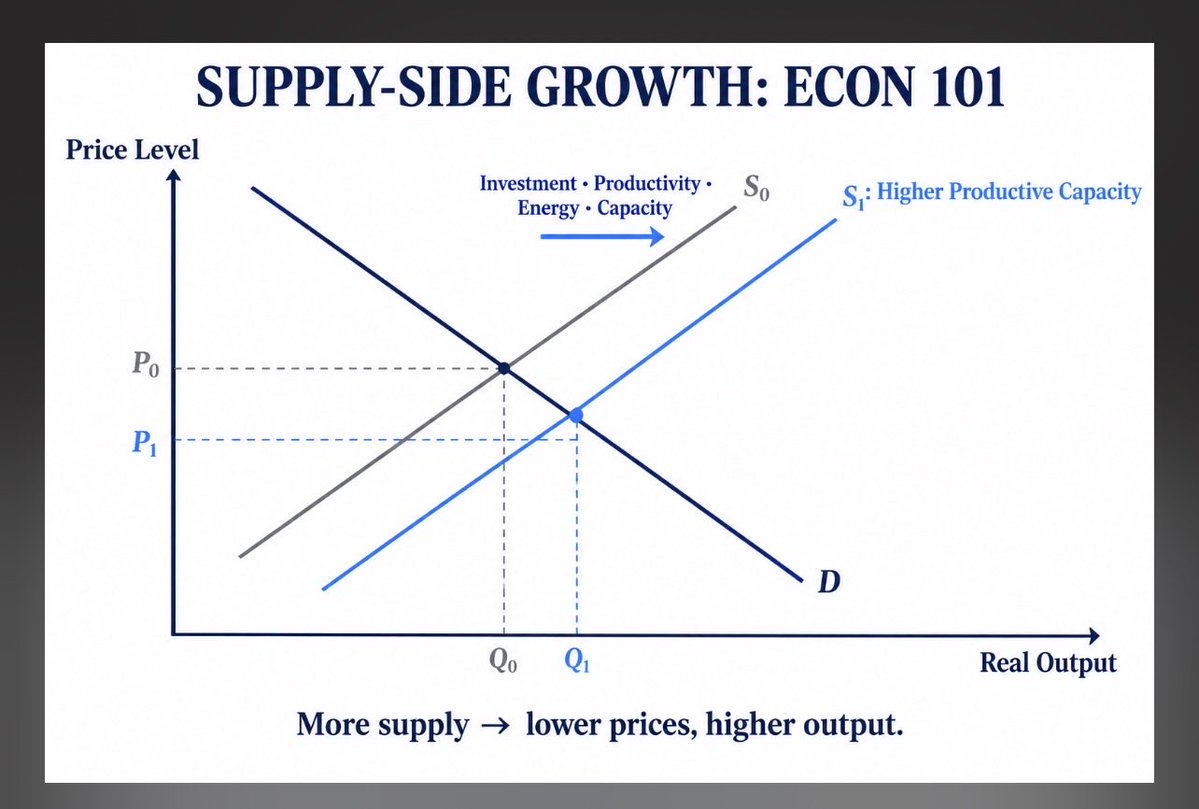
The Fed is failing to distinguish secular growth from cyclical demand. It remains unwilling to accept that supply-side growth is non-inflationary.
Expanding productive capacity is not the same as overheating demand.
Instead, it is using higher rates to fight supply shocks and structural growth trends, neither of which responds readily to monetary tightening, while hammering the sectors that do.
Those sectors did not drive inflation, but they are paying the price for the Fed’s response.
Look at the market’s worst-performing sectors and industry groups. Their common denominator is interest-rate sensitivity: they either depend heavily on borrowing or attract investors with dividends that must now compete with higher yields.
The market is signalling another Fed policy mistake. Remarkably, the pundits complaining about the narrow rally keep missing that message.
Can strong earnings bail out these beaten-down sectors? I doubt it. Until the Fed recognizes its mistake and changes course, those stocks are likely to remain unloved.
But if and when the Fed pivots, which I expect after the midterms, the market will rotate. Investors will sell a portion of their secular-growth holdings and buy beaten-down, interest-rate-sensitive stocks.
Get ready for the rebalance.
The Bond Market Is Losing Faith in the Fed the Term Premium says so.
When will the Fed become competent?
The rising Treasury term premium is a confidence problem. Investors are demanding more compensation to hold long-term bonds because they do not trust the Federal Reserve to get policy right.
Since the September FOMC, the increase in the ten-year yield has come mainly from the term premium, not higher expected short-term rates.
In the San Francisco Fed’s decomposition, the premium accounted for two-thirds of the yield increase through October 2. My reading is straightforward: the market is charging for the risk of further Fed mistakes.
The inflation evidence makes that loss of confidence understandable. Dallas Fed trimmed mean PCE inflation at 2.2%. 2-yr breakevens were 2.5% below the level when Trump took office, while five-year, five-year forward inflation compensation remained around 2.3%. These are not the market signals of a 1970s-style inflation psychology taking hold.
Yet the Fed continues to fight the last war. Its fear of doing too little risks becoming an excuse for keeping policy too tight. Investors are left wondering whether the central bank will follow the evidence or repeat its habit of responding late and then overcorrecting.
Ending forward guidance is one thing. Failing to replace it with a coherent framework is another. Data dependence should mean following underlying inflation, assessing the neutral rate and accounting for policy lags, not invoking yesterday’s inflation to justify today’s decisions.
A Fed that restored confidence could deliver a bull steepener: the two-year moving toward 3%, the ten-year returning to 4%, and the spread widening to 100 basis points. Lower expected short rates would bring down the front end; greater confidence in policy would reduce the premium demanded at the long end.
The Fed cannot promise away the term premium. It must earn it down. Stop living in the 1970s. Follow the data, apply the theory and give the bond market a reason to trust the next decision.
The Green Shoots of Trump’s Hamiltonian Economy
Scott Bessent warned from the beginning that Donald Trump’s economic program would take time to appear in the data. An economy conditioned to reward consumption over production, public borrowing over capital formation, and foreign supply chains over domestic capacity cannot be remade in a quarter.
But policy works with a lag. That lag is beginning to close. We are starting to see green shoots.
At an economic turn, economists follow the household survey. It often shows first whether Americans are finding work, re-entering the labor force or retreating from it. September’s report was solid: household employment rose by 406,000, the labor force expanded by 485,000, and participation climbed to 61.8 percent, its highest level since May. Hours worked also increased.
These are not recessionary signs. They point to a broader expansion of productive capacity.
Wage growth was 3% year over year, while productivity has improved. Business-sector productivity rose 2.2 percent over the year through the second quarter. Manufacturing productivity advanced at a 2.4 percent annualized rate, while unit labor costs fell 0.3 percent. That is the combination policymakers should want: more output per worker, lower unit costs and room for real wages to rise without an inflationary spiral. Attention Phillip Curve lovers.
The Trump program is not simply tax-cut economics. It is a supply-side strategy with national purpose: lower regulatory barriers, expand domestic energy, reward capital formation, rebuild strategic supply chains and make building in America more attractive than offshoring.
The objective is not merely a better quarterly GDP print. It is more energy, housing, equipment, factories, data centers, critical technology and domestic industrial.
The growth in Manufacturing employment is real. The US economy is turning.
That change should eventually show up in corporate profits. My estimate is that S&P 500 operating earnings can reach $450 per share in 2027, as AI investment, reshoring, energy abundance and productivity lift the corporate earnings base.
The inflation evidence is equally important. The Dallas Fed’s trimmed-mean PCE rose at only a 1.92% annualized rate in August, consistent with underlying inflation near the Fed’s target. The danger is that Wall Street Keynesians, Bond Vigilantes and a Federal Reserve trained to see growth as excess demand misread a supply-side expansion as inflation and choke it off.
The green shoots are appearing. Trump’s wager is that America can grow not by borrowing and consuming more, but by producing more.
The Saudis now understand the gravity of the situation in Yemen, the animosity of Iran, and the uselessness of Pakistan (and America/Europe). Turkey and Qatar are with Iran.
Saudis are left with the UAE and Israel, and Riyadh is moving in this direction. If so, smart move.
Tom Holman’s words are great, but there is almost no evidence that the Trump administration is breaking up China’s networks in the U.S. In fact, Chinese agents acted openly on our soil during Xi Jinping’s visit last week.
Slavery and concubinage (including sexual slavery) were recognized and legally regulated institutions in the traditional history of the Islamic world and classical Sharia jurisprudence for over a millennium. Under classical Islamic jurisprudence, chattel slavery was generally restricted to non-Muslim captives acquired through lawful warfare (jihad) in the dar al-harb (House of War) or their descendants. Free Muslims and protected non-Muslim minorities (dhimmis) living under Islamic rule were legally exempt from enslavement.
Islamic law permitted a master to have sexual relations with his female slaves, referred to as ma malakat aymanukum ("that which your right hand possesses"). This was distinct from standard marriage (nikah); female slaves served as domestic laborers or as sexual concubines. Jurisprudence provided certain rights, such as prohibiting the separation of mothers from young children, requiring basic provisions, and encouraging manumission (freeing of slaves) as an act of piety or expiation for sins. An umm walad—a concubine who bore her master a child—could not be sold and was automatically freed upon the master's death.
Historical data shows that Arab and Ottoman traders focused heavily on capturing women and girls. Buyers used female slaves for domestic work and sexual concubinage inside harems. Traders castrated many male slaves to create eunuchs. Masters viewed castrated guards and soldiers as more reliable and unable to reproduce.
Beginning in the 9th century and intensifying throughout the Middle Ages, the Muslim slave raids into Europe became a grim and persistent reality. Mediterranean transformed into a battlefield of human plunder as North African corsairs—pirates and slavers sanctioned by the Muslim states of Algiers, Tunis, and Tripoli—turned the coasts of Europe into hunting grounds. From the shores of Italy and Spain to distant villages in Ireland and Iceland, these raids, which reached their peak between the 16th and 18th centuries, terrorized Christendom. Entire communities were swept away into the darkness of captivity. Historical estimates suggest that between one and one-and-a-half million Europeans were enslaved by Muslim raiders during this period, feeding the insatiable slave markets of North Africa.
The raids were calculated acts of economic and social devastation. Armed with scimitars and matchlocks, the corsairs descended with terrifying speed, capturing men to row their galleys, women to fill harems, and children to sell in the bustling markets of Algiers or Constantinople. In 1627, a fleet of Barbary ships reached as far as Iceland, abducting 400 villagers in a single night, while closer to home, entire swathes of the Italian and Spanish coasts were depopulated. In 1540, the Corsican town of Bonifacio lost half its population to enslavement. Even great cities like Valencia and Naples lived in fear of these predatory fleets. European captives, bound and beaten, were paraded in North African slave markets, described by horrified Christian travelers as “infernos of human misery.”
But Christendom was not idle in the face of these atrocities. Spain, at the forefront of the Reconquista and hardened by centuries of conflict with Islamic forces, took the lead in fighting back. Spanish fleets, bolstered by Catholic alliances, waged relentless campaigns against the corsairs, culminating in decisive victories such as the 1571 Battle of Lepanto, where the Holy League shattered the Ottoman navy. Spain’s coastal fortresses and counter-raids on North African ports became symbols of defiance, and by the 18th century, the balance of power began to shift. Though the scars of these centuries-long raids remained, Europe’s resolve to push back turned the tide, eventually breaking the corsairs’ dominance over the Mediterranean.
📷 : Scene at a slave market by Swiss artist Otto Pilny (1866-1936) painted in 1919.
#archaeohistories
Iran's Economy is Collapsing
Understanding the IRGC's Dilemma
The IRGC likes to boast about its immunity to external pressure, but the economic situation reveals an organization that is disoriented, operating a model so rigid and so dependent on conditions that no longer exist that it has no productive response to the pressure now bearing down on it.
https://t.co/JFD2w56ajE
In 1949, roughly two million Kuomintang soldiers, officials, and civilians fled to Taiwan carrying almost nothing. Within thirty years, Taiwan posted GDP growth averaging close to 9 percent annually, built one of Asia's most competitive electronics industries, and gave ordinary workers real wage gains that mainland China, sealed under Mao Zedong's collectivism, would not match for decades. This contrast is a controlled experiment in political economy.
The refugees who landed on Taiwan had little choice but to produce. Chiang Kai-shek's government, chastened by losing the mainland, implemented a genuine land reform in 1953 that broke up absentee landlordism and handed title to the farmers who actually worked the soil. Secure property rights created the incentive to invest and improve. Farmers grew more because the harvest belonged to them, not to a committee in Beijing.
From the 1950s onward, Taiwan's planners (and they were imperfect, nobody denies that) kept currency relatively sound, maintained contract enforcement, and allowed private capital to accumulate. Small and medium enterprises multiplied without seeking permission from a central plan. By 1980, Taiwan's per capita income exceeded mainland China's by a factor of roughly fifteen. You cannot attribute that gap to geography, ethnicity, or culture; both populations share the same civilization.
Mainland China, meanwhile, destroyed capital through collectivization, killed somewhere between 15 and 55 million people in the Great Leap Forward famine of 1959 to 1961, and then wrecked whatever remained of voluntary exchange during the Cultural Revolution. Central planning actively consumes the human and physical capital required to produce anything at all.
Taiwan's prosperity emerged from treating property as inviolable, prices as information, and individuals as agents rather than resources to be allocated. The island proved that even desperate, stateless refugees accumulate wealth rapidly when government protects exchange rather than directing it.
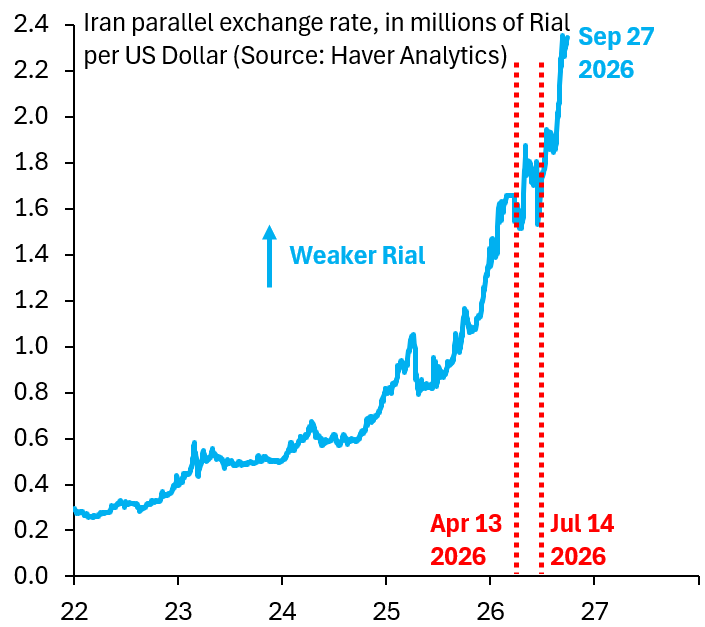
Iran used the one month pause in the blockade to export 80 million barrels of oil. The cash from those exports is about to run dry, so we're about to see a complete meltdown in the Rial and the economy. What's happened so far has only been the prelude...
https://t.co/sqEjdJEjDx
Fed Policy Mistake
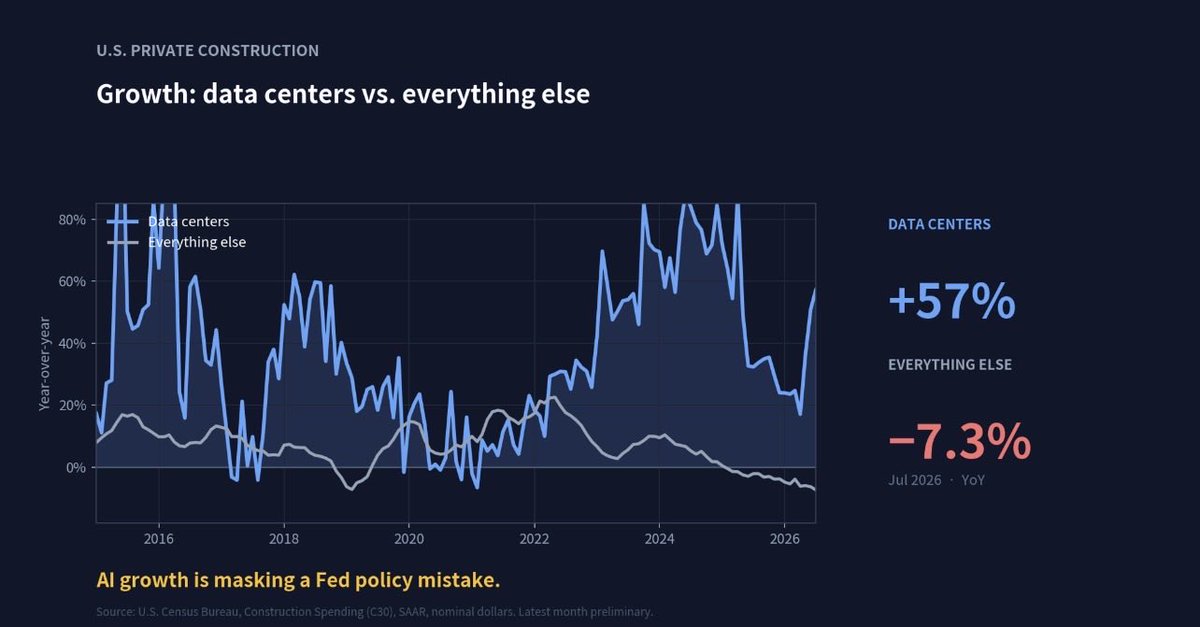
AI data-center construction is up 57%.
The rest of private construction is down 7.3%.
One sector is covering up a broader slump.
It’s amazing with all those thousands working at the Fed, they can’t look at the economy in a nuanced way.
Strip out the server farms and private building is shrinking.
Census C30, July 2026, SAAR. Nominal dollars.
The Fed’s false choice between growth and price stability.
Oh look deficits matter!
No one should be surprised. Debt levels matter again because they never stopped mattering. The Biden administration and its progressive-Keynesian allies acted as though fiscal arithmetic had been repealed. Their embrace of Modern Monetary Theory was not a serious economic strategy; it was a political licence for endless borrowing, deficit spending, and the fiction that public debt carries no consequence.
Wall Street and the Federal Reserve largely stood idle while MMT became fashionable in Washington.
The program was carried into government by former Fed Chair Janet Yellen, as Treasury Secretary, and former Fed Vice Chair Lael Brainard, as a senior White House economic official. Rather than challenge the premise that deficits could expand indefinitely without cost, the financial and policy establishment accommodated it. They treated debt-financed demand as economic management and dismissed concerns about inflation, interest costs, and fiscal credibility as outdated orthodoxy.
The consequences are now plain: persistent inflation pressures, elevated borrowing costs, distorted capital allocation, and a federal debt burden that narrows every serious policy choice. This was not unforeseeable. It was the predictable result of expanding demand through borrowing and monetary accommodation while neglecting the economy’s ability to produce.
There is no escape through another spending binge, financial repression, or central-bank accommodation. The only viable route out is real growth: more private investment, abundant energy, more housing, more industrial capacity, faster permitting, competitive taxes, and policies that reward work, savings, and production. America must rebuild the supply side rather than finance consumption with borrowed money.
The Federal Reserve shares responsibility. For too long, it has regarded strong growth as an inflation risk while treating productive capacity as largely fixed.
Its Keynesian reflex is to manage aggregate demand
stimulate when growth weakens and suppress when prices rise rather than recognize that productivity, capital formation, and expanded supply form the durable basis of price stability.
Kevin Warsh deserves no automatic benefit of the doubt. The test is not whether he can speak about credibility and independence. It is whether he will reject the false choice between growth and price stability, confront fiscal dominance, and understand that supply-side expansion is not inflationary excess but the foundation of sustained prosperity.
Simple question that needs to be answered: Under Warsh does the Fed’s reaction function change to view growth as good?
Right now the answer is no. The Fed is uber hawkish, plan for a massive policy mistake.
The Warsh Fed.
Pain must be felt on Main St!
Fed still believes it has a false choice: growth or price stability. Don’t fight it. Yes it’s wrong !
1) Tariffs are inflationary .. Hike rates
2) Growth is bad inflationary.. Hike rates
3) Hike rates into Negative growth Supply Shocks.
4) Wage growth inflationary: hike rates.
5) we live in the 1970s.
6) choose Wall St over Main St.
Expect a massive policy mistake, more rate hikes.
No the Fed reaction function has not changed.
Have a nice day.
Make America Produce Again
America’s resurgence is being driven by the private sector, not by a larger federal bureaucracy.
Since January 2025, the economy has created more than one million private-sector jobs while the federal workforce has fallen to its lowest level since the 1960s. More than 1.3 million additional native-born Americans are working.
That is the signature of a stronger growth model: investment over bureaucracy, opportunity over dependency, and productive work over government expansion.
President Trump’s approach is distinctly Hamiltonian, with a touch of Clay, Jackson and Mckinley.
It prioritizes productive capital, energy, domestic manufacturing, infrastructure, and the capacity to make real goods. Rather than relying on public hiring, deficit-funded consumption, or monetary stimulus to inflate demand, it seeks to expand the supply side of the economy.
That is how America achieves durable, non-inflationary growth. More investment raises productivity, expands output, eases supply constraints, and supports wages through genuine demand for labor. This is also how America grow out of the fiscal crisis Trump inherited.
The Federal Reserve and Wall Street should not reflexively attack this recovery. This is non-inflationary growth. Private-sector job creation, a smaller federal workforce, and more Americans in productive employment are not warning signs. They are evidence that pro-investment, pro-production, and pro-worker policies are working.
No, Growth Is Not Bad
For decades, Western economies accepted secular stagnation as the price of globalization: weak investment, depleted industrial capacity, cheap imported goods, and supply chains optimized for cost rather than resilience.
That model is breaking down. Covid exposed the danger of depending on distant, concentrated supply networks for everything from medical equipment to semiconductors.
The policy response, led by the United States, is not full decoupling. It is de-risking: rebuilding domestic manufacturing, diversifying supply chains, strengthening energy security, and investing in the infrastructure necessary to support a more resilient industrial economy.
Yet much of Wall Street research still treats growth as an implicit problem. A strong activity number becomes evidence of overheating. Higher capital spending becomes a source of inflation. Any sign of momentum is filtered through a single question: how long must the Federal Reserve keep rates restrictive?
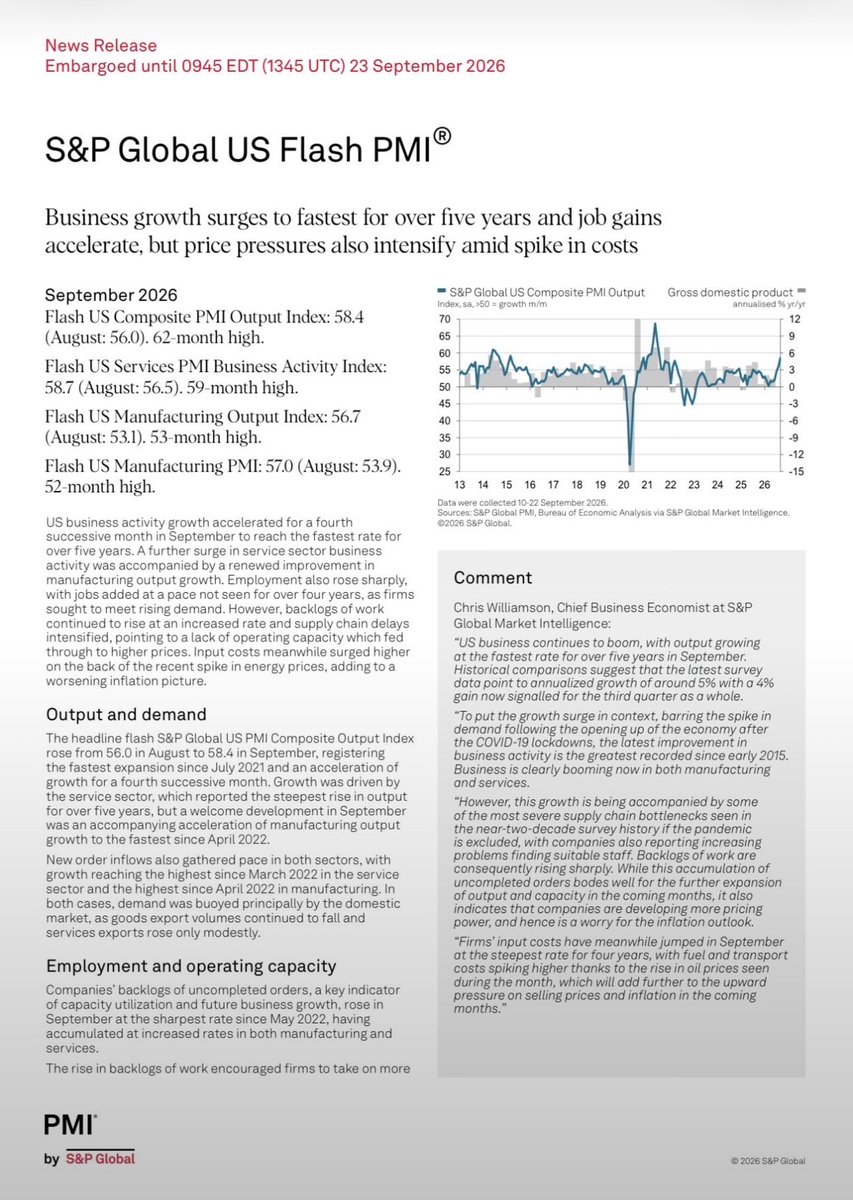
Consider the over reaction to this week’s preliminary PMI headline. One firmer activity reading was enough to revive inflation warnings and push the prediction market to price in multiple rate hikes!
Yes Main St is once again scarified.
But contrast that response with company calls in housing and consumer-facing industries. There, the message is often much less buoyant: affordability is strained, consumers are selective, and high borrowing costs continue to restrain demand.
The economy is not homogeneous. AI investment is a genuine secular growth story, but it is not the whole economy. Data centers, chips, power infrastructure, and industrial investment can be strong at the same time that housing, lower-income consumption, and rate-sensitive sectors remain under pressure.
That distinction matters. Growth driven by consumer demand outstripping capacity can fuel inflation. Growth driven by investment in factories, power generation, grids, ports, mining, logistics, and technology expands supply. It raises productive capacity, strengthens resilience, and reduces vulnerability to future shocks.
America does not need a policy framework that treats every growth signal as proof of excess demand. It needs one that recognizes a fragmented economy and distinguishes a necessary supply-side rebuilding cycle from broad-based overheating.
The Fed and Wall St need to get out of the 1970s.
The market is already voting for 10,000.
Doomsayers say war keeps oil high, tariffs rekindle inflation, the Fed stays restrictive and the US economy breaks. The narrative is neat and backward-looking.
Markets vote on fear in the short run and weigh earnings in the long run. The next move will not wait for midterms, a ceasefire photo or another inflation print. Risk assets will discount the direction of travel first.
That direction is clearer. An Iran settlement removes the geopolitical premium from oil. A China deal removes the tariff and supply-chain tax. Together they create a peace dividend: lower energy and goods costs, stronger real incomes, wider margins and more investment confidence.
The sequence is simple. Geopolitical risk falls; oil falls; inflation falls; yields fall; financial conditions ease; earnings rise. The stagflation case depends on high oil and ongoing trade friction. Remove those assumptions and it collapses.
The political calendar helps. The fourth quarter of a midterm year through the second quarter of the following pre-election year has historically been the strongest stretch of the presidential cycle. Midterm weakness often sets the autumn low; the next three quarters deliver the advance.
The Fed is the holdout. Its old reflex treated above-trend growth as excess demand. Kevin Warsh’s task is to bury that. Productivity-led growth is not overheating. AI investment, energy abundance, reshoring, capex and trade normalisation expand supply and allow faster growth without persistent inflation. Under supply-side policies the false choice between growth and price stability fades.
Treasury yields have peaked. Assume the 10-year reaches 4 per cent by end-2027. Equating the S&P 500 earnings yield with that yield supports a 25-times multiple.
A 2027 earnings target of $450 a share at 25 times implies 11,250. The 10,000 target uses 22.2 times, a 4.5 per cent earnings yield above the assumed Treasury yield. That is conservatism, not exuberance.
The bull market broadens from technology to industrials, consumers, exporters, housing-linked and rate-sensitive sectors. Crypto enters a new bull run as real yields fall and liquidity improves.
Bears demand certainty. Markets never do. They price the chance that peace lowers oil, lower oil restores disinflation and disinflation extends the earnings cycle. The vote has begun.
A once-contentious thesis will become consensus. Ignore the noise. The pain trade is due north.