The breakfast debate is framed as winner-take-all. Skip it and you'll overeat and gain. Or skip it and you'll finally lose weight. The evidence supports neither. On weight, breakfast and skipping come out even, and each carries one real advantage the other doesn't.
Weight first, since that's what people are really asking. A 2019 BMJ review pooled 13 randomized trials: no evidence breakfast drives weight loss, none that skipping causes gain. Skippers ate a bit more later but only partway, so total intake came out lower, about 260 kcal/day. Newer meta-analyses replicate it. If your lever is total calories, skipping has a genuine edge.
But that's not the whole picture. Eating in the morning measurably improves how you handle glucose all day, the second-meal effect. In a randomized trial in type 2 diabetes, skipping breakfast raised blood sugar and blunted insulin after both lunch and dinner vs the same meals on a day that started with breakfast. The first meal primes the system. Clearest in type 2 diabetes, but the physiology is general.
So it's a tradeoff, not a verdict. Normal glucose and your goal is keeping intake down? Skipping is defensible, and it doesn't backfire into overeating. Care about daytime glucose control, which matters in type 2 diabetes and prediabetes? Breakfast has a real edge. For most people, total intake and food quality matter more than timing either way.
The question isn't whether breakfast is good or bad. It's which of these two real effects matters more for your body, your glucose, and how hungry you actually are in the morning.
Psyllium lowers LDL by about 13 mg/dL across 28 randomized trials. The mechanism gets misrepresented constantly. It does not absorb cholesterol.
It does not scrub the gut. The mechanism is purely mechanical, and understanding it explains why most other "soluble fibers" do not produce the same effect.
Psyllium is the seed husk of Plantago ovata. When it hits the small intestine and hydrates, it forms a viscous gel. That gel physically traps bile acids, the cholesterol-derived molecules your liver releases through the bile duct to emulsify dietary fat. Normally about 95% of bile acids are reabsorbed in the ileum and recycled back to the liver. The pool cycles 4 to 12 times per day, losing about 5% per pass. The recycling is efficient because synthesizing new bile acids is expensive. The substrate is cholesterol.
When psyllium disrupts that recycling, the liver loses inventory. Loss of FXR-mediated feedback upregulates CYP7A1, the rate-limiting enzyme in bile acid synthesis, which depletes the hepatic cholesterol pool. SREBP-2 activates, LDL receptors get upregulated, and hepatocytes pull LDL from circulation to refill it. Serum LDL drops. This is the same mechanism used by prescription bile acid sequestrants like cholestyramine.
Jovanovski et al. (2018, American Journal of Clinical Nutrition) pooled 28 randomized controlled trials covering 1,924 participants. The median dose was about 10.2 grams of psyllium per day. LDL fell by approximately 13 mg/dL. Non-HDL fell by approximately 15 mg/dL. ApoB, a more direct measure of atherogenic particles, fell by 0.05 g/L. The apoB evidence was graded as high quality.
Two things matter. First, the mechanism is purely mechanical. Psyllium is not metabolized, does not enter circulation, does not act on a receptor. That is why it has a clean side-effect profile and does not interact with the cytochrome P450 system the way most lipid-lowering drugs do.
Second, viscosity is the active property. Inulin is also classified as a soluble fiber under FDA rules, but inulin does not form a viscous gel. It is highly fermentable instead. The label calls them both soluble fiber, but their functional profiles share almost nothing.
The honest framing on magnitude. A 13 mg/dL drop is meaningful but modest compared to even the lowest-dose statin, which typically delivers 25 to 50 mg/dL. If your numbers are borderline and you want to avoid medication, psyllium is one of the few interventions with this level of evidence. If a statin is indicated, psyllium is not a replacement.
Practical: target around 10 grams of psyllium husk daily, taken with or just before a meal with a full glass of water. That matches the Jovanovski median. Many trials dose 7 grams two or three times per day for a larger effect. Start at 5 grams and titrate up to manage GI side effects.
Jovanovski et al., Am J Clin Nutr, 2018
McRorie & McKeown, J Acad Nutr Diet, 2017
Gonzalez, Compr Physiol, 2012
The MTHFR and folate conversation skips the vitamin one step above it.
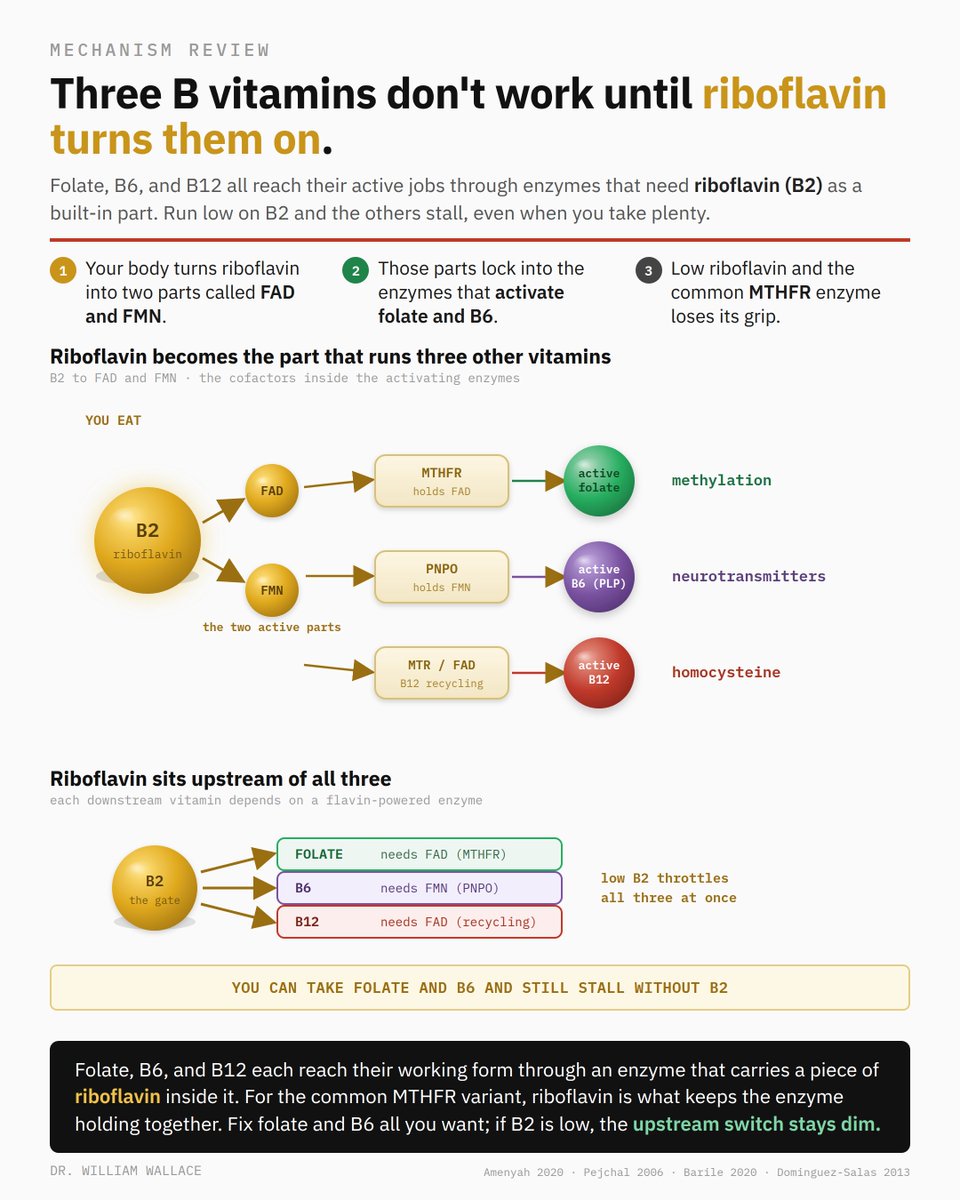
Your body turns riboflavin (B2) into two parts, FAD and FMN. Those parts are built into the enzymes that activate folate, convert B6 to its active form, and let B12 work in the same cycle. B2 sits upstream of all three.
It matters most for the common MTHFR variant: that enzyme doesn't just run slow, it loses its grip on its riboflavin part. Giving riboflavin to people with that genotype lowers homocysteine, because it helps the wobbly enzyme hold the piece it keeps dropping.
The nuance: most people aren't B2 deficient, and the clear effect is specific to the MTHFR TT genotype, not a general fix. It's about removing a bottleneck in the deficient, not taking more for everyone.
Magnesium and blood sugar are often viewed as unrelated, but inside the cell they're linked.
Insulin is called a key that lets sugar into cells. But insulin doesn't open the door itself. It signals from outside, and the cell has to do the work of opening up, which runs on energy.
That energy (ATP) only works when paired with magnesium. Low magnesium, and the cell gets insulin's message but can't fully act on it. Sugar stays in the blood. That weak response is part of what insulin resistance is.
This doesn't mean "magnesium fixes blood sugar." It's clearest in type 2 diabetes, and a blood test can miss it since a very small amount of magnesium is in your blood.
Insulin sends the message. Magnesium powers the cell's ability to answer it. Without enough, the message lands but the cell cannot fully respond.
For most of the last century, apigenin was a footnote — a yellow pigment in chamomile and parsley, studied mostly by people cataloguing the antioxidants in plants. In the last few years it has become one of the most-recommended compounds on the internet: the third ingredient in the famous sleep stack, a fixture in longevity protocols built around NAD+, and an addition to formulas aimed at cellular aging itself. How does the evidence hold up?
https://t.co/2TxeBoMXC3
Riboflavin (B2) absorption from a single dose maxes out around 27 mg. The surplus isn't all "wasted in your urine."
The fraction past that ceiling reaches your colon, where Faecalibacterium prausnitzii, a major riboflavin consumer and butyrate producer, uses riboflavin as an electron shuttle to survive against the oxygen-leaking gut wall.
In a 105-person RCT, riboflavin raised fecal butyrate with almost no shift in which bacteria were present. Same species, but likely more output.
Magnusdottir et al., Front Genet, 2015 https://t.co/pI8yvwfa4p
Yoshii et al., Front Nutr, 2019 https://t.co/mbf2KyzqP8
Gholami et al., Cancers, 2023 https://t.co/LAQncarxkJ
Your gut bacteria make all eight B vitamins. Researchers checked 256 common gut microbes for the genes: each B vitamin can be built by about 40 to 65 percent of them.
The ones that cannot make their own get them from the ones that can. Inside the colon, B vitamins move between bacteria through dedicated transporters. Producers synthesize, non-producers take up, the community stays fed.
That reframes vitamins, to an extent. They aren't only nutrients for you. They are a growth substrate for your gut microbes. Change the supply and you change which species survive. A B vitamin behaves like a prebiotic.
It also explains why shifting your gut bacteria can shift your B vitamin requirements. The microbes are both source and sink.
Note that we can count which bacteria carry the pathways and watch the vitamins move between them. How much then crosses into you is still being worked out.
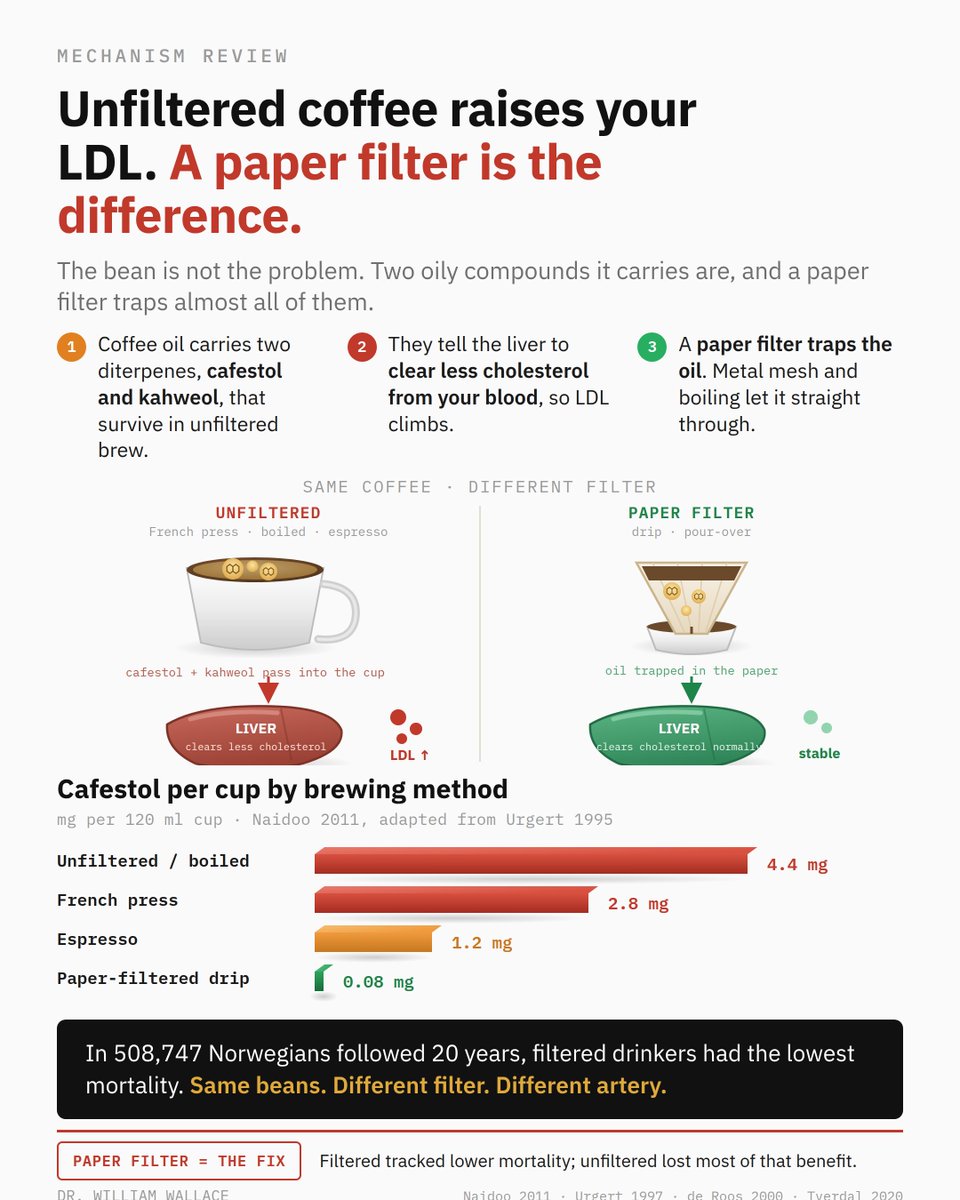
Unfiltered coffee raises your LDL cholesterol. Filtered coffee does not. The bean is identical. The only thing that changes is whether the brew passes through paper.
Coffee oil carries two diterpenes, cafestol and kahweol. They survive in French press, espresso, boiled, and Turkish coffee, and a paper filter traps almost all of them. That single step is the difference.
Once in your body, the diterpenes lead the liver to clear less cholesterol from your blood, and LDL climbs. Cafestol is one of the most potent cholesterol-raising compounds in the diet, and the effect shows up in controlled human trials, not just observational data. The diterpenes nudge triglycerides up too.
How much you get depends almost entirely on the brewing method. Per cup:
Unfiltered or boiled: about 4.4 mg
French press: about 2.8 mg
Espresso: about 1.2 mg
Paper-filtered drip: about 0.08 mg
That is roughly a 55-fold difference between an unfiltered cup and a paper-filtered one of the same coffee.
The long-term data points the same way. In 508,747 Norwegians followed for about 20 years, filtered coffee drinkers had lower mortality than people who drank no coffee at all. Unfiltered drinkers saw little or none of that benefit, and in men over 60, heavy unfiltered intake was associated with higher cardiovascular death. The risk tracked cholesterol: it grew when cholesterol was removed from the statistical model.
One honest caveat. That the LDL rise happens is well established. The exact molecular step, how the diterpenes lower cholesterol clearance, is still being worked out.
If your LDL is a concern, this is one of the easiest levers you have. You do not have to give up coffee. You just have to run it through paper.
Naidoo et al., Nutr J, 2011
Urgert et al., Eur J Clin Nutr, 1995
de Roos et al., J Intern Med, 2000
Tverdal et al., Eur J Prev Cardiol, 2020
collagen and vitamin C have a unique relationship
Collagen's three strands only lock into a stable triple helix after an enzyme adds OH groups to proline. That enzyme needs vitamin C as a cofactor. No vitamin C, no stable helix.
Under-hydroxylated collagen melts around 32 to 34C. Properly built collagen holds to ~40C. Your body runs at 37. This is why scurvy is a vitamin C disease, not a protein problem.
There's a magnesium ion plugging one of the most important channels in your brain. That block isn't a flaw. It's how your brain decides what to learn.
The NMDA receptor only opens when glutamate binds AND the neuron is already firing, both at once. That double-check pops the magnesium out, calcium floods in, and the synapse strengthens. That strengthening is learning.
The block keeps the synapse quiet until a signal is real. Low magnesium loosens that brake.
For decades, vitamin D and calcium have been the default recommendation for keeping bones strong. Most adults over 50 have taken them at some point. Many take them every day. A new systematic review in The BMJ says the evidence does not support that habit for healthy adults.
The review, published this month, pulled together every randomized controlled trial they could find on this question. 69 trials. 153,902 adults. The largest analysis of this specific question to date.
The result was consistent across all three groups they looked at. Vitamin D alone produced no measurable difference in fracture risk compared to placebo. Calcium alone showed a small reduction that the authors did not consider clinically meaningful. Combined supplementation showed a similar small reduction, also below the threshold the authors set for clinical relevance. The pattern was the same for hip fractures and for falls. It held up across age groups, dose levels, and trial designs.
The honest framing matters. The authors did not say vitamin D is useless. They said that in adults who are generally healthy, who are not already being treated for osteoporosis, and who live independently rather than in nursing care, routine supplementation does not appear to prevent fractures or falls by a meaningful amount. For people in those higher-risk groups, the evidence is more limited and more nuanced.
What the authors did recommend as a higher priority for fracture prevention: resistance training and balance work, alongside hazard assessment and tailored interventions for individual risk. They suggest redirecting clinical focus and research funding toward these.
This is a case where the science has moved faster than the recommendations. Many clinical guidelines and most marketing still treat vitamin D and calcium as essential for bone health in healthy adults. The trial data, accumulated over 154,000 people, points somewhere else.
Massé et al., BMJ 2026 69 RCTs, N=153,902 Trial registration: PROSPERO CRD42023483915
Coffee is not one drink. It is a category. The bean and water are constant across most home brewing, but the method changes which compounds end up in your cup. Two cups from the same bag can deliver very different chemistry depending on how they were brewed.
Four compounds matter for health. Caffeine drives the stimulant effect. Chlorogenic acids are the main polyphenols in coffee and carry most of its antioxidant activity. Diterpenes, specifically cafestol and kahweol, are oils that suppress the liver enzyme responsible for converting cholesterol into bile acids. When that enzyme slows, less cholesterol gets cleared and LDL goes up. Bitter phenolics accumulate with long extractions.
What the method controls. Angeloni et al. (Food Res Int 2020) compared eight brewing methods using the same beans. Espresso had the highest caffeine and polyphenol concentration per milliliter, three to six times more concentrated than drip or moka. But a shot of espresso is 30 mL. A cup of cold brew is 240 mL. Per cup, cold brew delivers more total caffeine and polyphenols because the serving is roughly eight times larger.
Diterpenes are where brewing method matters most for cardiovascular risk. They are oil-soluble, so a paper filter can physically trap them. Orrje et al. (NMCD 2025) measured these across methods. Paper-filtered drip: about 12 mg/L cafestol. French press and percolator: around 90 mg/L. Boiled coffee: 939 mg/L. Some espresso shots reached 2,447 mg/L, though espresso is highly variable. The paper filter is the key. Methods without one let the oils through.
This is why brewing method affects cholesterol. Jee et al. (Am J Epidemiol 2001) pooled fourteen randomized trials. Unfiltered coffee raised total and LDL cholesterol. Filtered coffee did not. Svatun et al. (Open Heart 2022, N=21,083) confirmed the signal in Norway. Drinking six or more cups of boiled or French press coffee daily was associated with total cholesterol about 9 to 12 mg/dL higher than non-drinkers. Filtered coffee showed only a small effect, mostly in women.
A note on the numbers. The per-cup mg values are estimates from per-mL concentrations times typical serving volumes. The relative ordering across methods is well-supported. Exact amounts depend on dose, grind, temperature, time, and bean. Espresso varies the most.
A note on cold brew. The graphic assumes paper filtration, which most commercial cold brew uses. Home cold brew through metal mesh or cheesecloth retains more oil and more diterpenes. The filter matters as much as the method.
The takeaway. If you want the caffeine and polyphenols without raising LDL, use paper-filtered methods. Espresso gives you concentrated chemistry in a small serving. French press and boiled coffee give you everything including the oils that raise LDL. Coffee is not one drink. The brewing method is the variable.
Angeloni et al., Food Res Int 2020 · Orrje et al., NMCD 2025 · Jee et al., Am J Epidemiol 2001 · Svatun et al., Open Heart 2022
For decades, magnesium sat in the supplement aisle as a mineral for muscle cramps, sleep, and general nutrition. Around 2010, that changed. A branded form called magnesium L-threonate launched on the back of a 2010 MIT rodent paper, and a new category was born — magnesium for the brain. Fifteen years later, that category has expanded to include other brand-targeted forms, premium price points, and confident claims about cognition, memory, and synaptic density. In this investigation, we review the science underneath those claims.
https://t.co/VLLpPjpHFu