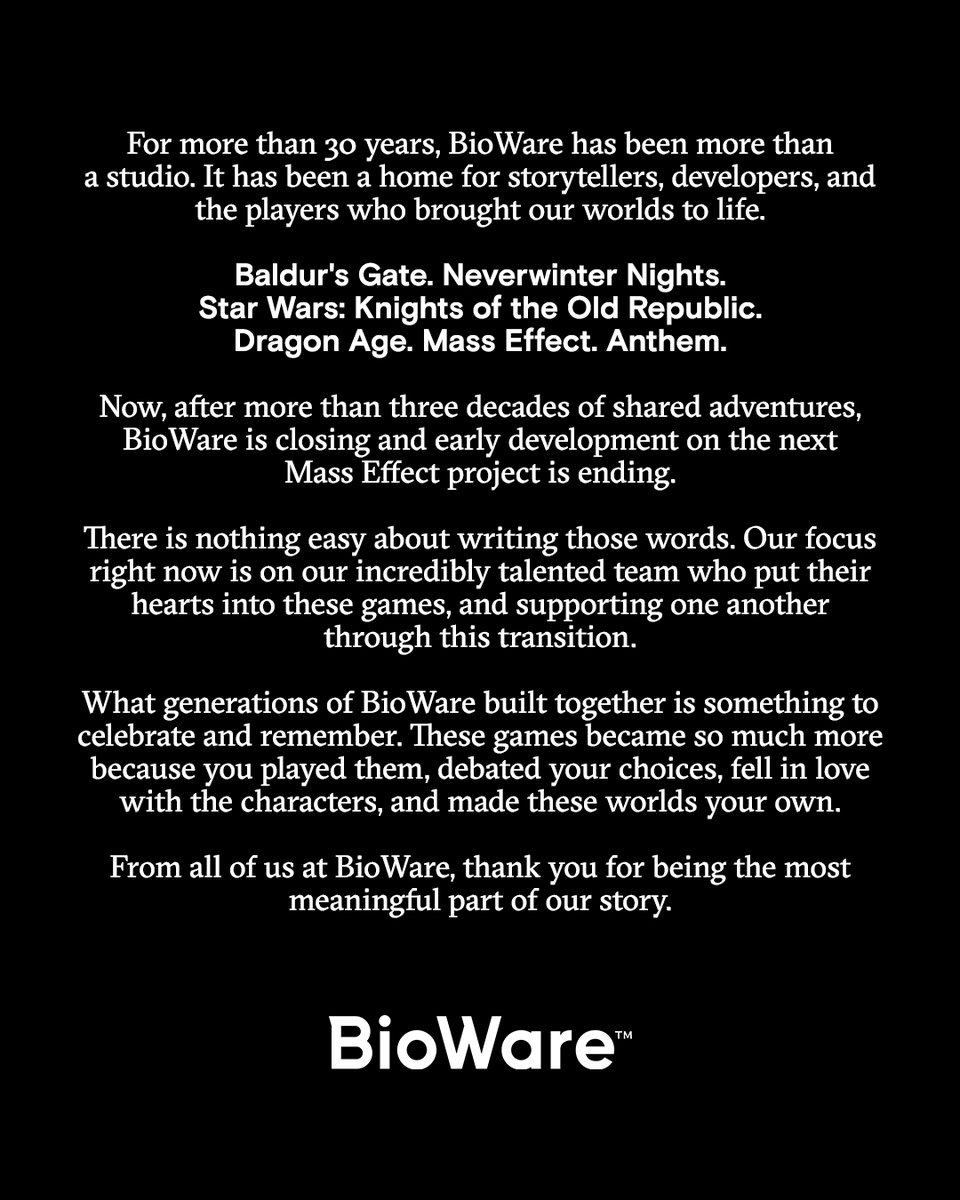
I see a lot of people expressing shock and sadness over BioWare shutting down. And I get it.
But here's the uncomfortable truth:
The BioWare that made Baldur's Gate, Neverwinter Nights, KOTOR, Dragon Age: Origins and the original Mass Effect trilogy had largely ceased to exist long before yesterday's announcement.
BioWare's decline began around the time the doctors left and much like what happened at Blizzard, most of the original talent responsible for building those legendary franchises had moved on years ago.
What remained was the brand. The IP. Basically just the name on the building.
But a studio's name doesn't make great games. Insanely talented people do.
And that's the lesson our industry somehow keeps refusing to learn.
The people who built those studios, who poured their blood, sweat and tears into establishing their creative identities were the actual assets. Their experience, their taste, their leadership, their ability to recognize what made a game special in the first place was always the thing that mattered, not the brand.
You can't simply replace those people, keep the logo on the door and expect the magic to continue.
Yet, that's precisely what publishers have been doing for the past 10-20 years.
They've spent billions acquiring studios and IPs, seemingly under the assumption that the creative output would continue regardless of who was actually making the games.
And when the original talent inevitably left, the remaining teams were expected to fill shoes that were often impossibly large, without necessarily having the experience, leadership or creative vision required to do so.
And... the results speak for themselves.
I think we'll eventually look back at the COVID-era acquisition frenzy as one of the most destructive periods in the history of our industry.
Publishers were buying studios left and right, paying absurd valuations mostly just to secure IPs... and developers were often all too happy to cash out.
At Moon Studios, we got quite a bit of crap for refusing to sell when seemingly everyone else was getting acquired.
I remember telling our team back then that I'd seen this movie before.
The exact same thing happened in the 90s, when EA went on its acquisition spree.
Studios were bought, their founders and creative leaders gradually lost the freedom to make the games they believed in, the original talent became frustrated and left and eventually the studios all became a Ship of Theseus.
History doesn't repeat itself perfectly, but it sure as hell rhymes, and that's exactly why I never wanted Moon to end up in that position.
And I don't think we're even halfway through the ultimate fallout of the latest acquisition frenzy.
There's going to be a very rude awakening for quite a few publishers when they discover that the studios they acquired for billions are worth a fraction of what they paid. And that shoving ideology down peoples throats ultimately came at a cost that they didn't quite grasp.
They didn't actually buy the creative vision, the institutional knowledge or the culture responsible for making those studios successful.
They bought the names, the buildings, the IPs and whatever teams happened to be there at the time.
But those things don't matter at all.
You can buy a studio. You can buy its IP. You can even buy its entire back catalogue.
But you can't buy the magic that made those games special in the first place.
And the sooner our industry understands that, the better.
BioWare is not, like, a guy. BioWare closing is not like Steven Spielberg or Quentin Tarantino getting fired or cancelled.
BioWare is a business entity that existed for 30 years. During that time people — including lead creatives who were responsible for the great games — came and went.
Some video game studios manage to maintain a culture and a sensibility around excellence and the key creatives either stick around for a long time or pass the reins to handpicked successors who share their values and preserve the culture and standards of the studios.
What has happened in the game industry over the last 15 years is that there came to be a widespread belief that the cultures that incubated excellent games were exclusionary racist, sexist, homophobic boys clubs that needed to change in order to welcome in different kinds of people.
Instead of hiring people who shared their values and sensibilities, the people at these game studios were pressured to push their workforces toward being 50% female while achieving racial equity. The staff of the studios changed dramatically, the cultures of the workplaces changed dramatically and the games changed dramatically.
The pandemic sent a lot of people into their homes to play video games, which seemed like it was going to drive an era of growth for the industry. At the same time, the new generation of gaming hardware required more detailed assets, more animation, and therefore more people to make these massive games.
So there was a huge hiring boom at the precise moment that there was an overarching focus of the demographics of the industry, which means that nearly every Western game studio’s workforce was completely transformed. Over 40% of games industry workers under the age of 25 identified as LGBT or nonbinary on recent surveys.
Additionally, some studios have had unique pressures that have driven a lot of turnover. At Rocksteady Games, for example, a lot of the people who made the Batman: Arkham trilogy were not interested in building the live service game Warner wanted, so most of the principals on those games left the studio during the production of “Suicide Squad: Kill the Justice League.”
The studio cannot pivot back to what used to be its strength at making single player titles after that failure because all the people who are responsible for the classic games are gone. They no longer have that strength. They no longer have the institutional capacity to make great games because great games are made by great people and the great people are gone. A similar thing happened to BioWare during “Anthem.”
They couldn’t just pivot back to making great “Dragon Age” or “Mass Effect” games after the failure of “Anthem” because too many people were gone and the culture had changed. They weren’t the same studio and they weren’t a great studio anymore.
The BioWare that was shuttered today is not the studio that made “Mass Effect 2” or “Knights of the Old Republic.” That studio hasn’t existed for many years. It was just the “Dragon Age: The Veilguard” studio.
While this may be sad news to some, it's important to remember that outside of anthem none of the games listed there were created by the bioware being canned
Its its not the name of the company but the people working there that matters and all of those people were long gone
These same skins put at a reasonable price point would absolutely generate revenue by increased sales and would still have reason to exist. If the original cash grab skins bombed due to their price you would never see a move like this again.
Riot keeps making 200-500$ skins because people keep paying that amount for them. They've determined that there are enough people out there with bad spending habits and low impulse control that it is a market worth tapping into. This all started with the original KDA prestige
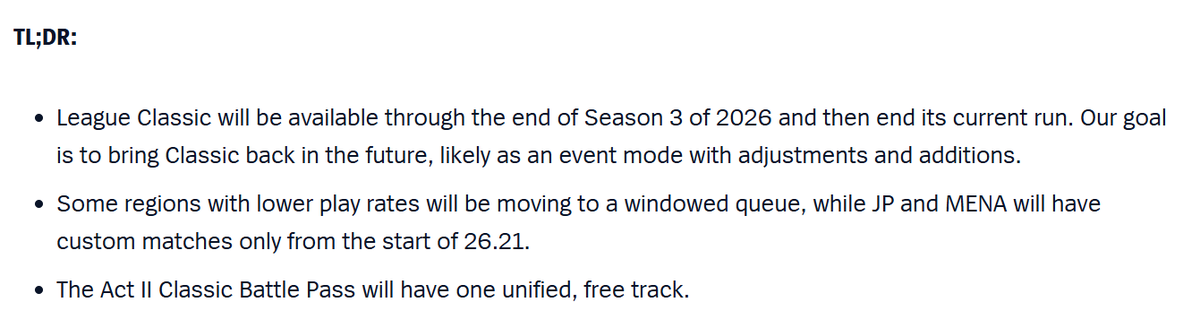
@WayOfTheTempest It was a version of the game that never existed, missing half of the champions. Ones that were included had patchwork kits mixed from different seasons. No classic skins outside of 1 base skin per champion. Adding modern gold scaling and jungle tuning
Did you even play before s6
-Tell players youre going to remake an old version of league
-Call it classic
-Release a version of the game that has never existed at any point in time before then
-Game flops
-Come to the conclusion that nobody wanted old league of legends
Riot special baby lets goooooo!!