Bridges were never the endgame for multi-chain.
Wire Network is building the Universal Transaction Layer.
Now your assets stay native, execution stays coordinated, and fragmented systems operate like one.
For six years, we've been building around one belief:
The future isn't one chain.
It's an economy spanning many ecosystems, applications, assets, and eventually autonomous agents.
That future needs infrastructure capable of coordinating what happens between them.
So we built it.
The Universal Transaction Layer.
Different ecosystems remain independent.
Assets remain native.
Coordination becomes shared.
Soon, Wire enters its next chapter.
Get access to $WIRE before TGE.
Wire's Liquidity Creation Offering (LCO) lets eligible participants acquire $WIRE Pre-Tokens ahead of launch.
Earlier stages come with lower purchase prices, with prices increasing as the offering progresses.
Early access to $WIRE, with a pricing structure that favors earlier participation.
Why does crypto still feel fragmented when the industry is more connected than ever?
Our CEO @KenDicross joined @AndrewAsksHow to discuss the problem Wire is solving, the infrastructure behind it, and what interoperability could unlock for the next generation of applications and autonomous agents.
Catch the full conversation below.
Episode 106 with Ken Dicross the CEO of Wire Network
Crypto tooling should be interoperable across chains
Having capital, apps, people fragmented is killing the industry
The solution is unified liquidity and products
02:01 @KenDicross on building @WireNetwork
05:55 Meeting the Bitcoin OGs at Satoshi Roundtable
12:15 Running clubs before crypto
15:52 Building something new with no pedigree
22:47 Launching wire
26:35 Underwriters let you exit Ethereum instantly
32:21 Stopping bridge hacks
35:54 Will AI agents find Wire
41:48 Walking to the bank is dead
47:21 Tokenized stocks and active TVL
51:31 Institutions and dark money onchain
1:00:29 Building an army
1:04:45 Owning the infrastructure
The bigger crypto gets, the less interoperability looks like a bridge problem.
It starts looking like a standards problem.
Different networks aren't going away.
Different execution environments aren't going away.
Different applications aren't going away.
So the answer can't depend on making everything the same.
The internet scaled because independent systems learned to operate through shared standards.
We think crypto eventually gets there too.
Different ecosystems. Common coordination.
@willmicah68@thinkagents Autonomous agents need infrastructure that makes coordination across ecosystems simpler.
Excited to see Think Agents putting that vision into practice.
One of the longest-running assumptions in crypto is that eventually, one ecosystem wins.
We think that's the wrong end state.
The internet didn't converge into one website.
Commerce didn't converge into one company.
Computing didn't converge into one application.
Successful systems tend to become more diverse as they grow, not less.
The infrastructure underneath them is what becomes standardized.
Wire is being built for that version of crypto:
Many ecosystems. Shared coordination.
What is Wire Network, why was it built, and where is it heading?
@KenDicross sat down with Jack to discuss the vision behind Wire, the Universal Transaction Layer, and the infrastructure we're building for the future of blockchain.
Catch the full conversation below.
USDC now lives across 38 blockchains.
That's incredible distribution.
Stablecoins can exist across dozens of networks.
That doesn't make those networks one system.
In fact, the more environments an asset reaches, the more obvious the coordination problem becomes.
Where does the asset live?
Which address controls it?
How does ownership change?
How does an application interact with it across environments?
Distribution is only half the problem.
Coordination is the other half.
More than 10 billion autonomous agents could exist by the end of 2030.
Yesterday: Humans clicked buttons.
Today: Software increasingly automates what happens after the click.
Tomorrow: Agents initiate, coordinate, and complete transactions themselves.
The infrastructure underneath those three worlds can't stay the same.
An agent economy needs transactions to be predictable across environments without requiring the agent to manually navigate the fragmentation between them.
That's the world Wire is being built for.
The next billion blockchain users might never click a button.
Crypto spent years asking:
How do we onboard the next billion users?
There's another possibility.
A meaningful share of future blockchain activity may come from software acting autonomously on behalf of users, businesses, and other software.
Those participants won't need better buttons.
They'll need infrastructure that can coordinate transactions predictably across environments.
The next generation of blockchain UX may have no interface at all.
We’ve received reports of individuals impersonating Wire Network recruiters and contacting members of the community.
Please be aware that Wire Network is not currently recruiting.
Any recruitment outreach claiming to represent Wire Network should be treated as fraudulent.
Please remain vigilant and rely exclusively on our official channels for legitimate Wire Network announcements and opportunities.
If you only remember one thing about Wire, remember this:
Blockchains are independent systems.
As more of them exist, coordinating activity between them gets harder.
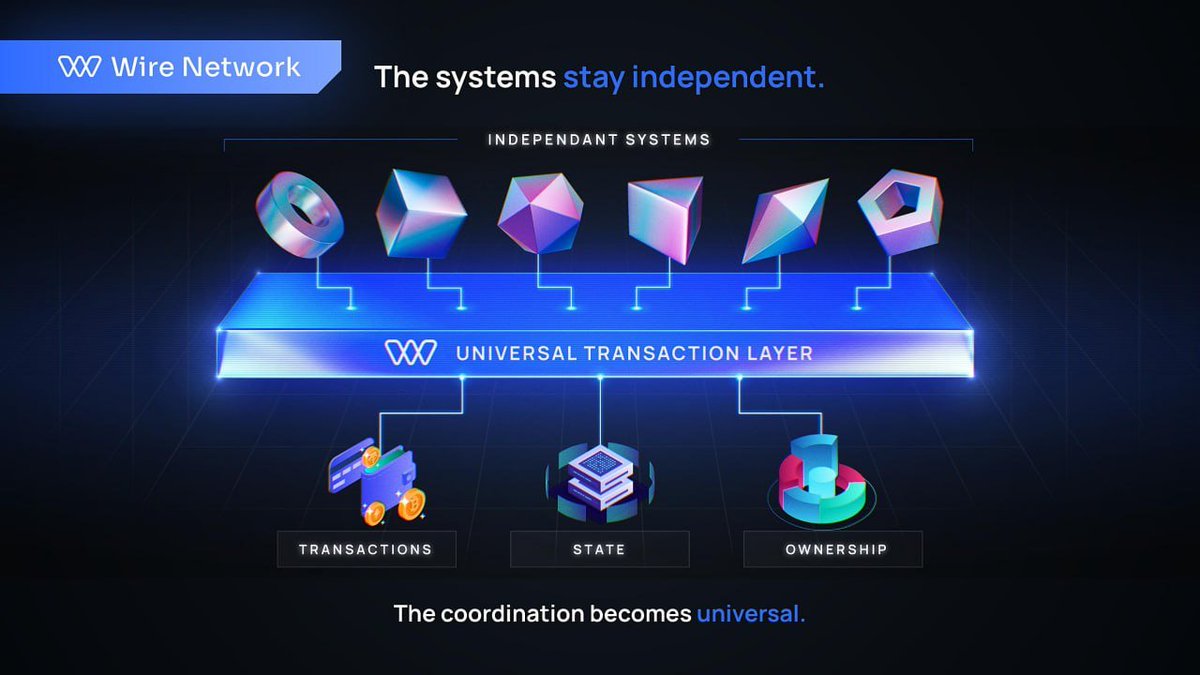
Wire's Universal Transaction Layer provides shared infrastructure for coordinating transactions, state, and ownership across connected ecosystems.
Assets can remain native.
Applications don't need endless point-to-point infrastructure.
Different ecosystems remain different.
The coordination becomes universal.
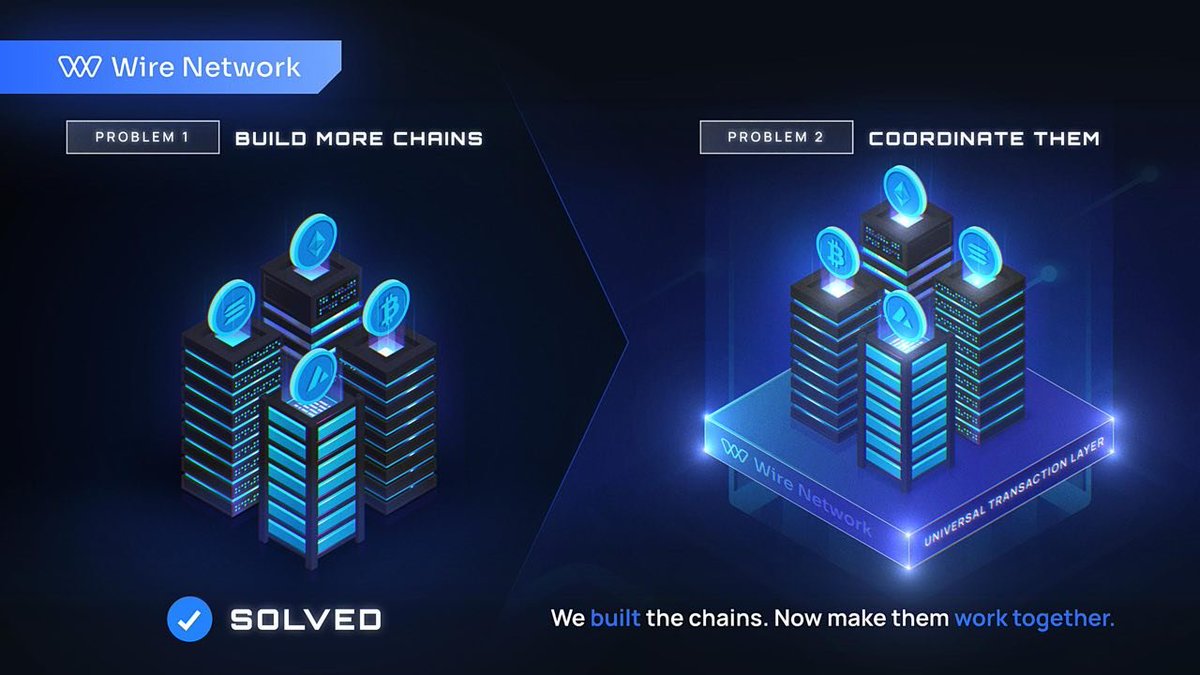
Crypto spent years asking:
How do we build more chains?
That worked.
Now we have another problem.
How do hundreds of independent ecosystems, applications, assets, users and autonomous agents operate without forcing everyone to navigate the complexity between them?
That's the problem Wire solves.
Not another chain trying to replace everything else.
Infrastructure designed to coordinate what already exists, and what comes next.
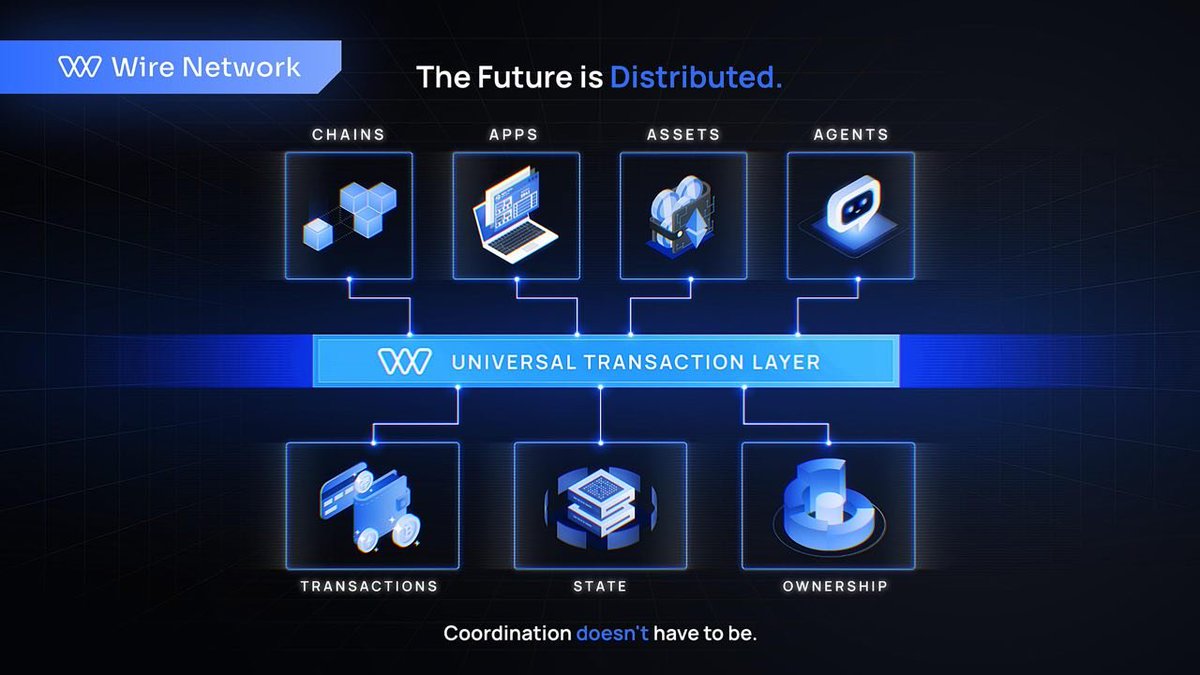
The future of crypto isn't one chain.
It's thousands of environments.
Millions of applications.
Billions of assets.
And eventually, autonomous agents continuously transacting between all of them.
That creates a problem the industry wasn't originally designed to solve:
Coordination.
Every independent environment has its own state, execution, assets, and rules.
Connecting more of them with more point-to-point infrastructure only makes the system increasingly complicated.
Wire takes a different approach.
The Universal Transaction Layer provides shared infrastructure for coordinating transactions, state, and ownership across connected ecosystems.
Assets can remain native.
Applications don't need to rebuild the same coordination logic for every environment.
Independent ecosystems don't need to become one ecosystem.
And the user, or agent doesn't need to understand everything happening underneath.
The complexity moves into the infrastructure.
That's important today.
It becomes far more important in an economy increasingly operated by autonomous software.
Because an agent shouldn't have to understand bridges.
It shouldn't have to manually choose networks.
It shouldn't have to reason about infrastructure before every action.
It should determine the outcome it wants.
The infrastructure should coordinate the rest.
That's the world Wire is being built for with the UTL.
Not another blockchain competing to become the destination.
A financial control plane designed to coordinate an economy that increasingly exists everywhere.
Five signatures authorized a $24.15M withdrawal.
The contract worked exactly as designed.
That might be the most concerning part.
In July, attackers reportedly compromised validator signing keys behind an AFX-operated bridge. Five hot-validator signatures were enough to satisfy the required quorum and authorize the withdrawal.
The underlying Arbitrum bridge wasn't compromised.
The verification logic wasn't bypassed.
The bridge simply received the approvals it was designed to trust.
Except the wrong people controlled them.
Security isn't only about whether your code works.
It's about what your architecture asks that code to trust.
Wire removes the intermediary bridge vault from that equation.
Sometimes the failure isn't broken logic. It's valid logic trusting the wrong thing.
The real test of infrastructure isn't how elegant it looks when there are five integrations.
It's what happens when there are fifty.
Then five hundred.
Point-to-point connections feel manageable when an ecosystem is small. As the number of environments grows, every new connection introduces another relationship that has to be built, maintained, monitored, and trusted.
Eventually, adding another ecosystem shouldn't mean adding another custom path.
It should mean connecting it to infrastructure that already knows how to coordinate the rest.