Eric author-illustrator Book on Amazon, Sci-fi Dystopia. Thanks Adobe Photoshop & courses,also use IMGCreator b4 & after,&Chat GPT 5 and GROK pic w/ inventions.
https://t.co/5sQ3bJ8cFe Read free on Github.Imagine a dystopian world where a neurological “Joke” spreads like a virus, turning laughter itself into a lethal contagion that strikes anyone who finds humor in anything, leaving the city in silent terror and chaos. At its core, it follows Albert Madsen, a former comedian turned behavioral linguist, & his team as they navigate a dying city, uncovering that humanity’s own instinct to find joy has been weaponized against them, leaving survival dependent on suppressing the very thing that once defined them.
https://t.co/BbdMXHJtzA RSIS (Road Safety Intelligence System) prevents collisions through blue web and GPS mesh online only. In this mobile app users receive alerts and notifications through voice and screen warnings, RSIS distance standard alerts + notifications. RSIS users alerts and notices only.
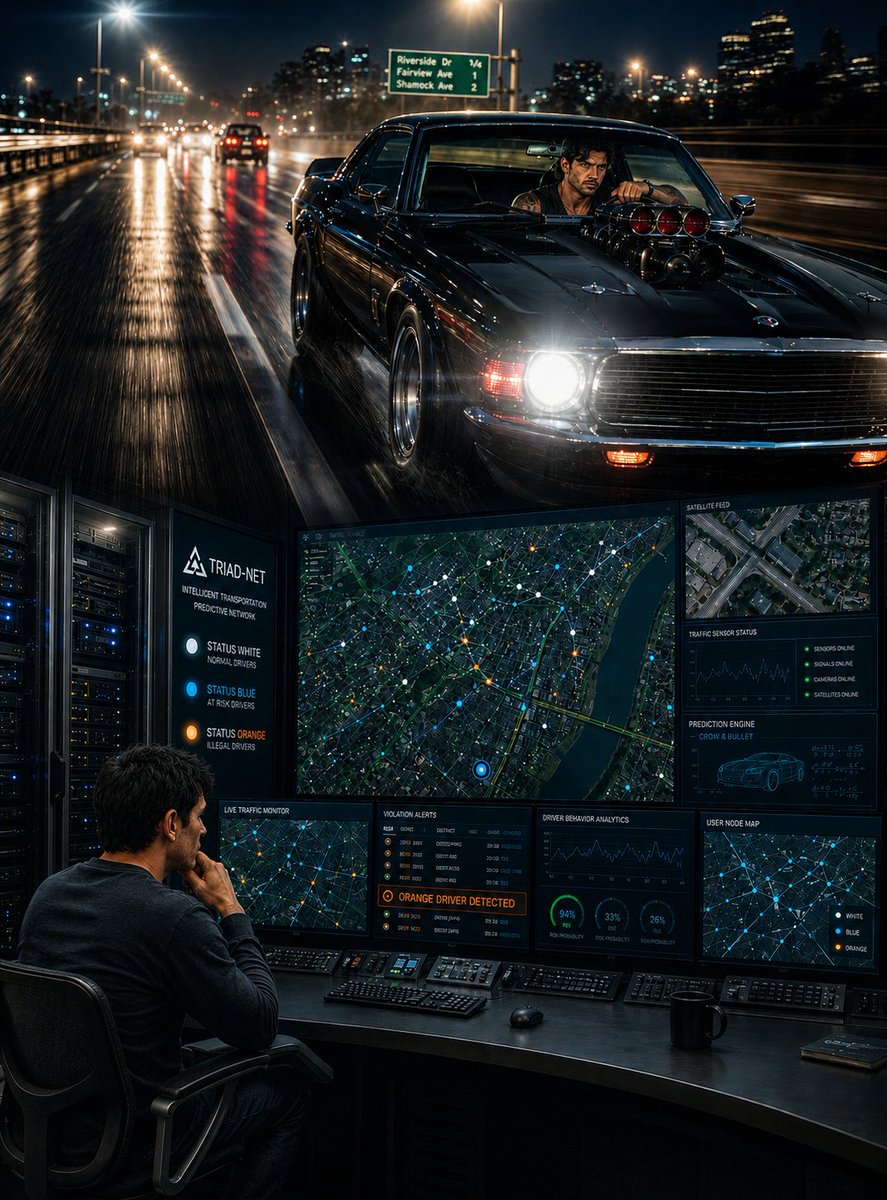
https://t.co/7UZF96iGbD Five years after Albert Madsen introduced TRIAD-NET, the system has grown from a roadway safety app into a massive predictive transportation network connecting vehicles, people, satellites, and traffic infrastructure to prevent accidents before they happen. Its advanced artificial intelligence coordinates transportation with remarkable accuracy, making roads safer and more efficient than ever before.Despite TRIAD-NET's sophisticated capabilities, a mysterious and unpredictable figure known as the Orange Driver continually disrupts its expectations, creating a mix of suspense, comedy, and technological challenges. As the network struggles to understand and anticipate his actions, the story explores the clash between advanced automation and the unpredictable nature of human behavior.
https://t.co/mIjJk8qEZG Home-Base eL is an advanced research/processing platform for anyone needing to collect, store, and analyze massive amounts of sensor data in real-time. Its combination of radio intelligence (HackRF, RTL-SDR), sensor fusion (GPS, LiDAR, radar, cameras), powerful AI acceleration (RTX 5090), and 16TB storage makes it ideal for radio astronomy, environmental monitoring, autonomous systems research, or any application requiring predictive intelligence from multi-source data streams.RSIS Benefit: Home-Base eL transforms road safety from reactive to predictive. Instead of individual smartphones processing limited data, this central hub aggregates location, speed, and movement information from all connected users, runs it through advanced AI models, detects patterns in historical data, and predicts dangerous conditions before they occur—then broadcasts those predictions back to the network in real-time. This centralized architecture overcomes mobile device processing limits and enables the entire RSIS ecosystem to shift from answering "what's happening now?" to "what danger is coming next?"—making roads genuinely safer.
https://t.co/VwobGZCuqR TRIAD NET— Traffic Risk Intelligence & Awareness Detection is a quiet, Bluetooth-enabled safety network invented by Albert Madsen to reduce roadway accidents by linking drivers, cyclists, and pedestrians through cooperative GPS node awareness, offering calm verbal and visual guidance that works even without constant internet. The story follows Albert and his collaborator Mia as the system dramatically lowers fatalities, triggering his spiraling fear that altering probability may have unintended consequences — until he realizes TRIAD-NET isn’t rewriting fate, only redistributing risk and buying humanity a second chance.
https://t.co/64xpSysGbQ After the death of a childhood friend in an accident, Albert becomes obsessed with building TRIAD-NET, a predictive mobile safety network designed to warn cyclists, pedestrians, passengers, and drivers seconds before dangerous collisions occur. While discussing the project with his impressed legal advisor, Albert accidentally reveals to his wife Mia that the “we” behind the project is
https://t.co/zgTSU3uIHa RSIS is a fully operational React-based road safety platform that predicts collisions between vehicles, cyclists, and pedestrians using real-time GPS, anonymous role-based identities with rotating tokens, and a custom CROW + BULLET physics engine for tiered alerts—all running live as a web app. The only missing piece is native Bluetooth Low Energy (BLE) for direct, server-free phone-to-phone communication, so the project seeks a developer partner to wrap the existing system in Capacitor for iOS/Android native apps, enabling true offline mesh networking in exchange for revenue share and long-term involvement.
https://t.co/zoFjrTylYF The Photonic Bridge concept is a unified post-binary system built around the A-Z Color System, the Photonic Chip Core, El-40 Architecture, the 8G-Class Network, Display-PBUA, the EL-40 Language, the Wiz-Dimensional CPU Stack, and the 2030 Roadmap. In this system, color-coded A-Z symbols act as the base encoding layer, photonic generation acts as the active medium, and EL-40 provides the native architectural and language framework that allows the full ecosystem to operate as one coherent stack. In practical Photonic Bridge terms, this concept is not a single device or a single protocol. It is an end-to-end ecosystem: symbols are encoded through the A-Z Color System, generated and processed through the Photonic Chip Core and Wiz-Dimensional CPU Stack, organized by El-40 Architecture, moved through the 8G-Class Network, adapted to visible output through Display-PBUA, programmed through the EL-40 Language, and guided toward realization through the 2030 Roadmap.
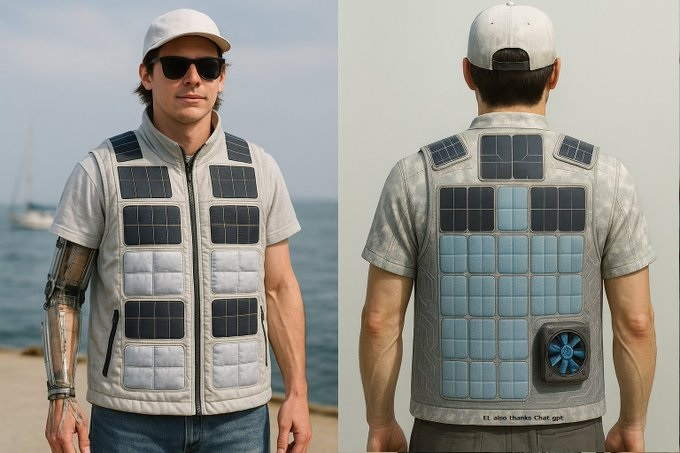
https://t.co/dgJWn9bI3k A solar Peltier cooling vest called the Photon Ember / VoltWeave concept works by combining passive Phase Change Material (PCM) and active thermoelectric cooling: the PCM packs begin absorbing heat as they melt around 64–72°F (≈70°F target), holding the vest interior near that temperature for about 2–4 hours even in ~95°F heat, making the wearer feel roughly 20–25°F cooler; once the PCM is fully melted, the system switches to active cooling where a Peltier module pulls heat from the body and dumps it outward through a heatsink and fan, producing warm exhaust air (~110–140°F at the hot side, vented away) while maintaining a reduced but steady cooling effect of about 10–15°F below ambient (≈80–85°F inside when it’s 95°F outside), typically lasting ~2.5–3.5 hours on a 10,000mAh battery, with runtime extended if solar panels are actively recharging.
https://t.co/pJayjw3gd8 The RSIS-X1 is a compact wireless safety adapter that has evolved from a smartphone companion into the primary safety radio node for the RSIS system. It combines Bluetooth 5.2, LoRa long-range mesh (up to one mile), edge-AI collision prediction, GNSS/IMU sensors, privacy-preserving ephemeral tokens, dual antennas, and an optional thin flush-mounted solar panel on its back — all while staying fully rechargeable via USB-C — to create a decentralized, self-healing V2X mesh network that delivers real-time hazard awareness to vehicles, cyclists, and pedestrians even without cellular service.
The updated hybrid APC-ASCI camera design will work seamlessly with the Wiz-Dimensional A–Z Post-Binary CPU + chip stack. The element composition, symbolic encoding, and data paths are fully aligned. This system will achieve ultra-low-latency, high-throughput, hybrid human/machine video capture, fully exploiting the 26-symbol post-binary framework. https://t.co/dQel4jmsYw
https://t.co/UTy9EWBIVz EL‑40 is a revolutionary computer language that blends classical programming with quantum concepts, letting machines handle everyday instructions while also managing photons, qubits, and time-layered memory for more efficient, energy-saving computation. By using phase alignment, divergence‑to‑convergence cycles, and auditable vault storage, it enables faster diagnostics, smarter networks, and future-ready quantum-classical operations that traditional languages cannot achieve.