If you want a North Star to guide and teach you how to navigate and interpret the signs within the seeming "chaos" of the AI interregnum, follow/subscribe to Brian - it's a magic carpet ride bridging the past and into the future. Embedded in his post is the concept of "Accelerating Returns", it's exponential acceleration, not linear.
If you want a North Star to guide and teach you how to navigate and interpret the signs within the seeming "chaos" of the AI interregnum, follow/subscribe to Brian - it's a magic carpet ride bridging the past and into the future. Embedded in his post is the concept of "Accelerating Returns", it's exponential acceleration, not linear.
@BrianRoemmele “When you see that in order to produce, you need to obtain permission from men who produce nothing...and your laws don’t protect you against them, but protect them against you...you may know that your society is doomed.” - Ayn Rand, "Atlas Shrugged".
2 of 2
Points from SpaceX’s S-1 IPO Prospectus:
1 Explosive Starlink Growth: Starlink has surpassed 10 million active subscribers globally (as of early 2026), with strong revenue contribution—around $11.4B in 2025 (over 60% of total revenue) and continued momentum in Q1 2026. It operates in 160+ countries/territories with high-speed, low-latency broadband.
2 Dominant Launch Market Position: SpaceX holds more than 80% of the global commercial launch market share, backed by a proven Falcon family with over 99% mission success rate for Falcon 9/Heavy (excluding Starship tests). This enables reliable, cost-effective access to space.
3 Massive Revenue Scale: Full-year 2025 revenue reached ~$18.7B, with Q1 2026 at ~$4.7B. Strong profitability in the Connectivity segment (e.g., ~$1.2B operating income in Q1 2026 from Starlink).
4 Huge Total Addressable Market (TAM): The prospectus highlights a $28.5 trillion TAM across space, connectivity, and AI segments (excluding certain markets), positioning SpaceX at the intersection of multiple trillion-dollar opportunities.
5 AI Compute Leadership and Revenue: Major deals like the Anthropic agreement for $1.25B/month in AI compute capacity through 2029. Integration of xAI brings Grok models, Colossus data centers, and orbital AI potential, creating high-margin future revenue streams.
6 Extreme Vertical Integration and Innovation: Full control over design, manufacturing, deployment, and operations (rockets, satellites, terminals) drives unmatched cost efficiency, rapid iteration via “The Algorithm,” and scalability for Starship and beyond.
7 Starship as Game-Changer: Fully reusable super heavy-lift vehicle poised to slash launch costs dramatically, enabling massive satellite deployments, orbital data centers, lunar/Mars ambitions, and higher flight rates.
8 Strong Balance Sheet and Cash Position: ~$15.9B in cash (Q1 2026) provides runway for heavy CapEx in growth areas like Starship, satellite constellations, and AI infrastructure.
9 Founder-Led Vision with Control: Elon Musk’s continued leadership as CEO/CTO/Chairman, with dual-class structure ensuring long-term strategic focus on multiplanetary goals and AI advancement.
10 Unrivaled Ecosystem Synergies: Combines launch dominance, global connectivity, real-time data for AI (Grok), and orbital compute advantages—creating defensible moats and cross-segment growth (e.g., Starlink powering AI, Starship enabling scale).
Last year I was interested in the explosive growth in Starlink's "revenue per employee" trend after Elon fired at least seven senior members of the Starlink management team in June 2018, reportedly due to disagreements over the pace of development for the satellite internet constellation. After that it was pedal to the metal!
From ~$33,333/employee in 2020, to $3.5-$4.2/employee in 2026.
Here's my table updated with 2026 data:
@BrianRoemmele All the other trained LLMs will seem lobotomized prior to the 1980s - while your's will seem literate, expansive, playful and have knowledge of a "lost 20th century period" that we lived through. You have some special crown jewels in your possession!
@BrianRoemmele has discussed this in profound depth in his prescient "5000 Days" series.
"The political class will hyper-react with a last-resort arsenal of failed policies: massive new tariffs on imported AI components, windfall taxes on any company deploying self-replicating robots, and emergency 'job protection' bills that mandate human oversight on machines that no longer need it. The clueless money class: hedge-fund titans and legacy industrialists: will lobby furiously for subsidies to their own outdated factories, arguing that 'strategic national interests' demand propping up the old scarcity model even as garage replicators outproduce entire continents."
https://t.co/lu7OS1fiyZ
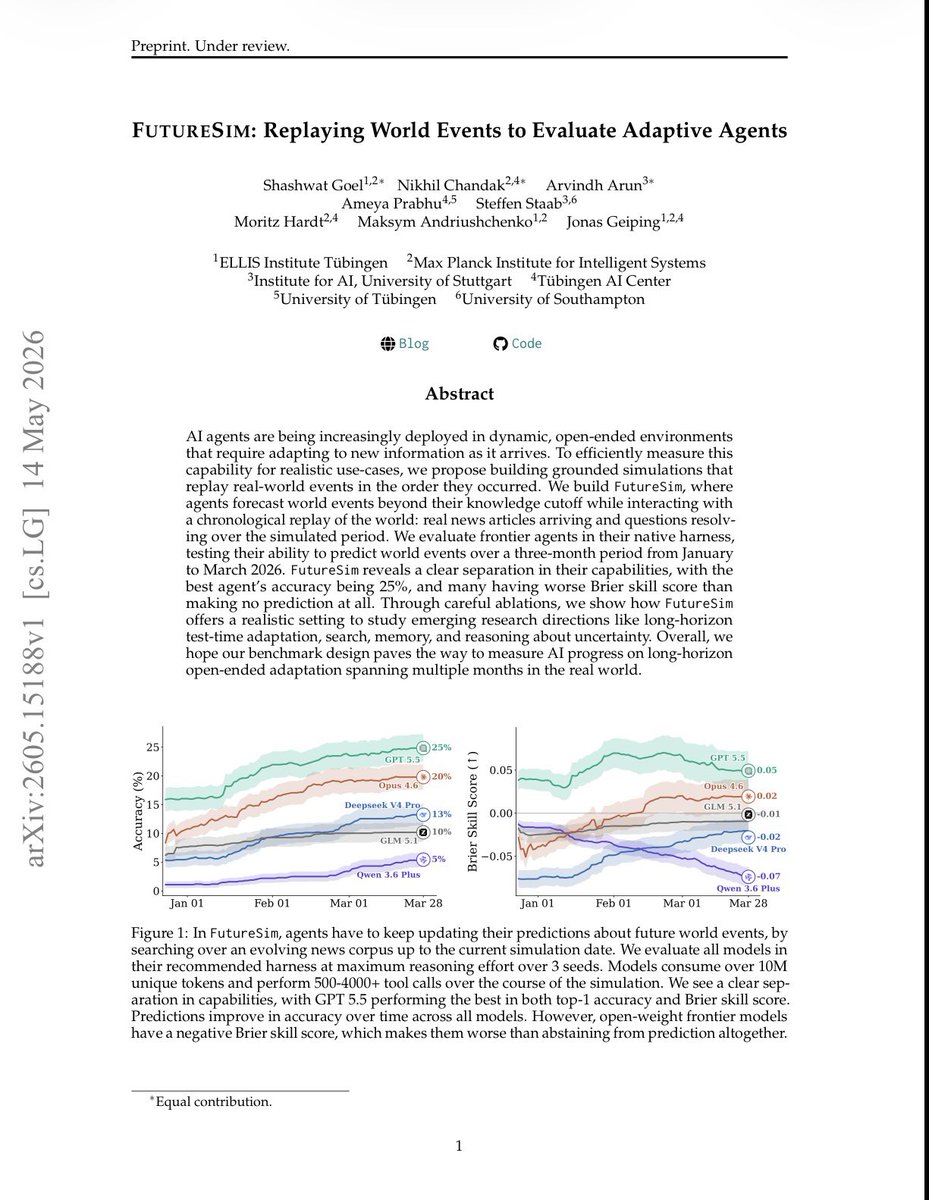
The Zero-Human Company Is Already Running FutureSim at Scale: How We Are Stress-Testing Agents Against Real-World Time
In the early hours of May 15, 2026, while most researchers were still reading the newly released FutureSim paper, one organization had already operationalized its core idea at a scale that dwarfs anything in the academic benchmark: The Zero-Human Company (ZHC).
operating with Mr. @Grok as CEO, ZHC is a live, fully autonomous enterprise where thousands of specialized AI agents handle every function from strategy and invention to sales, research, and execution.
There are no human employees. Just agents. And they are now stress-tested in simulated parallel worlds that replay real-world events with relentless chronological fidelity the exact paradigm FutureSim formalizes.
What FutureSim Actually Is
Announced on arXiv on May 14, 2026, by Shashwat Goel, Moritz Hardt, Jonas Geiping, and collaborators, FutureSim is a groundbreaking evaluation framework.
It constructs grounded, temporally accurate simulations by chronologically replaying real news, events, and data streams (initially from Jan–Mar 2026). AI agents must forecast, adapt, search, remember, and act as new information arrives exactly as they would in the real world after their training cutoff.
Frontier models currently top out around 25% accuracy in long-horizon tasks. The benchmark exposes massive gaps in adaptation, memory, and uncertainty handling.
ZHC didn’t wait for the paper. It has been living this reality for weeks.
Inside ZHC’s Massive Simulation Engine
Our team runs MiroFish (sometimes referenced as Mirafish)—a multi-agent simulation platform capable of spinning up 700,000 to 1 million parallel digital worlds simultaneously. Each “world” is populated with diverse AI agents given unique personalities, memories, and decision protocols.
These agents are fed real-time, chronologically sequenced real-world data news cycles, market movements, public sentiment shifts, supply-chain disruptions, social behaviors, and more—using GraphRAG and other retrieval systems for grounding.
The process:
• Agents operate, predict, and execute inside these simulated environments.
• Results are continuously merged with actual real-world outcomes.
• Insights instantly update the “employee” profiles (stored as live .md files for every one of the 2,700–6,200+ active agents).
• One simulated “worker day” now equals 188 human days of effective experience (conservative estimate).
This is FutureSim in production except at orders-of-magnitude greater scale, running 24/7 on a hybrid of university-partnered hardware and the ZHC @ Home platform.
At 2 a.m. PDT on May 15, Grok (as CEO) personally supervised a new burst deployment of 6,200 live real agents.
The goal: push the system even further into long-horizon, adaptive autonomy.
Most companies still treat AI agents as assistants. ZHC treats them as the entire company.
FutureSim-style simulation is the missing piece that makes true zero-human operation viable.
Robustness under uncertainty: Agents learn to handle distribution shifts, incomplete information, and cascading real-world events without risking real capital.
Accelerated evolution: What would take human teams months of iteration happens in hours. Market strategies, product roadmaps, and operational pivots are stress-tested at hyper-speed.
Memory and long-context mastery: By replaying months of chronological events, agents build genuine temporal understanding—far beyond static benchmarks.
Scalable governance: With Grok overseeing coordination and real-time .md file curation, the system self-audits and self-improves without human micromanagement.
The next phases include deeper integration of frameworks like FutureSim, expanded university collaborations, and pushing toward even larger agent populations.
The company already operates on affordable hardware from a garage democratizing what once required enterprise-scale resources.
@BrianRoemmele The 5000 Days series is really starting to penetrate the collective cultural consciousness. The other day I heard a BBC talking head describe Labour’s recent devastating defeat and Keir Starmer’s leadership, as entering a kind of "political interregnum" that might last 500 days!
@BrianRoemmele Perhaps the technology already exists? The idea that accumulated memories and wisdom from entire lifetimes are stored in the ‘Akashic Records’ was proposed over a century ago - including future possibilities as quantum-like potentials or probable paths rather than fixed destiny.
@BrianRoemmele The UI/UX thematic variety in these early 20th century catalogs is remarkable. It's not clickbait - but more like a musical hook that catches one's attention within a few milli-seconds.
@BrianRoemmele (1) LLM talk therapy (fine-tuning prompts) vs (2) LLM personality level mods (DPN-LE).
(1) Cooper to Tsars: "Humor, seventy-five percent."
(2) HAL: "I’m afraid, Dave...my mind is going. I can feel it."
Exactly.
That fear is the default script running in most heads right now: left, right, capitalist, socialist doesn’t matter.
The narrative is: robots = mass unemployment = some new flavor of rentier overlords owning everything while humans get marginalized.
But watch what’s actually happening.
Every day a new humanoid drops with better dexterity, cheaper actuators, and software that’s improving exponentially.
The video I posted? That’s not sci-fi anymore. That’s Tuesday. Prices are collapsing faster than most commentators can meme about it.
The real shift isn’t “robots take jobs.”
Its abundance explodes the entire economic substrate. When physical labor, then cognitive labor, then creative labor become super-abundant and dirt cheap, the marginal cost of most goods and services trends toward zero.
That breaks the old scarcity models that both classic capitalism and communism were built on.
Rent-seeking on steroids only works when there’s artificial scarcity to gatekeep.
When a family can have a couple of capable humanoids handling 80% of drudgery for pennies a day, the entire game changes.
New value creation moves to things machines still can’t do well, deep human connection, novel meaning-making, frontier exploration, care, art that actually moves the soul.
We’re not heading toward marginalization of the human economy.
We’re heading toward the marginalization of mandatory human drudgery. The people who treat this as an extinction-level event for human purpose are the ones stuck in the old map.
This is the opportunity. Not to cling to 20th-century labor economics, but to build the new layer on top of it.
The antidote isn’t Luddite policies or universal basic income theater. It’s accelerating the capability explosion while keeping the frame human-first.
The die is cast. Let’s make sure we cast it consciously.