I love media, ideas, tech, business, and entrepreneurship. Ever curious about the human experience, the state of the world, creating meaning, connecting.
@terri4436166795 Public pools used to be everywhere in America — Then racism shut them down.
Draining public swimming pools to avoid integration received the official blessing of the U.S. Supreme Court in 1971.
https://t.co/Rij0J2DDeX
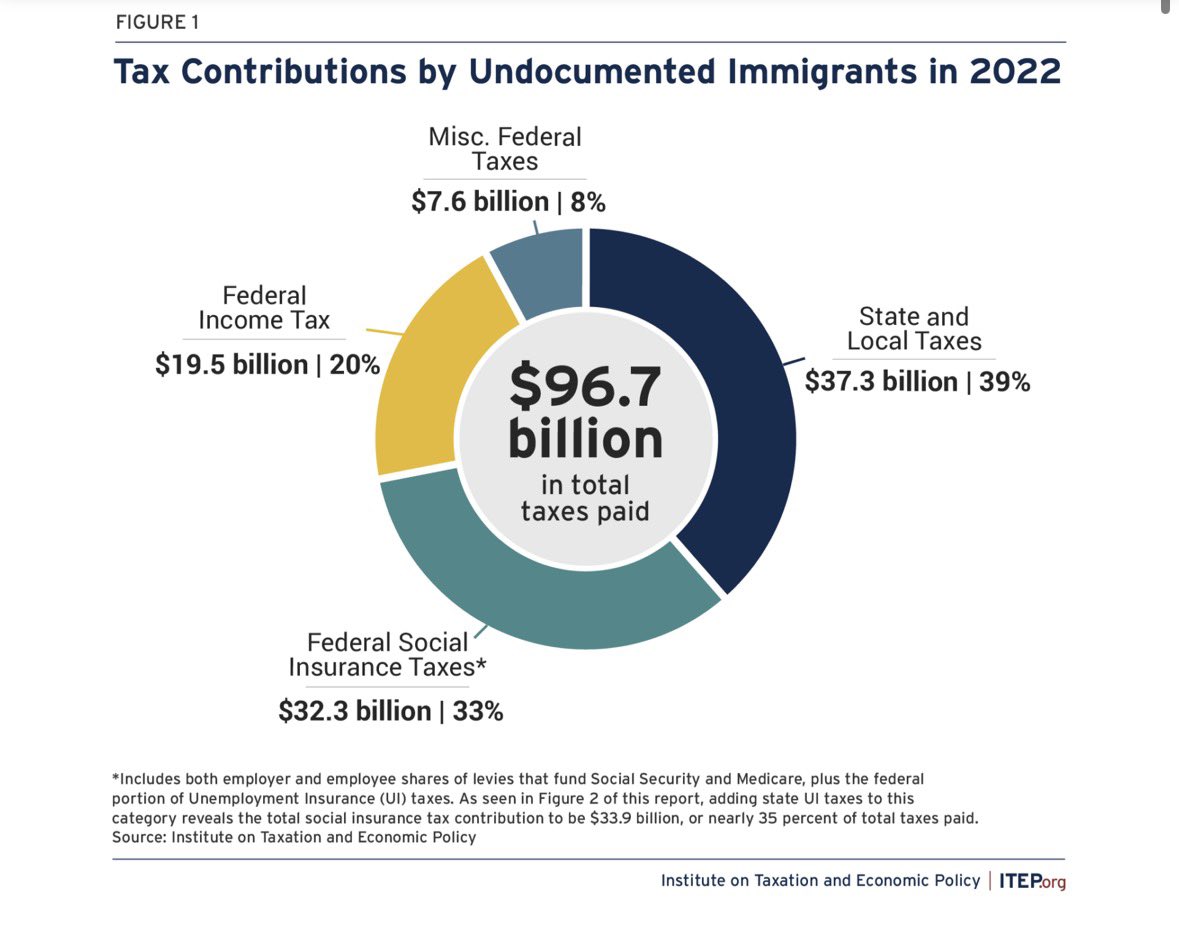
For decades, the IRS has had a system that lets undocumented immigrants pay their taxes. In total, they pay ~$100 billion each year, including $20 billion in federal income tax, much of which is paid through an ITIN.
Now the Trump IRS wants to scare them off paying taxes at all.
NEW: The health official who led the public response to the Hantavirus outbreak has little background in public health and previously was a penile implant specialist who hosted a podcast where he questioned the 2020 election and compared the Biden administration to Nazi Germany.
Andes virus is not being taken seriously by Trump or the CDC.
7 people from the ship are on honor system, supposed to check for fever, which isn't enough. Now, 18 others are going to be let out of quarantine at maybe 7 days, not 42 days. This is a dereliction of duty by the CDC
Even if one infected person with Andes Hantavirus only infects a few other people...
I feel like a lot of people don't understand exponential growth.
Lets say every infected person infects 5 others.
5 infects 25, infects 125, infects 625...see where this is going?
yeah it’s uhhhhhhhhhh not a good sign that all the infectious disease ~experts~ who’ve been denying COVID is airborne for the past 6 years are now super casually saying that Andes hantavirus *is* airborne and that *appropriate PPE includes N95 respirators and eye protection*
@DisabledDoctor@PathogenScribe This. Why does everyone try so hard to minimize? Risk of fire may also be low, statistically, but we have smoke detectors everywhere, some only ft apart. Why not plan well & be surprised if the worst doesn’t happen? Why say the bldg “can’t” burn til it does? See “airborne”!
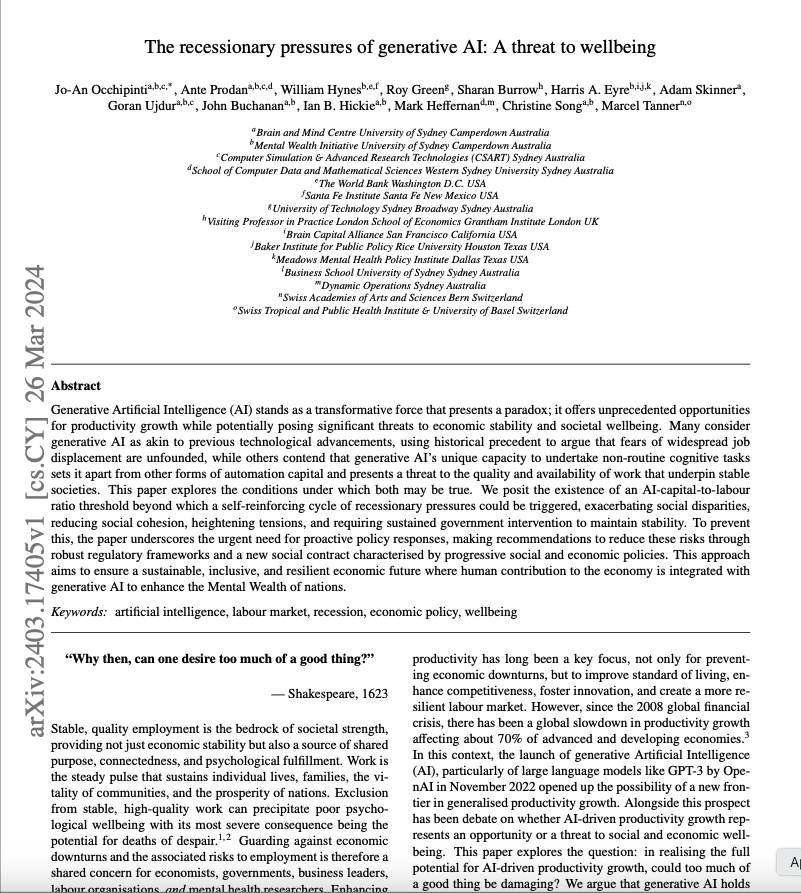
A public health paper just described how AI-driven unemployment could trigger the same economic collapse that caused the 2008 financial crisis.
Except this time, there is no housing bubble to blame. The bubble is the workforce itself.
The paper is called "The Recessionary Pressures of Generative AI: A Threat to Wellbeing." Published in 2024 on arXiv, later peer-reviewed and cited in public health literature through the National Institutes of Health. It is not written by economists. It is written by public health researchers, people who study what economic collapses do to human bodies and minds.
That framing changes everything.
Generative AI holds the capacity to profoundly reshape labour market dynamics and paradoxically, if left to market dynamics, undermine the very economic growth it aims to achieve.
The researchers start with a historical observation. Since the 2008 global financial crisis, there has been a global slowdown in productivity growth affecting 70% of advanced and developing economies. AI arrived as the promised solution, the technology that would finally break through the stagnation and deliver the productivity surge that had been missing for 15 years.
But the researchers identified a paradox built into the promise.
The pioneers of this technology are now openly acknowledging that generative AI is fundamentally a labour-replacing tool. Experts who understand the capability and trajectory of generative AI recognize that the current surge in AI-specialized jobs may ironically promote their own obsolescence.
Here is the doom loop they describe.
AI replaces workers. Displaced workers lose income. They reduce spending. Consumer demand falls. Companies see falling demand and cut costs by automating more. More workers displaced. Less spending. Less demand. More automation.
The productivity gains flow entirely to capital owners, the shareholders and executives whose wealth grows as the workforce shrinks. Workers receive none of the gains. They absorb all of the losses.
The researchers then apply the public health lens that makes this paper unlike anything economists have published.
They document what happens to human health during economic contractions driven by unemployment. Suicide rates rise. Substance abuse rises. Chronic disease rates rise. Mental illness rates rise. Life expectancy falls. The 2008 financial crisis generated measurable spikes in all of these across every country it touched.
Brookings Institution estimates that within the next decade, around 60% of job tasks in the United States alone are at medium to high risk of being replaced by AI.
If 60% of tasks are automated and the productivity gains go entirely to capital, the researchers argue the result is not just economic instability. It is a public health crisis at a scale that has no modern precedent.
The paper does not say this is inevitable. It says: without deliberate policy intervention, the market will not self-correct. The forces driving automation are too strong and the benefits too concentrated. And the people who will absorb the consequences, the workers have no seat at the table where the decisions are being made.
The conclusion is worth reading in full: a technology designed to produce abundance, left to market forces, risks producing the conditions for a recession that damages human wellbeing on a generational scale.
This paper was written in 2024. It was citing warning signs that were already visible then.
In 2026, those warning signs are now data points.
Source: "The Recessionary Pressures of Generative AI: A Threat to Wellbeing" · arXiv:2403.17405 · https://t.co/w1oIEexpSf · NIH/PMC: https://t.co/YaUg3XfuDR
@rgoodlaw@Maripuerta Here's a gift link to this op/ed by the Wall Street Journal on the economic contributions of immigrants:
"This isn’t a novel finding, but it shows how deporting noncriminal immigrants is economically counterproductive."
https://t.co/5cb3fCWgYs
Wall Street Journal Editorial Board goes to town against Trump admin mass deportation policies.
Focuses on empirical study finding ICE arrests have decreased employment among U.S.-born men with less formal education.
"In other words, deporting law-abiding workers reduces job opportunities for American workers. ... This isn’t a novel finding, but it shows how deporting noncriminal immigrants is economically counterproductive."
https://t.co/8FLpqre6S6
An award-winning Black bookshop is facing a “critical moment” to sell 1,000 books before the end of April so that Black authors ‘don’t lose a platform for their books.’ Afrori Books in Brighton has only four days left to reach its goal. https://t.co/3RvvvCLoxM