The downing (whether intentional or miscalculation) provided the US with a clear casus belli for proportional strikes, as CENTCOM stated. In audit terms, this highlights how fragile cease-fires become when armed aircraft patrol volatile maritime zones. De-escalation requires clearer rules of engagement or third-party monitoring in Hormuz, otherwise, these incidents risk rapid spirals.
AI-Led Tech Stock Rebound and Market Resilience Amid Geopolitical Shocks
What’s happening right now:
U.S. equity markets (particularly Nasdaq and semiconductor/chip indices) staged a strong recovery in recent sessions, led by renewed enthusiasm for AI-related names and platforms (including Apple’s latest AI updates). This follows prior volatility tied to geopolitical events and a strong May U.S. jobs report (~172,000 jobs added, beating expectations). Oil showed only modest gains despite Middle East tensions.
Significance:
It demonstrates the resilience (or perceived insulation) of the AI/tech growth narrative even as traditional risk assets face geopolitical and energy-price headwinds. This influences capital allocation, valuations, and broader economic sentiment.
Historical Context:
Builds on the post-2022/2023 AI boom (accelerated by generative AI breakthroughs) that has driven concentrated gains in mega-cap tech, similar in some respects to earlier technology cycles but with faster adoption and different fundamentals (productivity/AI capex vs. pure speculation in some views).
Data-Supported Theories:
• AI as relative safe-haven/growth anchor: Trading data and sector leadership during geopolitical spikes support theories that AI infrastructure and application spending are viewed as long-cycle, high-conviction investments less immediately sensitive to energy or traditional risk-off flows.
• Monetary policy and jobs-inflation dynamics: Strong employment data alongside energy/inflation concerns from the Middle East create a complex backdrop for Fed expectations; market pricing reflects bets on resilience.
• Concentration and momentum effects: Historical parallels (e.g., Nasdaq performance curves in prior tech eras) and current volume/leadership patterns suggest momentum and liquidity can sustain rebounds even amid external shocks, though they also highlight concentration risk.
This looks like classic mail-voting dynamics in a deep-blue area with low-turnout primary, where progressive mail voters mobilized late against a conservative outsider surge. Pratt performed unusually well for a Republican (channeling real frustrations on fires/homelessness), but demographics + voting method favored Raman closing the gap. Similar patterns have occurred in prior CA elections without proven systemic rigging. Ongoing federal probes and audits could clarify more, but current public results hold as legitimate under state rules.
@valuetainment Let’s hope it leads to the benefit of the African people and their future. Will provide a more comprehensive breakdown once more details are released.
Analysis:
Accurate. Official NY Fed release confirms 43.7% (13.3% “much worse” + ~30% “somewhat worse”) — peak since early 2023. Net year-ahead optimism (better vs. worse) hit lowest since Oct 2022.
Context:
Reflects persistent inflation/housing pressures + recent energy spikes despite stable short-term inflation expectations (3.5%). Labor/credit sentiment also softened. Data aligns with broader sentiment surveys.
Verdict:
Solid, directly from source. No exaggeration.
No, money isn’t “disappearing.” It’s a classic risk-off deleveraging move.
When stocks, crypto, gold, silver, and oil all sell off together (high correlations → ~1), investors aren’t rotating into another hot asset. They’re:
• Unwinding leverage/margin (forced selling)
• Raising cash → USD, T-bills, money market funds
• De-risking portfolios amid rising yields, sticky inflation fears, and geopolitical/oil volatility
This reprices risk broadly rather than transferring wealth to one class. Cash (and short-term Treasuries) becomes the temporary “safe” parking spot everyone mocks until needed.
Markets saw sharp correlated drops earlier in the week on strong jobs data + reduced rate-cut bets, with oil/geopolitics adding pressure. Equities rebounded modestly in spots today, but volatility remains elevated. No systemic “vanishing”—just psychology + positioning reset. https://t.co/dHWHU4ploL
Patience > panic. Markets cycle; liquidity doesn’t evaporate.
@Koltin777@CryptoTice_ Musk will pitch Terafab as a symbiotic, high-volume partnership with ASML to unlock vertically integrated, multi-planetary AI/robotics scale. By framing it as a mutual “moonshot” that strains but ultimately elevates the entire EUV supply chain amid exploding AI demand.
A material but not game-changing incremental addition (~0.18% increase in holdings). It underscores continued institutional demand but warrants monitoring for execution premium, funding costs, and correlation risks in a multipolar macro environment. Data-driven conviction remains high for long-term BTC bulls; near-term tactical caution advised.
Global Armed Conflicts Reach Highest Levels Since World War II (Uppsala Conflict Data Program Report)
What’s happening right now:
The Uppsala Conflict Data Program (UCDP) and PRIO released updated 2025 data showing 65 state-based armed conflicts—the highest number recorded since systematic data collection began in 1946. Interstate (state-vs-state) conflicts doubled from the prior year to eight, the highest since WWII. These include Russia-Ukraine, Iran-Israel, India-Pakistan, and Israel-Syria dynamics. Battle-related fatalities reached approximately 244,600 in 2025—the highest annual toll since 1994.
Significance:
The data indicate a structural shift toward a more violent, multipolar, and fragmented world with increasing interstate direct confrontations and regional spillovers. This challenges assumptions of post-Cold War stability and raises risks of contagion, humanitarian crises, and economic disruption.
Historical Context:
After a long post-WWII and post-Cold War decline in major interstate wars (with violence mostly intrastate or low-intensity), the last decade has seen a sharp reversal. The current spike includes great-power-adjacent conflicts (Ukraine, Middle East) alongside persistent ones in Africa and elsewhere. One-sided violence and non-state conflicts remain elevated in several regions.
Data-Supported Theories:
• Great-power competition and proxy dynamics: The doubling of interstate conflicts aligns with theories of renewed bipolar/multipolar rivalry (U.S./allies vs. Russia/Iran/China axes) playing out through direct and proxy channels. UCDP’s rigorous battle-death thresholds and state-involvement coding provide strong empirical backing.
• Conflict contagion and clustering: Data show rising regional spillovers; the Middle East and Eastern Europe clusters fit models where one theater (e.g., Iran-Israel-Lebanon) influences others via alliances, resources, or demonstration effects.
• Fatality trends: The 2025 spike to levels unseen since the mid-1990s (Rwandan genocide era) is driven by high-intensity wars in Europe and the Middle East, consistent with industrialized/proxy warfare lethality rather than purely low-tech insurgencies.
These are not foolproof predictors (they signal heightened risk and potential tops, not guaranteed immediate crashes). BofA still has a year-end 2026 S&P 500 target of 7,100 (implying modest downside or limited upside from recent levels around ~7,400) and favors selective individual stocks over the cap-weighted index.
7.8-Magnitude Earthquake Striking Southern Philippines (Mindanao Region)
What is happening:
A magnitude-7.8 earthquake struck early on June 8, 2026, with its epicenter approximately 24–32 km west-southwest of Maasim in Sarangani province, Mindanao, at a depth of roughly 35 km. The event caused building collapses, landslides, and structural damage, including to schools and commercial sites. Tsunami warnings were issued for parts of Southeast and East Asia but were subsequently lifted. Preliminary reports indicate at least 19–32 fatalities and over 130–200 injuries, primarily from falling debris and landslides, with rescue operations ongoing amid aftershocks.
Significance:
The quake represents a major humanitarian and infrastructural challenge for the Philippines, with potential secondary economic effects on regional trade, agriculture, and reconstruction costs. It highlights vulnerabilities in seismic-prone areas and may prompt reviews of building codes and early-warning systems. Globally, it serves as a reminder of tectonic risks in the Pacific Ring of Fire, with possible localized impacts on supply chains for electronics and commodities originating from the affected region.
Historical context:
The Philippines lies at the convergence of major tectonic plates, including the Philippine Sea Plate and Eurasian Plate, resulting in frequent high-magnitude seismicity. Comparable events include the 2013 Bohol earthquake and earlier Mindanao quakes, which similarly produced significant casualties and infrastructure damage. The current event aligns with long-term patterns of subduction-zone activity along the Philippine Trench and associated fault systems.
Data-supported theories:
USGS seismic data confirms the magnitude, location, and aftershock sequence (over 130 recorded), consistent with empirical models of megathrust and strike-slip fault behavior in the region. Historical catalogues show that events of M7.5+ in the Philippines often correlate with elevated landslide risk in mountainous terrain and higher casualty rates in densely populated or poorly engineered areas. Theories regarding aftershock decay follow Omori’s law, with declining frequency expected over days to weeks, supported by real-time monitoring networks.
🧵 World Audit Analysis: Why Oil Prices Haven’t Exploded Despite Iran’s Strait of Hormuz Disruption (June 8, 2026)
Here’s our clear-eyed breakdown of today’s CNBC report on the U.S.-Israel-Iran conflict now in Day 100.
Key Fact:
Iran’s severe restriction/closure of the Strait of Hormuz has removed ~14% of global crude supply. That’s double the 1973 OPEC embargo impact — yet Brent is still hovering ~$94–$97/bbl, not $150+.
Why the muted reaction? China.
China slashed crude imports from ~11.7M bpd in Feb to under 9M bpd by late May. That massive ~3M bpd cut represents ~74% of the entire global import decline and has acted as a giant pressure valve.
Other offsets:
• Coordinated SPR releases (U.S., Europe, Japan)
• Saudi rerouting
• Extra barrels from Brazil, Venezuela, etc.
• China drawing down stocks + slower refining/electrification push
Analyst Views:
• Societe Generale: China’s demand drop is the #2 offset globally. But inventories are falling fast. Strategic reserves must rebuild → higher long-term equilibrium oil price ahead.
• J.P. Morgan base case: Strait reopens in June → Brent ~$100 for 2026. Prolonged closure = +$5 to +$15.
• Fitch (more optimistic): Late July reopening → sharp drop to ~$70 avg from Sept.
Our Professional Assessment:
This is classic supply shock + temporary demand destruction. The cushion is real but fragile. Once SPRs empty and China resumes normal buying, the market will need higher prices to balance and incentivize new supply.
Risks We’re Watching:
• Renewed Israel-Iran strikes (prices +5% intraday Sunday)
• Escalation that pulls in shipping/insurance costs
• Broader inflation pass-through to gasoline, chemicals, transport
Investment & Audit Implications:
• Energy producers: constructive if $90–110 holds
• Consumers/refiners: hedge fuel exposure now
• Portfolios: stress-test ME supply chains, review geopolitical disclosures
• Long-term: diversification into alternatives accelerates
Bottom Line:
China bought the world time, but buffers are depleting. Base case $90–110 Brent through 2026 with upside skew on escalation. Monitor Chinese PMI/refining runs + Hormuz talks closely.
A relief rally on reopening could be sharp to the downside — be ready either way.
What’s your view on oil from here? Portfolio exposure?
https://t.co/oSmKIJAUbs
#Oil #EnergyMarkets #Geopolitics #WorldAudit
California’s key 2024 election law change centered on reinforcing the state’s existing no-photo-ID requirement for most voters by preempting local variations. https://t.co/izCxxtL7Wr
SB 1174 (Signed September 29, 2024, Chapter 990)
This is the most prominent and directly relevant 2024 change. It adds Section 10005 to the Elections Code and prohibits any local government (cities, counties, charter cities) from enacting or enforcing rules that require voters to present identification at polling places, vote centers, or other ballot submission locations—unless mandated by state or federal law. https://t.co/6vAJ9HUYpb
• Context and trigger: It directly responded to Huntington Beach’s local voter-approved measure (passed March 2024) requiring ID for municipal elections. State officials sued to block it, and SB 1174 ensures uniformity. California became the first state to explicitly ban local voter ID mandates. https://t.co/sNmqpmqsH4
• Legislative findings: The bill emphasizes that voter registration already requires a driver’s license number, California ID number, or last 4 digits of SSN; signature verification and other checks provide integrity. It argues voter ID laws can disproportionately affect low-income, minority, disabled, and senior voters, and that local rules create confusion and conflict with statewide policy. https://t.co/6vAJ9HUYpb
California’s baseline rules (unchanged by this bill):
• No photo ID required for most in-person voters.
• Limited exception under the federal Help America Vote Act (HAVA): First-time voters in federal elections who registered by mail/online without providing ID/SSN details may need to show ID (e.g., utility bill, sample ballot, or photo ID). https://t.co/95iBNrKlNH
• Vote-by-mail relies heavily on signature matching.
Other 2024 Election-Related Legislation
Several other bills were enacted, focusing on administration, access, and protections rather than major overhauls of voting mechanics: https://t.co/PkKt5zrmhx
• Voter registration and access expansions (e.g., AB 2127 extending New Motor Voter programs).
• Ballot processing and deadlines (later laws like those effective 2025/2026 standardized counting timelines and curing periods).
• Protections against intimidation (e.g., AB 2642, the California PEACE Act, strengthening rules on election-related threats and violence).
• Misinformation/deepfakes measures requiring platforms to address deceptive election content.
• Omnibus and technical bills for smoother election operations.
No sweeping shifts to universal vote-by-mail, primary systems, or major security protocols occurred in 2024 legislation beyond these.
Anthropic’s Confidential IPO Filing and Continued AI Sector Momentum
What is happening:
On June 1, 2026, Anthropic (developer of the Claude AI models) confidentially filed with the U.S. SEC for an initial public offering, following a $65 billion Series H round that valued the company at approximately $965 billion with a reported $47 billion annualized revenue run rate. Concurrent developments include Nvidia’s ongoing chip ecosystem expansions, hyperscaler capital raises (e.g., Alphabet’s $80 billion equity offering for AI infrastructure), and broader market fluctuations in technology equities amid mixed macroeconomic signals.
Significance:
The filing signals the transition of frontier AI companies from private to public markets, potentially unlocking substantial liquidity and setting valuation benchmarks for peers such as OpenAI and SpaceX. It underscores sustained investor appetite for AI infrastructure and applications while introducing new dynamics around public-market scrutiny, governance, and capital allocation. For equity markets, it reinforces AI as a dominant secular theme amid volatility in broader indices.
Historical Context:
The AI investment cycle accelerated following the public release of ChatGPT in late 2022, driving unprecedented private valuations and compute demand. Prior technology IPO waves (e.g., internet-era listings) followed similar trajectories of rapid scaling followed by public-market transitions. Anthropic’s move occurs alongside parallel preparations by other high-profile AI and space entities, marking an inflection point in the commercialization of advanced models.
Data-supported theories:
Revenue run-rate figures and post-money valuations are corroborated by company disclosures and funding announcements, aligning with observed hyperscaler capex trends (hundreds of billions cumulatively). Equity market data reflects periodic rotations into AI leaders during periods of broader uncertainty, consistent with growth-stock beta patterns documented in prior cycles. Theories of sustained compute demand are supported by semiconductor shipment and data-center utilization metrics, projecting multi-year infrastructure buildouts irrespective of short-term sentiment fluctuations.
These events collectively shape near-term risk parameters across geopolitics, natural hazards, and technological investment landscapes. Continued monitoring of diplomatic communications in the Middle East, seismic aftershock data from the Philippines, and AI capital-market developments is warranted for assessing downstream effects on portfolios and global systems.
Ukrainian Long-Range Drone Strikes Target St. Petersburg and Russian Strategic Sites
What’s happening:
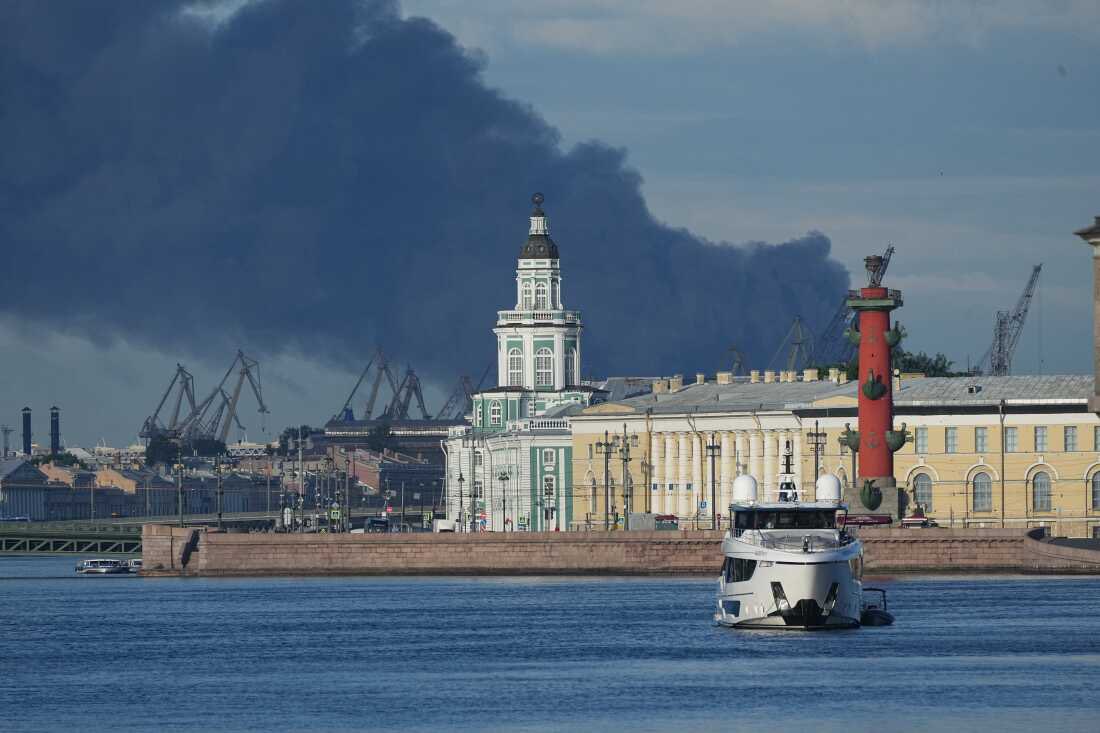
Ukraine has conducted multiple waves of long-range drone attacks (reaching ~1,000 km) on and around St. Petersburg, Russia’s second-largest city and site of Putin’s flagship St. Petersburg International Economic Forum (“Russia’s Davos”). Strikes hit oil terminals (causing visible fires and black smoke), naval facilities in Kronstadt (including the corvette Boikiy), and other military/energy infrastructure. Russia claims hundreds of drones downed across regions with “insignificant” damage; Ukraine confirms targeted hits on arsenals and bases.
Significance: Demonstrates Ukraine’s advancing asymmetric deep-strike capability deep inside Russia, embarrassing the Kremlin during a high-profile international event meant to project economic normalcy and attract investment. It underscores strains on Russian air defenses and shifts the war’s psychological and economic pressure onto Russian territory.
Historical context:
Represents the maturation of drone warfare in this conflict—from early Bayraktar TB2 successes to mass long-range strikes on Russian rear areas (previously seen in Moscow, Crimea, and Black Sea Fleet). Parallels historical strategic bombing campaigns or modern precision/deep-strike doctrines, while Russia continues its own extensive missile/drone barrages on Ukrainian cities and infrastructure.
Data-supported theories and evidence:
• Ukrainian drones have shown improving range, numbers, and real-time targeting, overwhelming point defenses in volume even if interception rates are high.
• The timing (coinciding with Putin’s forum and his rejection of face-to-face talks) appears deliberate to maximize political impact and signal resolve as Zelensky courts European mediators.
• No large-scale civilian casualties reported in these specific strikes, but they highlight the expanding geography of the war and potential for further escalation or negotiation leverage.
• Broader pattern: Ukraine leveraging technological adaptation and Western-supplied intelligence/components against a larger conventional force.
U.S.-Iran Conflict and Disruptions in the Strait of Hormuz
What’s Happening:
U.S. forces have intercepted Iranian ballistic missiles and drones targeting the Strait of Hormuz and Gulf allies, while conducting strikes on Iranian radar and drone sites (including Qeshm Island). Iran has responded with launches toward regional targets, though most were intercepted. Commercial traffic through the strait—normally carrying ~20% of global oil and LNG—has been sharply reduced amid a fragile ceasefire.
Significance:
This is the highest-velocity global risk event. Even partial disruptions create immediate upward pressure on energy prices, freight costs, and inflation in import-dependent economies. Vulnerable nations (least-developed countries and small island states) face acute cost spikes—potentially $20 billion+ annually in higher oil import bills—while broader supply-chain and food-security ripple effects are already appearing.
Historical Context:
The strait has been a flashpoint since the 1979 Iranian Revolution and the 1980–1988 Tanker War (when both sides targeted shipping). Similar chokepoint crises occurred during the 1973–74 and 1979 oil shocks. The current episode echoes those but occurs against a backdrop of already elevated post-2022 energy volatility from the Russia-Ukraine war.
Data-Supported Theories:
Wood Mackenzie models show a full prolonged closure could push Brent crude toward $200/bbl by late 2026 under worst-case scenarios, with global demand destruction of ~6 million barrels/day. Brookings analysis using historical price elasticities projects Brent reaching $120/bbl if the strait remains impaired past June, rising toward $150/bbl as inventories deplete. These are not speculative; they rest on observed supply elasticities and inventory drawdown rates from prior shocks. Markets are currently pricing a managed but persistent risk rather than full closure.