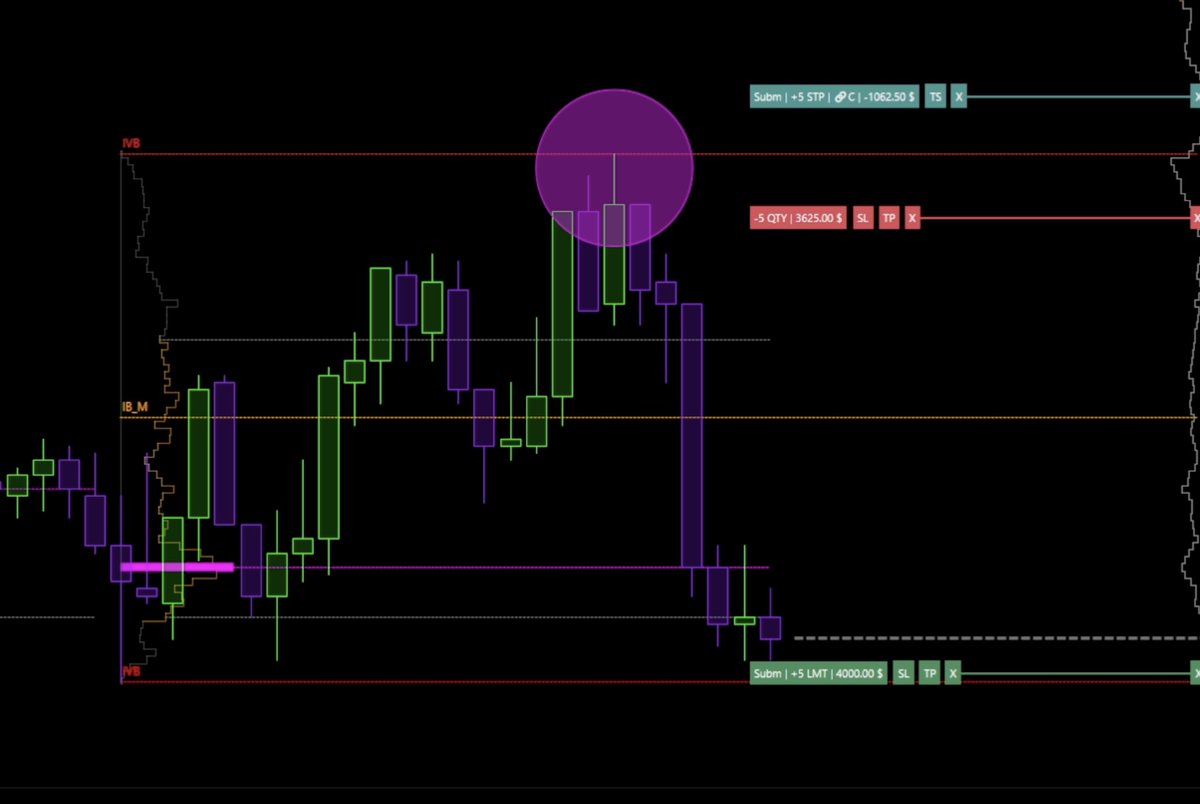
$1.4 billion has been bet on tomorrow's US midterms.
It looks like trading. Charts, odds, buy, sell. It isn't.
The numbers: nearly $1.1B on Kalshi and $340M+ on Polymarket tied to the midterms. Polymarket hit a record ~478,000 monthly active traders in October. Kalshi suspended six candidates for betting on their own races.
And the part nobody screenshots: according to CNN's reporting, most prediction-market traders lose money.
Mustafa started his career at Citadel and spent years building market infrastructure. On the World Class Edge podcast: "I don't like prediction markets either, because I think it's pure, pure speculation. Pure risk."
Why the boom now? Andrea Cimitan put it on our podcast: before and during global crises, "the amount of gambling increases dramatically." Add a phone that never leaves your hand and the urge to get rich by Wednesday.
What separates trading from betting:
1. An edge you can repeat hundreds of times
2. A risk you define before you enter
3. A process you validated before risking real money
One election is one coin flip. You can't build a sample size on it.
Patrick Nill has watched trading competitions for years: "The lucky punches, they make 100% at one day, but three days later they're away."
Betting picks an outcome. Trading manages probabilities.
An uncomfortable prediction from inside the industry: without regulatory barriers, financial institutions could cut full-time headcount by 50 to 80 per cent with the AI that already exists.
The junior work is what goes first. Research, data pulls, financial modelling — the tasks that used to be how you learned the business. In our own firm, AI integration has roughly quadrupled throughput.
Which creates a problem nobody has solved. If the apprenticeship tasks are automated, where does the next generation of domain expertise come from? Firms still have to train people they technically no longer need.
If you are early in a finance career, that is the question to be thinking about. Not whether AI takes the job — whether anyone will still pay to teach you one.
Worth reading twice if you’ve just discovered GEX.
Dealer hedging doesn’t create the move. It damps the move that’s already happening, or it accelerates it — and which one depends on positioning, not on the level being drawn on a chart.
That’s the difference between using gamma as a filter and using it as a prediction. The second one is just ICT with Greek letters.
Gamma Exposure Hedging flows are NOT the Only flows.
They simply support (negative) or contrast (positive) the flow that is already happening.
Don’t do the rookie mistake of believing they are ALWAYS at play.
They need context and outliers are where you see their true effect.
This is the only question that settles it, and almost nobody in trading education can answer it.
Not “do you have a strategy”, but do you have a live, tracked record with a regulated broker that a stranger can open and check.
Everything else is a screenshot, and a screenshot is a claim about the past made by the person who benefits from it.
None of these kids yapping about Account 819… whatever.
None of these has a live tracked track record with a regulated broker at @Kinfo
Here is mine: https://t.co/kDX7LqPGqu
Remember lil bros, Prop firm trading isn’t real trading.
Most backtests you see online are worthless, and it is not because the sample is too short.
They are overfitted. Nobody runs a single overfitting check before posting the equity curve.
A curve that only ever had to survive the past will always look perfect. The real question is how many attempts to break it has it survived, and if the answer is none, that is a drawing, not an edge.
Next time someone posts one: ask what they tested it against.
“Order flow is hard” usually means “order flow is unfamiliar.”
What you’re looking at is where aggression met absorption: buyers kept lifting, someone kept filling them, and one side ran out. That cluster isn’t a signal. It’s a receipt for an argument that already happened.
The hard part was never reading it. It’s that once you can, it tells you to do nothing most of the time.
We published this carousel on Instagram today, and we consider this topic to be of great importance, given the current state of geopolitical instability in the world.
Here is the important thing to understand: gold is not a fear asset. It's a rates asset wearing a fear costume. Every war headline, the same reflex: buy gold, it goes up in a crisis. Except the chain doesn't stop at the headline...
Conflict pushes oil. Oil pushes inflation. Inflation pushes the central bank. And gold has to compete with a risk-free yield that just went up, while paying you nothing.
The crisis is one input. The policy response is the one that decides. Retail trades the headline. The headline is two steps upstream of the thing that actually prices the metal.
What you think about this analysis? Give your opinion in the comments!
This is great, Bryan. Thank you for this post.
If anyone of you want to be part of what we are building and receive all the prizes we hive in our platform, check the link in our bio and subscribe to World Class Edge!
@andreacimi@WorldClassEdge@patricknill This is not ego, it’s for people who are wondering if @WorldClassEdge is real or bullshit. I did this during the livestream today. I want people to see that these are consecutive and consistent challenge wins because of the amazing education I continue to receive. Today:
The part people miss is that it's arithmetic, not preference. Trading income is lumpy, one quarter can carry the year. Put a fixed monthly withdrawal on that and you're pulling capital out exactly when the account needs it to recover. The account never compounds, however good you are.
Could I just retire and make a living ONLY out of trading? Yes
Will I do it? Hell nah
But first it’s incredibly boring and stressful, second it’s dumb.
@andreacimi Freddy ran this exercise on our side and landed in the same place on ICT and Fibonacci. Where he went further: S/R, breakouts and scalping are all B conditionally — they only work when the level is somewhere dealers have to hedge. Otherwise it's a line you drew.
Price is not the thing that moves. Price is what is left over. Here is the part retail charting has no way to account for.
When an institution buys protection, a market maker takes the other side. That market maker now holds an options position it never wanted directional exposure to, so it hedges in the underlying — buying or selling futures to stay delta neutral.
And it has to keep doing it. Every time price moves, the hedge is wrong again and has to be adjusted. That constant re-adjustment is a mechanical, non-discretionary flow of buying and selling that has nothing to do with anybody's opinion about the market.
Which way that flow pushes depends on one thing: whether dealers are long or short gamma.
Positive gamma: dealers sell into strength and buy into weakness to stay hedged. Their hedging works against the move. Volatility gets suppressed, price grinds in a range, and every breakout fails for no reason you can see on the chart.
Negative gamma: dealers buy into strength and sell into weakness. Their hedging amplifies the move. One push becomes three. This is what a day that “came out of nowhere” actually is.
Same chart. Same patterns. Two completely different markets — and nothing in the candlesticks tells you which one you are standing in.
What does tell you: total gamma exposure, the call and put walls, and the zero-gamma flip level where the regime changes sign.
Now the part that makes this checkable rather than another story about smart money. Those levels are published before the session. Write down the flip level and the largest call wall tomorrow morning, then look at where price actually spent the day. Do that for ten sessions. If it is noise, you will know inside two weeks and you will have lost nothing but ten minutes a morning.
We do not think you will find noise.
So: what did you call manipulation last week that was a dealer rebalancing a hedge?
Learn for free from world-class traders. Link in bio.
I’m proud of what @WorldClassEdge has become.
Our goal was to find a way to make institutional level trading education available to retails, and find a way to make it a good business
We started by trying to help great traders like @patricknill and the TTT team to monetize their experience and talent.
We tried that 2 times and ended up realising selling access to their live sessions wasn’t necessarily the best solution.
Some people loved them, some people didn’t.
So we decided to take a radical shift.
Make everything FREE.
And really pursue that goal to make institutional level trading education available to all retails.
We hired Market Makers, Professional Traders, Former Bank Traders, Hedge Fund managers.
More traders, more strategies, more content. All for FREE.
In order to keep it financially sustainable we chose 3 affiliate partners.
Our orderflow platform, Deepcharts.
A futures broker.
and a Prop firm.
Things that traders use everyday.
You will NEVER be forced to use them to access the free content.
Instead you get a lot of free stuff inside.
And if you chose them, you help us in this mission of waking up the trading space and giving real access to elite level trading knowledge.
Thank you to everyone who is watching the content and being active in the community.
@andreacimi When I’m recommending @WorldClassEdge to people I always tell them anyone who says trading is easy is full of shit and to run away as fast as they can. I quote you, actually. The “do not underestimate…” part and tell them that they must love this and obsess over it or don’t play
Fifteen minutes.
Macro dashboard. The outlook from here. Currency setups, stock setups, and a live read on each one with where IV is sitting.
Our traders, the real board, no slides.
Link in bio.
POV: you are trading so well that your competitors send an evil mosquito to sabotage you.
We have, at this stage, no evidence that this is a genuine risk management concern.
Everything that does actually go wrong at a desk, we are covering tonight. 6PM CEST, live and free.
👉 Link in bio.
What would you give to take a class with a World Cup Trading Championship finalist?
Nothing. That is the actual answer, and it is the part people keep refusing to believe.
The classes are free. The traders teaching them compete with real capital under audited conditions. There is no upsell at the end, because there is no product at the end.
Tonight you can watch them work rather than talk: the macro dashboard, the outlook from here, currency and stock setups, and a live read on each instrument including where IV sits.
6PM CEST.
Link in bio.
“Wrong trade? Just double down, right?”
Everyone laughs at this until they check their own worst day.
Averaging into a loser is not a strategy. It is the moment the position starts trading you, you stop managing risk and start negotiating with the market about whether you were right.
And it works often enough to teach you the wrong lesson. That is what makes it dangerous rather than merely stupid. The one time it does not work costs more than every time it did.
The fix is not discipline. It is deciding the size and the exit before the trade exists, so there is nothing left to negotiate once you are in it.
We work through how that actually gets built tonight. 6PM CEST, live, free.
👉 Tap the link in bio!