🧵1/11
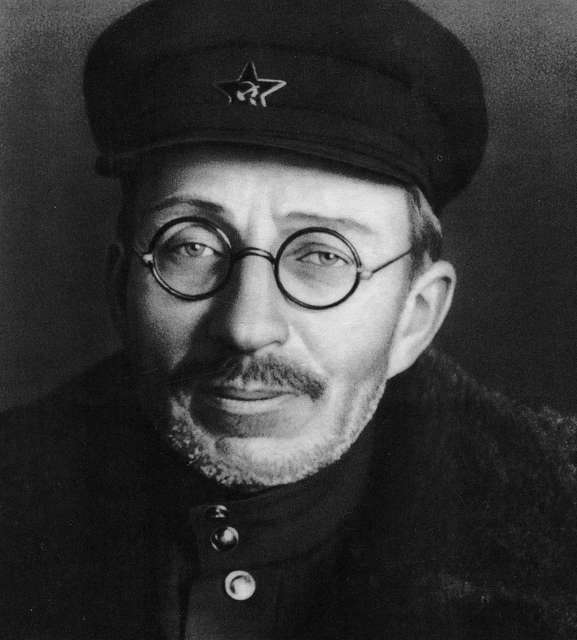
Qui était vraiment Anton Makarenko (1888-1939) ?
Un pédagogue révolutionnaire... oui.
Mais surtout un expérimentateur génial de la formation des hommes dans un monde en crise.
➡️Je vous propose un portait pour comprendre son actualité :
J’ai l’honneur d’intervenir le lundi 5 octobre prochain dans le cadre de la journée d'étude « Marxisme et anthropologie » Mon intervention prendra place à 16h45.
Elle est intitulée : Déclin de la population : une crise anthropologique ? Réflexions à la lumière du marxisme
En cette rentrée scolaire, les questions qui traversent l’École reviennent au premier plan.
À lire, notre premier numéro : « L’École en crise, la pédagogie en question ».
Notre éditorial : https://t.co/pYIcm9kwS7
Et si la population s'effondrait aussi vite qu'elle a crû ?
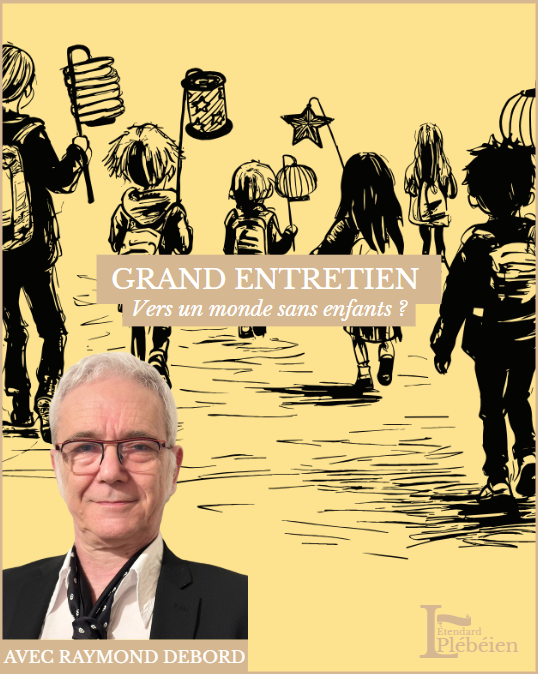
J’ai eu le plaisir de discuter de la baisse universelle de l’indice de fécondité avec le sociologue Raymond Debord
Vous pouvez regarder l’entretien ici : https://t.co/9qdYjHBrnQ
Mon article dans l’ouvrage collectif dirigé par Gilles Séraphin est désormais disponible gratuitement. Un travail introspectif avec pas mal de réflexions sur le marxisme et ses rapports à la sociologie et recherche marquée par l’empirisme
https://t.co/32omF7Dm55
Historien, résistant, fondateur des Annales : Marc Bloch entre aujourd’hui au Panthéon.
Retour sur la révolution historiographique qu'il mena avec Lucien Febvre : contre l'histoire réduite aux grands hommes et aux événements, les Annales ouvrent la voie à une histoire totale des sociétés.
A Russian psychologist spent 10 years proving that the act of talking to yourself out loud is one of the most powerful cognitive tools the human brain has, and almost nobody outside his field has read the work.
His name was Lev Vygotsky.
He worked in Moscow in the 1920s and died of tuberculosis in 1934 at the age of 37. He had no laboratory, no funding, almost no English readers, and a body of work that the Soviet government suppressed for two decades after he died.
He produced the foundational theory of how human cognition actually develops, and the central piece of that theory was a behavior almost every adult is faintly embarrassed about.
Vygotsky noticed that young children talk to themselves constantly. They narrate their own actions, they argue with imaginary opponents, they instruct themselves through tasks out loud.
The dominant theory at the time, from the Swiss psychologist Jean Piaget, said this was a sign of cognitive immaturity that children would eventually grow out of as they learned to think properly.
Vygotsky said the exact opposite.
He argued that this self-directed speech was the most important cognitive event in the entire developmental window, because it was the moment a child first started to use language as a tool to control their own mind. The child was not failing to think. The child was learning how to think by externalizing the process and listening to themselves do it.
He predicted that as children matured, this out-loud self-talk would not disappear. It would go underground. It would become silent inner speech, which is the running monologue every adult has inside their own head for the rest of their life.
The voice you hear when you read this sentence is the direct descendant of a four-year-old narrating their own block tower.
For 50 years almost nobody outside Russia had access to his work, and the few researchers who did pick it up could not get funding to test it. Then in the early 2000s the experiments finally started to pile up, and what they found was that Vygotsky had been right about something even more important than he knew.
The first major study came from Gary Lupyan at the University of Wisconsin and Daniel Swingley at the University of Pennsylvania in 2012. They ran a simple visual search experiment. Participants were shown 20 images at once and asked to find a specific object, like a banana or a chair. In one condition they searched silently. In the other condition they were told to say the name of the object out loud to themselves while looking for it.
The participants who spoke the target name out loud found the object significantly faster, with higher accuracy, than the participants who searched in silence. The effect was strongest when the spoken word matched a familiar object the brain already had a strong category for.
Saying the word out loud literally tuned the visual system to detect that thing better. The researchers called it the label feedback effect, and the implication was that the act of vocalizing a goal physically changes how the brain processes the world while pursuing it.
The second major study came out of the University of Michigan and Michigan State in 2017. The lead researchers were Ethan Kross and Jason Moser, and they used both EEG and fMRI to record what happens inside the brain when people talk to themselves while emotionally upset.
They asked participants to recall painful autobiographical memories and reflect on them in two different ways. Some used the first person, saying things like "why am I feeling this way." Others used the third person, referring to themselves by their own name, saying things like "why is John feeling this way."
The brain scans showed that the simple act of switching from first person to third person, even silently, decreased activity in the medial prefrontal cortex, the region responsible for rumination and self-referential pain. Within a single second of using their own name instead of the word I, participants showed measurably lower emotional reactivity. The shift required no extra cognitive effort. It cost the brain nothing. And it worked.
Kross described the mechanism in his interviews. Talking to yourself by name creates a small amount of psychological distance from your own experience. Your brain processes the situation more like a problem belonging to someone else, which means it can analyze it instead of drowning in it.
What Vygotsky had intuited in 1934 turned out to be even more powerful than the developmental theory he built it into. The voice you use to talk to yourself is not background noise. It is one of the most precise cognitive tools the brain has, and you can change how it works just by changing the pronoun you use.
People who talk through problems out loud are not anxious or unstable. They are running an externalized version of a process the rest of us are running silently and worse. The kindergartener narrating their block tower, the surgeon muttering through a procedure, the engineer pacing a hallway describing a bug to nobody, the athlete repeating a cue to themselves before a free throw, they are all using the same ancient mechanism that builds and steers human thought.
You can run the experiment yourself the next time you are stuck on something hard. Stop trying to solve it silently in your head. Say it out loud. Describe what you are seeing. Walk yourself through the steps as if you were explaining it to a colleague who is not in the room.
And when something genuinely upsets you, switch to your own name. Ask why this person is feeling this way, instead of why I am feeling this way.
The voice you have been told to keep quiet your entire life is one of the oldest pieces of cognitive technology you own.
Most people are still embarrassed to use it.
📢 Appel à contributions
La revue L'Étendard Plébéien prépare un numéro consacré à la question de la sortie de l'Union européenne et, plus largement, aux différentes critiques de la construction européenne.
Nous souhaitons donner la parole aux organisations, mouvements, partis et courants de pensée qui défendent une sortie de l'UE ou développent à son égard une critique politique, économique, sociale ou institutionnelle.
À l'approche de l'élection présidentielle, notre objectif est de contribuer au débat sur la question européenne en offrant un espace d'expression à des analyses souvent peu représentées dans les grands médias et les débats électoraux.
📄 Format : texte libre (2 000 à 10 000 signes)
📅 Date limite : 20 septembre 2026
Toute organisation intéressée peut nous contacter en message privé.
N'hésitez pas à partager cet appel.
Commençons par le commencement: cinématographiquement parlant, cela manque d'ambition, c'est assez convenu. Il me semble que notre mémoire collective et civique méritait une meilleure œuvre. Il fallait plus de beauté et d'audace pour rendre l'hommage d'autant plus saisissant.
Vers un monde sans enfants ? Derrière la chute de la natalité, @RaymondDebord interroge moins un phénomène démographique qu’une crise profonde de civilisation, entre néo-malthusianisme, logique économique et déni politique.
Une analyse incisive et à contre-courant 👇
Penser l’éducation comme un fait historique et social : ce portrait d’Anton Makarenko montre comment une pédagogie naît d’une révolution, pour répondre à une crise réelle et former un nouvel individu.
Bien plus qu’un pédagogue, une pensée au croisement de l’éducation et du politique 👇
🔴Que peut être une école en période révolutionnaire ? Instrument de domination ou levier d’émancipation collective ?
Entre rupture radicale avec l’ordre ancien et refondation des rapports éducatifs, ce compte rendu explore les enjeux politiques profonds de l’éducation. Une lecture exigeante et stimulante 👇
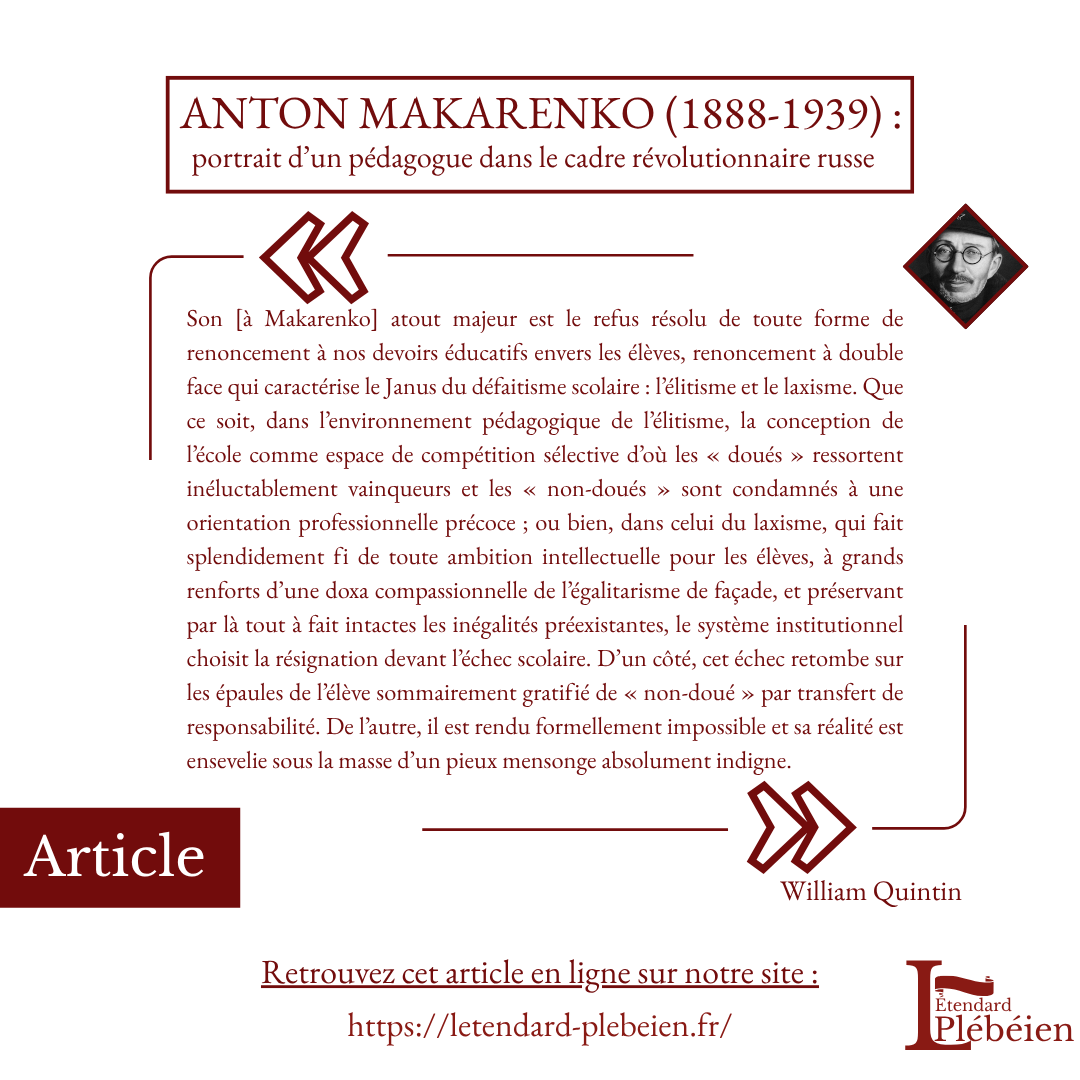
Peut-on éduquer sans renoncer ? À rebours de l’élitisme comme du laxisme, Anton Makarenko défend une exigence éducative radicale, au cœur des tensions révolutionnaires. Une réflexion dense sur l’école, l’égalité et la responsabilité. À lire 👇
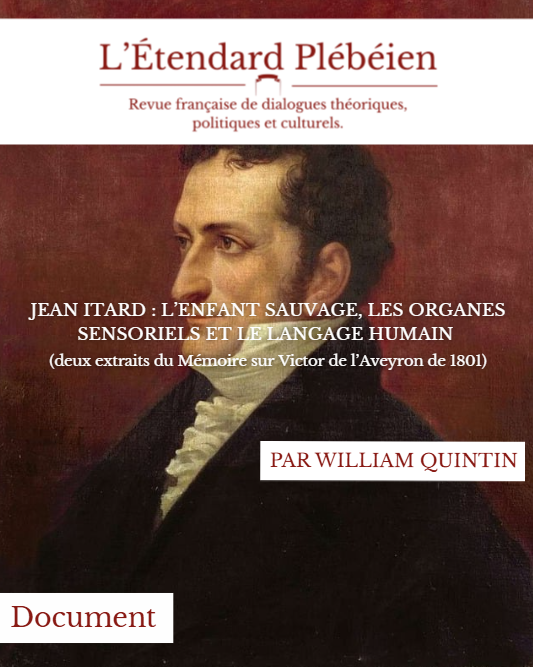
Qu’est-ce qui fait l’humain : la nature ou l’éducation ? À travers le cas de Victor, « enfant sauvage », Jean Itard interroge les liens entre sensorialité, langage et socialisation. Une réflexion fondatrice, entre science, pédagogie et philosophie 👇
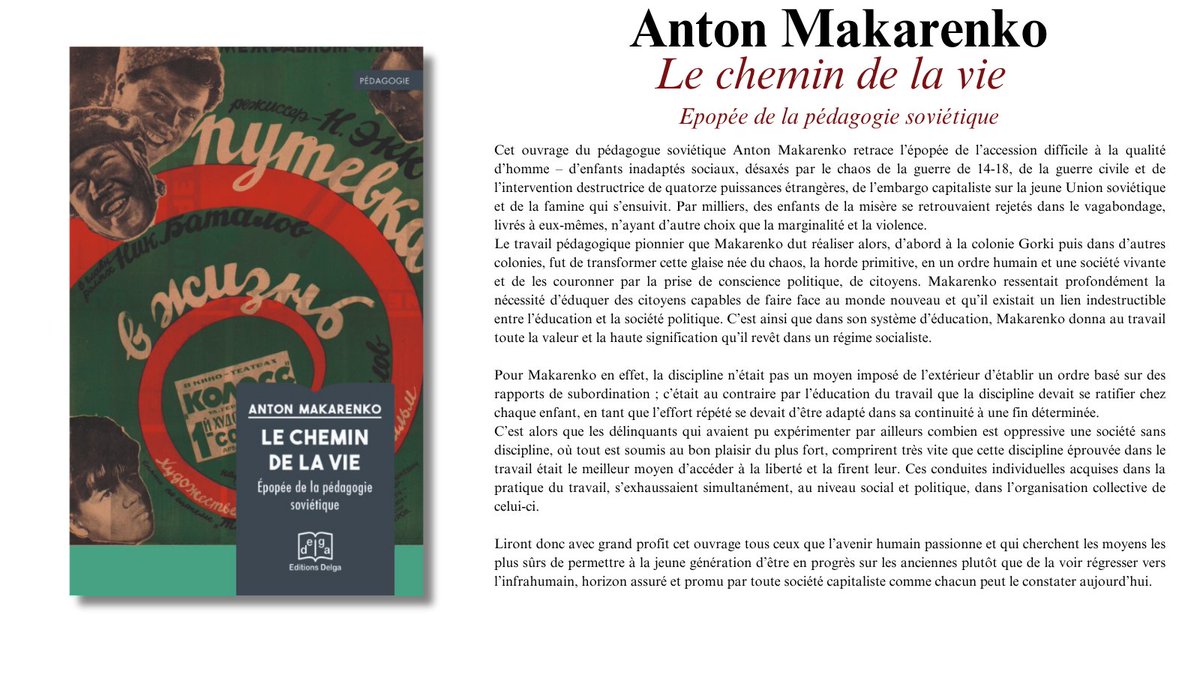
🔴Une occasion de redécouvrir « Le chemin de la vie. Epopée de la pédagogie soviétique » (titre original : « Le Poème pédagogique ») d'Anton Makarenko.
Aux @EditionsDelga
Extrait de notre recension de l'essai « Des enfants instruits. Réconcilier l’école et la culture » de Denis Kambouchner, publié aux Éditions Les Belles Lettres @BellesLettresEd :
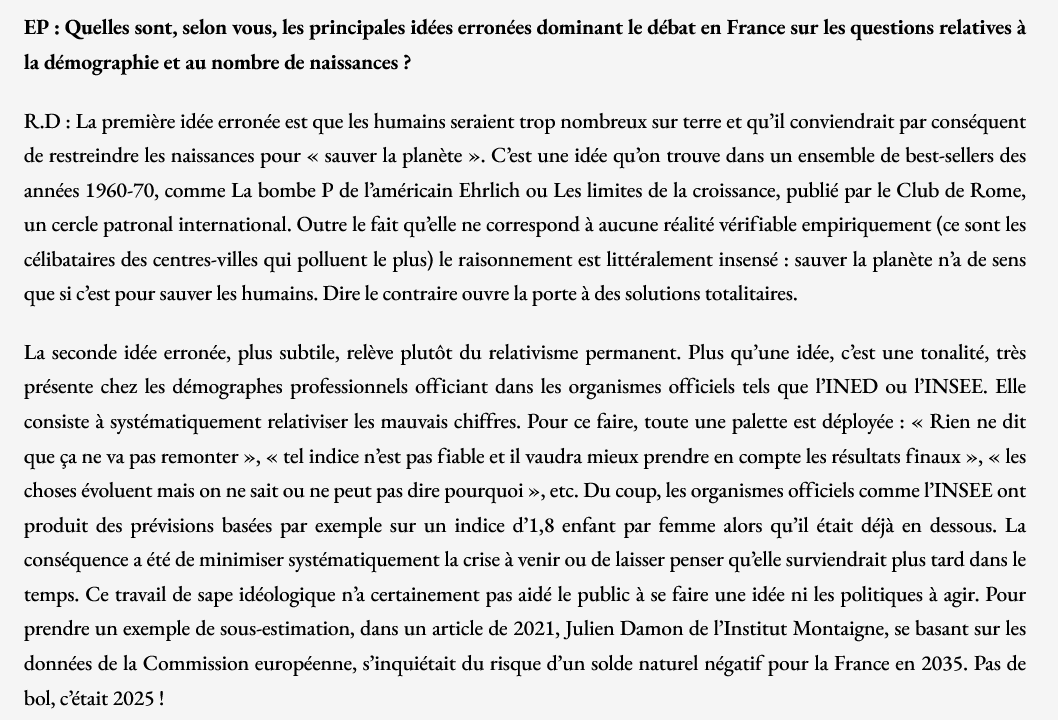
Le sociologue Raymond Debord @RaymondDebord critique la croyance répandue d'une planète qui serait confrontée à un problème de surpopulation, et déplore le relativisme en vogue par rapport à la gravité de la crise démographique.
Lien de l'entretien : https://t.co/KahUNu84lZ