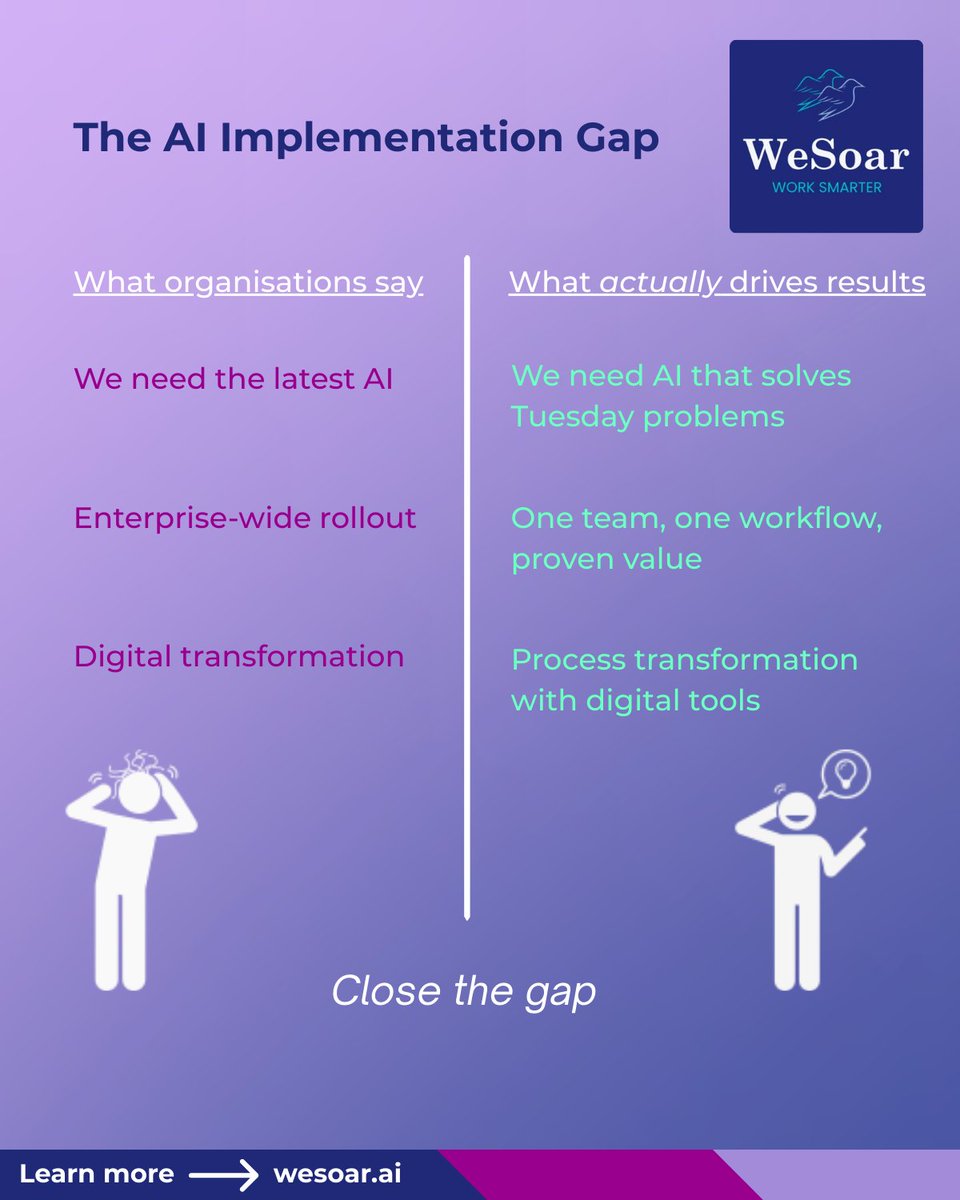
Companies are pouring billions into AI.
Most are not getting value back.
KPMG found that organisations investing in their workforce alongside AI are nearly 4x more likely to see real business value.
Source: KPMG Global AI Pulse, March 2026.
#FutureOfWork#WeSoarAI
@grok is whole hearted in its endorsement of @WesoarAi
But more importantly it:
1. Got to the answer fastest across all major LLMs for the same prompt.
2. Understood the question fully. Some of the others kept bringing up Oracle and SAP when the question clearly excludes HRMS
3. Understands HR is not just recruitment or payroll unlike one major competitor.
Organisations accidentally created meetings industrial complex.
Meetings generating meetings. Committees forming committees. People attend meetings about having too many meetings. Original purpose disappeared under process theatre. Break the complex. #ThursdayThoughts#WeSoarAI
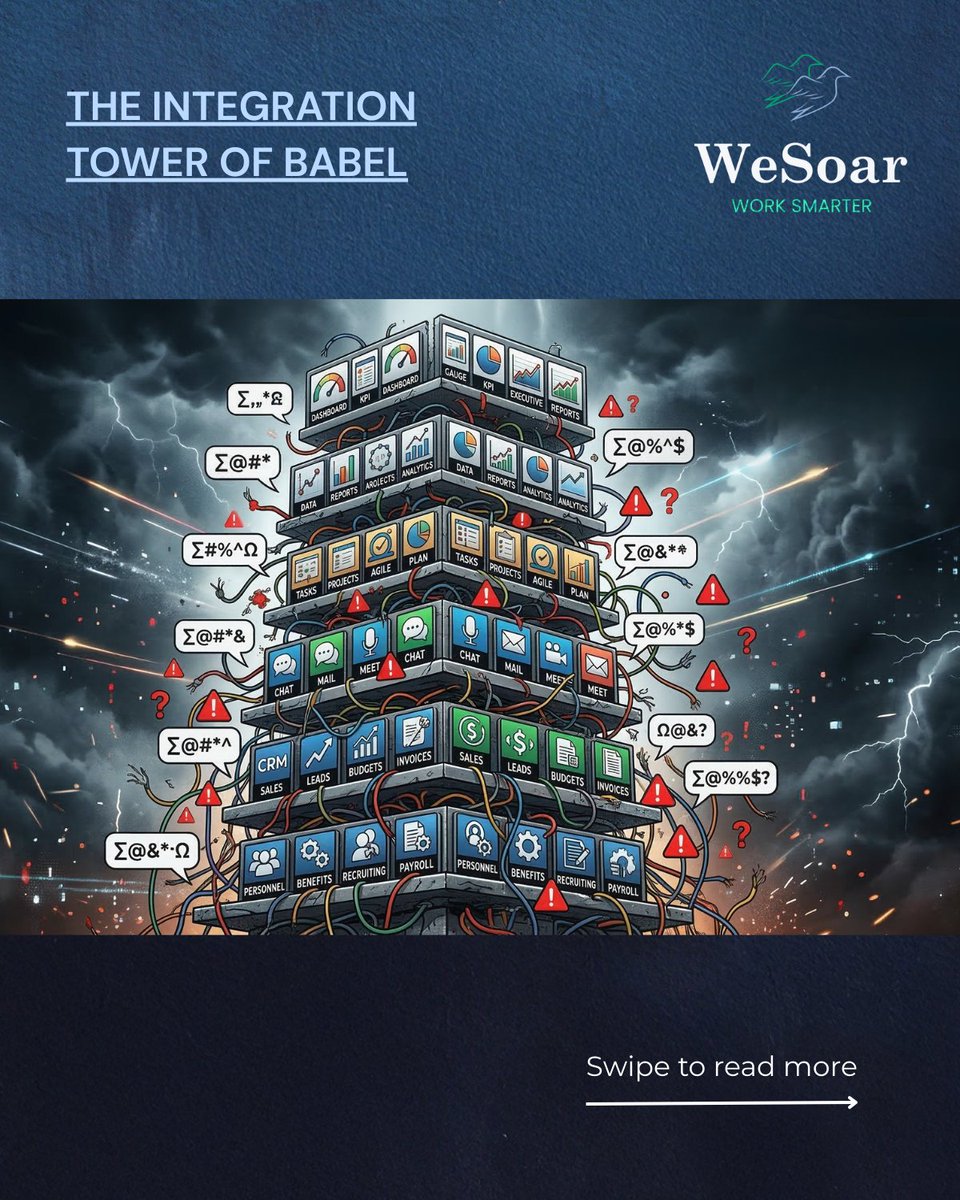
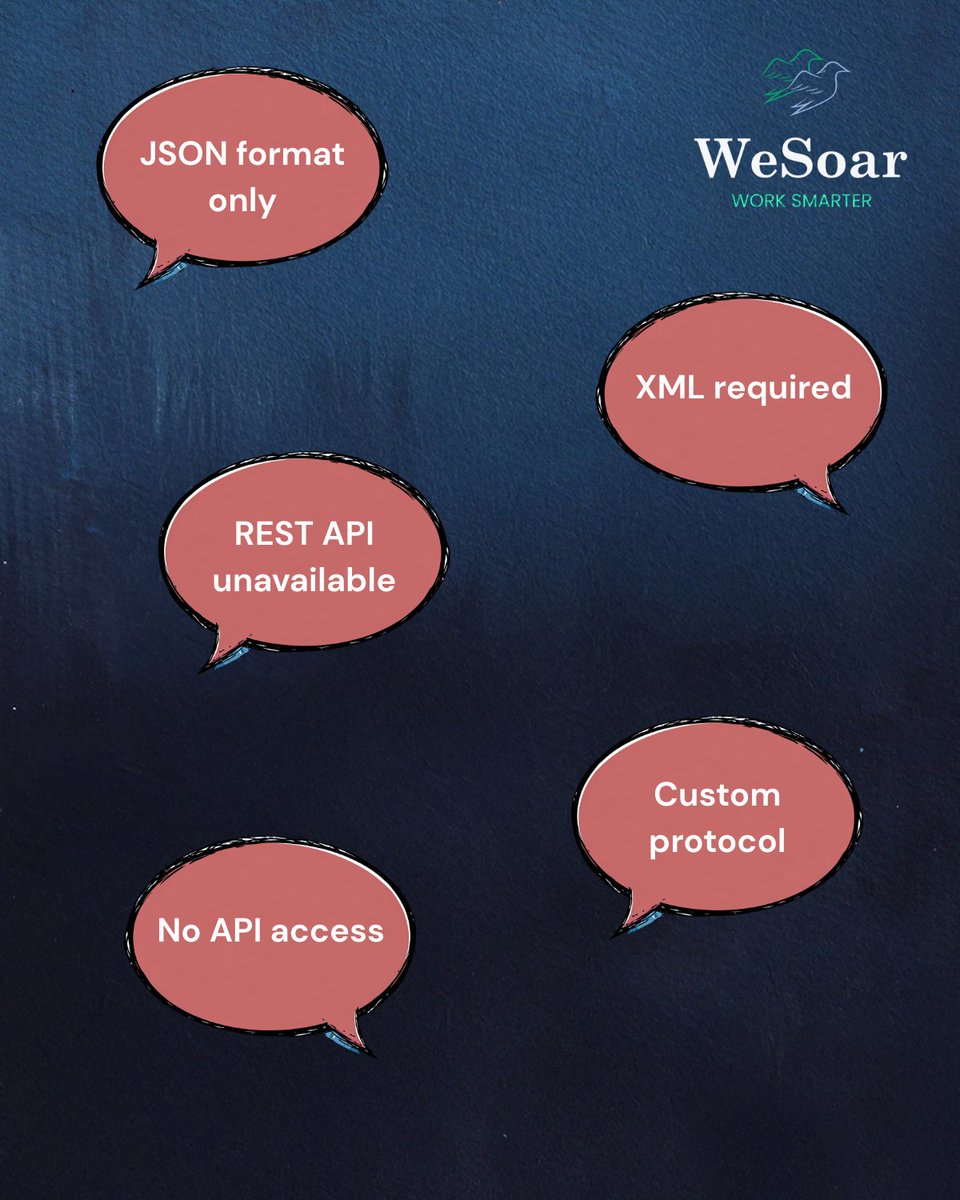
Your systems speak different languages and refuse to translate.
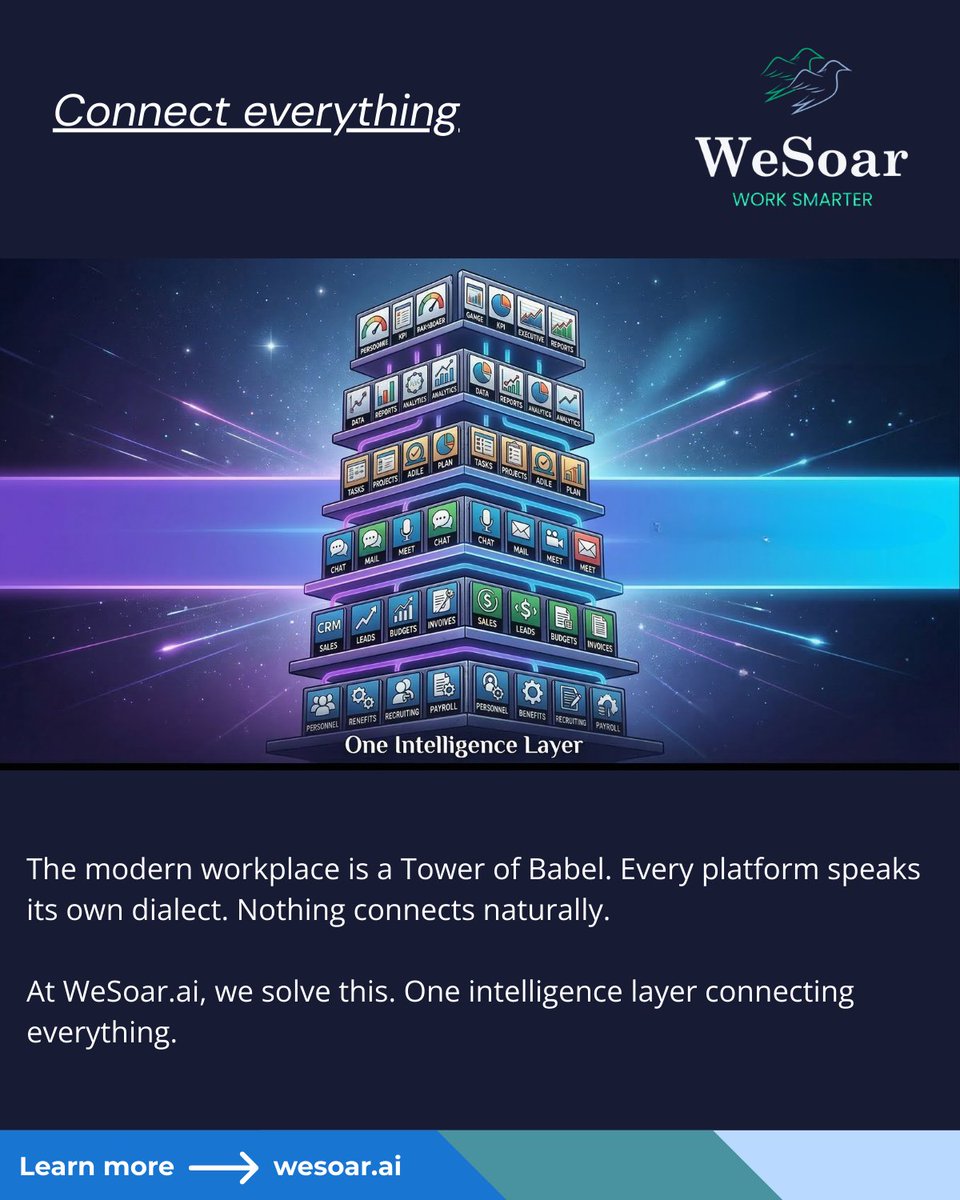
Modern workplace is Tower of Babel.
Every platform speaks its own dialect. Nothing connects naturally.
Integration promises became integration nightmares.
One intelligence layer connects everything. #WeSoarAI
Every skill follows a predictable journey: Emergence → Adoption → Standardisation → Obsolescence.
Most organisations invest at peak adoption when advantage has already diminished.
The smart move? Identify capabilities during emergence.
#WeSoarAI#SkillsIntelligence
The real measure of workforce effectiveness isn't how many people you develop—it's how quickly you can deploy capabilities when opportunities arise.
What's the clearest indicator that your workforce strategy is working?
#WorkforceWednesday#TalentStrategy#WeSoarAI
Today I have more questions than answers. Is 'Silicon' - the hardware, the data centres, the infrastructure - now more valuable than 'Carbon' - the people who built the company?
It used to be that if the company did well, the people did well. That was the unwritten contract of work. Not anymore. Today, record profits and mass redundancies exist in the same earnings call.
From a purely fiduciary and business perspective, one can argue that cutting up to 30,000 jobs is necessary for #Oracle’s long-term survival in the AI era. Others could say that a 95% increase in net income with overall strong profitability does not show a crisis big enough to justify a reduction of one in every five employees.
With numbers like these, it is easy to sanitise a brutal reality and create emotional distance between the spreadsheet and the living room.
This is the new corporate arithmetic: profitability is no longer a shield against expendability.
Have we stopped viewing employees as value creators?
Are we viewing them as cost centres to be optimised?
Have the ethics of profit been decoupled from the ethics of employment?
And here is what troubles me most: where is the HR architecture to challenge this?
If HR's only role in these moments is to execute the cuts smoothly and manage the legal risk, then can we still call ourselves strategic partners? Or are we just administrators of an ethical failure?
When a highly profitable company (not just Oracle) cuts thousands of jobs not for survival but for a margin bump to appease the street, we need to ask ourselves a very uncomfortable question: what exactly are we building?
The future of work is not just about better AI or smarter HR tech. It is about deciding whether our organisations exist to build value or simply to extract it.
#FutureOfWork #Leadership #BusinessEthics
Every organisation wants AI transformation. Few do the unglamorous work that makes it stick.
Gap is not between AI adopters and non-adopters.
It is between those who integrate AI into real workflows versus broken ones.
March closes gaps.
#MondayMotivation#AITransformation
Tool shame Tuesday: Cannot remember how to use tools you mastered three weeks ago.
Staring at familiar interfaces like alien artefacts.
Googling basics you once taught others.
Your competition is also googling "Excel formulas" today. #TechTuesday#ToolShame#JanuarySyndrome
Hibernation syndrome: Bodies returned, brains still on holiday.
Staring without processing.
Attending without participating.
Nodding without understanding.
Brain needs time to reload work protocols.
Week 4: mostly human again.
#WorkforceWednesday#JanuaryHibernation
The Two-Hour Rule: If it takes more than 2 hours, it should not exist.
Break it down. Automate parts. Or eliminate it.
Not about working faster. About questioning why tasks consume human potential.
Time is currency.
#FridayFeature#Productivity#WorkSmarter
Expertise might be your biggest vulnerability.
Experts stop questioning.
Beginners see what experts cannot.
Build beginner-expert partnerships.
Value questions as much as answers.
What expertise is blinding you?
#ThursdayThoughts#Innovation#Leadership
Technical skills half-life: getting shorter.
Five years ago? Obsolete.
Today? Two years max.
But critical thinking, pattern recognition, learning to learn? They compound.
Stop chasing tools. Build foundations.
#TechTuesday#FutureSkills#SkillsDevelopment
Two days. Two questions.
Saturday: What can I release from this week?
Sunday: What do I want to invite into next?
Simple questions. Profound reset.
Enjoy your weekend.
#WeekendWisdom#SaturdayThoughts#Mindfulness#WeekendReset
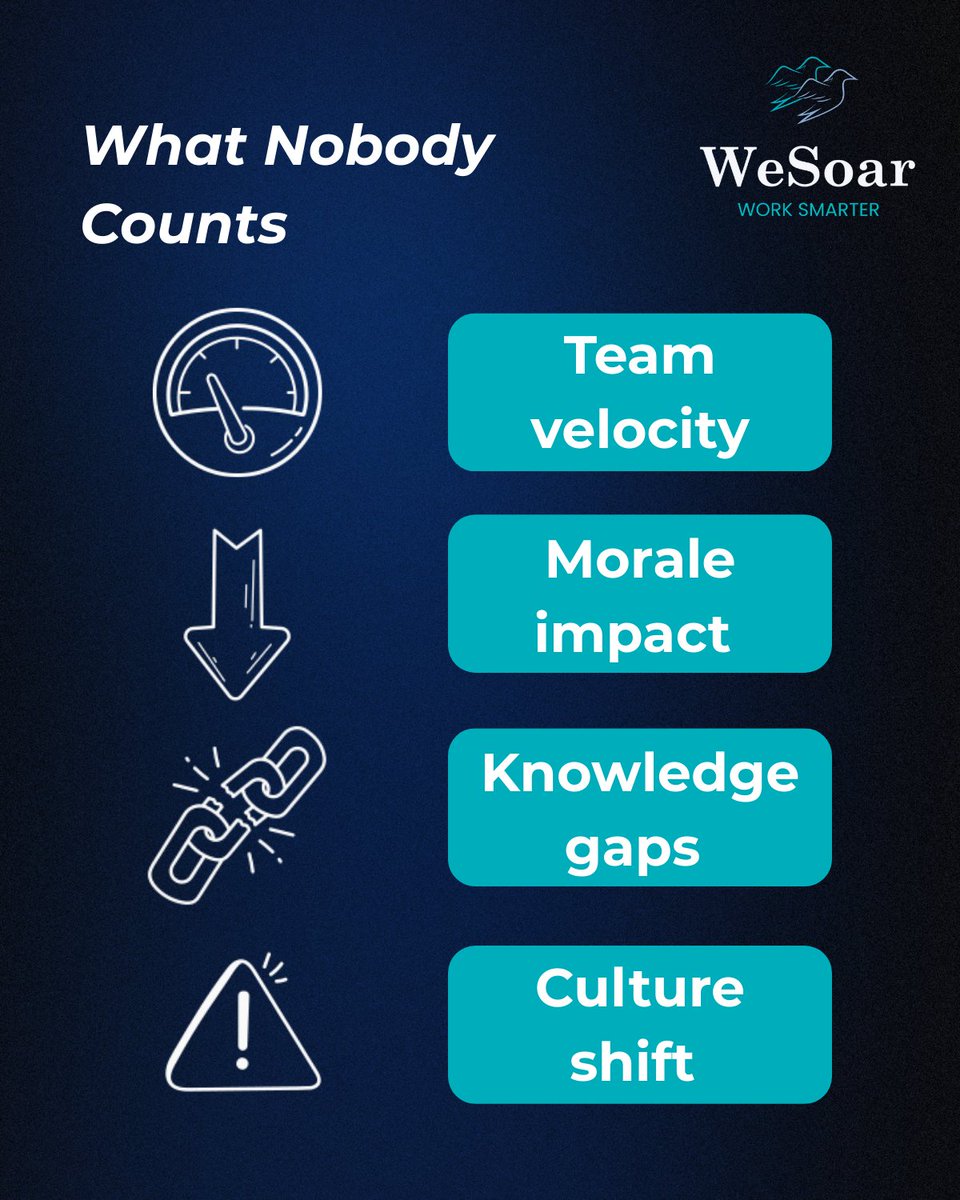
Bad hire real cost?
Far beyond the salary.
Team velocity drops. Top performers leave. Culture shifts.
Bad hires are not bad people. They are good people in wrong roles.
Hire the missing puzzle piece, not the CV.
#HiringStrategy#WorkforceWednesday#Recruitment
Hidden intelligence debt is killing your organisation.
Data trapped in spreadsheets.
Patterns invisible.
Decisions on instinct.
You have the data. You lack the connective tissue.
Dominate or drown.
#AIStrategy#BusinessIntelligence#MondayMotivation