A robot’s training starts before the model sees any data. It starts with the task, objects, camera setup and how the operator moves.
Collecting clean episodes that push the hardware is hard. Building one that generalizes is harder.
@PrismaXai
Announcement was made for the @PrismaXai Community Website Showcase!
Happy to have my 'PX compass' website being featured in the announcement!
Thank you!
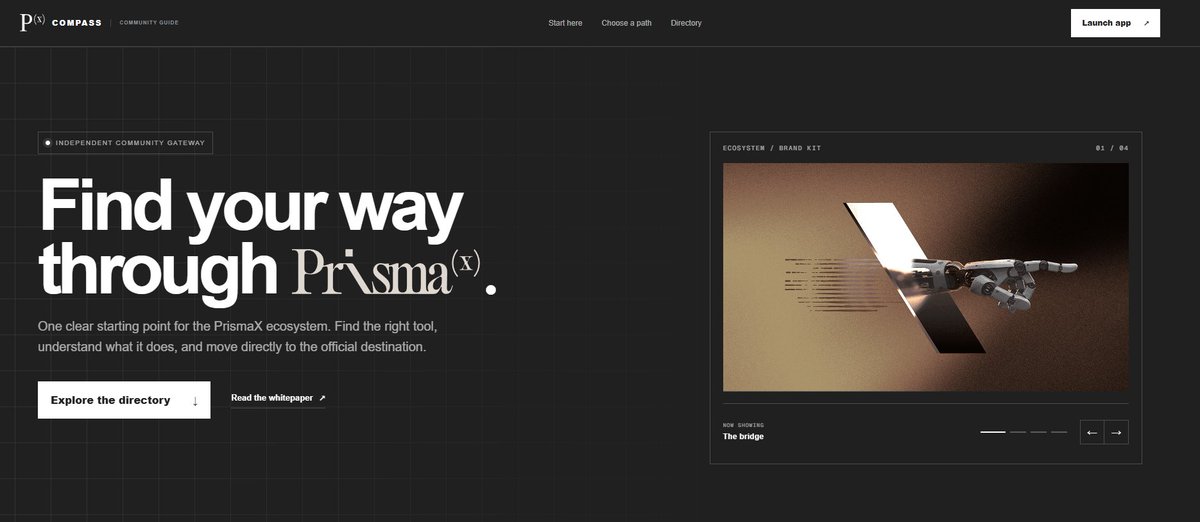
saw that there's a PrismaX Community Website Showcase event, so i decided to create a @PrismaXai Community Guide website!
https://t.co/CoeAEGZQah
PX Compass is a one-stop navigation hub that helps users discover and access the right resources across the PrismaX ecosystem.
10k+ sim ablations showed what works: fine-tune whole model, relative actions, right mounting height, low latency.
Hardware is easy. Policies that hold on the 1000th try in new rooms are the real game.
CoRL Austin Nov 9-12 with new demo. Come find @PrismaXai .
#IROS2026
From the @PrismaXai floor at IROS 2026 in Pittsburgh: the story was not the booths.
Boston Dynamics skipped the floor entirely, then dropped a new Atlas hand video on the final day and took the whole week anyway. Classic headliner move.
Meanwhile the hall was packed with hands.
Field notes from IROS 2026 in Pittsburgh: a show floor full of dexterous hands, hand makers turning into data companies, and site-unseen demos that held up. https://t.co/76rYBC8l6B
Performance in the wild mattered most.
@LumosRobotics towel folding stood out: smooth, near-human speed, site-unseen.
@PrismaXai booth ran π0.5 live on two YAM arms picking fruit. Trained on white background, zero-shot in a noisy hall we had never seen.
That’s the bigger lesson from IROS 2026.
Getting a VLA to work in the wild isn’t just about the model. Data, action representation, hardware and real world conditions all matter.
PrismaX is helping robotics teams close that gap and make physical AI work beyond the lab.
PrismaX is at IROS 2026 in Pittsburgh, and booth 1122 has been 🔥
The mission is simple: close the gap between what robotics models can do in simulation and what they can actually do in the messy real world.
Here’s what went down at the @PrismaXai booth 👇
Day 2 at IROS. Here's the demo running at booth 1122.
Come see it live, and catch @castorhat on the Tech Talk Stage at 3:15 PM: what makes good robotics data?
#IROS2026@ieeeiros
@castorhat later took the Tech Talk Stage with “Bringing a VLA into the Wild.”
One key finding stood out: relative actions were more robust to real world imperfections than absolute actions.
A 4° cumulative offset across 6 joints pushed performance down to ~30%.
Physical intelligence grows through real-world interaction.
Robotics Data turns those interactions into usable training data — and feeds the lessons back into the next round of collection.
Data quality decides almost everything: when the gripper closes, color vs shape, new lighting.
More than model size or architecture, the data sets the behaviors and the compute cost.
PrismaX just opened Robotics Data in limited release.
Growing bank of teleop + egocentric demos, plus custom collection for specific tasks and scenes.
Operators capture. Reviewers enforce quality.
A robot’s training starts before the model sees any data. It starts with the task, objects, camera setup and how the operator moves.
Collecting clean episodes that push the hardware is hard. Building one that generalizes is harder.
@PrismaXai
Bottom line: physical AI safety looks like LLM safety minus the philosophy.
Commercial risk + hardware constraints + careful data choices.
The unsolved hard problem is zero tolerance for physically wrong actions.
AI safety for LLMs was always mostly commercial: stop hallucinations, harm instructions, and controversy so the company avoids liability and bad UX.
That same playbook now has to map onto robotics models once they get capable. @PrismaXai
AI safety started as a commercial problem for LLMs. Robots inherit it, plus physics. We map each LLM safety failure onto physical AI. https://t.co/XxQtNu2LYU
No 50 kg robot is “safe.”
Mass + power already force deterministic safety (geofencing, soft stops, controllers).
Existing machinery laws, insurance, and tort cover most real-world harm.
The alignment-like lever is pretraining: just don’t put punching/kicking data in the set.