Famous funnyman, Trevor Noah, just shared that old story about how Uber got its fingers burnt in Nigeria.
It showed up & started dishing out fat bonuses to drivers per ride to boost uptake. At some point it started even giving bonuses to riders as well.
Before long, drivers figured out that they could create fake rider accounts, call themselves up, take quick rides, and keep scooping up bonuses.
Some then upped the ante. They installed GPS spoofing apps. Now, they didn't even have to move. You just park, rack up fake rides, grab bonuses till you taya, then go house & bed.
When Uber finally figured out the game, they were so shocked by the sheer scale that they suspended the incentives structure WORLDWIDE.
(Clearly someone at Uber didn't take his economics lessons seriously & probably never took the course on perverse incentives like "moral hazard," "Campbell's Law," "Goodhart's Law," & "Peltzman Effect." 🤦🏽♂️)
Now, Trevor is just trying to get us to have a good laugh at the expense of some too-smart-for-their-own-good Silicon Valley tech bros. Just like in some Akan & Caribbean communities, folks laugh at Ananse the spider when he gets tied up in his own schemes of trickery.
But then he used the word "ingenuity" to describe the drivers' actions. Which prompted a recall of my now fading stock of classical Greek learning.
You see, in ancient Greece, they distinguished between SOPHIA and METIS. Sophia was the stuff frequently translated as "wisdom." But we call "philo-sophers" and "philo-sophy" by those terms because "sophia" reflects the deeper use of intellect to solve problems one believes afflict the WHOLE SOCIETY. Metis is primarily about applying one's brain power to serve their own, or their group's, parochial problems or interests.
Simple enough distinction, but I argue that it is an essential device in the plot of every society's transition story.
In the 1000-year old Norse sagas, the Scandinavians begin very much with a cunning Ananse-like character called Loki. He was always the soul of all witty plays. He made the stories tick. Pure ingenuity!
Then he tricked someone to kill the god, Baldr, Lord of Light, truth, & beauty. Loki is finally unveiled as the chief enemy of the universe's progress.
Is it "ingenuity" if in the end it breaks the world?
😊
The Akans does not have a unifying word like Sophia for the use of the intellect to advance collective progress. They have several.
But they do have a pretty compact word for the kind of low cunning used to "mumu" Uber. They called it "aniteɛ" - keeping one's eyes opened. It starts off being about shrewdness,in which form it is generally admired because it prevents others from taking one for a fool.
But soon, ANITEƐ becomes a barrier to sound cooperation in a complex society. A society with too much aniteɛ or metis struggles to get enough people to sacrifice - to "close their eyes" to certain self-interests - in order to advance greater collective smartness.
It is hard to quibble with the truism that in low-trust situations, defensive cleverness is essential. But how then would one ever start to build trust?
At any rate, too much individual cleverness can manifest in common solutions becoming dumber. Like why there are no pedestrian walkways in Accra Airport City because every real estate developer maximises the gain from every square meter of land.
To repeat: too much personal ingenuity can sometimes lead to less social intelligence.
My hypothesis is that he believes he is doing stakeholders a favour by engaging on such consequential legislation. Notice how he points to his predecessors and argues that they did not engage at all on other legislation. The implication seems to be that stakeholders should be grateful for the engagement, even if the quality of that engagement is lacking.
If you publish a poor first draft of a bill and subsequently make substantial changes to it, a genuine commitment to transparency requires that you publish the revised and more polished draft as well. That way, stakeholders can review the current provisions under consideration and provide informed feedback.
"I hear the Tech industry but we will not rewrite the rules because that is what they want, there is a way laws are made in this country"
- @samgeorgegh on the NITA Bill pushback, transparency, and stakeholder engagement. #Newsfile
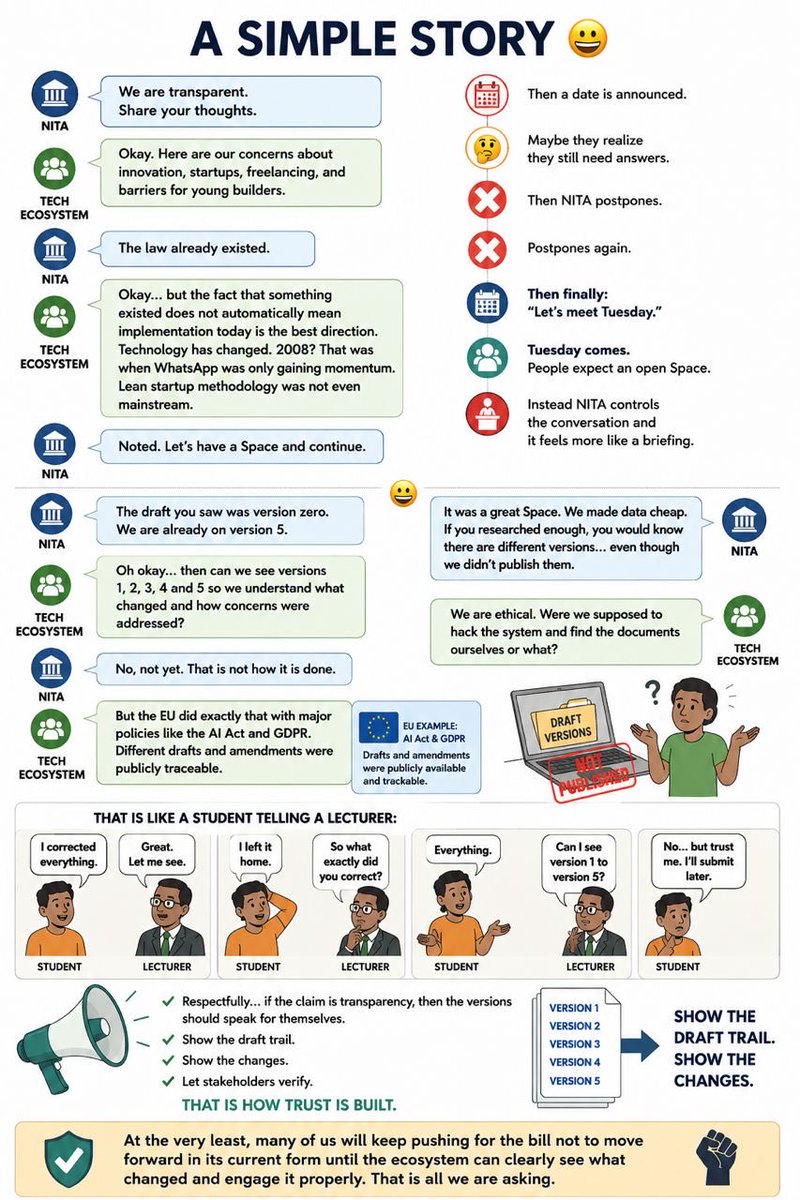
A simple story 😀
NITA:
“We are transparent. Share your thoughts.”
Tech ecosystem:
“Okay. Here are our concerns about innovation, startups, freelancing, and barriers for young builders.”
NITA:
“The law already existed.”
Tech ecosystem:
“Okay… but the fact that something existed does not automatically mean implementation today is the best direction. Technology has changed. 2008? That was when WhatsApp was only gaining momentum. Lean startup methodology was not even mainstream.”
NITA:
“Noted. Let’s have a Space and continue.”
Then a date is announced.
Maybe they realize they still need answers.
Then NITA postpones.
Postpones again.
Then finally:
“Let’s meet Tuesday.”
Tuesday comes.
People expect an open Space.
Instead NITA controls the conversation and it feels more like a briefing.
Then NITA says:
“The draft you saw was version zero. We are already on version 5.”
Tech ecosystem:
“Oh okay… then can we see versions 1, 2, 3, 4 and 5 so we understand what changed and how concerns were addressed?”
NITA:
“No, not yet. That is not how it is done.”
Tech ecosystem:
“But the EU did exactly that with major policies like the AI Act and GDPR. Different drafts and amendments were publicly traceable.”
😀
NITA:
“It was a great Space. We made data cheap. If you researched enough, you would know there are different versions… even though we didn’t publish them.”
Tech ecosystem:
“We are ethical. Were we supposed to hack the system and find the documents ourselves or what?”
😀
That is like a student telling a lecturer:
“Sir, I corrected everything.”
Lecturer:
“Great. Let me see.”
Student:
“I left it home.”
Lecturer:
“So what exactly did you correct?”
Student:
“Everything.”
Lecturer:
“Can I see version 1 to version 5?”
Student:
“No… but trust me. I’ll submit later.”
Respectfully…
if the claim is transparency, then the versions should speak for themselves.
You made data cheaper, fair enough.
But surely enough data was left to upload the updated drafts too 😄
No visible draft trail… but somehow we are all expected to just believe it on vim 😀
At the very least, many of us will keep pushing for the bill not to move forward in its current form until the ecosystem can clearly see what changed and engage it properly.
That is all we are asking.
@koboateng@pazunre@TheDumbTechGuy@MacJordaN@seth_doe22
@NITAGhana in the fashion of transparency and inclusion, why don't you consider document version history so that we can see immutable updates to documents on the blockchain to prevent Hon Sam from having to explain to all the people who didn't get the memo going forward?
@TheDumbTechGuy Nita why are you hurting us
Nita: it's not us ooo boss the law was already there
Tech bros: but nita you can amend it ??
Nita: the law is the law
Despite a very full plate, I have been needled by a Ghanaian business journo friend of mine based in NYC to have a go at the debate that has taken Ghana's tech community by storm: the draft NITA bill.
My short essay effectively aligns with what everyone else is saying: shred the bill and come back with something more aligned with modern tech reality!
But in the tradition of the Scarab, I try to go into a bit more detail than most mainstream pieces.
I also point out something that seems missing in the debate. With the rapid surge of technologies like AI, everyone is or will soon be doing stuff previously considered "ICT professional stuff."
Licensing ICT professionals is akin to licensing bloggers in today's rowdy information environment: trying to stop a hurricane by blowing fumes from one's mouth.
https://t.co/hrmLM6SKtE