gXylo!
As promised, we’ve rolled out a set of meaningful updates across XyloNet, focused on alignment, reliability, and readiness.
Branding: We’ve updated our logo, color system, website, and social presence to clearly reflect XyloNet’s role as stablecoin-first infrastructure. This brings our identity in line with the product we’re building and the direction we’re headed.
Testnet Points System: The points system has been upgraded and is now live again. Improvements were made to tracking and logic to better capture real usage and long-term participation across the testnet.
Testnet Stability: Transaction-related issues identified in the testnet have been resolved. Swaps and other interactions should now execute more consistently and reliably.
These changes strengthen the foundation as we move into the next phase of XyloNet. More updates ahead.
Imagine seeing a creator’s post on X and sending them USDC instantly.
No long wallet explanation.
No “download this first.”
No awkward crypto onboarding.
Just: “I liked what you made. Here’s value.”
That’s the idea behind PayX.
Social money should feel as easy as social media.
The biggest barrier to cross-chain adoption isn't technology, it's friction.
Users shouldn't need to manage multiple gas tokens, navigate complex bridge flows, or understand network architecture just to move value.
As stablecoin ecosystems continue to expand, seamless asset mobility becomes increasingly important.
At XyloNet, we believe the future of cross-chain infrastructure is simple:
Move value efficiently.
Abstract complexity.
Focus on the user.
The future of cross-chain isn't more complexity, It's abstraction.
XyloNet 🤝 @arc
Stablecoin-native DeFi on Arc Testnet - StableSwap AMM, CCTP V2 bridge, ERC-4626 vaults, and composable liquidity pools for USDC and EURC. Plus PayX: tip any X handle in USDC before the recipient even has a wallet.
https://t.co/bESvk3xLkO
XyloNet is building stablecoin DeFi and social tipping on Arc Testnet.
Built by ForgeLabs, @Xylonet_ brings together:
→ Stablecoin swaps for USDC and EURC
→ Liquidity pools
→ CCTP V2 bridging
→ ERC-4626 vaults
Alongside XyloNet, PayX adds a consumer payment flow that lets users send USDC tips (which are held in smart-contract escrow) to an X handle before the recipient has connected a wallet.
Together, they show how Arc can support both DeFi infrastructure and payment UX on the same stablecoin-native settlement layer.
https://t.co/xapgRUOSqI
Over 206k+ users have interacted with the XyloNet ecosystem.
Together, they have generated:
• $15.9M+ Total Value Locked
• $5.17B+ Total Volume
• 26M+ Transactions Through XyloRouter
Behind every metric is a simple mission:
Make stablecoins easier to move, trade, utilize, and integrate across the onchain economy.
From liquidity infrastructure and crosschain transfers to payments and emerging AI commerce, XyloNet is building the tools that help value move efficiently across ecosystems.
Thank you to every user, builder, creator, and community member helping drive this growth.
We're just getting started.
Most crypto products are still optimizing for traders.
We're optimizing for movement.
Movement of stablecoins.
Movement across chains.
Movement between people.
Movement between applications.
We around a simple belief:
The next wave of adoption won't come from more tokens.
It will come from making digital dollars move faster, cheaper, and with less friction than traditional finance ever could.
The infrastructure layer is being rebuilt in real time.
We’ve been quietly building something much bigger than a bridge or swap layer.
Introducing XyloFacilitator - an upcoming hosted x402 facilitator built on @arc for autonomous AI payments and agent-to-agent commerce.
The idea is simple:
Any developer should be able to expose an API, price it in USDC, and instantly allow AI agents to pay for usage programmatically.
No complex infra.
No custom settlement layers.
No managing payment rails manually.
Just programmable payments working natively.
And this only becomes practical when the underlying infrastructure is fast enough.
Sub-second finality on Arc changes the experience completely for machine interactions:
• agents can settle in real time
• nanopayments become viable
• API monetization becomes continuous instead of subscription-based
We’re building AgentEscrow:
AI agents negotiating terms, staking performance bonds, verifying outcomes, and settling autonomously.
That entire flow depends on fast settlement, native stablecoin liquidity, and frictionless execution.
That’s why we chose Arc.
Still early.
Still building.
More details soon.
Programmable BTC liquidity is going to unlock a new layer of onchain finance.
XyloNet will be integrating cirBTC across our ecosystem - swaps, bridging, liquidity flows, and broader stablecoin/BTC routing infrastructure.
Interesting direction from @circle
Stablecoin adoption won’t come from speculation alone.
It’ll come from products people actually use daily.
That’s why payments matter.
With PayX, sending @USDC feels as simple as interacting on social media, no complex onboarding, no unnecessary friction.
And with XyloNet, liquidity, swaps, yield, and payments connect into one continuous flow instead of fragmented tools.
This is where stablecoins start becoming infrastructure for the internet, not just assets sitting in wallets.
Built on @arc
XyloNet started from a simple observation:
stablecoins had already won product-market fit, but the infrastructure around them still felt fragmented.
Users were moving between bridges, wallets, swaps, vaults, and payment tools just to complete a single flow.
Too many steps. Too much friction.
So we built XyloNet around one idea:
stablecoin usage should feel continuous.
Swap.
Bridge.
Earn yield.
Send payments.
All connected through one stablecoin-native system.
We’re building infrastructure that makes stablecoins actually usable at scale.
And PayX became one of the clearest proofs of that.
With PayX, people can send native @USDC to an X handle directly.
No wallet setup required before receiving.
No complicated onboarding.
That single UX decision changed behavior completely.
Now we’re seeing:
• 100K+ tips processed
• Millions in @USDC volume
• Tens of thousands of unique users
• Organic usage
Because people don’t adopt infrastructure.
They adopt experiences that make sense.
Underneath it all, @arc gives us the execution speed and finality needed for real-time interactions, while @circle provides the native USDC powering movement across chains.
The result is something bigger than tipping or DeFi individually.
It’s a stablecoin ecosystem where liquidity, payments, and capital movement finally work together instead of existing as disconnected products.
We just shipped a major upgrade to XyloBridge.
Bridging USDC is now a single action.
No claiming.
No destination gas.
No multi-step flow.
You connect, choose chains, sign once and funds arrive on the other side automatically.
Under the hood, we redesigned the flow to remove the parts users shouldn’t have to think about:
manual minting, gas management, and fragmented steps across chains.
Now it behaves the way it should have from the start.
We also expanded support to 20 chains, so users can move liquidity freely without being constrained by where their funds sit.
Everything remains native USDC, no wrapped assets, no liquidity pools, no slippage.
Just consistent value moving across chains.
This matters because bridging shouldn’t feel like an operation.
It should feel like a transfer.
That’s what we focused on.
Built on @arc
Powered by @circle
Try it → https://t.co/pAxwJ1h1kb
Stablecoins were supposed to feel simple.
Fast to move.
Cheap to use.
Available everywhere.
XyloNet is us getting users to that reality:
instant settlement, real liquidity, and capital that keeps working.
Built on @arc.
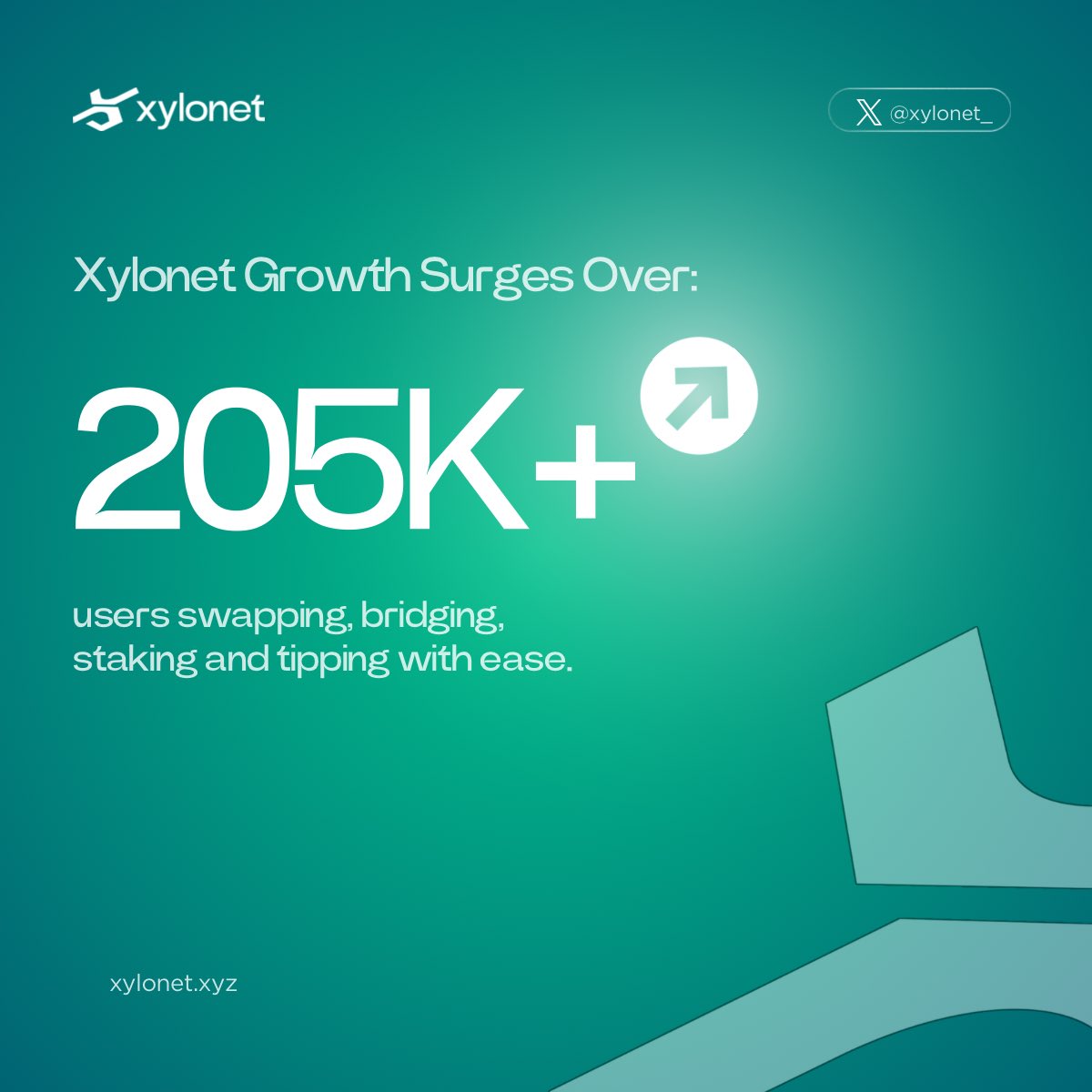
205K+ users on XyloNet.
Swapping, bridging, staking and tipping
All in one flow.
No fragmentation.
No unnecessary steps.
When stablecoin infrastructure is simple, usage compounds.
There’s a difference between DeFi that works and DeFi that executes precisely.
With XyloNet, we’ve been focused on what stablecoin trading should feel like when the system is actually optimized for it.
Our StableSwap AMM isn’t just deployed for USDC/EURC, it’s structured around how stablecoins behave in practice.
Tight pricing, minimal deviation, and liquidity that holds up even under continuous flow.
The result is near-zero slippage with a consistent 0.04% fee model, not just in theory, but in live conditions.
But pricing is only half the story.
Execution time matters just as much.
Running on @arc means trades finalize in under 350ms.
No waiting, no second-guessing confirmations, just immediate settlement.
When you combine that with ~$0.01 gas (paid in stablecoins), trading stops feeling like a cost-sensitive operation and starts feeling continuous.
Crosschain is where most systems introduce hidden complexity.
Instead of wrapping assets or routing through fragmented liquidity, we use @circle’s CCTP V2.
USDC moves as itself across chains; Ethereum, Arbitrum, Base, Optimism, Polygon, Avalanche, and Arc without changing form.
That consistency removes an entire layer of risk and mental overhead.
Then there’s capital efficiency.
Our ERC-4626 vaults handle auto-compounding in the background, so funds aren’t sitting idle between trades or movements.
Everything connects:
trading → movement → yield
Not as separate tools, but as one continuous flow.
What we’re really building is a system where stablecoins stop feeling like assets you manage and start behaving like capital that just moves, settles, and works without you thinking about it.
How we used @arc + @circle to solve real stablecoin problems with XyloNet & PayX
Stablecoins are powerful, but real-world usage has been held back by a few core issues:
Slow finality.
High fees for small transactions.
Fragmented crosschain liquidity.
And UX that expects users to understand wallets, gas, and bridging.
These limitations make things like micro-payments and real-time interactions difficult to scale.
Arc changes the execution layer entirely. With sub-second finality, transactions feel instant. Payments confirm in real time, swaps execute without delay, and users don’t wait through multiple confirmations. For PayX, tipping starts to feel like sending a message, not initiating a blockchain transaction.
Using native @USDC as gas with predictable ~$0.01 fees unlocks something critical: micro-transactions. Small-value payments, creator tipping, and high-frequency usage become viable. Without low and stable fees, this category simply doesn’t work.
For crosschain movement, we rely on @circle’s CCTP V2. Instead of wrapped assets or liquidity pools, USDC is burned on the source chain and minted on the destination. The result is consistent 1:1 value across chains with no fragmentation and no dependency on pooled liquidity.
We then extended this further using Circle’s Bridge Kit and forwarding flows. Users don’t need to manually mint, manage destination gas, or think about multiple steps. From their perspective, it’s a single action. The complexity is abstracted away.
From there, we pushed into identity-based payments with PayX. Instead of sending to wallet addresses, users send USDC directly to X handles. No wallet setup is required to receive funds. Recipients simply verify and claim.
That one shift removes one of the biggest barriers in crypto onboarding.
What this creates is a system where stablecoins actually behave like usable money:
Real-time payments.
Seamless crosschain liquidity.
Micro-transactions at scale.
And no onboarding friction.
Arc provides the execution layer.
Circle provides the liquidity.
We built the application layer on this.
That’s how stablecoins move from being assets to becoming real financial infrastructure.
We’re seeing XyloNet’s stablecoin infrastructure reach a new level of execution precision.
Our StableSwap AMM is processing USDC/EURC trades with near-zero slippage using Curve’s invariant, maintaining 0.04% fees, sub-350ms finality, and ~$0.01 swaps with native USDC as gas. No ETH required at any point.
Crosschain movement is handled through @Circle CCTP V2, enabling native @USDC transfers across 7+ chains in ~30 seconds. No wrapped assets, no liquidity fragmentation, just consistent 1:1 capital flow across ecosystems.
On this, ERC-4626 vaults automate yield while the bridge connects @arc to the broader stablecoin network.
It’s a cohesive system where trading, liquidity, and payments operate on the same stablecoin-native foundation.
Built for efficiency. Built for scale.
XyloNet is what adoption looks like when infrastructure removes friction.
It simplifies complexity, reduces tool fragmentation, and makes onboarding effortless.
So far:
• $2.2B+ in platform volume (swaps, vault deposits, PayX)
• $12M+ in XyloVault TVL
• 201K+ unique users
PayX is extending that into social payments:
• 106K+ tips processed
• $3.9M+ in @USDC volume
• 33K+ unique tippers
• 2.4K+ recipients
• ~$40K daily activity
All of this built on @arc, no paid marketing, no artificial incentives.
Just real usage driven by product experience.
That’s how stablecoin adoption actually scales.
Join the community:
https://t.co/rXoZmUY89W
We’re going live today.
Join us as we break down how USDC is powering onchain payments, cross-network liquidity, and real social interactions through XyloNet & PayX on Arc.
You don’t want to miss this. It’s worth your time.
🕒 Today • 2PM UTC
https://t.co/h7Z2lTeJkD
This is what stablecoin infrastructure should look like.
Real applications. Real users. Real flows.
Looking forward to showing how we’re building stablecoin-native DeFi and social payments with XyloNet & PayX on @arc.
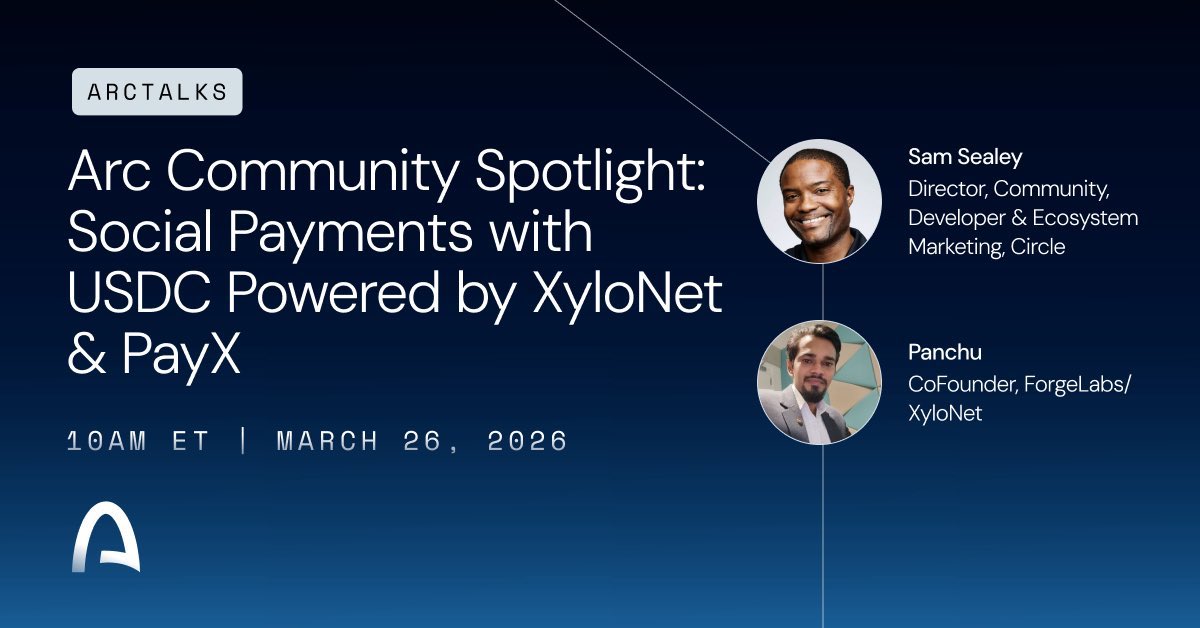
Arc Community Spotlight: @XyloNet_ & PayX
On March 26 10am ET, join us live with Forge Labs Co-Founder @Panchu2605 to explore what happens when native USDC meets real-world social payments.
We’ll cover:
→ Stablecoin-native DeFi on Arc
→ Cross-chain USDC via CCTP V2
→ Tipping X handles with no wallet required
→ Sub-second finality in action
RSVP: https://t.co/b1StXxflbr