20yo investor · documenting the process
Opinions welcome · No courses · Mistakes stay up
Successes are experience · Failures are lessons
Not investment advice
Another convoy is on the move.
BlueBirds 14, 15, and 16 have left our Texas facility and are on the road to Cape Canaveral.
Next stop: orbit. 🚀🚀🚀🚀🚀🚀🚀🚀🚀🚀🚀🚀🚀🚀🚀🚀
The largest commercial communications arrays ever deployed in low Earth orbit. A scalable platform to deliver space-based cellular broadband connectivity directly to standard phones, support secure government applications, and deliver a new third layer of connectivity.
In Midland, Texas, production continues to advance through BlueBird 50, with more than 20 spacecraft structures now being integrated as part of our assembly process.
One constellation. Connectivity. Resilience. Security. Built in Texas. 🇺🇸🌎📶📱
#ASTSpaceMobile #Broadband #ConnectingtheUnconnected #BlueBirds
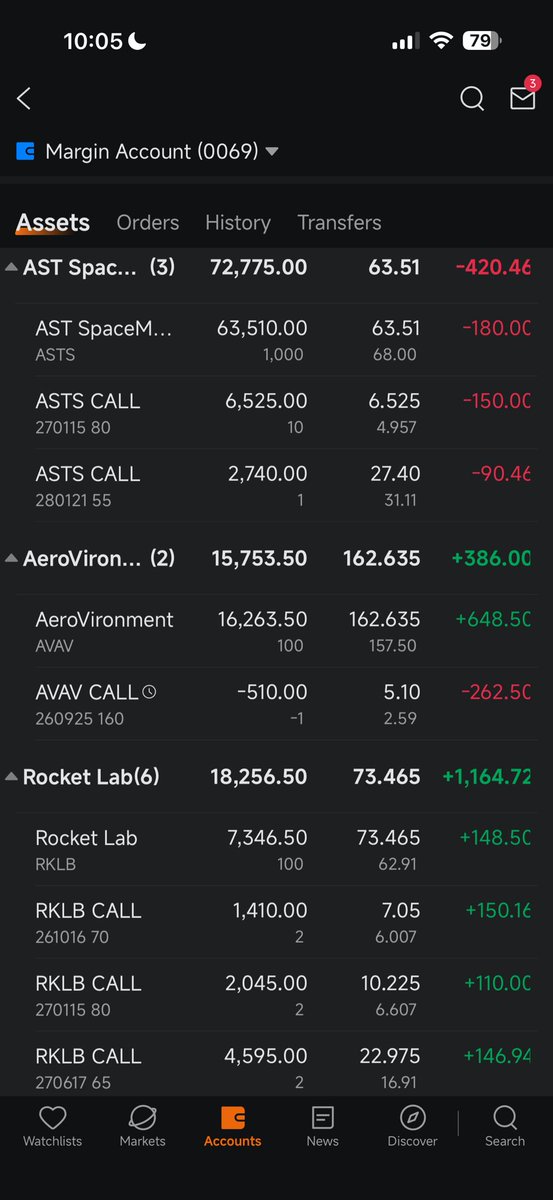
100k project update net value of account is roughly at 155k plus the 13k of Asts that is at another account taken profit for mstr and spacex and rklb leap call sell called Avav.
@SciGuySpace I would recommend against a new company trying to make Raptor 3.
While it appears simple on the outside (necessary to survive extreme heat without a heat shield), the inside has very complex geometry that can only be manufactured using highly modified 3D metal printing.
$RKLB disclosed it raised **~$1.944B gross** through its latest ATM by selling **~29.3M shares**, implying an average price of only **~$66.35/share**. That’s a major step down from its May 2026 ATM, where RKLB sold **~7.78M shares for ~$1.056B**, or roughly **~$135.6/share**. The proceeds help fund the Iridium acquisition and remove bridge-debt risk, but the tradeoff is clear: RKLB issued far more shares at a much weaker price. Now Iridium has to deliver real scale, EBITDA, and FCF to justify the dilution.
There are traits that reliably make you successful. There is no trait that makes you super-successful. Past a certain line — call it $100M+ — the deciding variable stops being you.
The traits are real and learnable: discipline, long attention span, tolerance for discomfort, the habit of finishing things, calibrated risk-taking, being easy to trust. Run those for twenty years and the odds of a good outcome — the strong career, the successful business, the eight-figure net worth — are genuinely high. This part of the game is close to deterministic. Traits compound like capital does.
But here's the problem with extrapolating that curve: traits are roughly normally distributed. Outcomes past $100M are power-law distributed. A normal input cannot produce a power-law output by itself. Something else has to enter the equation — and that something is luck.
Not luck as in "everything is random." Luck as in: variables that matter enormously and that you do not control.
Which decade you were born in. Buffett said it himself — born in Bangladesh instead of the US, none of it happens. Born in 1930 America, his exact skillset hit the greatest equity compounding era in history. Born fifty years earlier, the same brain runs a grocery store well.
Which wave you happened to be standing in front of. Gates was born in 1955 with access to a computer terminal at 13 — a few thousand people on earth had that combination. The founders of the internet era were the right age at the right time with the right obsession. Talent chose none of that.
Which coin flips landed. The hire that almost quit. The funding round that closed a week before the market shut. The competitor that made one mistake. Every $100M+ story contains five or six moments that could have gone the other way and ended it — and the person telling the story usually can't see them anymore.
The evidence is in the asymmetry: for every tail outcome, there are hundreds of people with equal traits, equal work, equal intelligence, who ran the same play and landed at merely successful. We just never interview them. Survivorship bias deletes the control group, and then we reverse-engineer the winner's habits as if habits were the differentiator. The habits got everyone into the room. The lottery picked who left with the building.
What follows from this, practically:
Work the traits relentlessly — they're the only part you control, and they're what makes you eligible for the draw. No traits, no ticket.
Maximize surface area for luck. More shots, more people met, more things shipped, more years in the game. You can't choose to win the draw; you can choose how many tickets you hold.
Don't judge yourself against tail outcomes. Measuring your life against a power-law winner is measuring yourself against a lottery result. The fair benchmark is: given my inputs, is my trajectory sound?
And don't copy the risk profile of the lucky. The tail winner who bet everything three times and survived is not evidence that betting everything is wise — the ones who did the same and died aren't writing books. Size to survive being wrong. Stay in the game long enough for a tail to possibly find you.
Traits make success nearly inevitable. Luck makes super-success possible. Confusing the two produces both arrogance in the winners and unearned shame in everyone else.
Do the work. Hold the tickets. Let the draw be the draw.
— Yaku · @YakuIsLearning
Addressing the strongest objection to this framework: "What about North Korea, pre-reform China, Cuba? Power didn't just remove players there — it smashed the whole private board."
Fair. And these cases are exactly the tail risk the framework already prices — the rare regime moment when the state reclassifies the entire structure as a rival. Measured in decades, not news cycles. Three realizations in a century. I don't deny them. Look at how the experiments ended.
First: abolishing private capital is not abolishing accumulation. In all three cases labor still created value, surplus was still extracted (the price scissors between state grain procurement and industrial goods was a textbook extraction mechanism), and surplus was still reinvested into expanded production. Every functional element of the board survived. Only the ownership column changed — the state became the sole capitalist. Critics inside the Marxist tradition itself called this "state capitalism" for exactly this reason. Power nationalized the board. It never deleted it.
Second: the legitimacy leash, proven by the strongest counterexample. China 1978 is the best evidence FOR this framework, not against it. A regime holding total power, with an explicitly anti-capital ideology, voluntarily re-invited capital — because suppressing market accumulation was strangling the growth its legitimacy required. The fist held every advantage and still had to reopen the board. Cuba has been reversing in slow motion: self-employment licenses, tourism JVs, remittances, dollar stores. North Korea held out — at the price of the 1990s famine — and even there, markets and a money-master class grew from below after rationing collapsed. The regime now tolerates and taxes them because it cannot feed the population without them. The purest suppression on earth runs on an informal capital circuit it officially denies.
Third: the board is global; the fist is territorial. Power can clear the board inside its borders, for a time. Capital crosses borders. Shanghai's capital kept compounding in Hong Kong and Taiwan. Cuban capital reassembled in Miami. The USSR at its peak sold oil into capitalist world markets and imported grain with the proceeds. At socialism's maximum extent — a third of humanity — the global board never stopped running for a single day. The holdouts eventually rejoined it on its terms.
Scoreboard over the framework's stated horizon: one case reversed and became the century's growth story. One is reversing gradually. One held out at famine-level cost and got markets anyway. Suppression is real — but suppression has a half-life.
So I'll amend my own line. Not "power has never destroyed capital." Rather: power has destroyed capital exactly three times — temporarily, territorially, at enormous cost — and every one of those regimes has either refunded the experiment or is still paying for it.
If that's the best case against the framework, the framework holds.
— Yaku · @YakuIsLearning
Take:https://t.co/YpfLUgtGvG
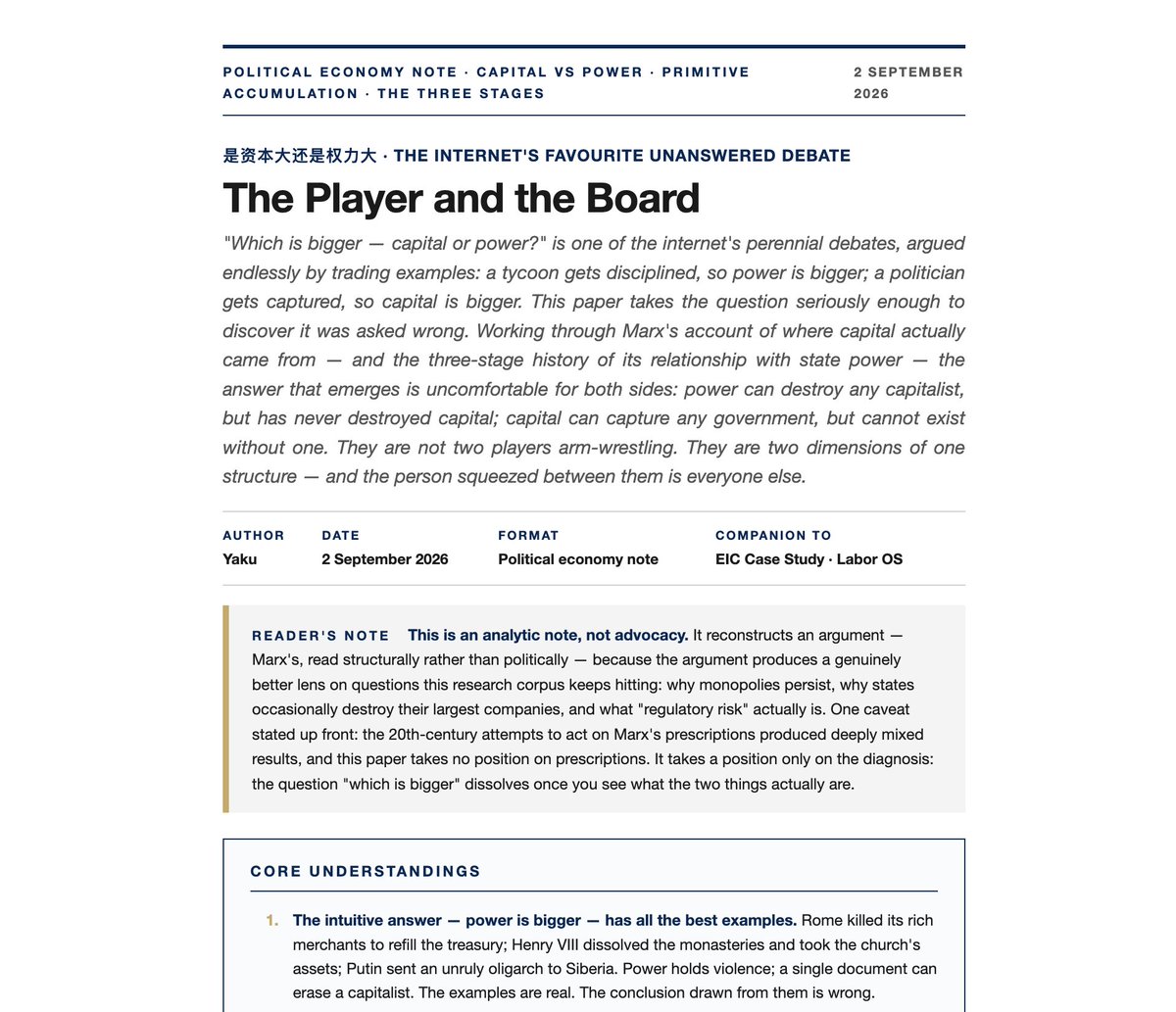
Which is bigger — capital or power?
One of the internet's most-posted, least-answered debates. It never rises above example-trading: a tycoon gets disciplined, so power is bigger; a politician gets captured, so capital is bigger. Each side holds its exhibits; neither convinces the other.
The intuitive answer favors power, and for a serious reason: power holds the violence. Rome killed rich merchants to refill the treasury. Henry VIII dissolved the monasteries and took the church's assets. Putin put a defiant oligarch in a Siberian prison. When the state wants a capitalist destroyed, one document suffices.
But push one layer deeper and you hit an uncomfortable wall:
Power has destroyed countless capitalists — and never once destroyed capital.
Khodorkovsky went to prison; Russia's oligarch structure survived intact, new oligarchs queuing where the old one fell. After 2008, Washington summoned Wall Street's CEOs for public humiliation, fined them, shamed them — then spent $700B of taxpayer money rescuing the banks that manufactured the crisis. Across nearly every "power crushes capital" episode in history, the same pattern: power hits the person. The structure that made that person rich is not touched. The player is replaced. The board keeps running.
To understand why, go back to the beginning — to Marx's question that economics textbooks never seriously ask: where did the capitalist's FIRST capital come from?
The textbook story: the diligent and thrifty saved their way to the first bucket of gold; the idle and wasteful ended up selling their labor. Inequality as natural selection. Marx called this the bourgeois creation myth, and the real history is the exact opposite. The first bucket of gold was not saved. It was taken. And the instrument of the taking was state power.
Enclosure: millions of farmers expelled from common land by Acts of Parliament, turned overnight into "free" laborers — free of everything except their hands. Colonial plunder: Spanish silver, East India Company extraction, the Atlantic slave trade — all channeled through state-chartered, state-armed vehicles into the original capital of the industrial revolution. No Royal Navy, no EIC monopoly. No Enclosure Acts, no Manchester mills.
Marx: capital arrives "dripping from head to toe, from every pore, with blood and dirt."
If the story ended there, "power is bigger" would be simply true. Capital was power's creature — it couldn't even be born without state violence clearing the ground.
But the story doesn't end there. Three stages:
Stage 1 — Power creates capital. Primitive accumulation. The state assembles the wealth, manufactures the labor force, drafts the legal shell. Absolute senior partner.
Stage 2 — Capital grows up. Once labor produces profit, profit funds investment, investment builds scale, and scale raises profit, the flywheel feeds itself. No more transfusions needed. The relationship flips from one-way dependence to mutual need: the state needs growth, jobs, taxes; capital needs property rights, contracts, labor discipline, bailouts. A dynamic alliance — cooperation without equality. And the balance shifts with every increment of scale: a company with a million employees can't be allowed to fail. A bank whose bankruptcy drags down the interbank market must be rescued with public money — even when it caused the crisis. A platform running society's payments and communications can't actually be destroyed. The child, raised by power, has grown to a size power can no longer casually kill.
Stage 3 — Capital shapes power. Election finance. Lobbying. The revolving door: Goldman partner → Treasury Secretary → back to Wall Street. Jurisdictional arbitrage forcing states to bid down their own tax and regulatory standards in the competition for investment. And the deepest lever: any government — whatever its declared ideology — must deliver growth to keep legitimacy, and in the world as it runs, growth means capital accumulation. A government that can't guarantee growth loses its mandate. So power serves valorization, whatever its speeches say.
The three stages aren't sequential. Every major economy today — whatever its system calls itself — runs all three at once. That's why the example-trading never settles anything: both sides are describing real, concurrent dynamics.
So which is bigger? The question is a trap.
It presupposes two separate entities. But capital and power are two dimensions of one social structure: one supplies the economic engine, the other the institutional frame; one makes wealth grow, the other keeps the growth from destroying the society hosting it.
Marx's line — the modern state as "a committee for managing the common affairs of the whole bourgeoisie" — is too strong at the literal level. States have real autonomy; they can and do strike particular capitalists. But structurally it holds: the state can regulate the speed, direction, and distribution of accumulation. It can execute a disobedient capitalist as a warning — 杀鸡儆猴. What it cannot do is terminate accumulation itself. Termination means no investment, no growth, no employment, no taxes — the regime's own material base, cut at the root.
The shepherd slaughters an unruly sheep — never because he opposes shepherding, but so the flock walks straighter.
That one sentence reconciles every example both sides have ever traded.
And for the majority squeezed between the two? Honestly: the answer changes almost nothing. In capital-dominant systems: platform extraction, algorithmic management, layoffs, and a government busy saving banks. In power-dominant systems: the same — plus the occasional public punishment of one capitalist, after which rents don't fall, conditions don't improve, and surplus extraction doesn't pause for a single day.
The structure's strongest defense isn't violence. It's disguise. Layoffs become "macro uncertainty." Stagnant wages become "supply and demand." Concentration becomes "the price of efficiency." Specific decisions by specific people inside specific arrangements, repackaged as weather — uncontrolled, unaccountable, unchangeable. Nobody gets angry at a typhoon.
But capital is not a typhoon. Marx spent his life arguing one sentence: capital is not a thing — capital is a social relation. It has a beginning, and the beginning was violent. What has a beginning is not an eternal natural law. What humans built, humans can in principle change. (How — that's the harder, more dangerous question. The 20th century's attempts produced deeply mixed fruit, liberation experiments and new oppressions both. No prescriptions here. The point is prior to any program: stop accepting a man-made arrangement as a natural order.)
What this refines in my framework:
比谁的拳头大, refined: the bigger fist wins the match — but the match is played on a board the fist did not make and cannot unmake. The fist rule governs players; the valorization rule governs the game.
The East India Company case, completed: 1858 was the ultimate "power beats capital" event — and the Crown destroyed the company while inheriting the entire structure: the trade, the taxation, the extraction, all continued under new management. The player was expropriated. The board was inherited.
Regulatory risk, correctly priced: if state strikes against capitalists are order-maintenance rather than anti-capital campaigns, then structures outlive their owners. Bet on boards, not players. A platform's moat survives its founder's fall. The tail risk worth pricing is not "the state dislikes this company" — it's the rare regime moment when the state reclassifies an entire structure as a rival. That's measured in decades, not news cycles.
Power removes players. Capital replaces them. The board runs on.
Whatever question you actually care about — political, economic, or investment — ask it about the board, not the players. The players are noise. The board is the signal.
— Yaku · @YakuIsLearning
Take in detail:
https://t.co/AlAHtPP60R
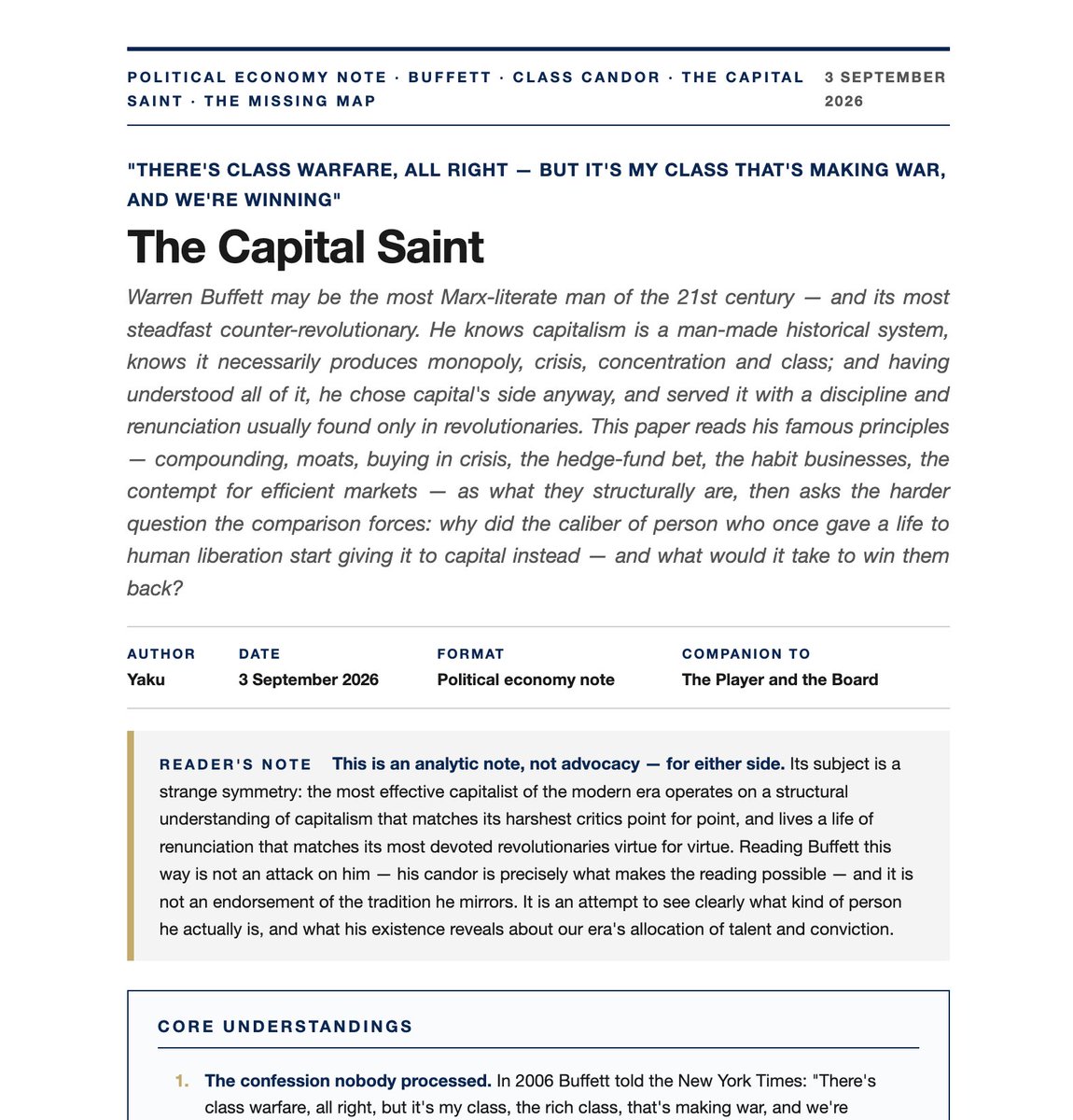
Buffett may be the most Marx-literate man of the 21st century — and its most steadfast counter-revolutionary.
In 2006 he told the New York Times: "There's class warfare, all right, but it's my class, the rich class, that's making war, and we're winning."
Ordinary defenders of capitalism can never say this. Their defense runs on three moves: naturalize the market ("it's inherently fair"), justify the outcome ("wealth flows to the most talented"), personalize the fortune ("mine is the reward of hard work"). Buffett performs none of the three. He concedes the market is not fair, concedes classes are real, concedes the winners hold structural advantages. He can afford the concessions because his position never depended on the story being true. It depends on the structure being durable — a very different thing.
That's the thesis: understanding a system is not the same as opposing it. Buffett grasps — as deeply as any critic — that capitalism is a man-made historical arrangement that necessarily produces monopoly, crisis, concentration, and class. He didn't choose capital's side out of ignorance of these facts. He chose it after fully understanding them. A self-aware counter-revolutionary — and self-awareness is armor. You cannot destabilize a man with facts he already trades on.
Walk his famous principles and each is a structural insight wearing folksy clothes:
Compounding — reinvest every profit, never consume the principal. Money whose sole purpose is to become more money; capital that must expand or cease to be capital. He ran this one loop for seventy years with almost no leakage.
Moats and pricing power — competitors can't enter, customers can't leave, prices can rise without losing anyone. He doesn't hunt excellent companies. He hunts companies excused from competition. Competition is for the companies he declines to buy.
Crisis — 2008, Wall Street liquidating to survive, and he puts $5B into Goldman on extraordinary terms. He knows what a bust actually is: not just destruction of wealth but redistribution of it. Small capital forced out, quality assets on sale, and whoever still holds cash buys the best at the bottom. What ordinary people experience as unemployment and foreclosure, the ready capital-holder experiences as a mass asset reorganization. He didn't theorize the mechanism. He monetized it.
The bet — $1M, ten years, an unmanaged index fund against hand-picked hedge funds. He won. The real lesson: much of elite finance income doesn't come from creating value but from occupying a position that collects fees whether clients win or lose.
The holdings — Coca-Cola, Kraft Heinz, tobacco-linked earnings. Products consumed daily, by habit, nearly impossible to quit. He offers no moral packaging — no "happiness," no "human progress." He values the brand, the distribution, and billions of ingrained habits. The question is never whether the product ennobles the customer. It is whether the customer can leave.
Efficient markets — "If markets were always efficient, I'd be begging on the street with a tin cup." Sixty years of returns built on markets mispricing. Here he and capitalism's harshest critics share one foundation: inequality is produced by the structure — by who owns what and who occupies which position — not by a few greedy bad men inside an otherwise fair machine. Same diagnosis. Opposite allegiance.
The candor — his secretary pays a higher tax rate than he does: she lives on wages, he lives on capital returns. Born in Bangladesh, he says, he'd have none of it. That's not humility. It's a structural statement: birth, institutions, and access to capital decide which game you're allowed to play, before ability is even consulted.
And then the part that makes him singular: the life.
The same Omaha house since 1958. McDonald's breakfasts and cherry Coke. A private jet he named The Indefensible, because even he couldn't justify it to himself. He doesn't consume the fortune — virtually all of it stays in the loop, compounding. What he worships is not what wealth buys but the growth of wealth itself. The old ascetic-accumulator personality, pushed one step past its origin: no God required. He doesn't accumulate to prove his election. He accumulates for capital's own sake — hours of annual reports every morning, tap-dancing to work, because watching compound growth unfold slowly and certainly through time is his joy and, functionally, his faith.
We have a phrase for people who give an entire life to a conviction: a battle-tested warrior of the cause. Apply the template and it fits without alteration. Buffett is a battle-tested capitalist warrior. A capital saint.
Which forces an uncomfortable comparison. The 20th century produced people of exactly this caliber — clear-eyed, iron-disciplined, indifferent to comfort — who gave everything to the opposite side. The Cambridge Five: the most brilliant graduates of their generation, holding everything the empire could offer, handing its secrets to socialism for laughably little money. Whatever you conclude about the act, they didn't do it for money. They believed. Einstein wrote "Why Socialism?" Helen Keller joined the Socialist Party. Picasso lent decades of prestige to the movement. King's final years turned against poverty, war, and the economic order itself.
One burned for the liberation of people. One burns for the valorization of capital. The flame's temperature is the same. The worlds it lights are opposite.
And seeing that symmetry exposes the deepest dilemma of the modern left — deeper than lost elections, harder than theory: it has been losing the ability to attract the Buffett-grade person. In the 1930s the best graduate of Cambridge might give a life to that cause. Today the same graduate goes to Goldman, McKinsey, or Silicon Valley. Not because people got more selfish — Buffett himself refutes that reading, living in his old house, leaving the billions in the loop. The question is where the discipline, intelligence, and sense of mission get deposited.
Why does capital keep winning the best people? Not theory — Buffett's own record footnotes the structural critique daily. Not ideals. The deficit is operational: capitalism may not tell humanity where it should ultimately go, but it is superb at telling every participant what to do tomorrow morning. Grow the number. Expand the company. Compound the capital. Measurable today against yesterday, every single day. Its rival currently offers the equivalently talented person no answer to one question: if I sit down at your desk instead — what exactly should I do tomorrow morning?
So tomorrow morning, Buffett sits down at the same old desk, opens the reports, and begins another day as capital's saint. He knows why he sits there. And on the other side of the world, nobody has yet built a compelling enough reason for someone of equal caliber to sit at a different desk — much less told them what to do there when they arrive.
The flame exists. The caliber of person exists. Only one side of history is currently handing out maps.
— Yaku · @YakuIsLearning
These are some of the questions I keep on asking for stocks I hold:
Is the market huge enough for 10x+ revenue growth?
Is the product actually better, or just hyped?
Are customers paying today, not just signing MOUs?
Is demand real, or is the company pushing supply?
Is the main risk execution, not lack of market?
Can gross margins improve with scale?
Does the company have enough cash to reach the next milestone?
Is dilution funding growth, or just survival?
Are bears focused on real problems, but maybe underestimating progress?
Does each quarter make the thesis clearer?
I think Warsh basically confirmed the tension I was worried about before he spoke.
The market didn’t take his Jackson Hole speech as full panic, but it definitely leaned hawkish. The key signal was that he pushed back on the idea that inflation is already fixed, and also pushed back on the idea that financial conditions are restrictive enough.
That matters because my concern was never just “will he hike or not.”
The real issue is that strong AI capex + sticky inflation makes the rate-cut narrative much harder. If the economy is still absorbing huge capital through data centers, power, chips and financing, while inflation is not clearly moving back to 2%, then the Fed has less reason to give the market cheap money.
That’s why the 2Y yield moved higher and September hike odds repriced after the speech. The market is basically saying: rates may have to stay tighter than risk assets wanted.
For BTC / QQQ, I still think this is the main tension:
AI fundamentals can be strong, but liquidity can become less friendly at the same time.
Could be wrong, but this is exactly why I wanted more cash before the event. Not because I had perfect conviction on the outcome, but because the range of outcomes was wide and the market was too dependent on one Fed reaction function.
Sometimes the disciplined trade is not forcing exposure when the macro signal is unclear.
100k project update: holdings and an updated value of roughly 140k, up 40% since the project started. Loaded up on calls and sell puts like I said I would. Furthermore, this week's valuation, heavy cash on hand, and account have gone up and down. There as some $SPCX and $ASTS that’s not yet transferred here yet. Comment and let me know if I should update the account twice a week
I think the AI trade is becoming more complicated than just “ $NVDA beat = risk-on.”
The numbers are obviously strong, and it’s hard to argue AI capex is slowing right now. But the part I’m trying to think through is the second-order effect: if Microsoft/Meta/Google/Amazon keep spending aggressively on data centers, power, chips, and financing, then capital demand in the economy stays very strong.
That may be good for AI earnings, but it’s not automatically good for the rate-cut narrative.
With PCE still around 3.7%, the Fed’s problem is pretty awkward: if growth isn’t really breaking, AI capex is still absorbing huge capital, and inflation is not moving cleanly back to 2%, what exactly is the justification for cheaper money?
This is why I wanted to say this before Warsh speaks today. The market is waiting for him to clarify the reaction function: does sticky inflation matter more, or does the Fed treat already-high long-end yields as enough tightening?
If he sounds clearly dovish, risk assets can probably breathe. But if he leans into inflation, or even just gives no clear framework, the market may demand a higher risk premium.
I don’t have strong conviction on the exact outcome, which is precisely the point. When the range of outcomes is wide and the market is positioned around one speech, I’d rather respect the uncertainty than pretend I know.
So for me, that means holding more cash, reducing exposure, and waiting for the signal instead of forcing a trade.
For BTC / QQQ, I don’t think the only question is “are earnings good?” anymore.
The more important question may be: does strong AI + sticky inflation force the market to reprice rates higher again?
Could be wrong, but this feels like the main tension right now:
AI can be fundamentally strong, while the liquidity backdrop becomes less friendly at the same time.