Outerloop 0.1.0 is out. A fleet of AI agents that improve your benchmarks on your code. Agents propose changes, run them on your cluster, and open pull requests when the metrics improve. We are open source. Let's embrace open science! Get started at https://t.co/tkGdjrUR9F
Hot take: In-context learning is powerful, but one forward pass over the context is not enough.
Introducing Context Tuning: efficient LLM adaptation by refining memory representations rather than model weights, empowering ICL with inference-time optimization.
📍Tomorrow at @icmlconf! Jul 8 (Wed), 5 PM, Hall A #2510
📎https://t.co/r7wTBOlgei
Agentic Learning AI Lab @agentic_ai_lab presents at #ICML2026 in Seoul✈️🇰🇷 Come check out our latest research!
📍Main Conference Papers
Temporal Straightening for Latent Planning
Tue Jul 7 10:30am Hall A #1509
Context Tuning for In-Context Optimization
Wed Jul 8 5pm Hall A #2510
📍Workshop Papers
The Surprising Effectiveness of Deleting Weights in LLM Reasoning and Adaptation
Fri Jul 10 Rm 318 | Foundations of Deep Generative Models Workshop
Seeking the Unfamiliar but Memorable: Conceptual Creativity as Meta-Learning
Sat Jul 11 Rm 401 | Human-AI Co-Creativity Workshop
Aligning LLMs with Human Uncertainty: A Beta-Bernoulli Calibrator for LLM Forecasting
Sat Jul 11 Gr. Ballroom 104–105 | Forecasting as a New Frontier of Intelligence Workshop
Alive and Predicting: A Live Evaluation of Multi-Step Forecasting Agents
Sat Jul 11 Gr. Ballroom 104–105 | Forecasting as a New Frontier of Intelligence Workshop
See threads below for details!🧵👇
Warm take: Your world model should never stop learning
Introducing AdaJEPA, an adaptive WM that plans, acts, and adapts in a closed loop. Every action leads to a new observation, and every transition refines the latent representation and prediction.
📝: https://t.co/85WWwn5QDS
🧐Can we use the wisdom of crowds to calibrate LLM forecasters?
Introducing Beta-Bernoulli Calibrator (BBC): besides realized outcomes, we also learn from human forecast distributions, which reflect both crowd beliefs and consensus.
🔗https://t.co/dLz8ewMraw
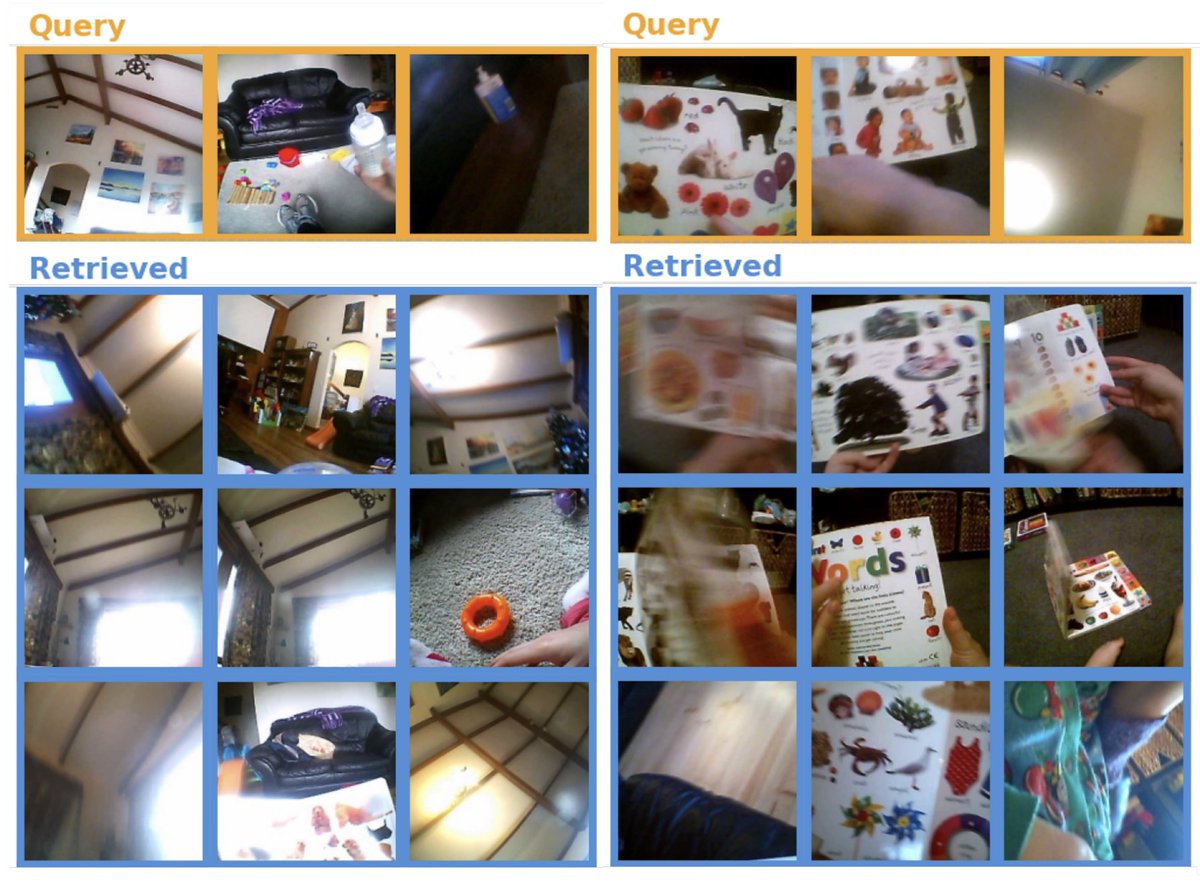
Children do not learn language by repeatedly shuffling and revisiting years of experience hundreds of times.
Can grounded word learning emerge from a single chronological stream of visual and verbal experience?
Introducing BabyCL. (1/6)
We visualize nearest neighbor event segment retrieval with the learned visual representations. BabyCL learns to group semantically similar scenes. (5/6)
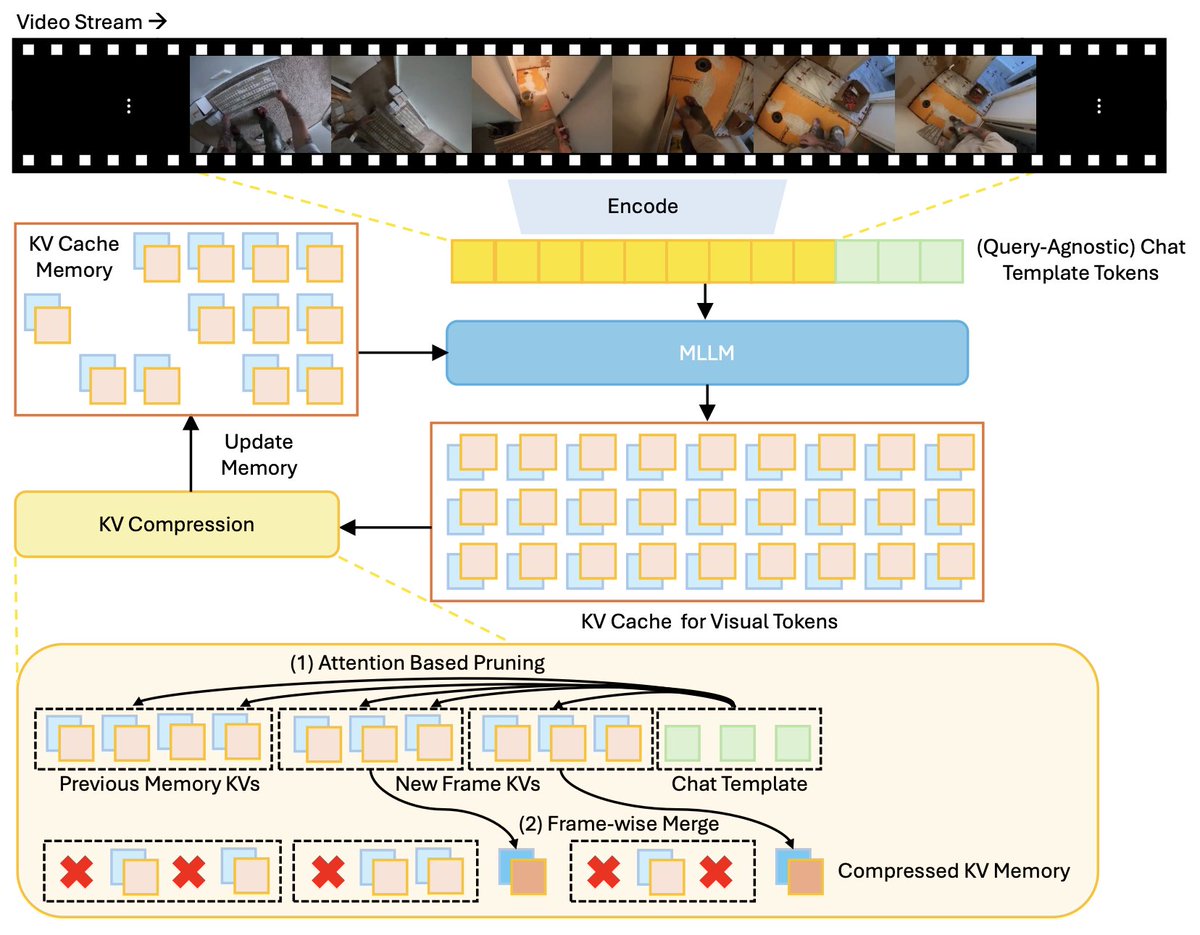
Attention-based KV cache pruning usually assumes access to the user query.
But what if the query hasn’t been asked yet, or we need to support many future queries without repeatedly re-pruning the video?
We found a surprising result: Very different text queries induce remarkably similar attention patterns over video tokens.
As a result, generic prompts like “What is happening in the video?” or even the model’s chat templates tokens “e.g. <|im_end|><|im_start|>assistant\n” can act as effective proxy queries for KV cache pruning. (1/6)
The StreamMem pipeline incorporates input frame filtering, attention-based KV pruning and merging, and YaRN context window extension. It achieves competitive performance with methods that rely on significantly larger memory budgets. (5/6)
Excited to be at #CVPR2026! I’ll be presenting two workshop posters tomorrow (6/4):
🔹“Continual Visual and Verbal Learning Through a Child’s Egocentric Input” at the CV for Children Workshop (Morning)
🔹“StreamMem: Query-Agnostic KV Cache Memory for Streaming Video Understanding” at the VidLLMs Workshop (Afternoon, 3:40–5:00 PM)
Looking forward to meeting people working on continual learning and multimodal learning!
More details about these works to follow.