😉 Ce que vous ne verrez pas dans la presse :
➡️ Stabilité des jeunes en bonne/excellente santé (80%) et de satisfaits de leur vie actuelle (70%)
↘️ Baisse du sentiment de solitude et pensées suicidaires
↗️ Forte hausse du bien-être mental (+12 pts !)
https://t.co/GUC7Tn8ncA
🌟 Out in Clinical Psychology Review after years in the making:
Pleased to share the 1st meta-analytic network analysis (MAGNA) investigating core maintaining features of anxiety symptoms pooling 156 networks (N = 303,151).
W/Belli, Tichelaar, @SachaEpskamp, & O'Driscoll.
🧵:
A beautiful day to start with Bayesian estimators in intensive longitudinal models this morning and network models for risk and resilience this afternoon @PsychScience#APS26BCN
🗣️ Il faudrait « éduquer » les gens sur la santé mentale pour qu’ils changent d’avis, d’attitude, de comportement et ne stigmatisent plus. On dit aussi « augmenter la littératie ». C’est peu plus compliqué ça…
https://t.co/CF8aItp1mD
Frustrated with DSM?
Interested in @HiTOP_system as a potential alternative?
Check our latest, led by J Tiego, using a bottom-up approach in a transdiagnostic twin sample evaluating the validity & heritability of the HiTOP model:
https://t.co/2tM67qsSSR
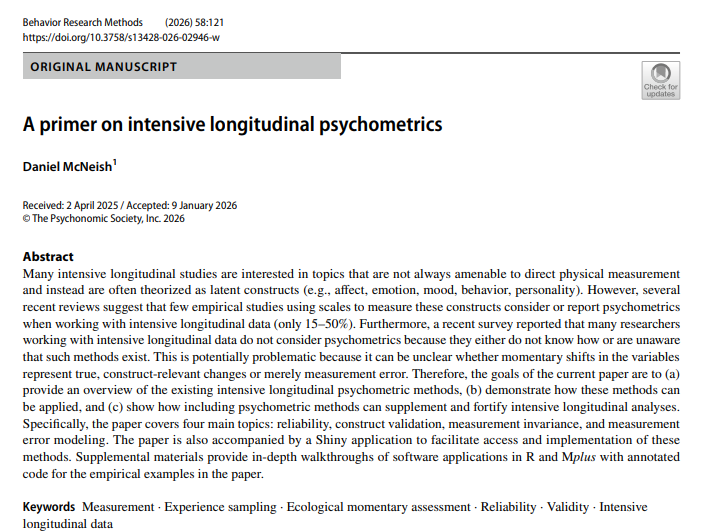
BIG NEWS: Our paper "Generative Psychometrics via AI-GENIE: Automatic Item Generation and Validation with Network-Integrated Evaluation" is now ACCEPTED AT Behavior Research Methods!! Link to the updated pre-print below! #psynomBRM#GenerativePsychometrics
The AI-GENIE package for automatic item generation and structural validation using LLMs and Exploratory Graph Analysis methods is now updated on GitHub!
Link below!
I'm a bit annoyed that NYT has settled on the title “Here’s What Psychiatrists Mean When They Say You Have A.D.H.D.” (presumably because it got more engagement) rather than the prior title “We’re Thinking About Mental Health Diagnoses All Wrong,” because the piece isn't really about ADHD. It's just an example I used in one passage.
Working with ABCD data? Using the CBCL? Check our latest led by @kane_pavlovich w. @constable_toby & J Tiego.
Diving deep into the psychometric properties of the CBCL, we find that widely assumed latent structures are not valid in the ABCD sample.
https://t.co/l5dAXgTxVu
When patients ask, “What disorder do I really ‘have’?” the honest answer is usually more interesting and messier than a single label. I wrote for the @nytimes on what I wish people understood about diagnoses and the nature of mental health problems.
https://t.co/ua2g6PzeAZ
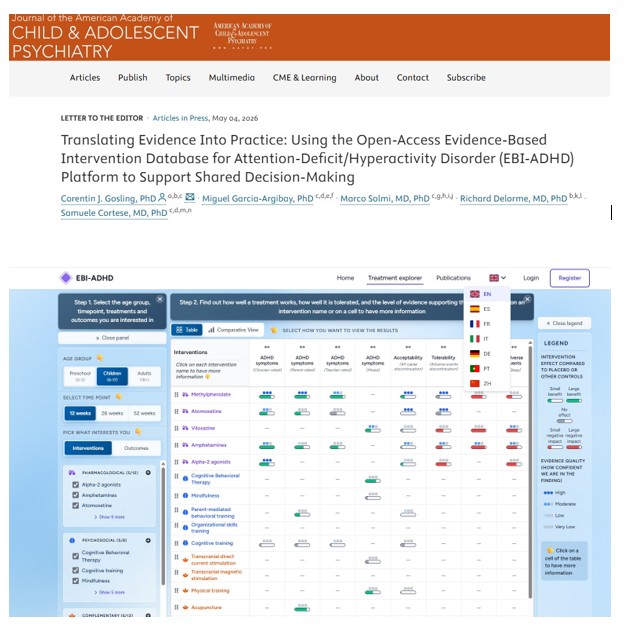
Out in @JAACAP
"We are pleased to introduce the Evidence-Based Intervention database for ADHD (EBI-ADHD: https://t.co/IEujfRXedd), a new and open-access online resource for the clinical and research community in child and adolescent psychiatry."
https://t.co/QZoJFdtj23