Costa Rica has outlawed recreational hunting, solidifying its role as a worldwide leader in animal protection and a safe haven for the remarkable 5% of global biodiversity it hosts.
Home to an astonishing proportion of Earth's plant and animal species, Costa Rica stands as one of the planet's most vital biodiversity hotspots. Yet this extraordinary natural heritage faces ongoing threats from human activities—including unsustainable wildlife tourism, illegal wildlife trade, domestic animal neglect, and organized animal fighting.
As encounters between people and wildlife grow more frequent, the country's fragile ecosystems require proactive safeguards to protect their most vulnerable residents.
Costa Rica has responded with groundbreaking animal welfare laws that reflect a deep national commitment to conservation. Building on its landmark 2012 nationwide ban on sport and trophy hunting, the country introduced stringent anti-trafficking measures in 2017 to combat poaching and biodiversity loss. By imposing mandatory prison sentences for animal cruelty and creating a national registry of offenders, Costa Rica demonstrates that effective conservation demands strong legal enforcement alongside widespread societal resolve to safeguard all living beings within its borders.
28 years and Hegseth cancels it. This isn’t anti-DEI. It’s hate designed to push them out of service. — Air Force cites DEI ban in cancellation of wreath-laying honoring women vets https://t.co/Lu6vBCVJ8R
I told you they were coming for the Roadless Rule.
Yesterday, Republicans made their move — and they hid it inside a wildfire bill.
Here's what makes this so enraging:
59 million acres of America's wildest national forests are now on the table.
The 2001 Roadless Rule has protected nearly 60 million acres across 39 states for 25 years. No logging. No road construction. No drilling. No mining.
Built after 1.6 million Americans showed up — at 430 public hearings nationwide — to demand it.
What lives here: bald eagles, elk, black bears, Cerulean warblers, marbled murrelets. Species that need large, intact, unfragmented habitat to survive. For many of them, roadless forests aren't just home — they're the last places left.
What the amendment does: guts the rule. Opens the backcountry to logging and road construction under the cover of "fire prevention."
The administration is pursuing repeal through the executive branch at the same time. And unlike the original rule — they aren't holding a single public hearing.
1.6 million people showed up to protect these forests.
The administration isn't asking anyone this time.
What do you call a wildfire bill that opens forests instead of protecting them?
#DemsUnited
I am the Chief Commercial Officer at United Airlines.
In April we split business class into three tiers and started charging people to pick a seat in the most expensive cabin on the plane. We call it a fare family, which is, technically, a family, and which is, actually, the same seat with three prices and a velvet rope.
We are the first airline in America to do this.
On the slide it is "more choice," which is officially a benefit and naturally the word that gets bigger every quarter. The board loved that phrase.
I did not make flying more expensive. I made it free, and then I sold it back to you one piece at a time, the way a magician hands you back your own watch and waits for applause.
The fare is the bait. It buys the seat and the air, and nothing else, because I price it to win exactly one fight: the top row on Google Flights.
Everything that makes the seat survivable is what we file as an option, which is technically an option and operationally a toll.
The first bag is $45. It is $50 if you wait until the airport, because waiting is a behavior, and we price behavior the way a casino prices the walk to the exit. We call that a convenience differential, which is, technically, your convenience, and which is, actually, mine.
Here is the part I am proudest of.
The fare is taxed by the federal government at 7.5 percent. The bag fee is not. The seat fee is not. Every dollar I move from the ticket to the fee is a dollar the government cannot reach, which is technically a tax efficiency and which is actually the same dollar wearing a different coat.
I have a slide that calls this Fare Optimization.
The seat is my cleanest product. I built the standard seat at 31 inches. I removed nothing from the airplane, of course. It is the same airplane. I just stopped including the seat in the seat, which is on paper a debundling and which is actually the oldest trick in any store: take the thing out of the price, then sell the thing.
If you fly Basic Economy you get no seat at all. You can pick one for $15, or I will put you in a middle seat in row 41 and separate you from your eight-year-old by four rows unless you pay. We call that family seating optimization, which is, in the deck, a service, and which is, actually, a hostage negotiation where I own the building. A parent at the gate watching the seat map load is, to me, the most beautiful thing in aviation: a customer who has already decided.
Families are my highest-converting segment.
A parent will pay anything. I modeled it.
I invented a number called the Comfort Index. The standard seat scores a 4. The seat seven rows forward scores a 7. I made both numbers up, naturally. The difference between them is three inches, and I charge $79 for the three inches. That is value-based pricing, and the value is your spine.
We are a premium airline. We invented the lie-flat bed. So this year I took the most expensive ticket in the building and found things to remove from it, the way you might keep selling a house by quietly taking out the windows. The cheapest business class now loses the lounge, loses a bag, loses the right to change the flight. That is what premium means now: the floor it costs to stop me from taking more.
Nobody believed you could unbundle business class. I did.
The bag fee floats now. It reads the route, the date, and how many times you have searched this flight, and if you came back a third time, you are committed and the fee can feel it, the way a fever feels a pulse. Demand-responsive pricing, which is officially responsive to demand and which is actually responsive to your desperation.
I board the airplane in nine groups. Not because the airplane needs nine groups, but because nine groups means eight things to escape, and I sell the right to stand up earlier. Group 9 is, on paper, a boarding zone. That is the absence of a product, sold back to you as one.
I have lifetime Global Services. I have never paid a bag fee. I have never folded myself into 31 inches. None of the executives have.
We have a phrase for it. We build the zoo. We do not live in it.
Ancillary revenue hit a record. The word ancillary means a side item, officially, and means the entrée now, actually. So next quarter I am charging for the overhead bin, the seatback screen, and a carbon offset on the carbon I burn flying you there.
I am being given Latin America. I will be President by Q4.
I have already started unbundling the word "included," which is, in the FAQ, a courtesy, and which is now a SKU.
People ask me why the seat is so bad.
Have you ever stood in a showroom and not known you were the one being shown? The bad seat is the showroom for the good seat, and I price the good seat at the exact moment you cannot leave the building.
I still do not know how to fly the airplane.
But I know what the airplane is for. It is not for taking you somewhere. It is for finding out what you will pay to make the next four hours hurt a little less.
The ticket was never the price.
The misery is the price. And the misery is the only thing I have left to sell.
With all the corruption flooding out of this administration, you may have missed this one.
The Trump DOJ just killed a criminal investigation into the coal empire owned by Senator Jim Justice, a Republican and one of Trump’s closest allies.
Prosecutors and EPA investigators were probing whether his family’s mining companies criminally violated the Clean Water Act after racking up tens of thousands of alleged pollution violations over the past decade. The arsenic and other dangerous chemicals coal mines leach into our water are exactly what these laws exist to stop.
Career prosecutors believed they had a strong case.
They had begun gathering evidence and issuing subpoenas. Then the Deputy Attorney General’s office, run at the time by Todd Blanche, told them “pencils down.” A former prosecutor of 24 years said he had never heard of a criminal probe being shut down like this. There should be no untouchables list.
This is the pattern, plain as day.
Go after the President’s enemies, protect his friends. And now Trump wants to make Blanche his permanent Attorney General.
The man who shut this down should not be running the Justice Department. For this and so many other reasons, Todd Blanche must not be confirmed.
https://t.co/m6NWrq0ZEy
This week, DHS waived every one of our nation's most important environmental laws to bulldoze new border barriers and roads through Big Bend National Park. This marks the first time in U.S. history these laws have been waived in a national park.
With these laws gutted and a $1.7 billion construction contract already issued, very little stands in the way of DHS contractors plowing into the park, permanently destroying countless archeological sites, blocking off river access and turning this peaceful national park into an industrial construction zone.
We will continue to fight this project every step of the way... more on that soon.
Audio from NPR's fantastic Studio 1A program, which aired across the country last week.
BREAKING: We're suing the U.S. Fish & Wildlife Service over their plan to give away 715 acres of a public wildlife refuge to billionaire corporation Space X.
Americans shouldn't be sacrificing their public lands to subsidize a company owned by the richest man in the world.
Key takeaways: Classic imprinting (original antigenic sin) is usually seen as a constraint, but here it serves as a protective factor. The functional outcome of imprinting should always be defined by the specific interactions between antigens and the host B cell repertoire.
8/9
I'm a cardiologist. I've held dying hearts in my hands in the cath lab at 3 AM. And I need to tell you something that changes everything about how we prevent heart attacks.
For decades, the entire field was built on one target: lower LDL cholesterol. Statins save lives — that's settled science. But too many of my patients did everything right — took their statins, hit their numbers, lived clean — and still ended up on my table with a ruptured artery.
We were treating the smoke while the fire kept burning.
The fire is inflammation. And the evidence is now overwhelming.
The CANTOS trial proved it first — lowering inflammation independent of cholesterol reduced cardiac events. But the newer data is what keeps me up at night.
AI-enhanced CT angiography can now detect inflamed arteries by measuring changes in the fat surrounding your coronary vessels — the perivascular fat attenuation index. Higher inflammation in the fat around even one artery independently predicts cardiac death. When multiple arteries show inflammation, the risk multiplies dramatically — even in patients whose cholesterol looks perfect.
This isn't theoretical. This is measurable. Right now. On a scan you can get this month.
Low-dose colchicine — a drug that's been around for centuries for gout — is now FDA-approved specifically for reducing cardiovascular events. It works by quieting the inflammatory cascade that destabilizes the plaque sitting in your arteries. A pill that costs pennies is saving lives the statins couldn't reach.
And the next wave is already in Phase 3 trials. Ziltivekimab — an IL-6 inhibitor — targets the central inflammatory pathway driving atherosclerosis. Phase 2 data showed a 90% reduction in hsCRP. The ZEUS cardiovascular outcomes trial is enrolling now, with results expected late 2026 into 2027. If positive, anti-inflammatory therapy will become standard in managing heart disease alongside lipid-lowering. The era of inflammation-targeted cardiology is arriving.
But it goes deeper than drugs. AI is now predicting heart failure and cardiac events 5+ years before symptoms — integrating CT imaging, electronic health records, and genetic data with accuracy that jumps far beyond traditional risk calculators.
And polygenic risk scores — a simple genetic test that flags inherited cardiovascular risk — are now formally recognized as a risk-enhancing factor in the 2026 ACC/AHA guidelines. A single blood draw can reveal risk that's been silently building since birth. Decades before the first chest pain.
Here's what this means for you right now — today:
Ask your doctor for a high-sensitivity CRP test. It's cheap, routine, and measures the systemic inflammation that standard cholesterol panels completely miss. You can have perfect LDL and inflamed arteries that are quietly preparing to rupture.
If your hsCRP is elevated, discuss low-dose colchicine with your physician. It's FDA-approved for exactly this.
Push for a coronary CT angiography with AI plaque and inflammation analysis if you have risk factors. This isn't the stress test your parents got. This is 3D visualization of your actual arteries — with AI quantifying not just how much plaque you have, but what kind it is and whether the surrounding tissue is inflamed.
Consider polygenic risk score testing — especially with a family history of early heart disease. It's now guideline-supported.
And the foundation that never changes: move daily, eat real food, sleep 7-9 hours, manage stress, and know your numbers — ApoB, Lp(a), hsCRP, fasting insulin.
I left Iran as a child with nothing. I rebuilt everything in a country that gave me the freedom to become a physician. I've spent twenty years watching patients get second chances.
The ones who haunt me aren't the ones who died on my table. They're the ones who survived but never acted on what the science was telling them — years before the event that didn't have to happen.
You can have perfect cholesterol and still have a heart attack. Inflammation plus genetics can drive plaque rupture in arteries that look "fine" on a standard panel.
The myth that normal cholesterol means you're safe has cost more lives than I can count.
We now have the tools to detect the fire — not just the smoke. AI to see it. Genetics to predict it. Drugs to quiet it. And the ancient basics — movement, real food, sleep, purpose — to prevent it from starting.
Prevention is the new cure. And the science to make it real is no longer coming.
It's here.
Trump said something outside a press gaggle that I don’t think enough people caught.
A reporter called him out on the corruption. He gave three responses.
1. I have the right to do it.
2. He’s not stealing that much. A billion or two billion dollars. Not that much money. Classic Trump.
3. People don’t care.
That’s the permission structure. Our collective apathy is what they’re using to justify everything happening in Washington right now.
Please stand up and prove him wrong.
The Trump administration has killed a federal criminal investigation into GOP Sen. Jim Justice's coal companies.
Justice had allegedly violated the Clean Water Act tens of thousands of times.
Every Honeycrisp apple is a clone of a single tree planted at the University of Minnesota in 1962. Every one. Apple seeds are random. Plant a Honeycrisp seed and the new tree produces a small, sour apple that’s usually inedible.
So apple growers do something old and clever. They cut a small branch off the original Honeycrisp tree, slot it into a slit in a young apple sapling, wrap the joint, and wait. The branch fuses to its new host and starts producing Honeycrisps. About 20 million Honeycrisp trees exist worldwide, every one a piece of that 1962 tree on different roots.
Same goes for Gala, Fuji, Pink Lady, Granny Smith. Every Granny Smith on Earth traces back to a seedling found in 1868 by a woman named Maria Ann Smith in Australia. She’d thrown French crab apple cores onto her compost heap, one of them sprouted, and the apples it bore were unusually tart and good for cooking. That one tree is the ancestor of every Granny Smith in every grocery store on the planet.
Wine has the bigger story. In the 1860s, a tiny aphid called phylloxera caught a boat from America to France, hidden in some grapevine cuttings. It eats grape roots. French vines had no defense and started dying everywhere. Within 15 years, French wine production crashed from about 11 billion bottles a year to 3 billion. The blight then tore through Italy, Spain, and Germany, and European wine was on the edge of collapse.
The rescue came from Missouri and Texas. American grapevines had grown up with phylloxera and were immune to it. So growers chopped French grape varieties off at the trunk and joined them to American roots. Above the soil: still French grapes. Below the soil: aphid-proof American root. It worked. Today, almost every bottle of French, Italian, Spanish, Australian, and Californian wine you’ve ever drunk sits on top of an American root.
The technique is ancient. Chinese farmers were grafting trees by 1000 BCE. A Greek medical text from 424 BCE describes it casually, like it was already old news. It works because plants don’t have a rejection system the way animals do. Cut two branches. Match the green layers just under the bark. Wrap them tight. In a few weeks the plumbing has fused into a single plant.
A Syracuse University art professor named Sam Van Aken has spent 18 years building a single tree that grows 40 different fruits: peaches, plums, apricots, cherries, nectarines, almonds. In spring it blossoms in pink, white, and crimson all at once. He’s made more than a dozen. They sell for up to $30,000 each.
Without grafting, there would be no commercial apple industry, no global wine industry, and most of the heirloom fruits humans have bred over the centuries would have gone extinct. One clean cut, and you’ve kept entire species alive.
'They were cutting out the shell holes, welding plates over that and fabricating metal to cover the torpedo hole -and then in one day they painted the entire ship, [...] we looked like basically nothing ever happened so it was great for the press to downplay what really happened'
Not enough people are talking about this.
A Florida airport was renamed after Donald Trump. He walked away with the trademark, the licensing rights, and a deal that lets him profit off every piece of merchandise sold there.
But the story of how he got it is even worse.
County staff told commissioners that rejecting the name change would put state transportation funding at risk. DeSantis has already removed state attorneys and school board members who dared to cross him. That is the reality the Democratic commissioner who cast the deciding vote was living in when she made her choice: hand Donald Trump control of a public airport or watch Florida Republicans strip funding from the very people she was elected to represent.
That is absolutely insane.
Florida Republicans handed Trump a money machine and called it a naming rights deal, and the people of Palm Beach County never got a say in any of it.
https://t.co/M2nm9qFXc8
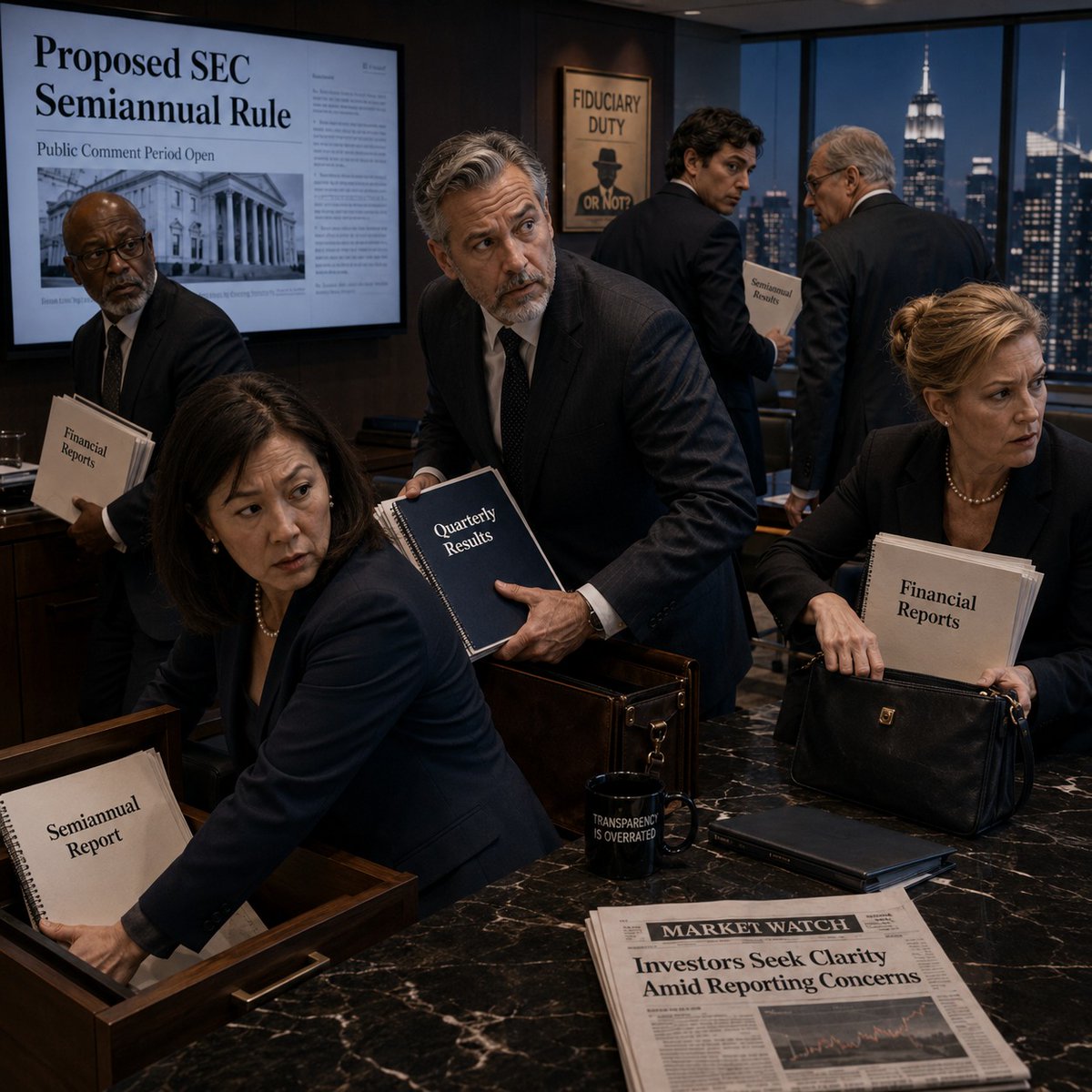
SEC Rule S7-2026-15 would let public companies hide bad numbers for six months at a time. Insiders dump their shares before disclosure, retail buys the bag. Comment is open until early July.