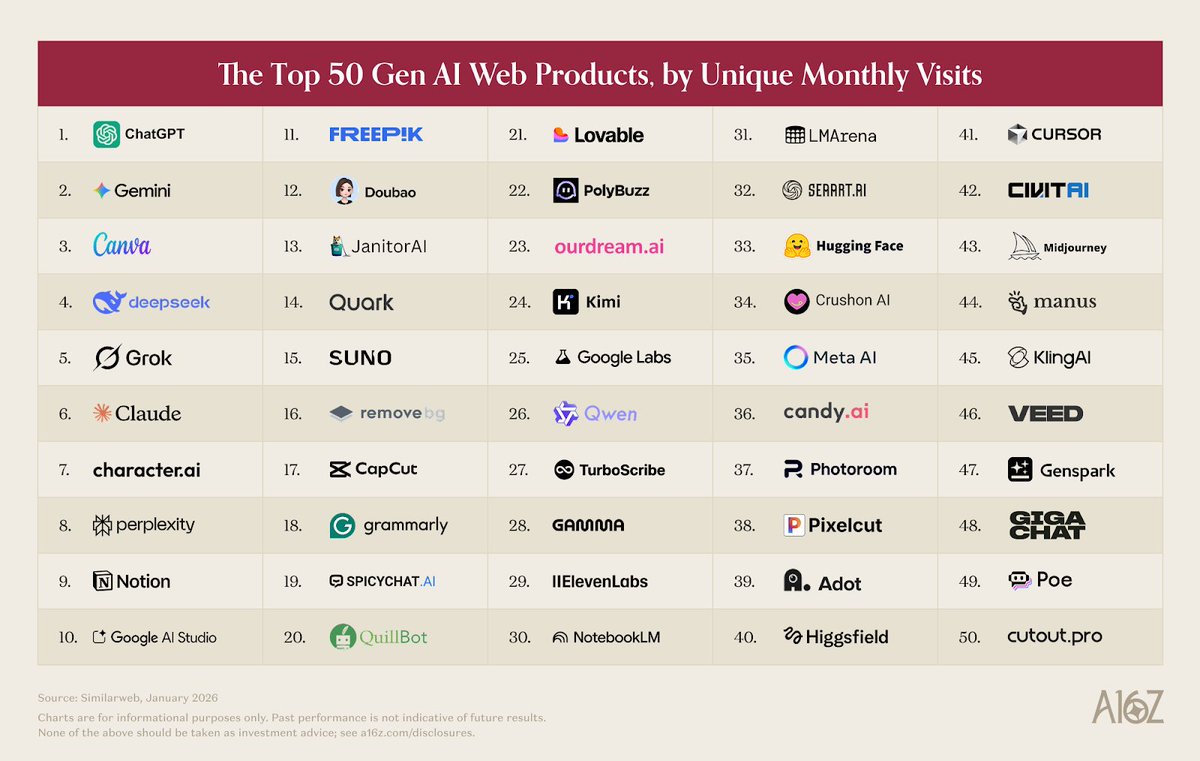
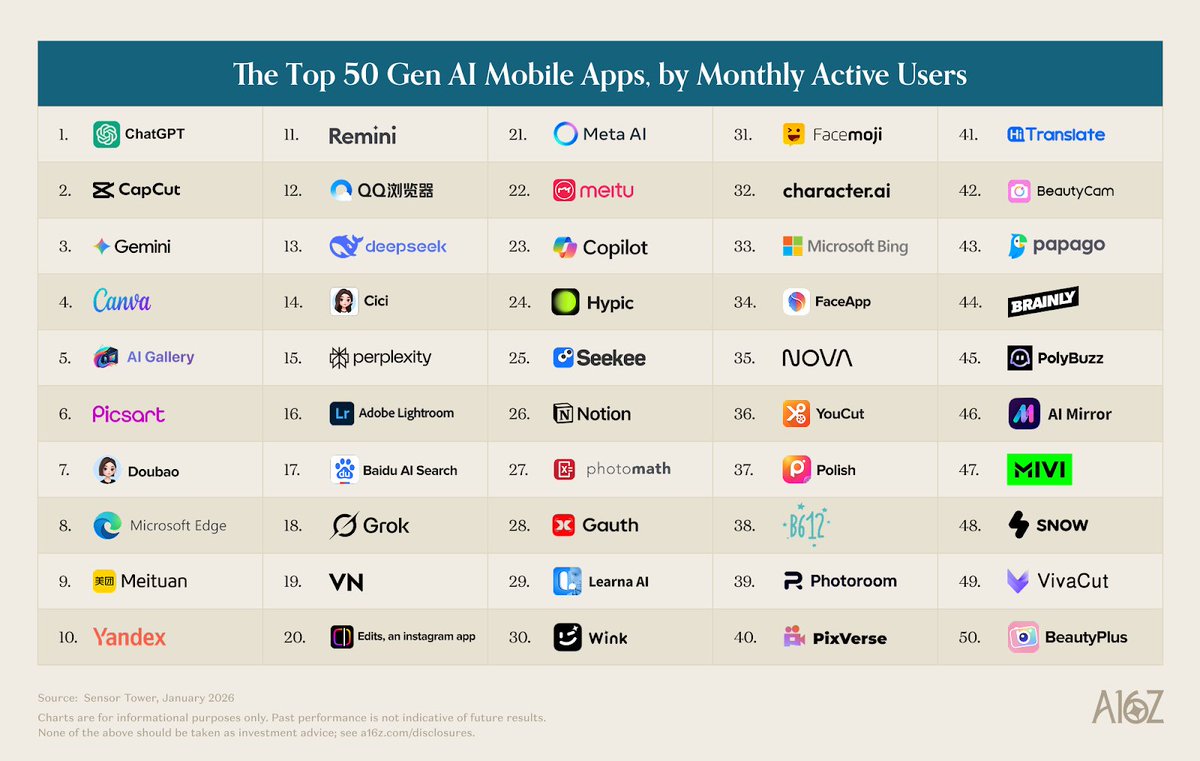
🚨 The @a16z consumer AI Top 100 is back!
For the sixth time, we ranked consumer AI websites and mobile apps by usage (monthly unique visits and MAUs).
This edition, we changed the rules. Here's why - and what the new list says about where consumer AI is heading 👇
The math on Apple’s AI play is insane.
The four hyperscalers are spending $700 billion on AI infrastructure in 2026. Apple spent $12.7 billion on total capex last year. The gap looks like Apple lost.
But run the numbers differently.
Apple has 2.5 billion active devices as of January 2026 and $157 billion in cash. The hyperscalers are burning through free cash flow so fast that Amazon is projected to go negative on FCF this year. Alphabet’s free cash flow is expected to drop 90%. These companies are borrowing against future revenue that doesn’t exist yet to buy GPUs that depreciate every 18 months.
Meanwhile, API pricing has dropped 97% since GPT-3 launched. Every dollar the hyperscalers spend training proprietary models gets commoditized faster than they can recoup the investment. Apple’s internal leadership reportedly views LLMs as commodities not worth proprietary development costs. That read looks increasingly correct.
This tells you everything about distribution economics vs infrastructure economics. OpenAI has committed $1.15 trillion in infrastructure deals through 2035. Apple already has the thing OpenAI would trade all those GPUs for: 2.5 billion devices with system-level integration, payment credentials, health data, and app ecosystem lock-in. That distribution can’t be replicated at any price point.
The hyperscalers are betting that building the best model wins. Apple is betting that models become cheap and distribution becomes everything. One of those bets requires $700 billion a year and growing. The other requires a software update.
If models commoditize, and pricing trends say they will, the entire AI capex cycle becomes Apple’s subsidy program. Everyone else funded the R&D. Apple ships the product.
Jeff Bezos wants AI to approve Miami building permits in 10 seconds:
“Miami should have an AI application that reads your building permit and it should give you a yes or a no in 10 seconds. Why does it take months and months and months to get a building permit? It doesn’t make any sense.”
In 2014, @realFredVoccola told investors he was building a multi-billion dollar software company in Miami. They said his employees would stare out the window and party all day.
Today Kaseya has 2,000+ employees in the city. $1.5B ARR. $15B valuation. Over 150 marriages between staff. Liquid millionaires—not paper, liquid—running to Fred’s office crying because they just bought their parents their first house. Brought their abuela over from Cuba.
Now Fred just relocated @SimproSoftware — Australia’s most valuable native software company—to Miami as North American HQ. Chairman & CEO. $300M+ revenue. 450,000 users. Targeting $1B ARR. Hiring several hundred in South Florida in 18 months.
His former COO? Now CEO of WatchGuard. Moving it to Miami. His former CPO? CEO of UpShop. Same building as Fred. Miami.
This is The Playbook—18 episodes extracting the operational frameworks behind outcomes like these. No panels. No thought leadership theater. Just the math of how the machine actually runs.
We’re starting with Fred because the pattern is the point: find an industry running at 7-11% margins, collapse the cost structure, and change the unit economics of an entire workforce’s life. He did it for MSPs at Kaseya. He’s doing it now for the $150B global trades economy—plumbers, electricians, field crews—through AI-first infrastructure.
His talent thesis doubles as a city thesis: labor costs 50% below NYC/SF. An immigrant workforce that tolerates risk and pivots every four hours. Five hungry FIU grads over an Oracle VP riding a wave. A city where people actually have dinner together across political lines.
Fred built the proof before anyone believed the thesis. Now the thesis is obvious.
Episode 1 is live
YouTube: https://t.co/jk7nfKpTVA
Spotify: https://t.co/jkjlks60CO
🔮 OpenClaw Miami
Live demos. Cuban coffee. Bring your Mac Mini — leave with a working agent.
📅 Feb 24 · 7 PM
📍 @thelabmiami · Wynwood
w/ @jdanjohnson@openclaw
NEWS: Apple has reportedly made significant progress in recent months on its smart glasses. The company is targeting the start of production as early as December, with public release in 2027.
• High-resolution camera capable of capturing photos and video
• No display. Interface will rely on speakers, microphones and cameras - letting users make phone calls, access Siri, take actions based on surroundings, play music and take photos.
• Apple aims to differentiate the product in two key areas: build quality and camera technology.
• Battery components embedded in frame
• Design uses high-end materials, including acrylic elements intended to give the glasses a premium feel.
• Two camera lenses: one for high-resolution imagery and another dedicated to computer vision. Second sensor is designed to give the device environmental context, helping it more accurately interpret surroundings and measure distance between objects.
• Goal is for the glasses to function as an all-day AI companion
via @business
Miami’s future is often framed as a choice between a 20' foot tall wall or inevitable retreat. We believe there is a third way. Next Saturday at the PAMM, we are presenting an honest and optimistic roadmap for a resilient City.
https://t.co/8VFfOEuubB
I didn't expect Miami to have this much funding activity.
Looking at rounds over the last few years - it isn't just crypto. Looks like Miami is more of a contender than it gets credit for being.
Palantir Technologies said it’s moved its headquarters to Miami from Denver as more tech firms seek to base themselves in Florida. https://t.co/vSHOVOPlnT