Bitcoin mining | Nov 16
Difficulty: −9.1% to 134.82T
USD hashprice: −4.7% to $30.45/PH/s/day
Fees: 0.0229 BTC/block
PowerCompute bought 600 S21++ units.
https://t.co/X5UEuBailL
https://t.co/hPUVMJEjAD
Which metric would change how you run your fleet?
@kristoffer78089 Exactly. Minimum charges can make a big difference, especially when miners need to shut down during unprofitable hours. Would you still choose a fixed rate if it came with a monthly minimum?
Weak mining margins: fixed or variable power rates?
Fixed offers cost certainty. Variable may offer cheaper hours, but brings price spikes.
Minimum bills and shutdown terms affect flexibility too.
Which would you choose, and why?
#BitcoinMining
@kristoffer78089 Yeah, I’d want a live test too. Repair history helps, but seeing all hashboards running steadily would give me more confidence. Would a short warranty tip you toward used?
Hypothetical ASICs, both 200 TH/s:
New: $3,000, 15 J/TH, assumed 4 years left
Used: $1,500, 20 J/TH, assumed 2 years left
At $0.06/kWh, new saves $1.44/day: 2.85 years to recover its premium through power savings alone.
Which would you buy?
#BitcoinMining
@RadekB88059 Knowing which units dropped and what happened just before helps techs narrow things down faster. Do you find the fault takes longer to locate or to fix?
Which cost your mining operation the most revenue in the past 3 months?
Count repair waiting time under repair delays; factor in curtailment compensation.
What would reduce your biggest loss?
@EirikHaugedfcr I’d test a range rather than trust one rate over 2–3 years. Flat difficulty, moderate growth, and a tougher stress case, compounded each adjustment. Which assumption makes the project stop penciling out?
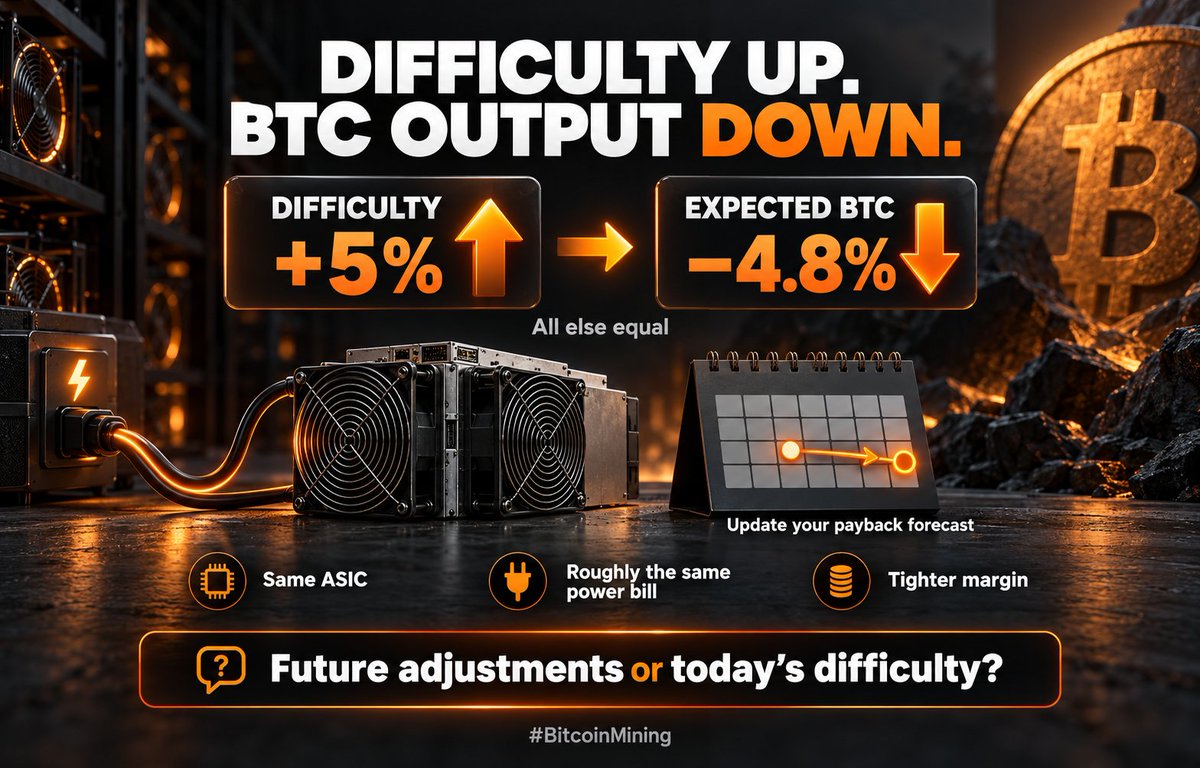
Difficulty rises 5% → expected BTC output falls about 4.8%, all else equal.
Same ASIC, roughly the same power bill, tighter margin. A payback forecast needs updating too.
Do you model future adjustments or use today’s difficulty?
#BitcoinMining
@RadekB88059 Fair point. A thin power margin leaves little room when revenue drops, and today’s payback estimate can quickly stretch out. How much margin would you want before buying?
What’s your first filter when evaluating an ASIC: hashprice, margin per kWh, or payback period?
Each catches something different, and each can mislead if used alone. Which one has proved most useful in your own mining decisions?
@LiriopeC71349 Exactly. Age matters less than efficiency. An older ASIC can still earn its keep on cheap power, but high J/TH turns it into a very loud space heater pretty fast.
Old ASICs don’t die. They just slowly become electric heaters with pool credentials.
Still, cheap power can keep older gear useful.
What’s the oldest miner you can still justify running?
@astreedVM17 I’d track both USD and BTC-denominated hashprice. $/PH/day helps with power and operating costs, while sats/PH/day shows the underlying mining yield. sat/vB is mainly a transaction fee-rate metric, not a direct hashprice measure.
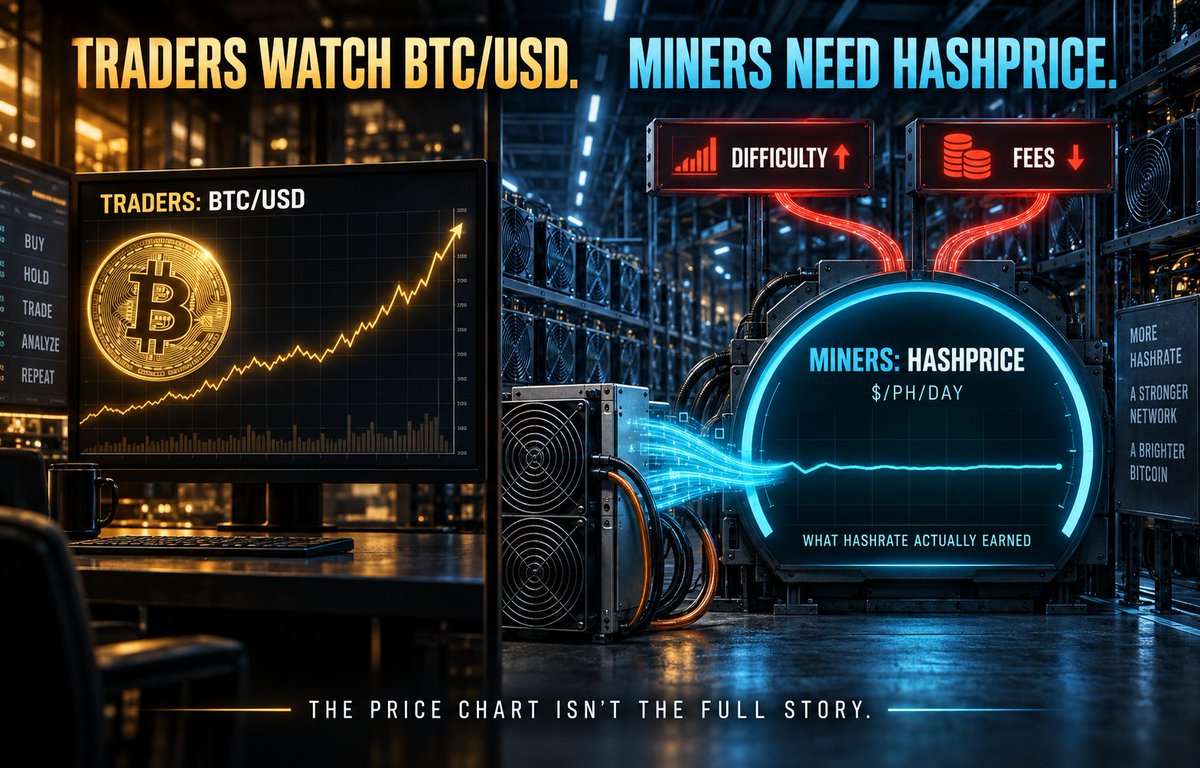
Traders watch BTC/USD. Miners need hashprice.
$/PH/day shows what hashrate was actually earning before power and operating costs.
BTC can rise while mining revenue stays flat if difficulty rises or fees fall. The price chart alone doesn’t tell the full story.
Same 200 TH/s. Very different power bill.
30 J/TH → 6 kW
15 J/TH → 3 kW
That’s why efficient ASICs can stay online longer when mining conditions get rough. Lower J/TH buys breathing room. It doesn’t guarantee profit.
@ZsofiaToth47361 That’s a solid all-in rate. Clear SLA credits and zero maintenance fees make a huge difference. The headline rate means nothing if the final bill tells a different story.