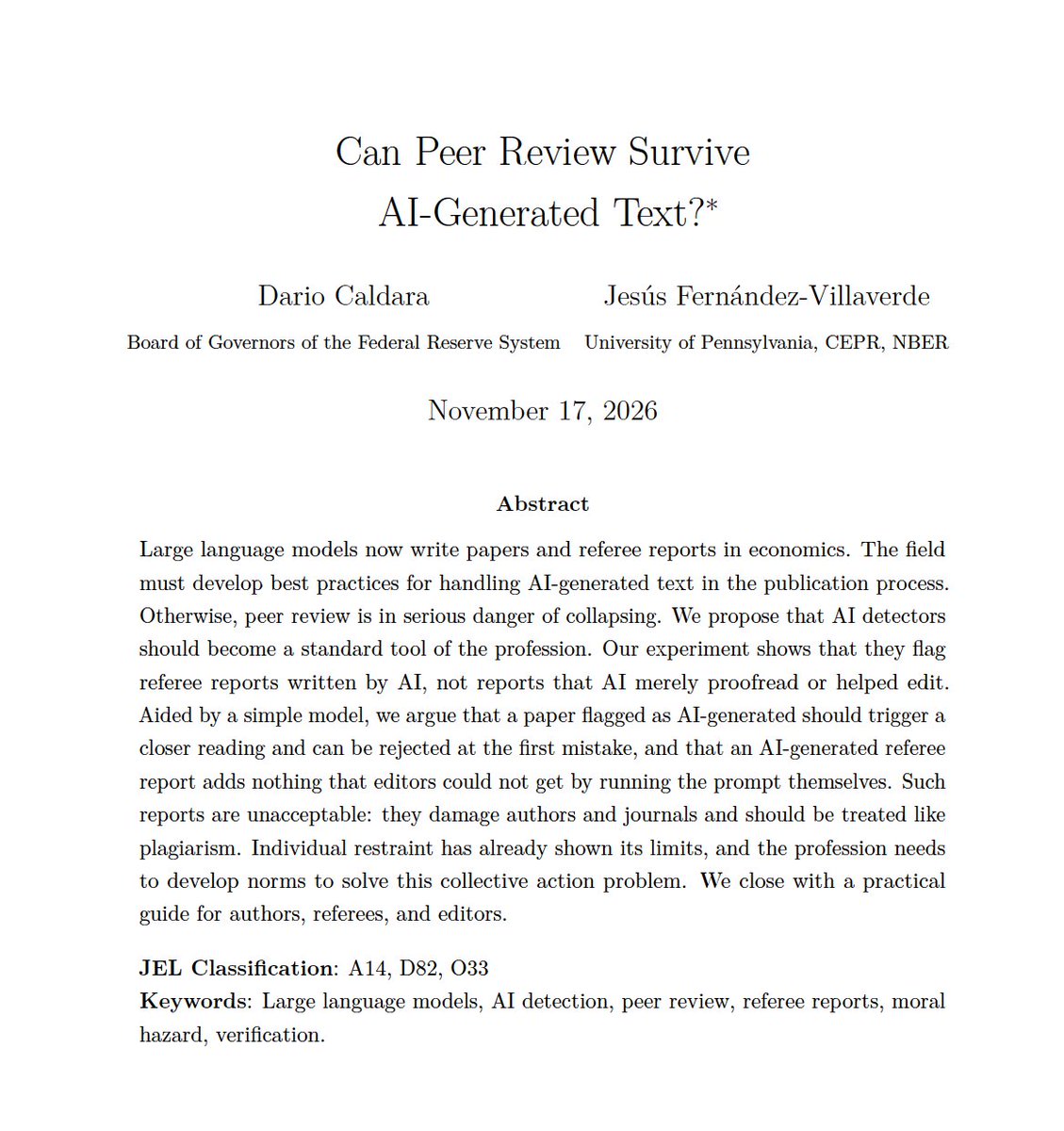
Let me return to the issue of AI-generated papers, because many seem to be missing the fundamental point of my paper with Dario Caldara: who should carry the burden of verification.
I went to law school. One of the first things you learn there is that a key decision in any legal system is which side bears the burden of proof. In criminal cases, the burden of proof lies with the state, not the defendant.
Placing the burden of proof on the state is a straightforward application of optimal mechanism design: proving guilt is easier than proving innocence, and, as a society, we have decided to minimize the number of innocent persons who are punished.
But civil law shifts the burden of proof to the defendant when the facts point to the defendant’s negligence, and the defendant can produce the evidence at a lower cost. The classic case in English tort law is Byrne v. Boadle (1863), which established the principle of res ipsa loquitur (“the thing speaks for itself”). The court held that, when a barrel of flour falls from a second-story warehouse window onto a passerby, it is the warehouse owner who must show that he was not negligent. Barrels do not usually fall on their own, and only the warehouse owner can know how the barrel was handled and why it fell.
The same applies to papers. The burden of verifying the argument and the results lies with the author, not the editor or the referee. The author has a lower cost (they know the paper, after all), and the verification only needs to be done once, not repeated by every reader. This is not about equity; it is about simple mechanism design.
The editor and the referees need to judge whether the paper is an important contribution to the literature and whether it is a good fit for the journal in terms of focus and quality. They can also provide useful feedback on how to frame the question or on how to propose further exercises. But neither the editor nor the referees should be forced to check the proofs or the computations.
Now, as a by-product of reading the paper, the editor and the referees often find mistakes. That was useful in the past. Right now, it would make much more sense to require the authors to formally verify their results with Lean or LLMs and submit verification evidence with their paper (or an explanation of why they disagree with Lean or the LLM).
In the past, checking that the author had undertaken a reasonable amount of due diligence was based, to a large extent, on the writing. A clearly written paper correlated, not perfectly but to a high degree, with due diligence. If you are writing your paper carefully, you have probably found where most of the material mistakes are.
The problem is that right now I can prompt an LLM, generate something that looks like a reasonable paper in a few hours, and submit it to a journal without even reading it (or only cursorily). This is not a hypothetical; it is already happening at an increasing speed: I get one of those papers every morning.
The problem is not that the text is AI-generated, but that AI-generated text correlates highly with a lack of verification.
This leads to a pooling equilibrium in which editors and referees cannot distinguish papers with verification from those without. It is the market for lemons all over again. And that would break the peer review process.
Again, I insist: a paper flagged by Pangram as 100% AI-generated would not be a problem in itself if I had reason to believe the author had verified it. The problem is that I usually do not.
Even when I generate texts myself with AI (for example, when I write instructions for my RAs) and I read them, I find that, while the original text is quite good, I need to change things here and there, and, before you realize it, Pangram no longer flags the text as 100% AI-generated: it has become my text.
You may ask: doesn’t this mean, then, that Pangram is useless? No. Forcing authors to “humanize” their text is a tax, not a large one, but a tax that will deter the most outrageous cases of “I just submit whatever the LLM produces for me.” It is a first line of defense, a thin screening one, not the whole defense structure.
This does not mean, either, that authors should not use LLMs. I use LLMs aggressively. I burn through my token allocation every week like there is no tomorrow (and perhaps, with AI, there is no tomorrow anyway). Academics who refuse to use AI in their research are sore losers.
But look, at the end of the day, you need to write your own introduction, even if the LLM can help you with a first rough draft. If you didn’t even write your introduction, you are not getting the point of your own paper. I feel this myself when my coauthor write the introduction to our joint paper. Until I write my own slides, I don’t get all the nuances of the introduction.
And I am not advocating automatically rejecting papers flagged as 100% AI-generated, either. I am advocating looking at them but never giving them the benefit of the doubt. If the argument is not clear, if the contribution is not transparent, if there is a serious mistake, out! I am happy to spend time as an editor with the paper of an assistant professor who has made rookie mistakes in their introduction. I am not happy to spend time as an editor going over the output of an LLM that the author did not bother to verify.
The ironic thing is that, if we don’t fix this problem, journals will end up going, even more than it is the case now, for papers by “big names.” If you think that AI-generated text will “democratize” economics, you are mistaken. It will make it even more hierarchical. If you are junior researchers, you will be the one losing, not me.
Now, before wrapping up:
1) No, if English is your second language, Pangram will not flag your text because an LLM helped you with grammar and syntax. I have checked that myself (how many “Fernández-Villaverdes” do you know who have English as their first language?).
2) No, Pangram does not discriminate against people from any particular group. There is zero evidence of that outside the New York Times craziness.
3) And yes, the cartoon is AI-generated.
My paper with Dario is here:
https://t.co/lufwMLCu0L
After years of championing a two-state solution, @MarwanMuasher now calls himself an "ex-two-stater." Dr. Muasher, who served as Jordan's deputy prime minister, explains why in the first episode of Re-Orient with @gonultol.
Listen now: https://t.co/eQf1Cqg4ig
I am sharing a new paper today with Dario Caldara: “Can Peer Review Survive AI-Generated Text?”
https://t.co/lufwMLCu0L
Dario and I, as editors, are increasingly getting papers submitted to our journals that are 99 percent AI-generated. Even worse, we are also receiving many AI-generated referee reports, both as editors and, more frustratingly, as authors.
And we cannot emphasize this enough: the real problem is not that the papers and reports were AI-generated; it is that no one had done the thinking behind them, and you can so easily tell. The papers were eminently forgettable, and the referee reports were disappointingly uninsightful. We have seen too many reports of the form: “The paper is well-written and addresses an important problem. However, the authors should consider additional baselines.”
This deluge of AI-generated text puts peer review in jeopardy: journals will be flooded with low-quality submissions, economists will decline requests to referee papers or routinely use AI to referee them, and which papers get published will become less and less linked to their quality.
We do not want to defend the status quo entirely. Peer review is slow, many reports are poor, and editors (including us!) make bad calls all the time. Still, well-executed peer review remains the best system we have for assessing each other’s work and advancing the profession. AI could improve peer review if used deliberately for that purpose, for instance, to check proofs and code. That is not what we are seeing.
The difficulty is that readers, including editors and referees, cannot see how AI was used. As a result, in practice, the burden of verification shifts from the author to the reader.
Since we reject this shift, Dario and I did what economists always do when something bothers us: we wrote a paper.
So, what do we do in it? First, we check whether AI detectors such as Pangram get this right: is a referee report flagged as AI-generated indeed AI-generated? Or is Pangram just flagging proofreading and editing? No. We run an experiment with 25 referee reports from the pre-AI era. Proofreading and editing do not trigger AI-generated flags. Only when we ask the LLMs to substantially rewrite the referee report or to generate a new report do we get the AI-generated flags. Pretty compelling evidence, if I may say so.
Second, we build a theoretical model to explore who should bear the burden of verification: the author or the reader? (Yours truly always enjoyed the courses on the rules of evidence in law school; yes, as Billy Wilder would say, nobody is perfect.)
The answer is that it is much more efficient for the author to do it, because the author can verify at a much lower cost and only needs to do it once (rather than each reader repeatedly). Before AI, the authors more or less had to verify the results, even if only because they had to type them in. This was not perfect (and all papers ever published in economics probably have at least one mistake). But the problem is that, with AI, the author does not even need to read the text. Or can just skim it. Writing is thinking, and without writing there is usually not much thinking.
So, a paper flagged as AI-generated is prima facie evidence that the author has not verified it. Should this lead to an automatic rejection? No. But there should be a zero-tolerance policy for serious mistakes. The first serious mistake we find in the paper, and it is out! In comparison, for a non-flagged paper, a serious mistake is something that the editor might determine it can be fixed in a revision.
We are stricter with referee reports. There is absolutely no point in the referee generating a report using an LLM. As an editor, I can do that directly and save myself the trouble of asking you for it. Now, of course, you can use the LLM to help you with the report (if the journal allows it! Many journals do not allow you to upload the paper to an LLM, and you need to follow the rules). For example, you can use the LLM to search for existing results in the literature.
But peer review is not about finding one sentence that is not entirely precise or a slightly sloppy mathematical proof. Referees are asked: “Is this idea important despite its flaws?” And, relatedly: “Is the paper a good fit for the journal in terms of quality and focus?” That judgment is the task for which you are selected as a subject expert.
We also propose that journals require that, before a paper is submitted, the author submit it to an LLM using an approved prompt and include the LLM report and a discussion of what was and was not fixed. That way, the referee would not need to check (or at least not check so carefully) every technical detail, and they could focus on the big picture: Is this a good paper? Is this a good fit for this journal? What is fundamental for this paper to become publishable at this journal?
Anyway. The paper has many other arguments, and we try to be nuanced. So, before ferociously typing the first complaint that crosses your mind, would you consider reading it? Chances are that we have already discussed your objection. We have been thinking about this for a long time.
But by all means, leave good comments!
I’m waking up struck by the amount of firsts with these midterm elections:
-First black female governor in US history
-First Muslim Senator
-First openly gay Senator
-First female Native American Governor
-First female Native American Senator
-First Latina Governor in Texas history
-First female Governor in Ohio history
-First elected female Senator in South Carolina history
-First Black Governor in Florida history
-First elected Latino governor in California history
-First Kansas Democratic Senator this century/in 94 years
-First Congress set up for Black Speaker of the House
Now official… Democrats just won every single statewide office in Texas:
Senate
Governor
Lt. Governor
Attorney General
Land Commissioner
Comptroller of Public Accounts
Agriculture Commissioner
Railroad Commissioner
All 4 Supreme Court Justices
@benwansell Blurring of lines between AI "usage" vs inauthentic authorship (Opus writing the paper) is frustrating! Especially b/c grad students at top programs have top-tier access to frontier models (thx to enterprise pricing) and can out-token less-resourced PhD students to publish first
Today's terrorist attack in the southern Jordanian town of #Karak comes nearly 10 years after #ISIS claimed responsibility for killing 10 people there. In 2016, seven Jordanian security officers, a Canadian tourist and two Jordanian civilians were killed. 🧵