Business Owner. YBF Performance consultancy services. Working with performance orientated athletes, coaches and other practitioners in sport and business.
If you’re only doing conventional broad jumps and vertical jumps in your training…
You’re missing out on serious athleticism
Here are the 12 best variations I use with my athletes to build real, 360-degree explosiveness
Save this
Most athletes stay one-dimensional because they never train multi-planar explosiveness
The horizontal, lateral, and rotational power that actually transfers to first-step quickness, cuts, and game speed.
Add 2–3 per lower body or speed session.
Which one are you adding first?👇
Sprinting has always been the ultimate plyometric to me.
High forces + short ground contacts.
In the recent paper, they compared sprint vs some plyos and found sprinting produced ~2.0x bodyweight in average vertical GRF, compared to ~1.65x BW in the drop jump condition, with
Soviet sport scientists spent decades trying to solve one problem…how do you take the strength you build in the weight room and actually get it to show up in competition?
Their answer was the bridge. General means build the foundation and Special strength exercises carry
13 REAL plyometrics for athletes!
1. Band assisted pogo jumps
2. Drop jump into band accelerated vertical
3. SL vertical into SL broad
4. Repeat SL broad jump
5. Triple hurdle jump
6. SL drop jump
7. Standard drop jump
8. Drop jump to vertical jump
9. Depth jump
10. Depth jump to broad jump
11. Box “double jump.”
12. SL drop jump to SL broad jump
13. Hurdle to box jump
Learn the “Wall Drill” in 60 seconds! 🧱⏱️
For Sprinters: This is the secret to ground reaction time and quick-twitch power. Perfect for mastering those start block angles and building elite stability.
For Every Athlete: Your bones and tendons need a workout too! Bone density depends on "impact" signals like plyos. If you don't challenge your frame, it won't stay strong. 🦴✨
Simple drill, massive results! 👏👏
Box Squats are one of the most effective Squat patterns for Athletes…
1. Enhanced Neural Drive
2. Faster Recovery
3. Greater Rate of Force Development
4. Consistent Range
5. Greater Stability
Box Squat heavy and often!💪🏻📈
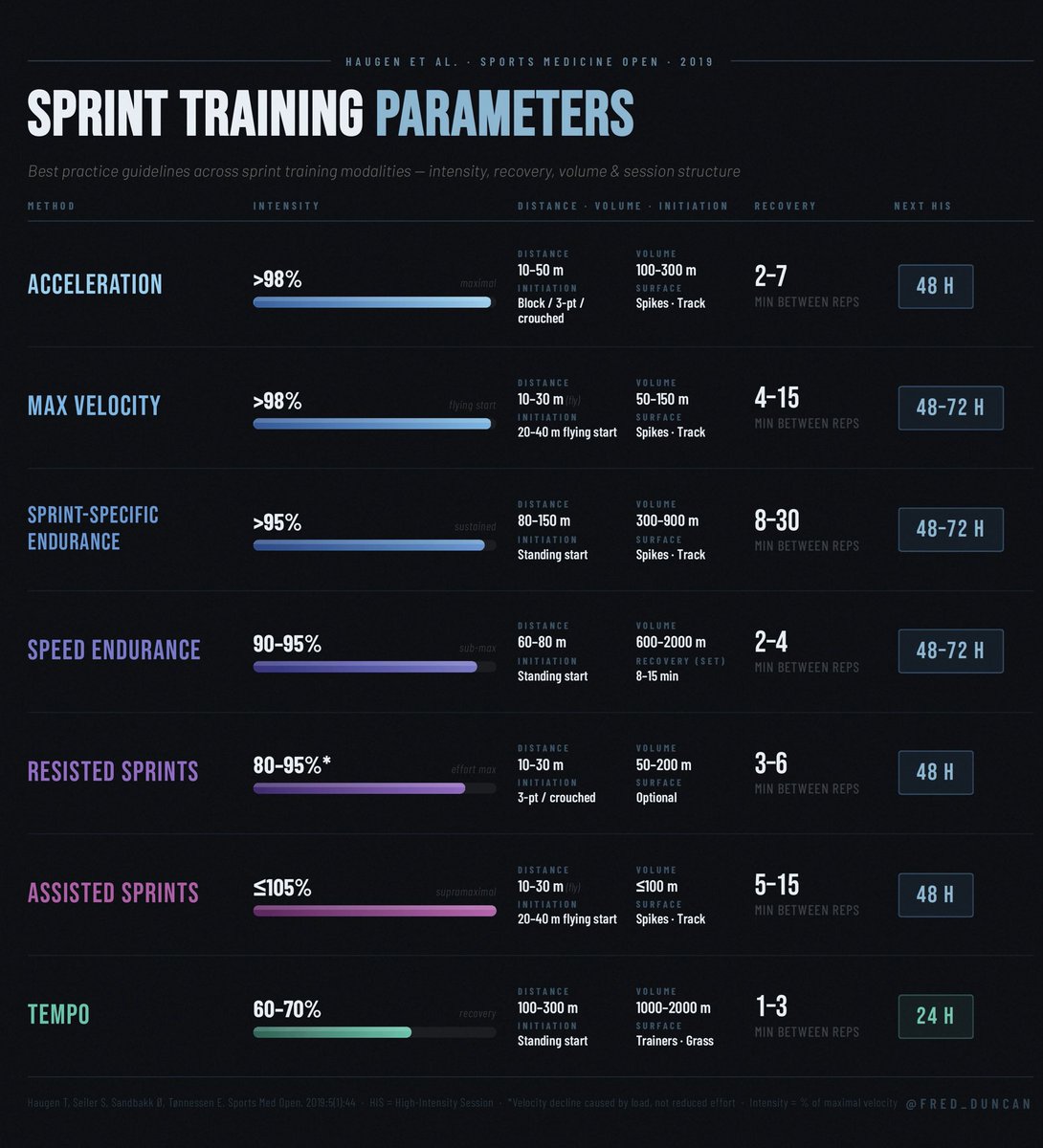
Elite sprint development requires real structure.
Specific intensities, volumes, and recovery windows that produce the right stimulus and the adaptation that follows.
This is from Haugen et al, laying out the key parameters behind what elite sprinters actually do. It’s a great
One of my key observations when I started competing in Masters sprinting (at 40) was that many older sprinters had a good stride rate (cadence) but poor stride length. Their nervous systems were fast, a prerequisite for a good sprinter, but they had little power. They looked weak; their legs going like a fiddler’s elbow but covering little ground. The better age-group sprinters had longer, stronger, strides.
Most people assume that when we get older and slower, it’s because we “can’t move our legs fast anymore” - this turns out to be mostly wrong. In sprinting, stride frequency changes surprisingly little with age.
My observations are borne out by research:
Study 1: Masters sprinters (100 m)
‘Age-related differences in 100-m sprint performance” observed that in male and female master sprinters, the reduction in sprint speed with age was primarily due to shorter stride length and longer ground contact times, whilst stride rate remained unchanged until very old age: https://t.co/AN44IcB20X’
Study 2: Biomechanics across age in competitive sprinters
“Biomechanical and skeletal muscle determinants of maximum running speed with aging” found that the progressive decline in maximum sprint speed with age was mainly related to declines in stride length and force production, while stride frequency declined much less: https://t.co/BYUrs6ePkH
So, what really declines in older age (if you don’t train it) is stride length.
Why? Because stride length depends on things that deteriorate unless we actively train them:
- Peak force production
- Rate of force development (how fast force is applied)
- Tendon stiffness and elastic recoil
- Hip extension and ankle plantar-flexion power
- Ground contact effectiveness
You can still turn your legs over quickly, but if you can’t hit the ground hard and elastically enough - your body doesn’t go anywhere. What preserves stride length, and therefore sprint speed, is power and stiffness from:
- Heavy strength work (especially hips, quads, calves, posterior chain)
- Short sprints with full recovery
- Hill sprints
- Plyometrics, jumps, hops
- Keeping ankles, hips, and tendons springy, not just mobile
You don’t need to overdo it, but you do need some. If you don’t train force production and elasticity, speed erodes. If you do, it’s remarkable how much can be retained, even later in life. At 50yrs my 100m best was only one second slower than my senior personabest. Even though I was nowhere near world-class as a youngster I became world-class as an older runner, primarily due to retaining the above qualities.
Sprint speed is a use-it-or-lose-it system. You know what to do
Plyometrics: What can we learn from masters of the craft?
Here's what I've learned from the themes and commonalities between the world's experts on high powered plyometric training.
Plyometric experts all have strong clarity and give deep thought to the following:
🔸Their plyometric philosophy
🔸Quantifying plyometric intensity
🔸The individual athlete
🔸The specificity/intensity tradeoff
🔸The balance w/ sport specific training
The Plyometric Purpose
Each expert has a clear definition of plyometric training.
What it is.
And what it isn't.
When to use it.
And when not to.
They all have a clear "why". They don't all agree... but they each have a specific & clear purpose for using plyometrics.
Quality > Quantity
All clearly consider plyos to be a high powered, quality-dependent training stimulus.
All are thoughtful & methodical in quantifying intensity of exercises used. None solely count "foot contacts". Most use a product of: [foot contacts] * [intensity factor]
💥 Intensity factors are established in a number of ways across the expert group but most are a combination of one or more of the following:
🔸Published research
🔸Contraction types & contact times
🔸Experiential knowledge
Quantification ↔️ Classification
Once intensity is quantified exercises can be classified.
The experts all have clear categories of exercises from which they build clear training menus and progression plans. Example:
All consider the individual athlete
The training process is strongly guided by:
🔸Training purpose
🔸Time of year
🔸Sport specific training
🔸The athlete "type"
🔸The athlete training history
🔸The athlete injury history
Greyhound vs Bulldog
Athlete type is widely considered a determinant of plyo training response.
Greyhound: Light & elastic. Responds potently to plyos.
Bulldog: Muscular/strong athlete. Responds well to strength work but careful, moderate plyo doses can help ↗️ elasticity.
What about the sport?
All want clarity of the plyometric demands of the sport training.
All want to avoid overload of similar stimulus to the sport training.
All ask "what relevant stimulus can we give the athlete that the sport training is not providing?"
Intensity ↔️ Specificity
There is a tradeoff between plyometric specificity & intensity.
When we ⬆️ specificity we can infringe on sport technique & inadvertently ⬇️ the magnitude of physical quality overload.
"General" plyometrics overload physical qualities. Established sport specific drills are likely best way to balance both.
Thanks for reading.
All of this info has come from
@SportsmithHQ podcasts from:
@sprintcoachSWE
(episode 272)
@SheppardCoach
(ep28 & 103)
@MMJPerformance
(ep38)
@BooSchex
(ep212)
@dkhammy
(42)
And other resources from:
@wildy_jj@benthebounce@DerekMHansen
@missyMmcbeth So true but i still see (and expect will continue to see) young athletes who cannot squat (or worse, have not even had their squat pattern tested) being loaded up with a bar and plates.
Why sport is so amazing. @BrigRangersRLFC are one game away from meeting @hullkrofficial in the Challenge Cup. Two teams that last played each other in the Challenge Cup 23rd March 1901 at @BrigRangersRLFC then home ground Lane Head, Hull won that day 7 nil.
Love this for unilateral power AND deceleration
The acceleration increases speed of load & rate of force production
AND
Enhances entry speed to single leg landing…
Great for unilateral stability & handling ground forces eccentrically
If your training sucked in 2025… do these things in 2026!
1. Stop training like a bodybuilder… be athletic, throw med balls, train power
2. Train plyometrics in multiple planes
3. Stop being afraid & lift heavy!!
4. Build your grip strength
5. Perform maximal depth landings
6. Train plyometrics unilaterally
7. Race a partner when you sprint
8. Use repeat contact jumps/plyos
A lot of conversations around stiffness miss the point because they treat it like one quality.
Tendon stiffness and muscle stiffness adapt to different stimuli and both matter if the goal is speed.
Heavy strength work and long duration ISOs expose the tendon to high strain
Have TIGHT HIPS?
The ‘Kettlebell Weight Shift’ can help open up tight groin muscles, re-engage your glutes & allow for a deeper more comfortable squat in just seconds!





![EamonnFlanagan's tweet photo. Plyometrics: What can we learn from masters of the craft?
Here's what I've learned from the themes and commonalities between the world's experts on high powered plyometric training.
Plyometric experts all have strong clarity and give deep thought to the following:
🔸Their plyometric philosophy
🔸Quantifying plyometric intensity
🔸The individual athlete
🔸The specificity/intensity tradeoff
🔸The balance w/ sport specific training
The Plyometric Purpose
Each expert has a clear definition of plyometric training.
What it is.
And what it isn't.
When to use it.
And when not to.
They all have a clear "why". They don't all agree... but they each have a specific & clear purpose for using plyometrics.
Quality > Quantity
All clearly consider plyos to be a high powered, quality-dependent training stimulus.
All are thoughtful & methodical in quantifying intensity of exercises used. None solely count "foot contacts". Most use a product of: [foot contacts] * [intensity factor]
💥 Intensity factors are established in a number of ways across the expert group but most are a combination of one or more of the following:
🔸Published research
🔸Contraction types & contact times
🔸Experiential knowledge
Quantification ↔️ Classification
Once intensity is quantified exercises can be classified.
The experts all have clear categories of exercises from which they build clear training menus and progression plans. Example:
All consider the individual athlete
The training process is strongly guided by:
🔸Training purpose
🔸Time of year
🔸Sport specific training
🔸The athlete "type"
🔸The athlete training history
🔸The athlete injury history
Greyhound vs Bulldog
Athlete type is widely considered a determinant of plyo training response.
Greyhound: Light & elastic. Responds potently to plyos.
Bulldog: Muscular/strong athlete. Responds well to strength work but careful, moderate plyo doses can help ↗️ elasticity.
What about the sport?
All want clarity of the plyometric demands of the sport training.
All want to avoid overload of similar stimulus to the sport training.
All ask "what relevant stimulus can we give the athlete that the sport training is not providing?"
Intensity ↔️ Specificity
There is a tradeoff between plyometric specificity & intensity.
When we ⬆️ specificity we can infringe on sport technique & inadvertently ⬇️ the magnitude of physical quality overload.
"General" plyometrics overload physical qualities. Established sport specific drills are likely best way to balance both.
Thanks for reading.
All of this info has come from
@SportsmithHQ podcasts from:
@sprintcoachSWE
(episode 272)
@SheppardCoach
(ep28 & 103)
@MMJPerformance
(ep38)
@BooSchex
(ep212)
@dkhammy
(42)
And other resources from:
@wildy_jj
@benthebounce
@DerekMHansen](https://pbs.twimg.com/media/F9Iq4IZWoAAUeCt.png)


