This report and the one by @PeterMcCrory both show early evidence of how the use of AI expands individuals' task frontier. This is what a theory of endogenous utility predicts, although there are other possible mechanisms. Clear more research is needed.
We're seeing how AI may change who does what at work.
@Alex_M_Richmond and @caroline_m_chin's new @OpenAI Economic Research report studies “task crossover”: work associated with one occupation appearing in another worker’s AI use. https://t.co/ZoNrXw6BPB
I focused on the demand-side effect in the lecture. But a firm without its own generative capacity with the same co-evolutionary logic wired in cannot deliver such service. In my view, these two form an intertwined loop.
In my inaugural lecture, I argued that in the generative economy, firms and individuals need a generative architecture in which the capacities of people and their AI agents grow endogenously through coevolutionary interaction (https://t.co/hVqk7DCF85)
Join Professor Youngjin Yoo (@YoungjinYoo) for his inaugural lecture as he examines how generative AI is challenging the very foundational assumptions of digital and economic theory.
Wednesday 10 June 2026, 6.30 - 8pm
Sign up here: https://t.co/Si4yyd8MOY
"Instead of asking how many jobs AI will eliminate, we should ask whether we are building systems that help people discover new goals, pursue meaningful problems, and create value others did not yet know they wanted."
Is AI killing jobs?
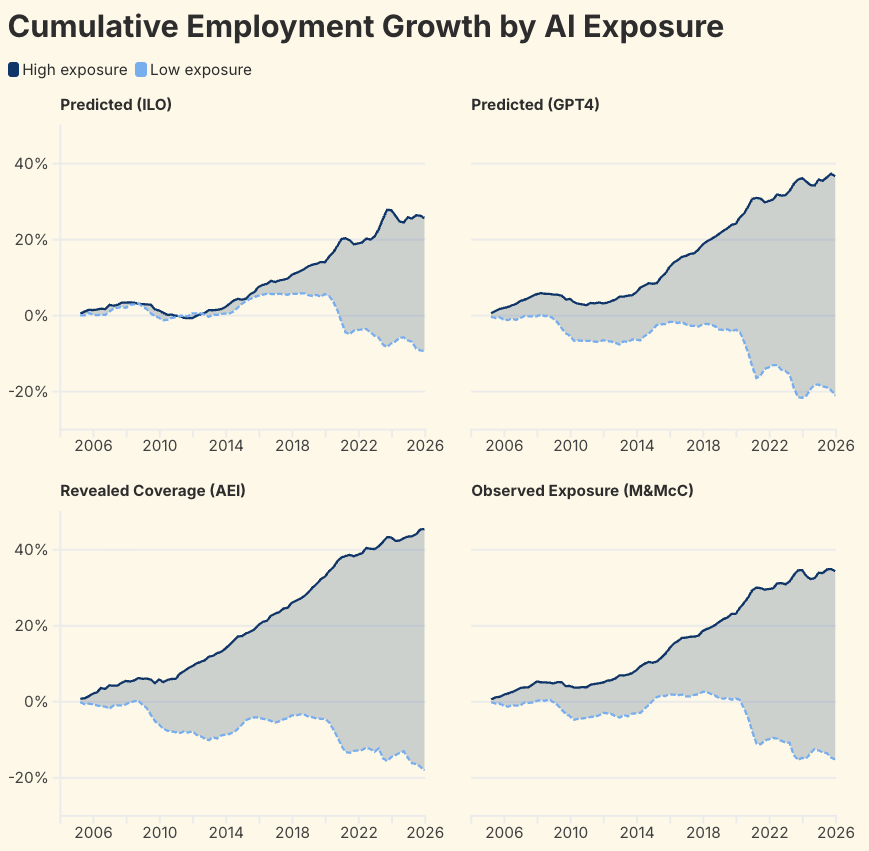
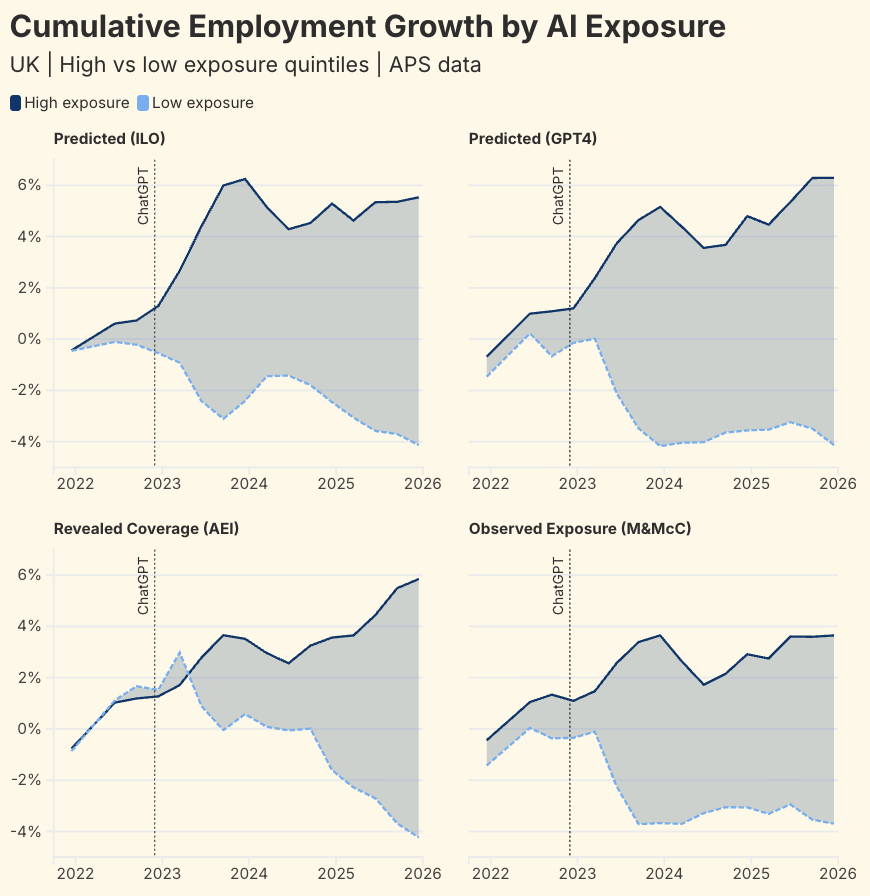
New data shows that, more than three years after the release of ChatGPT, there is no evidence for a significant impact of AI on overall employment in the UK.
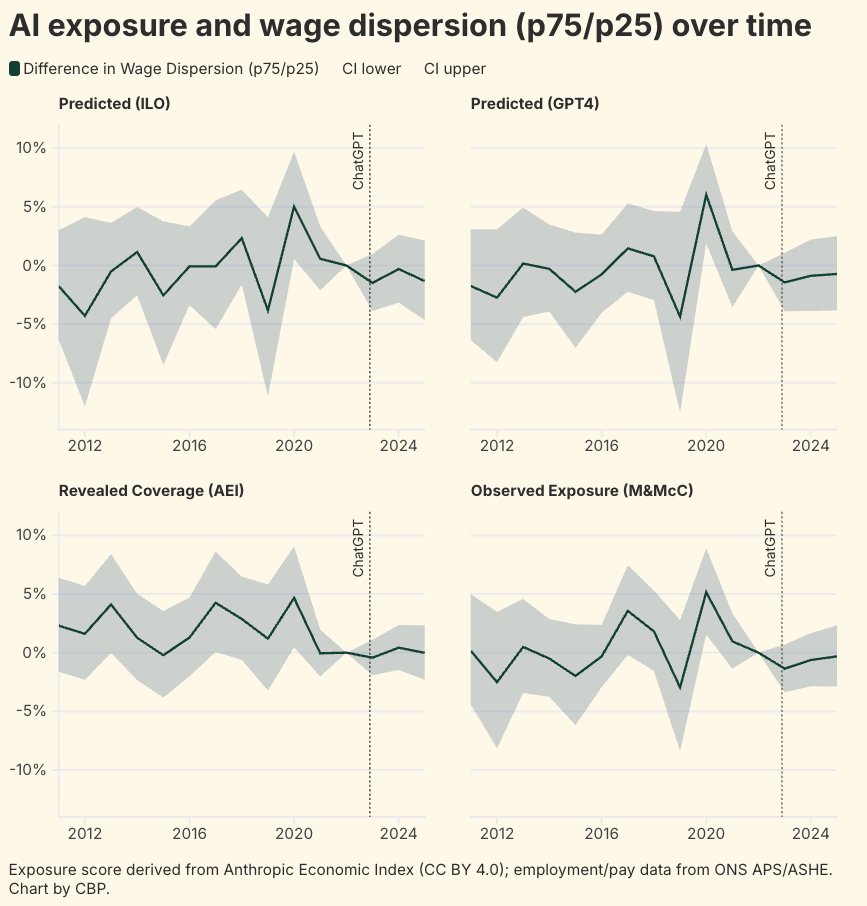
In our new report, we break down the labour force into different occupations and use four measures of AI exposure to determine how likely they are to be affected by the technology.
Surprisingly, occupations with higher exposure to AI have grown faster than least-exposed ones, not slower. This holds across all four measures, and across two different data sources.
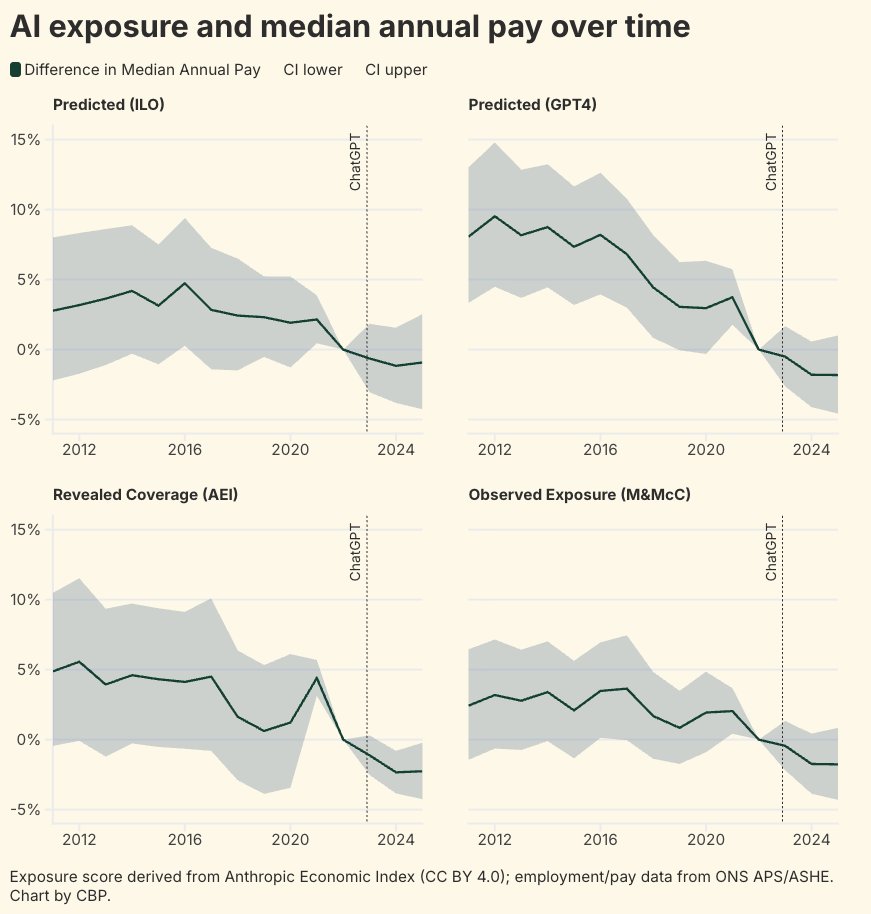
The wage picture is different. Pay in AI-exposed occupations has lagged the rest of the labour market since 2019.
But that gap opened three years before ChatGPT, which makes AI an unlikely candidate for the observed wage compression.
This flattening of the wage structure is visible across the within-occupation distribution and strongest at the top quartile, which is consistent with labour market dynamics that predate generative AI.
I was chatting with my buddy at Google, who's been a tech director there for about 20 years, about their AI adoption. Craziest convo I've had all year.
The TL;DR is that Google engineering appears to have the same AI adoption footprint as John Deere, the tractor company. Most of the industry has the same internal adoption curve: 20% agentic power users, 20% outright refusers, 60% still using Cursor or equivalent chat tool. It turns out Google has this curve too.
But why is Google so... average? How is it that a handful of companies are taking off like a spaceship, and the rest, including Google, are mired in inaction?
My buddy's observation was key here: There has been an industry-wide hiring freeze for 18+ months, during which time nobody has been moving jobs. So there are no clued-in people coming in from the outside to tell Google how far behind they are, how utterly mediocre they have become as an eng org.
He says the problem is that they can't use Claude Code because it's the enemy, and Gemini has never been good enough to capture people's workflows like Claude has, so basically agentic coding just never really took off inside Google. They're all just plodding along, completely oblivious to what's happening out there right now.
Not only is Google not able to do anything about it, they don't seem to be aware of the problem at all. I'm having major flashbacks to fifty years ago as a kid at the La Brea Tar Pits, asking, "why can't they just climb out?"
My Google friend and I had this conversation over a month ago. I didn't share it because I wanted to look around a bit, and see if it's really as bad as all that. I've been talking to people from dozens of companies since then. And yeah. It's as bad as all that.
Google is about average. Some companies at the bottom have near-zero AI adoption and can't even get budget for AI. They may have moats and high walls, but the horde is coming for them all the same.
And then there are a few companies I've met recently who are *amazingly* leaned in to AI adoption. One category-leader company just cancelled IntelliJ for a thousand engineers. That's an incredibly bold move, one of many they're making towards agentic adoption. In my opinion, that company is setting themselves up for a _huge_ W.
As for the rest, well, it's the Great Siloing. Everyone's flying blind. With nobody moving companies, no company knows where they stand on the AI adoption curve. Nobody knows how they're doing compared to everyone else.
Half of them just check a box: "We enabled {Copilot/Cursor} for everyone!" Cue smug celebrations. They think this is like getting SOC2 compliance, just a thing they turn on and now it's "solved." And they don't realize that they've done effectively nothing at all.
All because of a hiring freeze.