@nsitharaman#Budget2025#बजेट2024
शराब की प्राइज बढ़ाने से नशा करने वाले कम नहीं होंगे... कुछ और सॉल्यूशन निकालो।
यहां शराब की बात नहीं हो रही।
अगर टाइम मिले तो यहा से थोड़ा सुझाव लो।
https://t.co/qICZC8FunQ
रिटेलर को बचाना भी है, और उसको दारू(more expiry)भी पिलानी है।
12 August 2026: No Trades. Just Protest.
Skip trading on 12 August to support the demand for a CAS rollback.
Let’s make trading volume drop so sharply that the media can’t ignore it.
Post a screenshot of your empty order book and show your support.
Do nothing = guaranteed failure. Act together = a chance to win.
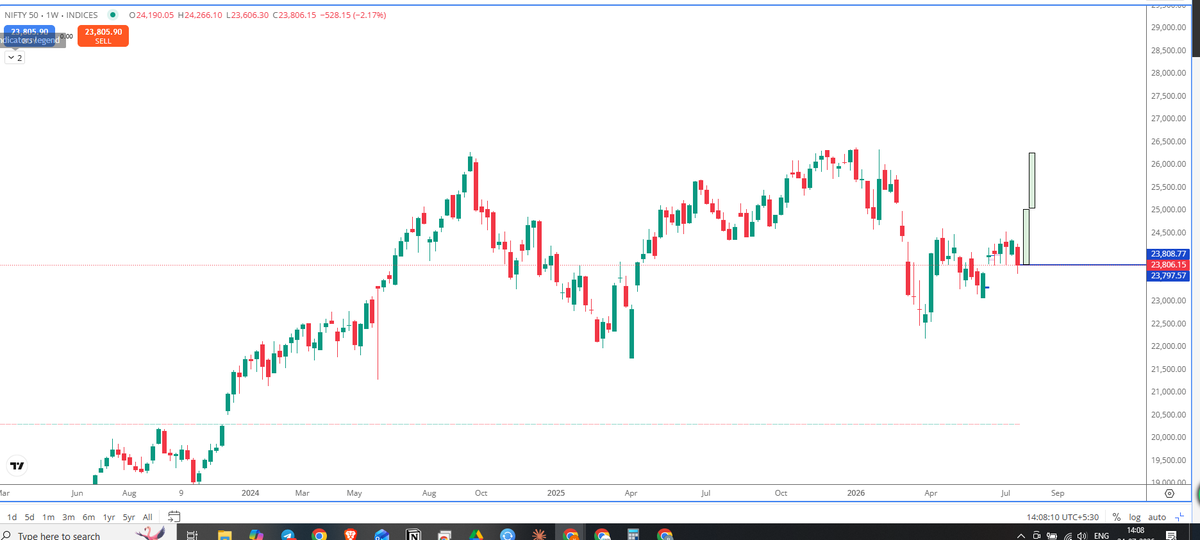
2020 Crash Vs 2026
Same pattern, Same Reversal
History repeat itself - 90% chart looks same
We are about to major breakout and major bull run again
This pattern keep repeating again and again before every Crash
I recently came across the story of a professor who quietly built a ₹3,670 crore listed stock portfolio.
His name is Shivanand Mankekar. 😎
For over 30 years, he taught Financial Management at JBIMS, Mumbai. Among his students were Uday Kotak and Chanda Kochhar.
One of his most remarkable investments came in Pantaloon Retail.
Before investing, he spent time inside Big Bazaar stores, observing customer behaviour instead of relying only on financial statements.
That conviction turned a ₹30 lakh investment into ₹190 crore at its peak, a 630x return.
Some of his other multibaggers:
Geodesic: ₹9 lakh became ₹12.3 crore (137x)
Financial Technologies: ₹3.2 crore became ₹123 crore (38x)
Wockhardt: ₹30 crore became ₹357 crore (12x)
He also identified winners early in L&T, Castrol, Sesa Goa, Infosys, Wipro and Bharti Airtel.
His famous investing lesson:
"You don't value a company by its profits or assets. You value it by its cash flows."
Today, Mankekar Shivanand S. publicly holds 3 listed stocks worth over ₹3,670 crore:
- Rubicon Research: ₹3,333 crore
- Data Patterns: ₹325 crore
- Arisinfra Solutions: ₹12 crore
He has always kept a low profile, staying away from TV appearances and social media.
Truly inspiring. ❤️
8 years back, I spoke to @jackschwager, the man behind the Market Wizards series. @mysandz spoke to him again recently on In The Money, and it was an interesting conversation. Market Wizards is probably the only book I've read multiple times when I was trading actively.
The one thing that stood out to me from the video was the debate between systematic vs. discretionary trading. There's a common assumption that the best traders are rules-based, meaning they follow a fixed set of rules. The logic is that this helps them keep their emotions in check so they can follow the signals dispassionately.
But what Jack found among the traders he interviewed was that almost all of them were discretionary traders. They had rules, but they knew when not to follow them. Meaning, they knew when their approach wasn't working and when they had to change the "rules" they were following.
The one purely systematic trader he ever profiled kept changing his systems. He once showed Jack the equity curve of the original system he made his first money on. It went straight up while he traded it, and straight down after he abandoned it. If he had stuck to it with blind discipline, he would have been wiped out.
At the very least, what this shows is that there isn't just one way to make money. There are numerous approaches that work, and you ultimately have to figure out what works for you and stick with that approach until it stops working, because nothing works all the time. People change, the markets change, and so do the strategies.
Full episode link in comments.
🇮🇳INDIA SELECTED 20 HOMEGROWN "AI MODELS" UNDER THE INDIAAi MISSION FOR GOVERNMENT SUPPORT
12 Large language models
8 small language models
SarvamAI
BharatGen
Gnani AI
Soket AI
Gan AI
Avataar AI
GenLoop
Zenteiq
IntelliHealth
Shodh AI
Fractal Analytics
Tech Mahindra Maker's Lab