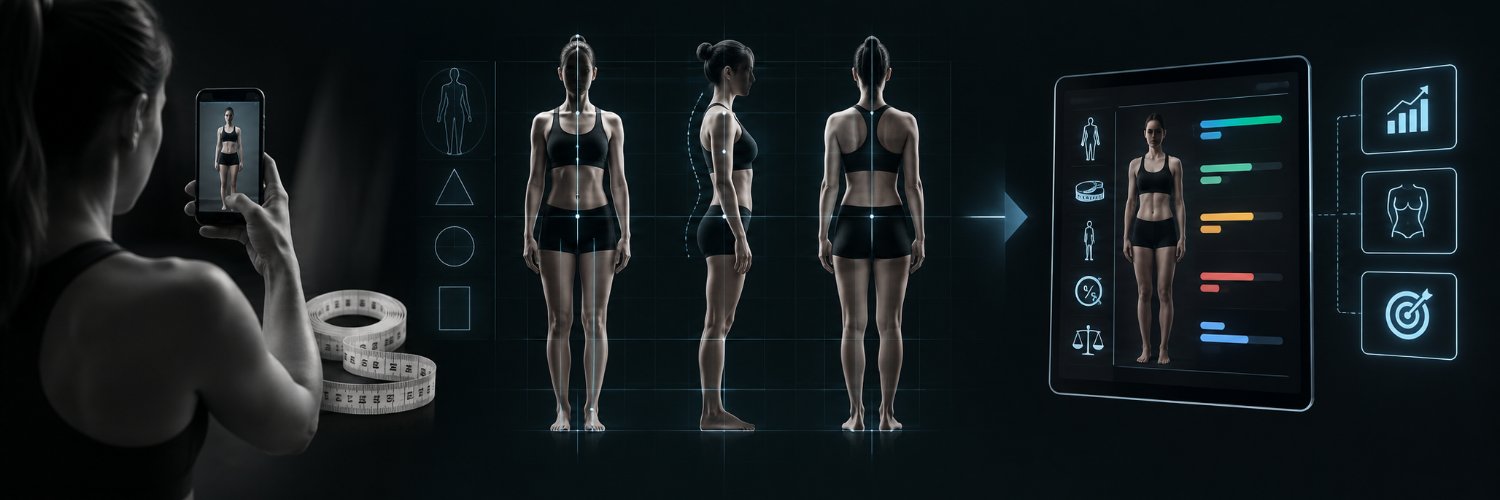
Body shape, proportions, posture, body fat and symmetry from a single photo or a tape measure, then a personal report that ranks exactly what will move the need
The scale alone can't tell you if your body is changing.
Track four signals: photos, tape measurements, a 7-day average of scale weight, and strength. If all four agree, trust the direction. If they disagree, look at the pattern.
How much muscle can you build naturally?
Rough averages on a good program: year 1 about 9-11 kg of lean mass, year 2 about 5, year 3 about 2.5, year 4+ 1-1.4 kg or less.
The famous FFMI limit of 25? The highest value in one 1995 sample, not a law.
Measuring your body wrong spoils every number after it.
Stand relaxed and tall. Keep the tape level and snug. Read at the end of a relaxed exhale. Measure twice. Same time, same spot, every month.
:
https://t.co/U9WhcZyBsr
:
Is bad posture really that bad? Evidence says posture is only weakly linked to pain. Long sitting, low strength and little movement matter more.
Try the 10-minute routine in the video.
Free posture check: https://t.co/iDwAXDoyLu
:
BMI is useful, but limited.
It can't see muscle, where fat sits, or fitness. Pair it with waist-to-height (under 0.5 is a good sign).
Free BMI calculator: https://t.co/OhnxyXfhVt
:
Spot reduction is a myth. In a widely cited 2011 trial, 6 weeks of ab training did not reduce abdominal fat.
What does work: a 10-20% calorie deficit, protein, 8-10K steps, lifting and sleep.
Free waist-to-height check:
https://t.co/bzXozIpvvK
:
What is a good body fat percentage?
ACE categories:
Men: fitness 14-17%, average 18-24%
Women: fitness 21-24%, average 25-31%
Methods can differ by 5+ points on the same day. Track the trend.
Free calculator: https://t.co/oOWg7sJ0F3
: