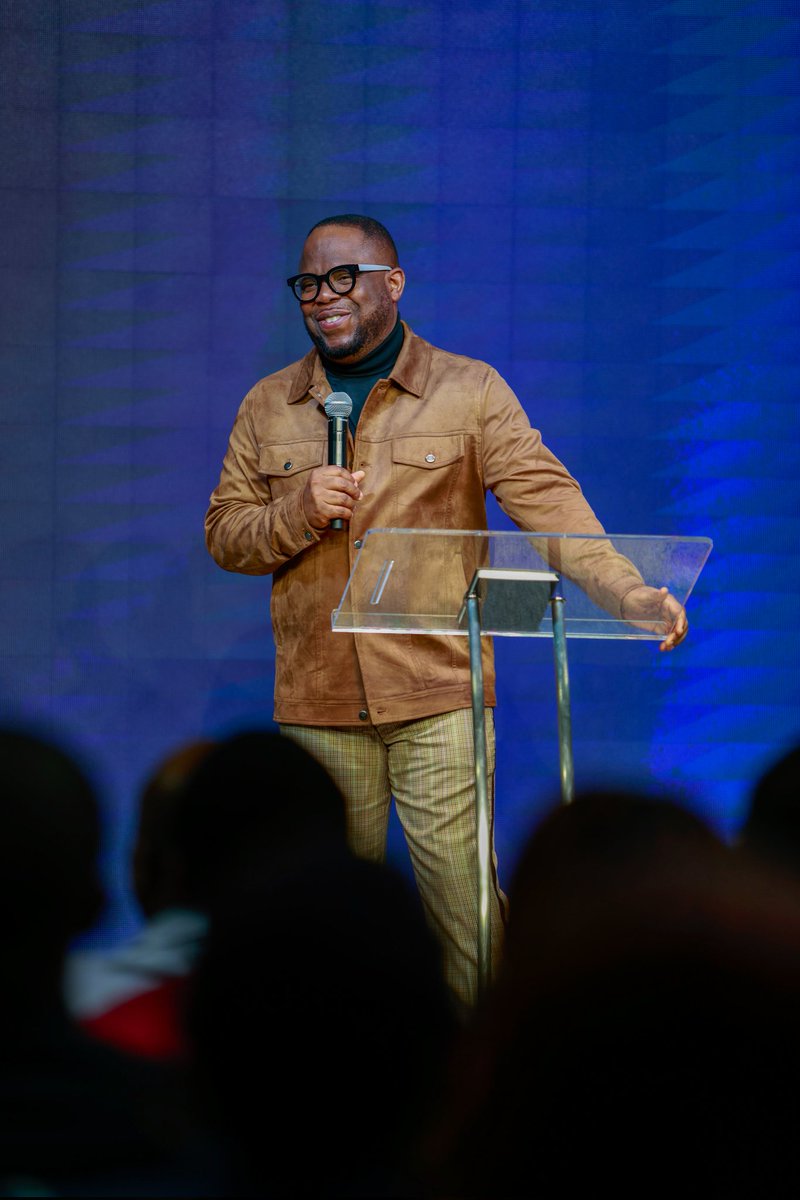
An emissary of the Help of God to men. Impacting Lives, Influencing Nations //
Founding Pastor @ The SONS' Place Global Church // CEO @ Awesome Food Ventures
Lack Of Electricity Makes The Population Double In Nigeria - Fayose
When you don’t address the issue of electricity, by 7 o’clock it gets dark, and people start engaging with their wives, so the population doubles. The simple problem is that, because there is no electricity, people go to bed early. Their minds are already prepared for it. If this is the only option available, they simply stay at home. But if we address the electricity problem, there will be nightlife.
Ayodele Fayose, Chairman, Rural Electrification Agency
This is one of the most pervasive themes in Paul's theology: God's sovereign purpose never eliminates human responsibility; it establishes it. Divine certainty and human action are not competitors but companions.
Paul himself embodies this tension throughout his ministry.
In Acts 27:22–31, God gives Paul an unequivocal promise:
"There will be no loss of life among you..."
The outcome is settled because God has spoken. Yet moments later, when the sailors attempt to escape in the lifeboat, Paul declares:
"Unless these men remain in the ship, you cannot be saved."
There is no contradiction. The God who ordained the end also ordained the means. The certainty of God's promise did not render the sailors' remaining on board unnecessary; it made their remaining the very instrument through which the promise would be fulfilled. Divine sovereignty does not bypass human agency—it governs it.
The same pattern appears repeatedly in Paul's writings.
1 Corinthians 3:6–9 — "I planted, Apollos watered, but God gave the growth."
Paul refuses two opposite errors. He neither attributes everything to human effort nor dismisses human effort as irrelevant. Planting was real. Watering was real. Both required labour, wisdom, sacrifice, and obedience. Yet neither planter nor waterer possessed the power to produce life. Growth belonged exclusively to God.
The farmer cannot manufacture life in a seed, but he must still plough the field.
The preacher cannot regenerate a sinner, but he must still preach the gospel.
The believer cannot sanctify himself apart from grace, but he must still pursue holiness.
God alone gives the increase, yet He ordinarily gives it through means He Himself has appointed.
This is why Paul can write in Philippians 2:12–13:
"Work out your own salvation with fear and trembling, for it is God who works in you both to will and to do according to His good pleasure."
Notice the logic. He does not say, "Work because God is absent." He says, "Work because God is at work." Human obedience is grounded in divine operation. God's working is not an alternative to ours; it is the reason ours is possible.
Likewise, in Colossians 1:28–29, Paul describes his ministry:
"For this I toil, struggling with all His energy that He powerfully works within me."
Paul genuinely toils. He genuinely struggles. Yet the strength by which he labours is not self-generated but divinely supplied. The harder Paul works, the more he magnifies the grace that empowers him.
This same principle governs salvation itself. Faith is indispensable, yet salvation is entirely of grace. Repentance is commanded, yet it is God who grants repentance. Believers are called to persevere, yet it is God who preserves them. Scripture never treats these truths as rivals. It presents them as complementary realities within God's redemptive purpose.
Paul therefore rejects two extremes. Fatalism says, "If God has determined the outcome, my actions do not matter." Self-sufficiency says, "The outcome ultimately depends on me." Paul embraces neither. Instead, he proclaims a God whose sovereign decree establishes—not abolishes—the meaningfulness of human obedience.
The biblical pattern is remarkably consistent:
God ordains the harvest; therefore we plant.
God grants the increase; therefore we water.
God promises preservation; therefore we remain in the ship.
God works within us; therefore we work without.
God guarantees His purposes; therefore our obedience becomes the appointed means by which those purposes are accomplished.
In Paul's theology, divine sovereignty never negates human responsibility. It is precisely because God is sovereign that human actions are meaningful, effective, and caught up in the accomplishment of His eternal purposes.
Moses lists his deficits and every single one is true.
No standing. No eloquence. No credibility. A murder charge outstanding in the country he's being sent to.
His analysis is correct. The gap is fatal.
God doesn't close it. Doesn't hand him eloquence. Doesn't restore the reputation. Doesn't answer one objection on its own terms.
He asks him to check his pockets.
What is that in your hand?
A stick.
And here's what your pastor never told you.
That rod is the emblem of his failure.
It's not a symbol of his calling. It's the tool of the job he took after he failed and ran. It's forty years of exile. It's his demotion, carved in wood. It's the thing he picked up when he stopped being a prince and became nobody.
He'd been holding his own shame for forty years and never once thought it was worth mentioning to God.
It is the only thing in the entire story God uses.
It splits an ocean.
Nothing in his hand changed.
The question changed.
So: what's the thing you're ashamed of? The wasted years. The job beneath you. The failure you keep out of your bio.
Look down.
That's not your disqualification.
That's the material.
Before you surrender to the weight of life's battles, remember this: you are anointed.
The anointing is not a religious decoration. It is God's empowerment for the realities of life. Scripture declares that "the yoke shall be destroyed because of the anointing" (Isaiah 10:27). The anointing exists to remove burdens and break yokes.
Life's vicissitudes rarely announce themselves. They come as burdens that weigh down the heart, pressure that crushes the mind, disappointments that drain your strength, and yokes that seek to enslave your future. But God never intended you to confront them empty-handed.
The anointing is part of your divine defense. It is heaven's provision against the pressures of earth. It gives strength when you should have collapsed, wisdom when you should have been confused, courage when fear comes knocking, and power to break what human effort cannot.
Do not merely admire the anointing—leverage it. Pray. Stand on the Word. Walk in faith. Stir up the gift of God within you. Refuse to bow to burdens that the anointing was given to lift or submit to yokes that the anointing was designed to destroy.
You may be under pressure, but you are not without power. You may be in a battle, but you are not without divine backing.
You are anointed. Live like it. Pray like it. Believe like it. And watch burdens lift and yokes shatter under the power of God.
Anything you believe above the Word of God becomes an access point for demonic interference.
One of Satan's oldest and most effective strategies is deception. He does not always begin by attacking openly. He begins by persuading people to trust something more than they trust God's Word.
It may be a dream. It may be a vision. It may be a prophecy. It may be a spiritual experience. It may be a tradition, a philosophy, a fear, an emotion, a testimony, or even the opinion of a respected minister. The moment any of these is given greater authority than Scripture, they cease to be servants of truth and become instruments through which deception can operate.
Many believers are governed by dreams instead of the Word. A single dream can keep them in fear for months, while dozens of clear biblical promises fail to move them. This is a dangerous reversal of God's order. Dreams must never rule the believer. The Word of God must judge every dream. Scripture does not bow to experiences. Experiences must bow to Scripture.
God can speak through dreams, as the Bible clearly shows. But not every dream comes from God. Some arise from the activity of the human mind, while others may deceive. Every dream, vision, prophecy, revelation, and spiritual experience must therefore be tested by the written Word of God. If it contradicts, adds to, or undermines the authority of Scripture, it must be rejected regardless of how dramatic or convincing it appears.
The believer's confidence is not in dreams but in Christ revealed through His Word. Our faith rests on what God has spoken, not merely on what we have seen, heard, or felt.
Whenever anything is enthroned above the authority of Scripture, deception finds a place to grow. And where deception is embraced, demonic influence finds an opportunity to work.
Let the Word of God remain the highest authority. Everything else must be examined in its light.
My PhD research is framed by the effectual logic developed by the scholar Saras Sarasvathy. She set out to study a very particular and fascinating group of people.
She wanted to understand how genuinely expert entrepreneurs actually behave, those who had successfully built thriving ventures not just once, which could simply be attributed to luck, but repeatedly, which points instead to mastery and skill.
What she discovered surprised a great many people in the business world because it challenged much of what traditional business education had long been teaching. These seasoned entrepreneurs did not behave like forecasters at all. They did not begin by trying to predict the future and then work backwards from their predictions.
Instead, they behaved like resourceful builders, creatively working with whatever resources, relationships, and opportunities were already within their reach. She gave this distinctive way of thinking and acting a name. She called it effectuation, a slightly technical term, and she distilled the entire approach into five clear, practical, and remarkably simple principles. I am going to introduce all five briefly here, and then devote an entire section to each of them later, because together they form the very backbone of everything I want to teach you.
The first principle is simply this: start with what you hold. Do not sit around waiting for ideal conditions, perfect funding, or a flawless plan. Begin today with who you already are, what you already know, and the people you already know.
The second principle is: risk only what you can afford to lose. Instead of asking the gambler's question, "How much might I gain?" the wise builder asks a steadier and more disciplined question, "How much could I genuinely afford to lose?" and then refuses to risk anything beyond that.
The third principle is: build through partnership. Grow your venture by patiently weaving together a patchwork of people who are willing to commit themselves to the journey alongside you.
The fourth principle is: turn your surprises into opportunities. When the unexpected happens, and it certainly will, treat it as raw material for something new rather than as a disaster to be mourned.
And the fifth principle is: shape the future rather than trying to predict it. Invest your limited energy in the things you can actually control, and then act with conviction, trusting that committed action shapes outcomes in ways that anxious forecasting never can.
Now here is what struck me most powerfully in my own research, and it is genuinely the hinge upon which this entire work turns, so I want to slow down and make sure you see it clearly. Long before this way of building ever received a sophisticated academic label like effectuation, the Scriptures had already described precisely the same posture toward life. The Bible had already captured this way of thinking, living, and acting centuries before modern entrepreneurship gave it a name. And the Scriptures had a name for it too. It is called faith.
Life is in phases, whatever seed you sow today will become the fruit you reap as harvest tomorrow.
Yesterday, Peter Obi called on President Tinubu to resign over insecurity, hardship and all the other ills of his administration.
The supporters of President Tinubu heavily criticized Peter Obi because they did not like the statement.
But that was the same approach used by Tinubu against Jonathan during his time in office.
Life has a way of bringing everything full circle.
Yesterday, it was Jonathan's turn. Today, it is Tinubu's turn. If Peter Obi manages to get there tomorrow and fails to deliver, another person will also hold him by the very words he used against others.
That is the circle of life.
Power changes hands. Positions also change. The people being criticized today were once the critics of yesterday.
And those doing the criticism today may become the ones being criticized tomorrow.
I am Ekene Aninze Esq.
One of the most underrated economic assets in the Kingdom of God is speaking in tongues.
Most people think speaking in tongues belongs only in prayer meetings, conferences, and church services. They fail to realise that the same Holy Spirit who empowers prayer is the Spirit who inspired creation, innovation, wisdom, strategy, governance, and productivity.
The world runs on information. Markets reward insight. Industries reward innovation. Organisations reward problem-solvers.
But when a believer prays in tongues, he is not merely making spiritual sounds. He is engaging the Spirit who knows all things, sees all things, and understands opportunities long before they become visible to everyone else.
"He that speaketh in an unknown tongue edifieth himself."
The word edify means to build up.
And here is the reality: economies are built by people before they are built by money.
A strengthened man will always outperform a weakened man.
A man full of divine wisdom will often outperform a man with superior resources but inferior insight.
Many people are looking for financial breakthroughs when what they really need is spiritual capacity. Because when capacity grows, opportunities that once looked impossible suddenly become manageable.
The greatest economic advantage is not money.
It is insight.
It is knowing what others do not know.
It is seeing what others cannot yet see.
It is discerning what others overlook.
It is having the courage to act when others hesitate.
Speaking in tongues strengthens the inner man, sharpens spiritual perception, aligns the heart with divine wisdom, and positions the believer to become a carrier of solutions.
No wonder Scripture says we speak mysteries.
Mysteries are hidden things.
And hidden things are where opportunities live.
The next business idea, the next innovation, the next strategy, the next solution to a complex problem may not come from panic, noise, or endless scrolling. It may come while praying in the Spirit.
Never underestimate the economic value of spiritual intelligence.
Tongues may not put money directly into your account, but they develop the person who creates value, solves problems, builds organisations, leads people, generates wealth, and changes nations.
The believer who prays in the Spirit is not escaping reality.
He is connecting to the highest intelligence available in reality.
And when divine intelligence meets diligent labour, extraordinary outcomes become inevitable.
One of the most neglected commands in the New Testament is found in 1 Thessalonians 4:11:
"Study to be quiet, do your own business, and work with your own hands, as we commanded you."
Notice Paul did not merely suggest it. He did not present it as a motivational idea. He commanded it.
For those who argue that church should only teach spiritual things and never discuss work, industry, productivity, or business, this verse presents a serious challenge. The same Apostle Paul who taught justification by faith, the gifts of the Spirit, the coming of Christ, and the mysteries of the gospel also commanded believers to mind their affairs and work with their own hands.
Paul understood that the gospel is not disconnected from everyday life. Spirituality that cannot produce responsible, productive, and diligent people is incomplete. The Church is not merely preparing people for heaven; it is equipping them to live honourably on earth.
Work was not man's idea. It was God's idea before the Fall. Therefore, teaching believers about work, enterprise, productivity, stewardship, and value creation is not a departure from Scripture—it is obedience to Scripture.
Paul did not just teach it.
He commanded it.
You are not an accident drifting through history. You are the manifestation of a divine intention, a life that Heaven envisioned long before you ever took your first breath. Before your parents met, before your name was spoken on earth, God had already spoken concerning you. Every step of your journey is part of a story that began in eternity and continues to unfold through His mercy and faithfulness.
So lift your head and walk with confidence. You are not struggling to discover whether your life has meaning; you are discovering the depth of a purpose that has always existed. Every challenge, every delay, and every victory is woven into a larger narrative authored by God Himself. Your existence is evidence that His promises never fail and that His word always finds expression in human history.
And never forget this: you are standing on foundations you did not build. There are prayers you never prayed, tears you never shed, sacrifices you never made, and acts of obedience you never witnessed that have become channels of mercy for your life. Parents, mentors, grandparents, pastors, and faithful saints have gone before you, and their devotion has become part of your inheritance.
Rather than seeing yourself as someone who started from nothing, recognise that you are the fruit of a legacy of grace. You are walking through doors opened by the faithfulness of others and carrying forward a covenant that spans generations. Honour those foundations by living intentionally, loving deeply, serving faithfully, and becoming a blessing to those who come after you.
May your life become another chapter in God's unfolding story of mercy, so that future generations will also stand where you once stood and say, "Someone believed, prayed, obeyed, and because of that, I am here."
You are prophecy in motion, mercy in expression, and grace made visible. Walk boldly, live purposefully, and trust completely, for the God who began this beautiful story is faithful to bring it to completion.
Beloved,
Mathetheuo University is here.
A fully online and automated learning platform specially designed only for ministers who want structured ministry training and certifications.
Learn from anywhere in the world and progress at your own pace while being equipped with sound doctrine, practical ministry wisdom, leadership training, and kingdom focused learning.
This is more than taking courses.
This is ministry formation for serious ministers.
Watch the video attached and click the link to begin your journey today.
https://t.co/mZsK701lkW
Regrads
Dele Osunmakinde PhD
There are things you cannot truly gain in Christ until you deliberately count some things as loss.
This was the testimony of Paul the Apostle in Philippians 3.
Paul showed us that gaining Christ is not just about adding Jesus to your life. It also involves letting go of every confidence system that competes with Him.
Notice carefully. Paul did not say those things were useless naturally. He said compared to Christ, they had become loss.
Many believers today want Christ while still holding tightly to old identities, fears, religious systems, and fleshly confidence.
But Paul counted them loss.
Let us look at the things Paul listed and what they look like today.
“Circumcised the eighth day.”
This spoke about ancestral covenant identity and inherited religious confidence.
Today this may sound like: “My bloodline.” “My family background.” “My spiritual lineage.” “My village identity.” “My ancestral history.”
Paul said: Count it loss for Christ.
“Of the stock of Israel.”
This spoke about ethnic pride and spiritual superiority through natural birth.
Today: “My tribe is special.” “Our family carries power.” “Our people are spiritually unique.”
Paul said: Count it loss.
“Of the tribe of Benjamin.”
This spoke about pedigree and prestigious heritage.
Today: “My father is a bishop.” “My mother is a prophetess.” “I was born into ministry.” “I carry a respected spiritual name.”
Paul said: Count it loss.
“A Hebrew of Hebrews.”
This spoke about deep religious culture and tradition.
Today: “I grew up in church.” “I know church culture.” “I know spiritual language.” “I understand all the protocols.”
Paul said: Count it loss.
“As touching the law, a Pharisee.”
This spoke about religious status, knowledge, and self righteousness.
Today: “My theological degrees.” “My deep revelation.” “My ability to sound spiritual.” “My confidence in knowledge.” “My religious pride.”
Paul said: Count it loss.
“Concerning zeal, persecuting the church.”
This spoke about sincere religious passion without proper revelation.
Today: Fighting everybody online. Attacking believers constantly. Thinking aggression equals spirituality. Using noise to prove conviction.
Paul said: Count it loss.
“Touching the righteousness in the law, blameless.”
This spoke about confidence in personal performance.
Today: “My fasting.” “My prayer life.” “My discipline.” “My moral record.” “My self effort.”
Paul said: Count it loss.
Why?
Because you cannot fully gain Christ while still placing confidence in these things.
The excellency of the knowledge of Christ requires that every competing confidence system loses its place in your life.
You cannot fully understand sonship while still living in fear of ancestry.
You cannot fully understand grace while still trusting in self performance.
You cannot fully embrace your new creation identity while still emotionally tied to inherited religious fears.
Paul counted all these things loss because he found something greater in Christ.
This is the struggle today.
Many want Christ plus ancestry. Christ plus fear. Christ plus performance. Christ plus religious pride.
But Paul’s message was clear.
Christ must become your only boast.
There are things you must deliberately count loss if you will truly walk in the liberty, confidence, and fullness of Christ.
Like the church at Antioch, one of the hallmarks of raising strong local churches is raising in house ministry gifts and ministry teams and giving them expressions within the local church.
One of the blessings of Antioch for Paul the Apostle and Barnabas was that they were given the latitude to stand among other in house gifts to advance truth.
Antioch had prophets and teachers already functioning within the local church. It was not a one man system. It was a training church. A sending church. A speaking church. A reproducing church.
Do not just bring “Agabus” for meetings while your own people remain undeveloped.
Raise in house graces. Train your own ministers. Give them room to grow. Give them room to teach. Give them room to make mistakes, learn, mature, and function.
The strength of a local church is not in how many guests visit. It is in how many sons and daughters are raised.
Your work as a leader is not complete because people depend on you for everything. Your work is complete when others can minister effortlessly in your absence and even in your presence.
There is something deeply fulfilling about sitting in church on a Sunday morning, fully present, taking notes, receiving, watching others minister powerfully, accurately, and confidently within the house you helped build.
Not because you are tired. Not because you are absent. But because the house has grown beyond one voice.
That is maturity. That is leadership. That is Antioch.
Start today the school of the local church. Train your ministers. Build systems of doctrine, character, and expression. Let the people see ministry modeled up close.
The future of strong churches is not celebrity dependence. It is local church formation.
The greatest leaders do not merely gather crowds. They raise voices in-house!
When preachers say things like,
“the devil is very patient… (on the contrary he is not Rev12:12)
he will watch you rise…
then press a button for your fall,”
what they are really doing, whether they realise it or not, is reframing God as passive and Satan as sovereign.
And that is not just poor theology.
It is an insult to the finished work of Christ.
Let me be loud and clear.
There is no scripture that presents the devil as the silent architect of a believer’s destiny. None.
What Scripture shows us is this:
“He that keepeth Israel shall neither slumber nor sleep” (Psalm 121:4)
“The Lord is thy keeper… the Lord shall preserve thee from all evil” (Psalm 121:5 to 7)
“Who is he that condemneth? It is Christ that died… who also maketh intercession for us” (Romans 8:34)
“We are kept by the power of God through faith” (1 Peter 1:5)
So who is watching you?
The Lord. Not the devil.
Who is preserving you?
The Lord. Not your vigilance against demons.
Who is interceding for you right now?
Christ Himself. Not your fear management system.
This idea that the devil is monitoring, waiting, calculating, and then pressing a button is nothing but a dressed up mythology that gives Satan predictive authority he does not have.
Let me say it boldly.
The devil does not have a control panel over your life.
There is no button. There is no switch. There is no remote.
What kind of gospel is it that tells believers:
God saved you but Satan is supervising you
Christ redeemed you but the devil is tracking your future
You are seated with Christ but one unseen button can crash everything
That is not the gospel of The Bible.
That is fear, dressed in religious language.
Scripture never tells you to be devil conscious.
It calls you to be Christ conscious.
“Looking unto Jesus, the author and finisher of our faith” (Hebrews 12:2)
Let us go deeper.
If the devil can wait patiently and press a button at the right time, then what exactly is Christ doing at the right hand of God?
Is His intercession ineffective?
Is His victory partial?
Did He disarm principalities, or did He merely inconvenience them?
Colossians 2:15 settles it.
He disarmed them. Publicly. Completely.
Not temporarily suppressed them until they regroup.
Disarmed.
So where did this narrative come from?
It comes from a theology that is more impressed with what Satan might do than with what Christ has already done.
And that is the problem.
Because once you start magnifying the supposed patience and strategy of the devil, you unconsciously:
minimise the vigilance of God
undermine the intercession of Christ
weaken the confidence of the believer
And suddenly, the believer is no longer standing in victory.
He is waiting to be ambushed.
That is not Christianity.
That is anxiety with scriptures sprinkled on top.
Let me close this with force.
God is not less attentive than the devil.
God is not less strategic than the devil.
God is not reacting to the devil.
He is the One:
who called you
who justified you
who glorified you
And the same God is the One actively keeping you.
So reject every teaching that makes you feel:
watched by darkness
tracked by demons
one mistake away from collapse
You are not being monitored for downfall.
You are being kept for glory.
And no devil, patient or impatient, has a button to rewrite what God has already finished.
One of the most pressing questions in the mind of many...I was asked again last week
“Sir, can a Christian be bewitched?”—referring to Paul’s sharp rebuke in Galatians 3:1.
Before answering, I told them this:
You cannot isolate Galatians 3:1 and build a mystical doctrine on it.
You must read it in the context of the whole epistle.
The book of Galatians is not a fragmented letter—it is a full, robust defence of the gospel of grace against the infiltration of legalism and false doctrine.
Then I read the verse out loud:
“O foolish Galatians, who hath bewitched you, that ye should not obey the truth, before whose eyes Jesus Christ hath been evidently set forth, crucified among you?” — Galatians 3:1 (KJV)
Let’s be clear:
The bewitching here is NOT altars, NOT ancestral cycles, NOT village spirits, NOT covens, and NOT demonic sieges.
Paul is not talking about a shrine in your village—he’s talking about your theology!
This is not a mystical attack—it is a doctrinal drift.
The bewitching is in NOT OBEYING THE TRUTH.
It is in abandoning the gospel of grace for the works of the law.
It is in turning away from Christ crucified to embrace human effort.
Paul says the gospel—the cross—was publicly and powerfully preached. It was evident, clear, and vivid.
But the Galatians walked away.
That is the real bewitchment.
Not demonic candles.
Not ancestral thrones.
But rejecting the revelation of Christ.
Every time you disobey the truth of the gospel, you step under a spell—not a shrine spell, but a spell of self-righteousness and religious performance.
That is why Paul shouts, “O FOOLISH GALATIANS!”
You don’t need a demon to fall—just a false teacher with a nice voice.
This is warfare in your theology.
Not a night battle, but a belief battle.
The worst spell you can fall under is a gospel that has no cross.
BUT WAIT—THERE'S MORE.
We must also be balanced. Because Scripture does not stop there.
Witchcraft is not only theological—it is also behavioural.
Paul lists witchcraft (Greek: pharmakeia) as one of the works of the flesh in Galatians 5:20.
That means there is a practical, flesh-based witchcraft—manifested in control, manipulation, domination, intimidation, and emotional coercion.
You don’t need a spell book to operate in witchcraft.
You just need to start using fear, guilt, or false submission to control others.
When spiritual leaders manipulate followers, when spouses control each other with fear, when people hijack your choices by emotional bondage—that is witchcraft in operation.
It's not mystical—but it is fleshly and destructive.
AND YES—IN SOME CONTEXTS, THERE IS PRACTICAL WITCHCRAFT.
Let’s not be naïve.
In some cultural and spiritual environments, actual witchcraft—through spells, incantations, rituals, sacrifices, and altars—is real.
It exists, and Scripture doesn’t ignore it.
But we must not elevate it above Christ.
We must not make it the centrepiece of our gospel.
We must not reduce every issue to a shrine or a generational curse.
Jesus is greater.
The blood speaks louder.
The cross is final.
No Christian should live in fear of witchcraft.
So here is the full picture:
Theological witchcraft—rejecting the truth of the cross.
Behavioural witchcraft—manipulation, control, and soulish influence.
Practical witchcraft—real but defeated, never greater than the finished work of Christ.
So, can a Christian be bewitched?
Yes—but not in the way many think.
You are bewitched when:
You replace the cross with effort.
You abandon grace for law.
You manipulate people instead of walking in love.
You fear darkness more than you trust light.
You allow the works of the flesh to dominate your relationships.
The greatest spell is not cast in darkness—it is cast when truth is abandoned.
The person who asked me replied: “Thank you sir, I now understand.”
And I said: “God bless you!”
Approaching Epistle to the Ephesians as the doctrinal guardrail of the early church is profoundly consistent with Paul’s instruction in First Epistle to Timothy 1:3, where he commanded Timothy to remain in Ephesus and charge certain men to teach no other doctrine.
This reveals something striking: Ephesus was not merely a location; it was a doctrinal command centre.
The Ephesian church became the theological backbone of apostolic Christianity, and the Acts of the Apostles 19 narrative shows the spiritual intensity of that region.
When Paul established the church there, extraordinary miracles occurred, occult systems collapsed, and doctrinal clarity displaced mystical speculation.
When we read Ephesians through the lens of “Remain in Ephesus”, we are not merely reading encouragement; we are reading Paul’s most concentrated doctrinal architecture.
The anchor text becomes:
Ephesians 1:3
“Blessed be the God and Father of our Lord Jesus Christ, who hath blessed us with all spiritual blessings in heavenly places in Christ.”
This verse functions as the doctrinal atmosphere of Ephesus.
It establishes that the believer operates from heavenly realities, not earthly anxieties.
Below are five critical doctrinal elements in Ephesians chapter 1 that explain why Ephesus became the doctrinal guardrail of the early church.
REMAIN IN EPHESUS
First Doctrinal Guardrails from Ephesians Chapter 1 is
The Doctrine of Heavenly Location
Christianity Begins with Location, Not Struggle
Ephesians 1:3
Paul begins not with ethics, instruction, or correction.
He begins with location.
Believers are blessed with every spiritual blessing in heavenly places in Christ.
This is revolutionary.
Paul is establishing a cosmic doctrinal framework before any practical instruction.
The Ephesian dimension teaches that the Christian life is not lived toward heaven but from heaven.
This doctrine protects the church from three doctrinal errors:
• earth bound Christianity
• ritual based spirituality
• mystical speculation
Paul grounds doctrine in union with Christ in heavenly realms.
This is why Ephesus becomes the doctrinal headquarters.
Every doctrine must begin with position in Christ.
Without this starting point, theology drifts into:
• fear driven religion
• warfare obsession
• human performance
The Ephesian guardrail insists:
The believer operates from blessing, not toward blessing.
Dele Osunmakinde PhD