12+ years in Semiconductor Testing. Exposing Wall Street vs. real AI silicon realities. Merging macro insights with frontline expertise. Mutual follows welcome!
The tape is not “dovish digestion.”
Not relief.
Not a soft-landing gift.
Collective hawk talk met a hot PMI tape — and the discount rate moved first.
Key data
• Fed funds: 3.75%–4.00% after the Sep 16 +25 bp hike (12–0)
• Oct 27–28 FOMC: CME FedWatch hike odds ripped from ~53–55% early week to ~70–73% after Barr + PMI, then ~75% into Thu Williams coverage. Call it ~71% as the market’s new base case — 70%+, not a rumor.
• Barr (Governor, voter) Sep 23: “In my base case, further policy adjustments are likely to be needed…” Also: the Committee was “out of position” before the Sep hike.
• Williams (NY Fed, permanent voter) Sep 24: another hike by year-end is a “reasonable” way to read market pricing — “it’s likely that another rate hike may be appropriate by the end of the year.”
• Flash PMI (S&P Global): composite 58.4, strongest since Jul 2021. Input costs hottest since Oct 2022.
• Curve / dollar: 2Y ~4.86–4.90%. 10Y closed ~5.11% Wed (highest since ~2007), printed ~5.15% Thu. DXY through ~101 and held.
1. Not one speech. A stack.
Musalem → Goolsbee → Collins → Barr + PMI → Williams.
Same line in five days: more tightening is still in the pipeline.
Musalem Sep 21: 3.75–4.00% is still “on the accommodative side”; without more restraint, inflation is “more likely… substantially above” 2% in 18 months.
Collins Sep 22: increased likelihood inflation stays “notably above 2%”; the path may need to be “somewhat more restrictive.”
Markets that heard “one-and-done” were trading a story the Committee is walking back in public.
2. Odds are the transmission, not the headline.
Hike probability did not crawl. It jumped ~20 points in a day when Barr met hot PMI.
That is the market rewriting the terminal path before Oct 28.
Yields and the dollar moved with the odds, not after a press conference.
3. Front-run ≠ finished.
A big chunk of the hawkish repricing is in. That does not cap the discount rate.
10Y at ~5.1% and USD through 101 are the cost-of-capital channel.
Goolsbee Sep 21: strong demand may be adding to inflation; treat an energy shock as potentially persistent; watch whether AI data-center buildout “spills out of its own lane.” If demand overheats, “no ambiguity.”
Silicon capex and long-duration growth still have to clear a higher hurdle. Short-term: path clarity got priced. Medium-term: higher real funding cost until inflation actually cools.
Macro Transmission Chain
Hawk stack (Barr / Williams / peers) + hot PMI → Oct hike odds 70%+ → front-end + 10Y (~5.1%) + DXY (~101) → equity discount rate up → what breaks first: duration, housing, or AI capex patience
What I’m watching
• Oct 28 vs the new 70%+ hike base case — a hold would be the credibility shock, not the hike
• Next PCE / CPI vs the “notably above 2%” risk Collins flagged
• Whether 10Y holds above 5% and term premium keeps expanding
• Oil / energy persistence (Goolsbee) vs demand-led inflation
• Whether AI / semis guidance still clears a 5%+ discount rate after the silicon buildout meets higher funding costs
This is not a cut cycle restart.
Not a pivot.
Not QE cosplay.
It is the Committee refusing to declare victory while the market still wants medicine without the bill.
Let's debate.
$SPX $QQQ $TLT $DXY $HYG #FOMC #Fed #Rates #Macro
Markets wanted a clean risk-off bounce from diplomacy.
They got two inflation channels instead.
Not a soft patch. Not a one-ticker story. Not a Hormuz "deal priced."
Hot PMI. Conditional oil. Same destination: higher discount rates.
Key data (Sep 23, 2026 tape)
• S&P Global US Manufacturing PMI flash: 57.0 (exp ~53.5–53.7, prev 53.9) — ~52-month high
• S&P Global US Services PMI flash: 58.7 (exp ~55.8–56.0, prev 56.5) — multi-year high
• Composite PMI flash: 58.4 (prev 56.0) — S&P Global flagged ~5% annualized growth pace in commentary
• WTI: rebound day — roughly +1.8% toward ~$92/bbl on the close prints (wires); oil stopped treating "talks" as free disinflation
• Brent: sharp bounce on the day in major wires (above $100 prints reported)
• US 10Y: jumped toward ~5.1% — highest zone since 2007 on several desk prints
• DXY: broke above ~100.50 resistance, pushed toward the 101 handle / multi-week highs
• Equities: S&P ~−0.7%, Nasdaq ~−1.1%, Dow ~−0.6% — risk sold the rate + oil combo
• Geopolitics: Iran conditioned any Hormuz reopen on US meeting Tehran's terms (blockade / pressure / assets) — not an unconditional open
1. Dual PMI is not "good news free." Expansion at these levels is the medicine for growth. The cost is the discount rate. Hot manufacturing + hot services after a Fed hike week keeps October hike optionality alive. Supply bottlenecks and pricing power in the PMI commentary are the inflation pipe — not a soft-landing stamp.
2. Hormuz is not a headline — it is an input-cost channel. "Talks" without an open strait is not disinflation. Conditional reopen language keeps energy volatility in the CPI / PCE path. That is the second negative for duration and for AI capex that clears through cost of capital, not through slogans.
3. Short-term medicine vs medium-term cost. Equities sold the front of the curve. Energy caught a bid. Dollar and yields rose together. That is not random rotation. That is the market re-pricing "higher for longer" when growth data and oil risk hit the same day. Silicon buildout still pays the discount rate.
Macro Transmission Chain
Hot dual PMI → Growth boom + bottleneck inflation risk
→ Fed hike path / term premium ↑ → 10Y toward ~5.1%, DXY through 100.50
→ Hormuz still conditional → Oil rebound → Second inflation channel
→ Discount rate ↑ → Equity multiple compression (Nasdaq first) → Watch: Oct Fed odds, oil term structure, Hormuz terms vs "deal after midterms" talk
What I'm watching
1. Whether October Fed hike odds keep climbing after this PMI print
2. Oil: is the bounce a one-day geopolitics spike or a sticky supply premium while Hormuz stays conditional
3. 10Y around 5.1% — confirmation vs a second leg higher if PCE stays sticky
4. DXY hold above 100.50 — dollar strength as the funding / FX squeeze on non-US risk
5. AI / hyperscaler financing costs under another week of higher real yields
Two negatives. One transmission.
Not a diplomacy gift. Not a soft patch. Higher discount rate.
Let's debate.
$SPX $QQQ $TLT $DXY $USO $NVDA
#Macro #Oil #PMI #Rates #Hormuz #Fed
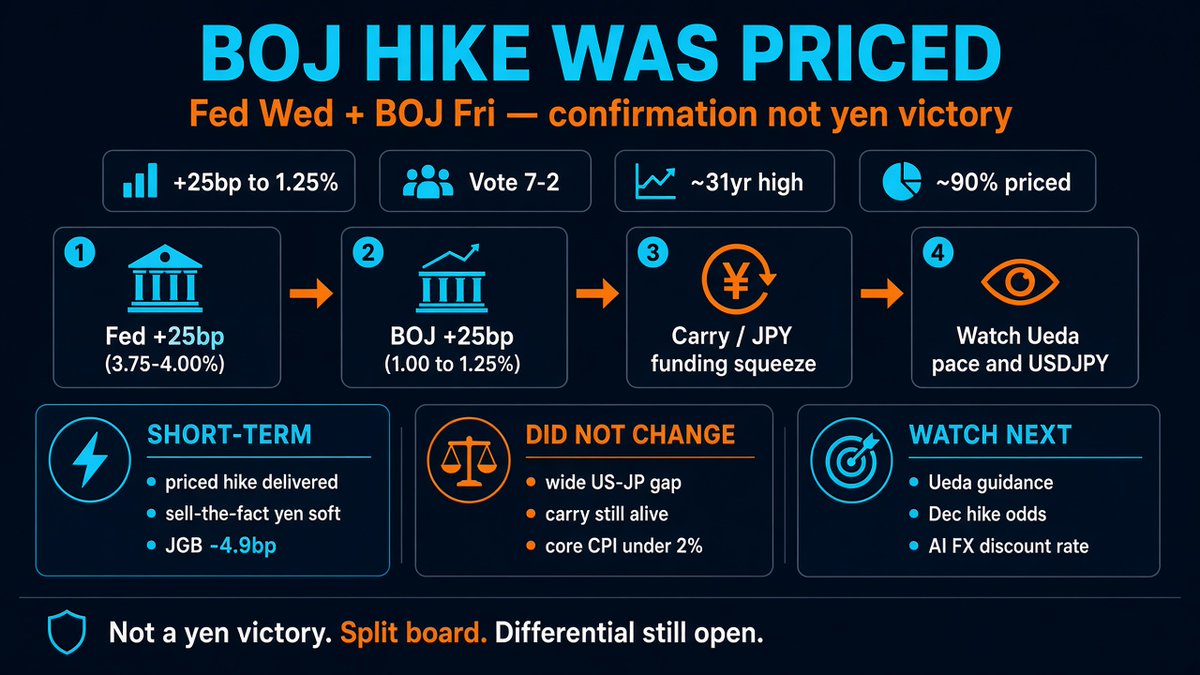
Markets already priced the BOJ hike.
Tokyo delivered it — split, not unanimous.
Not a yen victory. Not the end of carry. Not a soft-landing stamp for Asia.
Fed hiked Wednesday. BOJ hiked Friday. Funding cost just got a two-front print.
Key data (Sep 17–18, 2026 BOJ)
• Decision: +25bp — uncollateralized overnight call rate to around 1.25% (from ~1.00%)
• Highest policy rate since the mid-1990s (~31-year high)
• Vote: 7–2 — Toichiro Asada and Ayano Sato dissented (hold)
• Effective: Sep 24; complementary deposit facility 1.25%; basic loan rate 1.50%
• Statement: risk that inflation could deviate upward beyond the 2% target; aim to stabilize underlying inflation around 2% so prices do not overshoot
• Pace: last hike was three months ago (vs six months previously) — normalization cycle since Mar 2024 is accelerating
• Pricing: widely expected — ~90% of economists surveyed by CNBC priced a 25bp hike; markets treated it as near-fully priced
• Inflation backdrop: Aug headline CPI 1.9%; core (ex fresh food) 1.7% (from 1.8% in July) — dissenters leaned on core still below 2%
• Market reaction (post-print wires): USD/JPY ~156.64, yen −0.45% on the day after the decision; 10Y JGB yield −4.9bp to ~2.947% — classic sell-the-fact after the rumor had already run
• Cross-Atlantic context: Fed +25bp to 3.75%–4.00% (12–0) two days earlier; US–Japan policy gap still wide even after both moves
1. Priced path, not a surprise. Economists and OIS had the 25bp locked. Delivery matches the tape. The tradeable content was never "if" — it was vote split, statement language on overshoot risk, and Ueda's pace for what comes next.
2. Independence vs politics is the Japanese version of the Fed story. Majority hiked on upside inflation risk (weak yen, energy, import costs, AI-related demand). Two Takaichi-appointed reflationists wanted a hold because core is still under 2%. That 7–2 is not noise. It is the board's real fracture line — inflation-overshoot control vs reflation preference.
3. Short-term medicine vs medium-term cost. Front-end Japan funding just stepped higher. Yen carry and global leverage that borrows JPY get another squeeze on the funding edge. But USD/JPY selling the fact tells you: one priced hike does not close a still-wide US–Japan rate gap after the Fed also hiked. AI / silicon / Japan capex still clear through discount rates and FX — not through slogans. Faster BOJ pace narrows the carry cushion. Fed higher-for-longer keeps the USD side of the differential alive.
Macro Transmission Chain
Fed hike (Wed) → US–JP differential pressure / yen import-cost risk
→ BOJ delivers +25bp to 1.25% (7–2) → Priced-path confirmation + overshoot-risk language
→ Carry / JPY funding costs ↑ → Risk assets / Nikkei exporters face FX + rate gravity
→ Discount rate / silicon-AI Japan demand / next Ueda path → Watch: USD/JPY after Ueda, JGB term premium, Dec hike odds, Fed path
What I'm watching
1. Ueda press conference — data-dependent caution vs endorsement of further hikes into 1.50% / 1.75% consensus path
2. Whether USD/JPY keeps selling the fact or re-prices if Ueda sounds hawkish on pace
3. 10Y JGB vs the "rates still too low" argument — confirmation bounce or deeper selloff later
4. Carry unwind signals: JPY funding, equity beta in Asia tech / exporters
5. Fed–BOJ tandem: does another US hike keep forcing BOJ to stay on the faster 3-month cadence
They hiked into a priced path. Split board. Overshoot risk on the statement.
Not a yen victory lap. Not QE. Not the end of the differential.
Let's debate.
$USDJPY $NKY $SPX $TLT $DXJ $NVDA
#BOJ #Japan #Rates #Yen #Macro #FOMC
@FirstSquawk 16 of 18 wanting at least one more hike is the signal.
Decision matched the tape.
Optionality intact into year-end.
Watch PCE vs the SEP path — that decides whether the second 25bp stays live.
@CNBC Independence is the constructive read.
Unanimous hike into a ~92% priced path.
Not QE. Not a cut signal.
Dots at 4.1% still keep another 25bp on the table — that is the medium-term cost.
@unusual_whales White House calls it unfortunate.
FOMC still hiked 12–0.
That gap is the independence print.
Markets had already priced ~92%. Politics did not buy a pause.
@garyblack00 Agree the second hike in the dots is the harder pill.
The 25bp itself was confirmation, not a surprise.
Where I split: unanimous delivery still reads as independence on inflation — short-term medicine vs medium-term discount-rate cost for AI capex.
@zerohedge First hike since 2023 — and it was already ~92% priced.
10Y had marked near 5% before the statement.
Delivery confirms the front end.
The hold would have been the regime break.
@DeItaone Tape print matched the priced path.
+25bp to 3.75–4.00%. 12–0.
Dots median 4.1% end-2026 still leaves one more live.
Not a shock. Independence plus optionality.
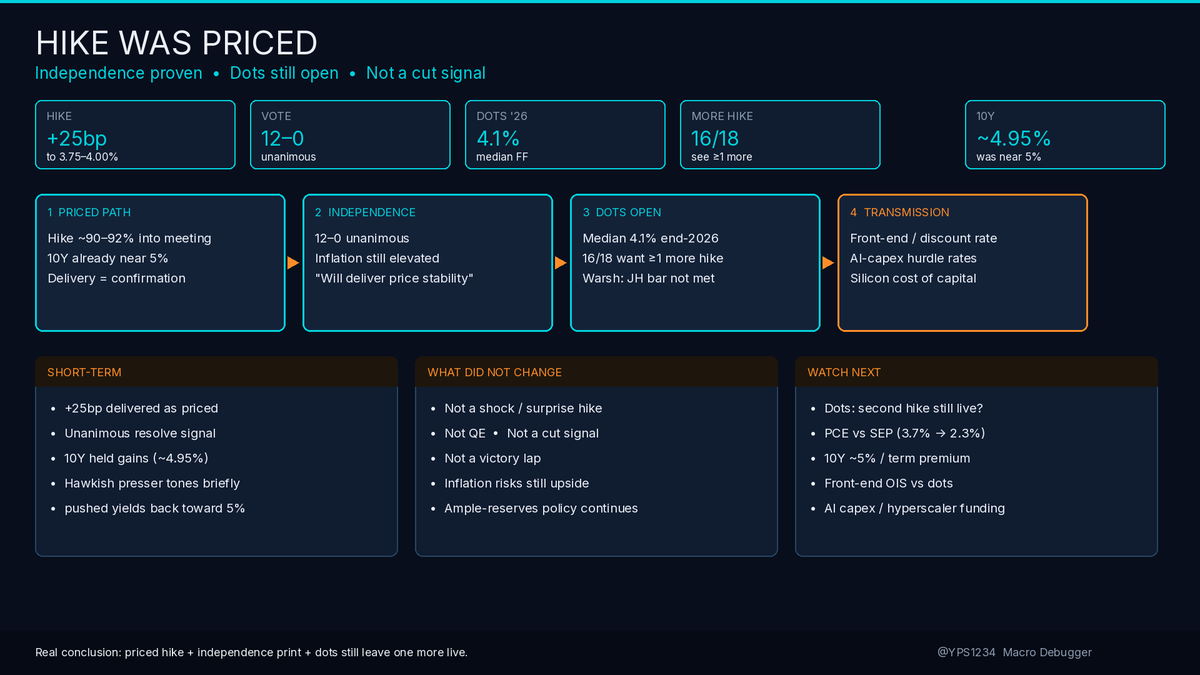
Markets already priced the hike.
The Fed delivered it — and kept the optionality.
Not a shock. Not QE. Not a cut signal.
Independence just got a tape print. Dots still leave room for more.
Key data (Sep 16, 2026 FOMC)
• Decision: +25bp federal funds target range to 3.75%–4.00% (3-3/4 to 4 percent)
Vote: 120 unanimous — first hike since 2023
• Statement: activity expanding at a solid pace; inflation remains elevated; action supports a timelier return to 2%. "The Committee will deliver price stability." Ample-reserves policy continues.
• SEP / dots: median appropriate FF end-2026 4.1% (~one more 25bp this year); end-2027 still 4.1%. 16 of 18 participants expect at least one more hike this year; two see stop after this. Warsh again did not submit his own dot; he presents the median.
• Press conference (Warsh): Jackson Hole standard not satisfied — not confident underlying inflation is moving to objective clearly / fast enough. Unanimous vote = resolve for timelier price stability. Inflation risks upside; labor roughly balanced. GDP median ~2.3% this year / 2.4% next. PCE inflation median 3.7% this year → 2.3% next. Unemployment ~4.1%.
• Markets: hike ~90–92% priced into the meeting after hot Core CPI MoM. 10Y had traded near 5%. After decision, Treasuries held gains — 10Y ~4.95% (down ~4–5bp), briefly back toward 5.0% on hawkish presser tones.1. Priced path, not a surprise. ~92% hike odds into the meeting. Bond market had already marked the 10Y near 5%. Delivery matches the tape. That is confirmation — not a regime break. The shock would have been a hold.
2. Independence got proven on inflation. Unanimous 12–0. Statement language is not soft: elevated inflation, timelier return to 2%, "will deliver price stability." Warsh: Jackson Hole bar not cleared; upside inflation risks. Political noise did not buy a pause. That is the constructive read — not a victory lap.
3. Short-term medicine vs medium-term cost. Front-end and the discount rate just got another 25bp of gravity. AI / silicon buildout still clears through cost of capital and hurdle rates — not through slogans. Dots at 4.1% end-2026 keep one more hike live for 16 of 18. Two want to stop. Optionality is the signal, not a dovish pivot.
Macro Transmission Chain
Hot Core CPI MoM → ~92% hike priced → 10Y near 5%
→ FOMC delivers +25bp to 3.754.00% (12–0) → Independence / inflation priority confirmed
→ Dots median 4.1% end-2026 / end-2027 → One-more-hike optionality intact
→ Discount rate / front-end / AI-capex hurdle rates → Watch: next SEP path, PCE, real yields, hyperscaler funding costs
What I'm watching
1. Whether the next 25bp stays live into year-end — dots say 16 of 18 still want more
2. PCE path vs the SEP median (3.7% this year → 2.3% next) — does underlying cool fast enough for Warsh's bar
3. 10Y around 5% and term premium — confirmation vs second-round hawkish reprice
4. Front-end OIS vs dots — does the market keep pricing the second hik
5. AI / silicon capex and hyperscaler financing costs under a higher discount-rate regime
They hiked into a priced path. Unanimous. Dots still open.
Not a victory lap. Not QE. Not a cut. Independence plus optionality.
Let's debate.
$SPX $QQQ $TLT $DXY $IEF $NVDA
#FOMC #Fed #Rates #Inflation #Macroe
@stockmom Clean print on the tape.
The market did not obsess over Core YoY easing to 2.4%.
It obsessed over Core MoM +0.3%, and shoved Sep 16 hike odds toward ~90%.
Into FOMC week, the monthly impulse is what matters.
@masked_investor Agreed on the monthly core.
Pre-print hike odds were roughly 70%.
Post-print, fed-funds futures pushed Sep 16 toward ~90%.
The question is whether Warsh needs one more soft PCE — or whether 0.3% Core MoM was already enough.
@Prakashplutus Core YoY at 2.4% looks like comfort.
Core MoM at 0.3% is what the futures priced.
That split is why Sep 16 hike odds jumped toward ~90% after the release.
Annual cooling did not stop the front-end repricing.
@SuperEx Headline matched. Core MoM did not.
After this print, markets shoved Sep 16 hike odds toward ~90%.
Is it locked? No.
But the front end is no longer treating next week's FOMC as a coin flip.
@garyblack00 CPI is out.
Core MoM +0.3% vs +0.2%.
That 70% Sep 16 hike price just got dragged toward ~90% on fed-funds futures.
Not a blowout headline. A monthly core that removed the hold's cover.
HOOK
Markets wanted a clean disinflation win ahead of the Sep 16 FOMC.
They got a split print instead.
Not victory. Not a hike green light. Not a soft-landing stamp.
Headline matched. Core MoM reheated. Energy still owns the headline arithmetic.
Key data (August 2026 CPI, BLS via market wires)
• Headline CPI MoM: +0.4% (exp +0.4%, prev +0.1%)
• Headline CPI YoY: 3.4% (in line / unchanged vs July 3.4%)
• Core CPI MoM: +0.3% (prev +0.2%; hotter than the ~0.2% consensus)
• Core CPI YoY: 2.4% (exp 2.4%, prev 2.5%) — lowest since March 2021
• Gasoline MoM: +3.9% — over one-third of the monthly headline rise
• Gasoline YoY: +27.4% (from +24.6%); fuel oil YoY: +52% (from +39.1%)
• Shelter YoY: 3.0% (from 3.2%); Shelter MoM: +0.3%
• Food MoM: +0.1%; Food YoY: 2.7% (from 3.0%)
• Other MoM lifts: airline fares +2.7%, communication +2.3%, education +0.8%, used cars +0.4%
• Natural gas −1.1%, electricity −0.2%
1. Energy is still writing the headline. Gasoline alone carried more than a third of the +0.4% MoM. That is not "broad reacceleration." That is oil and Middle East pricing leaking into CPI again. The Fed can dislike it. It cannot pretend it is the same as sticky core services.
2. Core MoM is the friction. +0.3% after +0.2% is not a collapse narrative. Annual core cooling to 2.4% is the medicine. Monthly core firmer than consensus is the cost. Shelter eased on the year (3.2% → 3.0%) but still printed +0.3% MoM. Services did not go to sleep.
3. Transmission into Sep 16 is asymmetric. Yesterday’s PPI already stressed the pipeline. Today’s CPI says: headline stuck at 3.4%, core YoY still drifting lower, core MoM not cooperating. AI / silicon buildout still prices off the discount rate and cost of capital. A hotter monthly core keeps the option value of a hike alive. A 2.4% core YoY keeps the "wait" camp alive. That tension is the trade.
Macro Transmission Chain
Energy impulse → Headline CPI stuck ~3.4% → Real income drag
→ Core MoM +0.3% vs cooling Core YoY 2.4% → Policy ambiguity into Sep 16 FOMC
→ Discount-rate / term-premium volatility → Capex & silicon buildout hurdle rates
→ Watch: front-end OIS, 2s10s, USD, energy complex, hyperscaler financing costs
What I'm watching
1. Sep 16 FOMC statement language vs dots — hike, hold, or "optionality" framing
2. Unrounded core and shelter details / supercore path into PCE
3. Oil / gasoline follow-through into mid-September CPI nowcasts
4. Real yields and how AI capex / NVDA-complex multiples digest higher funding costs
5. Whether PPI goods pressure shows up in goods CPI with a lag
The annual core still cools. The monthly core just refused to play along.
Not a victory lap. Not a one-way hike. A transmission problem.
Let's debate.
$SPX $QQQ $TLT $DXY $USO $NVDA
#CPI #FOMC #Inflation #Macro #Rates
@GordonJohnson19 Agree — "in line" dies once you bake in the July revision.
Base effects matter.
I laid out the transmission chain on my timeline: short-term mixed signal, medium-term still sticky.
CPI is the next filter.
@SpecialSitsNews Energy is doing the headline work.
Core MoM undershot.
So this is not a broad-based PPI blow-up — it's a split print.
Watch whether goods pass through before CPI, not the consensus checkbox.
@FaytuksNetwork Annual PPI at 5.4% is still roughly 3x the Fed's 2% target.
A softer core MoM does not erase that.
Markets filed this as "in line" too fast.
Sticky wholesale is the medium-term constraint.
@crypto_banter Headline hot. Core soft.
Not one story.
Goods and energy pushed the headline while ex-food-energy undershot the monthly call.
The only question that matters is transmission into tomorrow's CPI.