Decentralized AI solutions will be key to Universal Basic Income (UBI) when robots start taking over. Our personal data will be our income.
Don't give away your data so freely - it will be worth more than your life someday.
@_k_a_r_r_a_@georgegalloway "Let me help Israel achieve its objectives by letting them and the US destroy my bases, my infrastructure and my people - and our leadership" 🤦🏽
I assume you also believe that Russia destroyed its own Nord Stream pipeline like the "official" story stated?
Federal Reserve purchases of US Treasuries 1-year or less just surpassed $500 billion.
Back in December 2025 Jerome Powell claimed this intervention was necessary because of a potential liquidity shortage in April 2026 tax season.
We are now 3 months after tax season and the Fed is still purchasing roughly $40 billion worth of T-Bills per month.
The only other time we've seen interventions like this was in the lead up to the 2020 "virus" that they used to cover up the REPO banking crisis.
We still have no idea what's going on here or why the Federal Reserve continues to massively intervene.
@BrettErickson28 So sad. Looks like the only way this ends is a regime change in either Iran or Israel/US. Living in the 21st century and still believing war is necessary - with all the tech and diplomacy that exists in the world - there are a select few that still choose war.
NEAR now has a public revenue dashboard.
Track protocol fees, product revenue, and how usage offsets $NEAR emissions—live and onchain.
https://t.co/FMaouk6gY6 ↓
Sequoia partner @sonyatweetybird says we're going from the age of product-led growth to the age of agent-led growth.
"You see this most clearly if you're using Claude Code actively. It says, 'Hey, for a database, you should use Supabase. For hosting, use Vercel.' It's choosing for you, the stuff you should be using."
"Product-led growth brought us closer to the vision of 'best product wins,' but ultimately people are still lazy. They can't read all the reviews, and they kind of default to what looks cool on the website."
"Whereas your agent has infinite time to go and make these choices for you. It can go and read all the documentation, read all the user comments, and figure out [what you need] for your use case."
> be demis hassabis
> spawn in london
> age 4, become child chess prodigy
> win chess tournaments
> reach ~2300 elo
> face danish chess champion
> game lasts hours
> position is a forced draw
> too exhausted to see it
> resign
> danish guy laughs and shows the draw
> feel sick to my stomach
> realise something is wrong
> chess is too narrow a problem
> brilliant minds wasting decades on it
> decide not to become a chess pro
> buy a computer with chess winnings
> teach self to program from books
> start hacking on games with friends
> decide to finish school early
> apply to cambridge age 16
> cambridge says you're too young
> forced to take a gap year
> enter a video game coding competition
> win
> get invited to join bullfrog game studio
> too young to be legally employed
> work there anyway
> build ai system inside theme park game
> game becomes a global hit
> turn 17
> offered £1,000,000 to stay and build games
> turn it down
> go to cambridge anyway
> decide games aren't enough
> study computer science
> interested in agi since 2007
> most people laugh at this idea
> realise brain is only form of agi we have
> want to learn more about human brain
> go back to school
> study neuroscience
> realise academia moves too slow
> decide to build a company instead
> start deepmind
> pitch “solve intelligence”
> investors don’t know what that means
> get to meet peter thiel for one minute
> wonder how to convince him
> spend one minute playing chess with him
> pitch "solve intelligence" again
> he invests
> go into total stealth mode for two years
> no website
> secret office
> candidates think it’s a scam
> start to train ai in simulated environments
> train ai with reinforcement learning
> train ai on pong first
> it sucks
> can't win a single point
> keep trying
> wait it won a a point
> wait it's winning every single point
> it actually works
> expand to train on any two-player game
> chess first, then move on to go
> beats world champion at go
> beats pros at starcraft
> games is not enough
> want to push into science
> realise compute is the bottleneck
> know this will take decades
> google offers ~$400m
> not the highest price
> but they offer unlimited compute
> accept
> refuse to become a product team
> stay in research mode
> determined to use ai for good
> need to figure out what's next
> land on protein folding
> 50-year-old unsolved science problem
> many great minds have tried and failed
> "good luck"
> start up alphafold
> try to solve protein folding
> humans take years to find 1 protein structure
> alphafold can find ~5 per day
> submit results, win competition
> not good enough
> hire more scientists
> rebuild it
> go from solving one per day to millions per day
> create invaluable system
> pharma would pay anything
> have to decide what to do with this
> could sell access for usage
> maybe make it a paid service
> remember childhood chess tournament
> remember why we built this
> decide to give it away all away for free
> publish all known protein structures publicly
> win nobel peace prize
> just the beginning towards agi
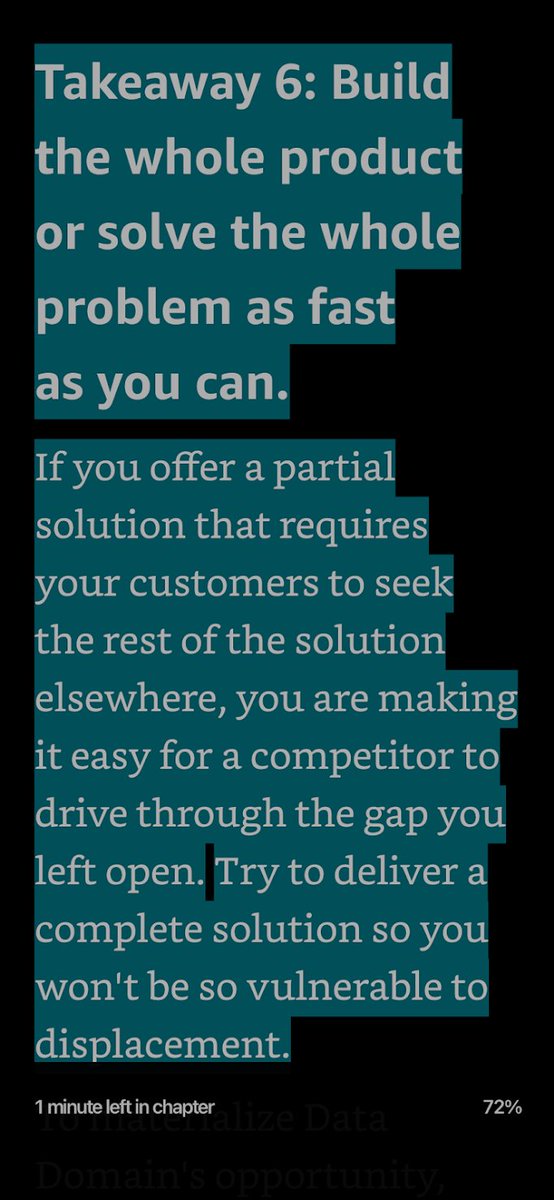
Solving the whole problem works because it lets you own the workflow. Tools improve steps, but workflows shape daily behavior and decisions. When a company becomes the system customers work inside every day, expansion is easier and competitors matter less
BUILD THE WHOLE PRODUCT
If you're a startup CEO, you should think deeply about what Frank Slootman says : "Build the Whole Product, or solve the Whole Problem as fast as you can".
In 2026, the biggest winners will be companies who realize that fragmented experiences don't serve the customer well, and will solve the entire end to end problem for their customer. Customers are tired of stitching together five tools that each do 80% of what they need. They want one solution that does 100% of what they need.
Fearless, visionary entrepreneurs will build a whole solution for their customer segment, even if it means that solution has to compete across multiple categories, including with entrenched incumbents.
Now this doesn't mean they will solve the whole problem for EVERYONE from day one. They will choose very specific customer segments (size, geography, vertical, behavior, etc) and solve the entire problem for that segment, and do it 10x better than the customer could do by cobbling together several systems. And then they will expand concentrically from that initial segment.
One of the best examples is Square, which took on decades-old incumbents in payment processing, hardware terminals and POS, and built a hardware + software system that solved the entire problem for micromerchants. Not just software, but also custom hardware that the team built from scratch, despite having zero hardware experience. Why? Because hardware was critical to deliver the whole solution. By doing so, they "compressed" the value chain across 3 industries, and instead of the customer needing to feed 3 profit pools for payments, hardware and POS, they only needed to pay one company, leading to a much lower Total Cost of Ownership.
If you're an entrepreneur tackling a WHOLE problem and building a WHOLE product, please ping me. I'd love to connect and chat.
this is one of the clearest explanations of why prediction markets matter that I’ve seen.
Vitalik is basically saying:
> prediction markets aren’t about gambling, they’re about forcing accountability into beliefs.
> on social media, people get rewarded for being loud, extreme, and wrong.
whereas on prediction markets, you get punished for being wrong and that flips incentives completely.
> what’s powerful here is the idea that markets discipline narratives.
you can scream "this will definitely happen" on X and get likes, but the moment you have to put money behind it, uncertainty suddenly matters.
that’s why prediction markets feel healthier than most info ecosystems:
> lies are costly
> confidence has a price
> reality settles arguments
they don’t eliminate misinformation, but they price and that alone makes them one of the most honest coordination tools we’ve ever built.
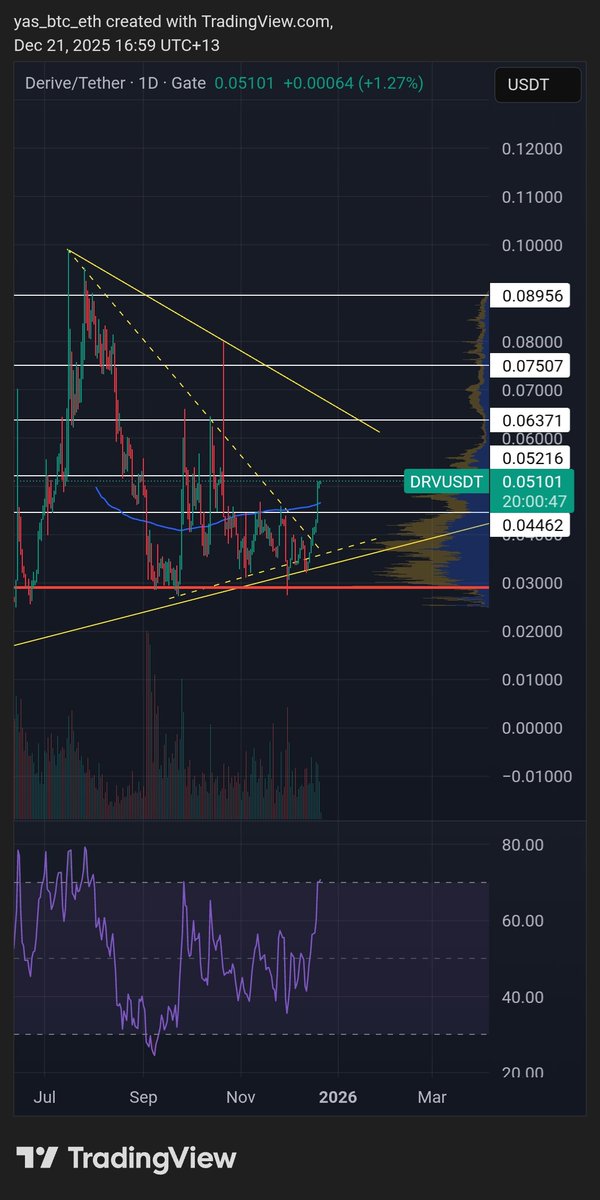
No one talking about $DRV - TA is set up to go on a major uptrend the next few months as we are likely starting our Wave 1 on the daily. Breaking $0.063 and that yellow trend line above confirms a huge DRV season coming @DeriveXYZ LG
nailed it. and captured why exactly vibes are so bad.
crypto people didn't want to compete with the real world. they were tricked by the subsidy provided by a neverending rising tide that made crypto apps easy to monetize even without pmf. that subsidy is going away, so they're upset. now they have to beat web2 guys. and that's hard and not that sexy.
@TheVolOfGeorge I think you're going to be surprised with how $DRV performs the next couple months. TA looking strong and fundamentals is only getting better as users, revenue, etc. Go up
The global yield crisis:
Global 10+ year government bond yields have jumped to 3.9%, the highest since 2009.
World bond yields have are now 5.6 TIMES above the 2020 pandemic low.
This comes as the cost of long-term borrowing has surged across major economies, including the US, Japan, the UK, Canada, Germany, and Australia.
Japan's 40Y and 30Y Government Bond Yields have rapidly risen to 3.71% and 3.38%, the highest since their debuts in 1999 and 2007.
At the same time, the German 30Y yield has surged to 3.46%, the highest since July 2011.
Investors are increasingly demand higher compensation due to rising global debt levels and falling conviction about further rate cuts worldwide.
The era of cheap money for governments is over.
@TheVolOfGeorge@OfVoice25355 All this and its still ~$3m FDV. Pumped to $22m or so and now it looks like it's bottomed. So TA and fundamentals are sound.
@TheVolOfGeorge $ADM @OfVoice25355 is my other one I'm super bullish on. Founder raised $25m to bring institutional level DeFi for retail. He ex Coinbase, has the connects and stablecoin yield platforms will have a run sometime soon. Also, theyre not listed on any exchange - no marketing either
To keep things simple, my core view is that I am very bullish on options flow into the crypto market, especially as crypto becomes more integrated with traditional finance (TradFi).
Options volumes in TradFi typically make up around 3.7 times that of futures volumes, meaning the options market is the dominant derivative market. Currently, the crypto futures market is approximately 60 times larger than the options market. I believe that the crypto options market will not only catch up but will surpass futures, becoming the larger derivatives market within the next five years. Therefore, betting on a leading crypto options platform is a solid investment.
Secondarily, platforms like Hyperliquid have caused significant disruption outside of the typical crypto native circles, even if many within the space haven't fully realized the impact yet. The advent of a truly pure, open, and permissionless on-chain DEX is a genuine game-changer for the future of finance. The market is now actively hunting for the next successful "Hyperliquid-type" decentralized exchange.
This brings me to Derive. After extensive research both as a user and through code review of various platforms it's clear to me that Derive has the best development team in the crypto options space. Particularly when considering that the codebase of some competing platforms appears sketchy to me from reading their code
Sorry that this was a massive answer 😂😂