Thank you for contacting PalmPay. Please be informed that our network is currently working.
However, we strongly recommend that you seek the services of a much stronger network provider; if issues persist, please send us a screenshot of the error message via DM. Thanks, GB.
DANGOTE REFINERY'S ACCUSATION OF SABOTAGE VS PENGASSAN'S SUPPORT FOR THE NIGERIAN ENGINEERS IN DPRP.
1.
Dangote Refinery's accusation of sabotage against Nigerian workers is a ploy to deceive the public. @akintollgate@SirJarus@IU_Wakilii@Morris_Monye
Growing up as a dependent of a Shell mgmt staff in the 80s and 90s, I can tell you categorically how PENGASSAN played a direct role in the quality of life of Local employees. In 1989, a SHELL Manager stationed in PH in Drilling, Well Engineering or Production dept had a take home pay of about N4,000 - N5,000/month and the exchange rate was N2/$.
This meant they earned about $2,000 - $2,500 per month before PAYEE. Deductions for housing, vehicles or other items were deducted from payroll. On the other hand expatriates from the Netherlands or UK or U.S. were earning $17,000 - $21,000 USD per month for the same position and qualifications while enjoying zero debits for all local expenses.
PENGASSAN was the only mechanism to challenge the management of SPDC at the time to review this unusual compensation model.
Local employees sent on cross posting to these same countries were not earning as much as their foreign counterparts who were sent to Nigeria, however they earned significantly more on foreign rotations that were about 4–6yrs in durations.
In 1995-96 there was a collective bargain agreement that resulted in the adjustment of local employee salaries at the time the USD was devaluated from N22/$ to N70/$.
Once again it was PENGASSAN that rose to the occasion. The local oil economy saw a boom with higher wages for local staff, introduction of car loan programs and purchases of new vehicle fleet for mgmt and senior staff, housing loans and several perks.
Organized labour can be effective and pro-business. Today I hear the same expatriate vs local attitudes may have returned. I am sure others can contribute to this post.
The mass dismissal has drawn criticism as a betrayal of Nigerian workers, especially after Aliko Dangote recently praised local engineers for outperforming their foreign counterparts.
Many now accuse the refinery of hypocrisy for retaining expatriates while letting Nigerians go.
Amid Nigeria’s fragile economy under President Tinubu, the development raises fears of growing unemployment, job insecurity, and an escalating labour crisis across the energy sector.
This is reprehensible. Dangote Petroleum & Petrochemical Refinery is abusing “reorganisation” as a smokescreen for deep injustice and systemic suppression.
To Dangote management:
• You betray trust by casting people aside without fair process.
A Thread 📌
@kidqudzy@IU_Wakilii This is a disgrace. Dangote Petroleum & Petrochemical Refinery’s move to mass-terminate staff under the pretext of “reorganisation” is blatant oppression — not reform.
To the management:
– You deny staff dignity, welfare, security.
– You silence their voice, deny their...
Between Investment Protection and Workers’ Rights: The Untold Struggles at the Dangote Refinery 2.
After listening to more information, I am directing this second piece to the Nigerian Content Development and Monitoring Board @OfficialNCDMB , the Federal Ministry of Labour and Employment, and the Government of the Federal Republic of Nigeria,
The recent mass termination of Nigerian engineers at the Dangote Petroleum Refinery has been explained away by management as a response to sabotage. However, testimonies from staff members paint a very different picture; one that points to years of poor working conditions, unfair labour practices, and pay disparities that undermine Nigeria’s local content aspirations.
Staff recruited across various batches, revealed that a level 9 step 3 engineer earns as little as ₦383,000 monthly. Even with shift allowances, total pay rarely exceeds ₦500K. In an industry where safety is paramount, personal protective equipment (PPEs) were reportedly issued only once, forcing workers to buy replacements from their pockets when worn out. Such alleged neglect of welfare and hazard protection stands far below the acceptable minimum standard for oil and gas operations.
In fact, the unannounced resignation of the refinery’s Chief Operating Officer, David Bird, further highlights these concerns. Known for promoting Nigerians within the refinery, it is elleged that he left due to the worsening staff welfare situation. Yet, despite his efforts, Nigerian engineers continue to earn a fraction of their expatriate colleagues’ salaries. While local staff struggle with ₦383,000, their Indian counterparts reportedly earn no less than $2,000 (around ₦3,000,000) monthly, even though a lot of them are Diploma holders. This fosters resentment and erode morale.
The situation came to a head when staff sought to exercise their right to unionize by joining the Petroleum and Natural Gas Senior Staff Association of Nigeria (PENGASSAN). Management, however, threatened them, insisting that because they operated within a Free Trade Zone, they could not join any trade union. PENGASSAN nevertheless registered hundreds of staff and formally wrote to the refinery. The response was punitive: workers were forced to declare whether or not they had registered, shift buses were withdrawn, and many were denied access to the refinery before their official termination letters were released.
This raises troubling questions. If sabotage truly occurred, can the management of Dangote Refinery explain what it was and who was culpable? Why were Dangote Fertiliser staff, who also joined PENGASSAN, not sacked? Is it because the fertiliser plant depends on locals for over 90% of its operations, while the refinery, being largely run by expatriates, can afford to dispense with Nigerian engineers? The selective application of punitive measures suggests that this is less about sabotage and more about silencing Nigerian workers who dared to seek fair treatment.
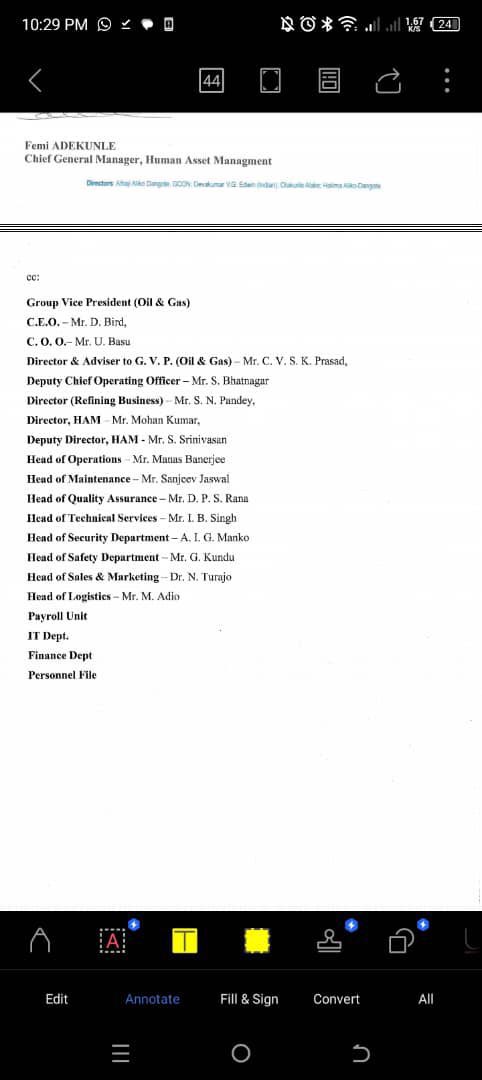
Now, a new management directive signed by Manas, a senior official of the refinery, has been released in response to the “manning crisis” caused by Nigerian staff not reporting to work. It reads:
•“All leaves of expats are cancelled until further notice. Anyone needing leave on genuine emergency will have to talk to me.”
•“Six (6) days work (12 hours) plus one day off to be followed in every unit until normalisation.”
This order confirms the depth of the crisis. With Nigerian engineers disengaged or locked out, expatriates are being overstretched to fill the gap. Rather than solving the crisis, such directives create unsustainable pressure on expatriates, deepen the divide between local and foreign staff, and expose the refinery’s overdependence on foreign labour. It further reveals that the termination of Nigerians was not a matter of discipline alone but a miscalculation with serious operational consequences.
@Realoilsheikh@OfficialNCDMB 🚨 OUTRAGEOUS!
@DangoteGroup Refinery has issued a blanket TERMINATION of staff under the guise of “reorganisation”.
But here’s the truth:
⚠️ Welfare of workers = NEGLECTED
⚠️ Right of association = SUPPRESSED
⚠️ Safety concerns = WEAPONIZED against staff