Qwen 3.6 27B dropped yesterday. We wired it into GhostDesk.
In the demo: an AI agent reads our Gmail, finds the referenced GitHub issue, analyzes the ticket, and drafts a reply. 100% local, zero API, zero glue code.
The agent doesn't plug into your apps. It uses them. Screen, clicks, keyboard — from inside its own sandboxed desktop.
A few lines of prompt, and it's running.
MCP server, works with Claude Code / Cursor / VSCode / OpenCode. Self-hosted. Model of your choice — this one runs Qwen 3.6 27B locally.
🎥 Demo ⬇️
🔗 https://t.co/bXA4rNZIfl🔗 https://t.co/eGwKElHp8a
Meet LiteRT.js: @Google’s new Edge AI runtime for the web! ✨
We've made it easier to convert from PyTorch to #WebAI using the common LiteRT model format. Powered by #WebGPU, WebAssembly, & #WebNN! Time to upgrade from TensorFlow.js and build the future.
Read more ➡️ https://t.co/1TcWVrUsuA
@JulienChieze Le problème le plus important, c’est que si tu pars vivre à l’étranger après avoir acheté un jeu dématérialisé, il devient impossible de transférer ton compte vers le pays où tu as déménagé. C’est un vrai problème pour le jeu dématérialisé !
Je rejoins votre point, mais je le formulerais autrement. Si les grandes entreprises américaines — les GAFA et bien d’autres — ont émergé, ce n’est pas grâce à l’État : c’est parce qu’elles évoluent dans un cadre favorable, fait d’une vraie culture entrepreneuriale, d’une fiscalité équilibrée et de règles plus justes.
En France, c’est l’inverse : la pression fiscale est telle qu’investir devient décourageant. C’est précisément là qu’il faudrait commencer la réflexion.
As a result of a US government directive, we are suspending access to Claude Fable 5 for all users. You can continue to use all other Claude models.
Here’s what this means for you:
Across Claude products, new sessions will run on your selected default model or Opus 4.8, and existing Fable 5 sessions will end with an error.
On the Claude Platform, requests to Fable 5 will also return an error. Please update your integrations to other Claude models.
We know this is a disruption to your workflows; we appreciate your patience and support.
The US government, citing national security authorities, has issued an export control directive to suspend all access to Fable 5 and Mythos 5 by any foreign national, whether inside or outside the United States, including foreign national Anthropic employees.
The net effect of this order is that we must abruptly disable Fable 5 and Mythos 5 for all our customers to ensure compliance.
Access to all other Claude models is not affected.
We apologize for this disruption to our customers. We believe this is a misunderstanding and are working to restore access as soon as possible.
Read our full statement: https://t.co/bwn0sximKZ
For over 20 years, we've dedicated ourselves to removing language barriers so people can learn, speak and connect more deeply than ever before.
Today, we’re taking our next step with the release of Gemini 3.5 Live Translate — our latest audio model for live, speech-to-speech translation across 70+ languages. 🧵
Introducing Claude Fable 5: a Mythos-class model that we’ve made safe for general use.
Its capabilities exceed those of any model we’ve ever made generally available.
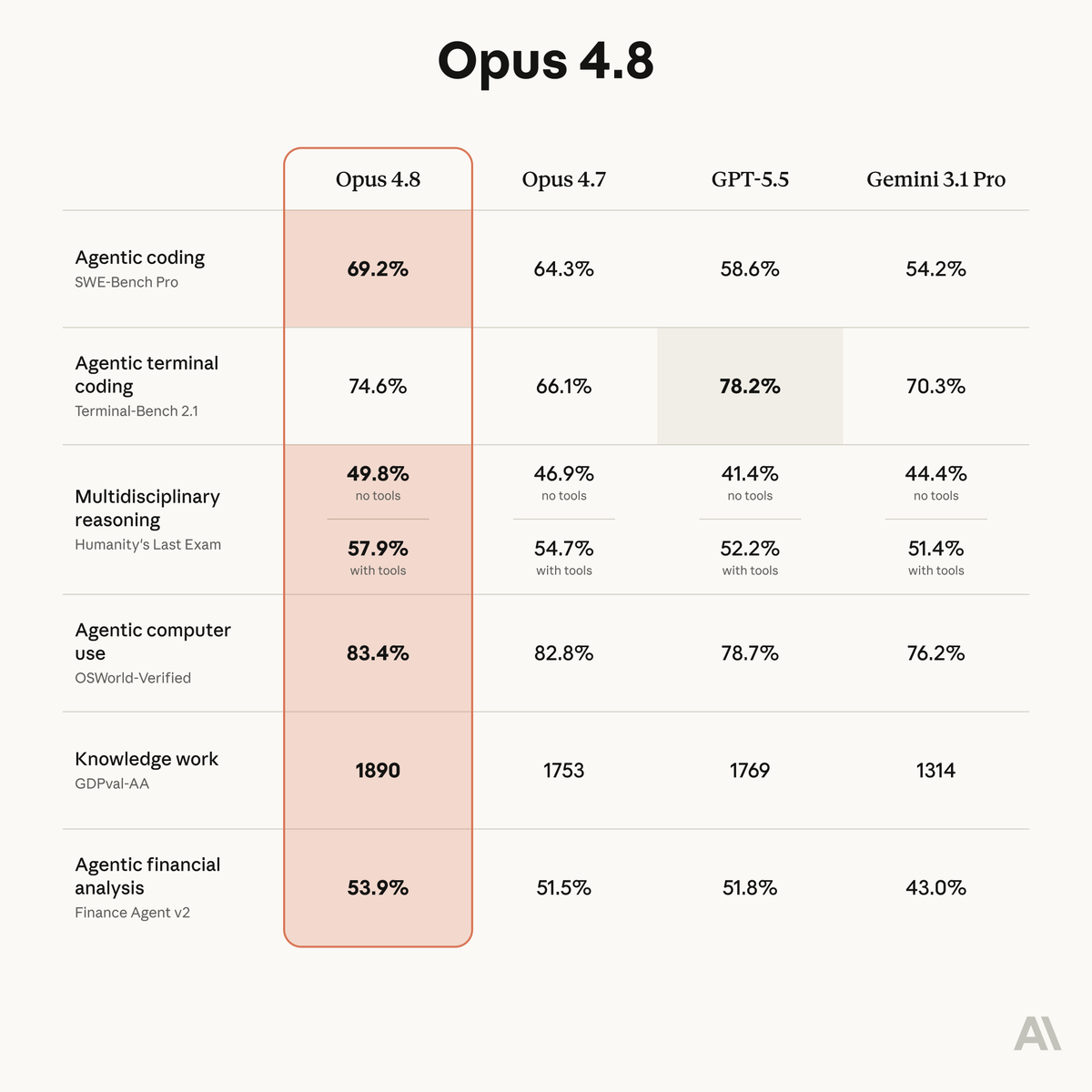
Introducing Claude Opus 4.8: it builds on Opus 4.7 with sharper judgment, more honesty about its own progress, and the ability to work independently for longer than its predecessors.
Available today at the same price.
I've seen some confusion online on how to run llama.cpp with MTP (Multi-token prediction) in the simplest way possible.
ICYMI, MTP is a new flavor of speculative decoding built-in to the model itself, that ~2x your tokens per sec for most use cases.
2x generation speed = Truly a game changer. 🔥
How to run it?
brew upgrade llama.cpp
# or you might need to install from source until build 9200 is in your package manager:
brew install llama.cpp --HEAD
Then pick either the Dense 27B or the 35B A3B MoE.
Personally I tend to stick to the Dense model where I achieve ~30 tok/sec on my machine. The MoE is of course way faster at an impressive ~100 tok/sec on my machine. Truly rapid. ⚡️
In both cases you probably want 48GB or better 64GB RAM or VRAM, though 36GB might work with more strongly-quantized versions.
# Dense:
llama-server -hf ggml-org/Qwen3.6-27B-MTP-GGUF --spec-type draft-mtp --spec-draft-n-max 2
# MoE:
llama-server -hf ggml-org/Qwen3.6-35B-A3B-MTP-GGUF --spec-type draft-mtp --spec-draft-n-max 3
Enjoy!
We just released something new: Luce PFlash
Long-context prefill is a silent killer for throughput speed. llama.cpp takes ~257 seconds to prefill 128K tokens of Qwen3.6-27B on a single RTX 3090. So we tried to solve the problem.
A small Qwen3-0.6B drafter loads in-process, scores token importance across the whole prompt, and the heavy 27B target only prefills the spans that matter. 128K prompt in 24.8 seconds, ~10.4x faster TTFT, NIAH retrieval preserved at every measured context.
It is a clean C++/CUDA port of FlashPrefill wired through Block-Sparse Attention, with a custom Qwen3-0.6B BF16 forward so drafter and target share one ggml allocator. The whole thing is a single daemon command (compress) in front of the existing dflash spec-decode stack.
More details here: https://t.co/DLIrzbomN2
Today we’re releasing Qwen-Scope 🔭, an open suite of sparse autoencoders for the Qwen model family. It turns SAE features into practical tools:
🎯 Inference — Steer model outputs by directly manipulating internal features, no prompt engineering needed
📂 Data — Classify & synthesize targeted data with minimal seed examples, boosting long-tail capabilities
🏋️ Training — Trace code-switching & repetitive generation back to their source, fix them at the root
📊 Evaluation — Analyze feature activation patterns to select smarter benchmarks and cut redundancy
We hope the community uses Qwen-Scope to uncover new mechanisms inside Qwen models and build applications beyond what we explored.Excited to see what you build! 🚀
🔗🔗
Blog: https://t.co/ndwiE1tnb9
HuggingFace: https://t.co/1kICpK8eXG
ModelScope: https://t.co/U7v1FjmPaW
Technical Report: https://t.co/CZMjEZK0sa
That moment when you boot into the main menu of your childhood..
Cross-compiled Warsmash (a LibGDX-based Warcraft III engine reimplementation in Java) to JavaScript using TeaVM so the whole game runs directly in the browser, with map files served from OPFS. Still some quirks left but great progress.
Credits to Retera for his hard work.
#Warcraft3 #RetroGaming #Gamedev #TeaVM #LibGDX #WebGL #Java #OpenSource #BrowserGaming #IndieDev #RTS
Most LLMs can play chess if you feed them coordinates.
Fewer can open a chess UI, read the board from pixels, and move the mouse themselves.
Qwen 3.6 27B, running locally, doing exactly that through GhostDesk.
🔗 https://t.co/TAUe2Zv71z
🔗 https://t.co/l77Hk8fDVt