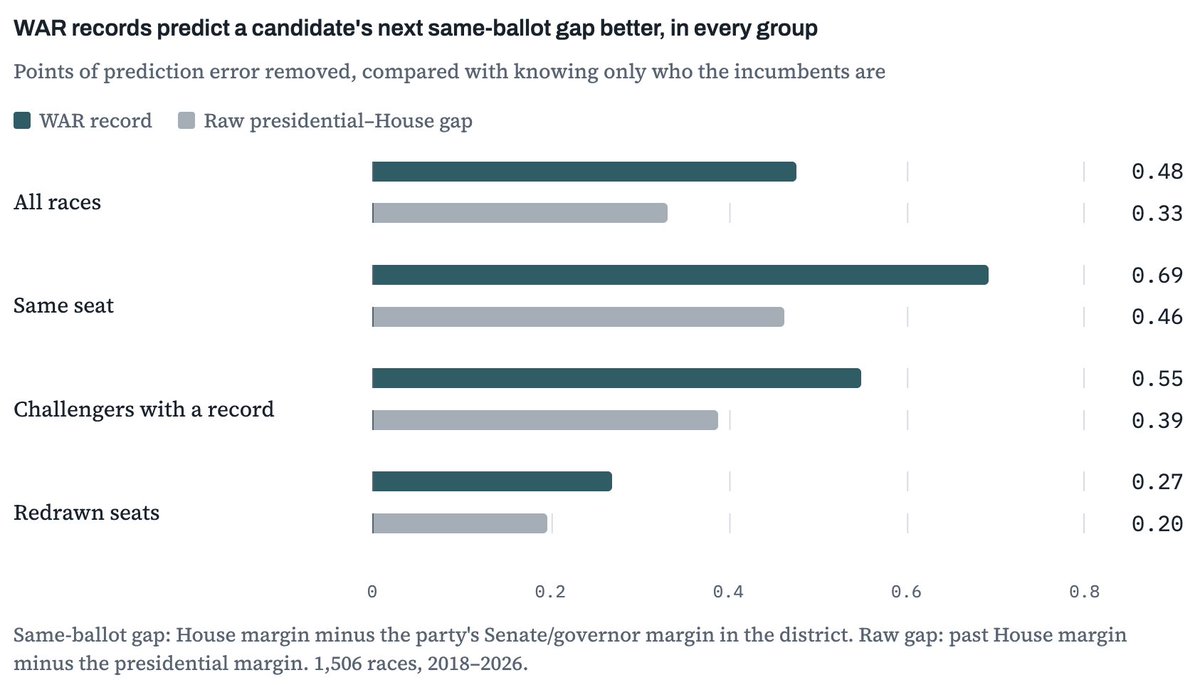
I mostly try to stay out of the WAR wars re: candidate selection. But to be clear, one side of that debate is almost ... denialist. Yes, candidate strengths exist; they can be measured (imperfectly) and predicted to some degree.
Here's something WAR predicts well: future same-ballot overperformance ("how much will Cuellar outrun Hinojosa by, compared to the average TX Democrat?")
A candidate's prior WAR tells you a lot about how they'll run against their party's Senate/governor nominees in the future.
We're honored to be profiled by @Inc.
The story looks at @VoteHub's rapid growth, our expanding role in election media, and the work that went into covering the 2026 midterms.
https://t.co/ojh7snRsUI
@stogachess Ashley Moody has now been the strongest-performing Republican on Florida's statewide ballot for *three consecutive* cycles. To borrow Billy Beane's age-old question: "If she's such a terrible candidate, why doesn't she perform badly?"
I will wade into the Democratic candidate quality discussion to make what I think is an important point.
In my view, progressive U.S. Senate candidates faced a particularly difficult mix of circumstances in 2026, and simply measuring their performance against the 2024 presidential results misses much of that context.
Merkley had to deal with a weak Democratic gubernatorial performance in Oregon; Flanagan with Minnesota's fraud scandal; Nixon with a strong candidate in Moody and a Florida electorate shifting right amid domestic migration; and of course Troy Jackson with Susan Collins.
Over time you would expect this to "even out" where just looking at swing from a previous Presidential election in a midterm year would be useful. But I think it's pretty clear on a case-by-case basis progressives just had to deal with disproportionately tough headwinds in 2026.
Split Ticket's WAR metric from @lxeagle17 generally does a *very* good job of accounting for these contextual factors, particularly in Minnesota and Oregon.
Full Thoughts on Abdul El-Sayed's Performance in Michigan
I think 2026 Michigan is really complicated, so buckle up and please read the whole post before drawing conclusions.
On the one hand, AES probably underperformed by about 4-5 points based on the 2026 national environment, 2024 presidential results, demographic shifts, and incumbency. But I don't think you can just label him a 5-point underperformer and move on. He finished only 4 points behind Benson, who has a history of strong electoral performances. He also came out of a late, heavily contested primary against someone who had been the presumptive nominee for months, where Democratic money and organizing was divided for a long time.
Michigan was also a relatively weak state for Democrats overall, after accounting for its 2024 results and the national environment. I have the generic U.S. House vote about 1.8 points more Republican than expected. We're still waiting on the full data, but my initial analysis suggests this was largely because Republican turnout was stronger than we'd expect given the races on the ballot.
It's possible that one aspect of AES as a candidate was that he helped energize the GOP base and pulled down Democrats across the ballot, including Benson. I can't prove a causal pathway (AES on ballot -> stronger than expected GOP turnout) from these numbers alone, and maybe there's another simple explanation I'm missing. But I have trouble thinking of one that fits as well. The left has long argued that progressives can energize the Democratic base enough to offset small persuasion losses. In Michigan this year, we instead saw unusually favorable turnout dynamics for Republicans compared to the nation as a whole. But again, I don't think that's something you can take at face value and move on from. Republicans poured attention (Fox News mentions) and money into opposing AES, and those resources had to come from somewhere. Any focus on turning out Republicans against him wasn't going toward opposing Annie Andrews and boosting GOP turnout in South Carolina, for example. And, this happened against a backdrop of really weak Republican turnout and enthusiasm across much of the country. In 2026, in states like Louisiana, Tennessee, and North Carolina we saw Republicans just get lulled to sleep, given the remarkably weak enthusiasm among young and low-propensity Republican voters. This year's unusual dynamics make me skeptical about just how much we can generalize to future elections, even if we accept that AES's presence on the ballot helped drive up GOP turnout.
And I really want to emphasize that AES did reasonably well on persuasion relative to Benson and Michigan House Democrats. "Democrats for Rogers" just wasn't much of a thing at all. The harder question is how much AES contributed to the turnout dynamics that hurt Democrats across Michigan, and how generalizable this is in the future.
@Ethanfracisco AOC ran about even with the top of the ticket despite being an incumbent who outspent her opponent 48:1. That puts her WAR slightly below average, since incumbents with that spending advantage typically outrun a generic candidate. Overall, WAR was decent for the left this year!
@honestlygfy@Ethanfracisco@RileyTX DAC ran ~3.5-4 points behind the top of the ticket in an ancestrally D district and spent $1.5 million while her opponent didn't even file with the FEC. R+6 WAR is about spot on and clearly reasonable, and any model that says something less than R+5 would be clearly wrong!
EV data traditionally isn't included in polls + fundamentals forecasts, and was not at all in ours this year (or anyone else's).
We did make an experimental version of our forecast including EV in key areas for a client this year, which was substantially better than our public forecast. I am not sure sure what we will do in 2028.
Early voting helped us anticipate North Carolina's gerrymander unraveling, with Democrats flipping Trump+15 seats. But it's not just counting Democrats and Republicans: we offer a look behind the curtain at *how* we identified the national Democratic turnout advantage.
Early voting showed Democrats turning out less frequent voters while Republicans stayed home. In this piece, we explain how we identified those patterns and what they told us about the electorate before Election Day.
https://t.co/84uf2e3RHv
Early voting showed Democrats turning out less frequent voters while Republicans stayed home. In this piece, we explain how we identified those patterns and what they told us about the electorate before Election Day.
https://t.co/84uf2e3RHv
Building this was not easy and took multiple 4AM nights, so I really hope people find it useful! For researchers, academics, and nerds: we have a full, downloadable candidate quality database for all federal elections between 2014 and 2026, viewable here.
https://t.co/Wnl69vFo9W
Lakshya’s WAR model is such a creative and important project in election analysis, and it gets better every cycle. Measuring candidate quality in midterm years is incredibly hard, and Lakshya is the best in the world at it! The care and work he puts into this model really show.
Building this was not easy and took multiple 4AM nights, so I really hope people find it useful! For researchers, academics, and nerds: we have a full, downloadable candidate quality database for all federal elections between 2014 and 2026, viewable here.
https://t.co/Wnl69vFo9W