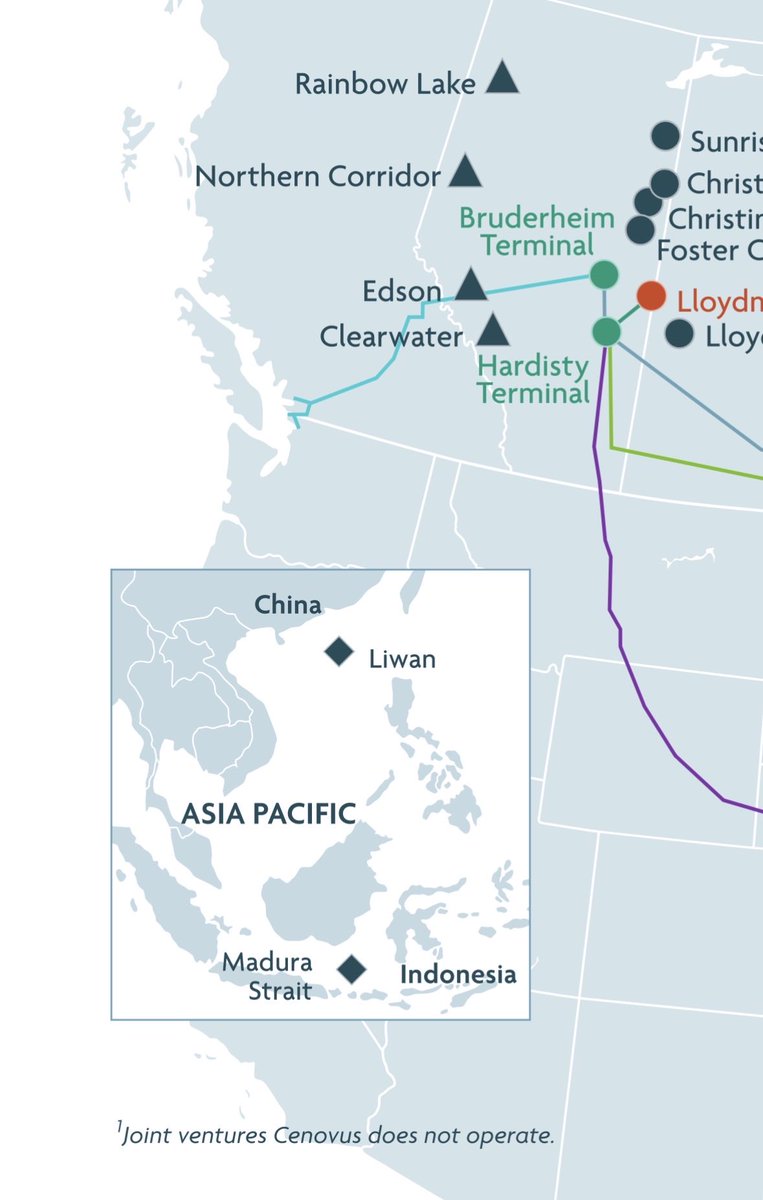
"I have heard some proponents of the carbon tax defend it by suggesting that the world will require decarbonized oil barrels going forward. To be honest, Cenovus places over one million barrels a day across three continents, and none of our customers have ever suggested or even asked about the carbon intensity of Canadian crudes.
If customers were willing to pay for decarbonized barrels, we would certainly see these price signals and not require government interference.
The carbon tax escalates through time, making our industry less resilient at lower commodity prices, and will require the premature shut-in and reclamation of oil producing projects that would otherwise be economic to produce.
Much of this is being orchestrated in the belief that we can build a functioning carbon market. The reality is that carbon markets are a political construct and there are no examples of functioning, enduring, or investible carbon markets to draw from." /5
@ExnerPirot I didn’t see any note on AB retaining their 100k tCO2e annual threshold to define an industrial emitter through this MOU. Did I miss this?
The discussion paper on Carbon Markets the feds released in Dec 2025 would include essentially all O&G facilities, regardless of size.
Cenovus has literally been operating in Asia for over a decade. I think they know better than Carney how much of a premium their customers and partners in Asia are willing to pay for Canadian heavy oil with carbon capture, and I’m guessing it’s zero.
1. It’s an expectation only in the EU market, and they’re walking it back
2. Almost all of Canada’s oil exports go to USA and Asia
3. No one is paying a premium based on carbon intensity anywhere
4. Our barrels are already very climate competitive with other heavy oil producers Venezuela, Mexico and Iraq
Totally ignores that proponents have indeed proposed 1.3mbd in new pipeline egress. There is a a business case and the global market is desperate for more Canadian barrels.
But the pipeline that would help us double non-US exports and cement Asian alliances has a tanker ban and a $20B carbon capture project and an obstinate Premier attached to it! We’ve actively made it risky.
@timhodgsonmt The rushed publication of new federal methane regulations in Dec 25' without proper industry engagement & the release of a discussion document on carbon markets that essentially moves the industrial emitter threshold to 0 tCO2e/yr for OG sites does the opposite of what you state.
Putin says Russia ready to supply Europe as Iran war sparks energy crisis
Those who want to restrict Canadian oil and gas production aren’t reducing global demand, they’re increasing Russian supply. Please, let’s be the ones to meet our allies’ needs!
https://t.co/F1bnaUTI0L
This is important. Federal modelling of energy demand and production has justified many ambitious/expensive policies, and has assumed declines in fossil fuels. It has a terrible track record. Here is the hit and a miss in natural gas demand from CER scenarios in 2007, 2016 & 2021.
“We’re doubling down on electrification. Because that’s where capital is going in the world.”
A generous take is that EVs looked like a good industrial policy bet 4 years ago and lots of countries did it.
But in 2026 to undertake no calibration and accept no changes in calculus? C’mon
Carney govt trips to China and India, and the speech in Davos, bolstered hopes we’re serious about being an energy superpower.
Meanwhile in Canada, ECCC has been adding new policies and proposals that are killing investment certainty at home. My latest:
https://t.co/2IIYZlNJCA
We’ve got to stop conflating everything with being an energy superpower.
Solar and EVs have their place but they don’t contribute to superpower status, which is about market power and geopolitical influence and is derived primarily from oil exports.
LNG and uranium contribute.
what most Canadians don’t realize is that this GST credit expansion will cost taxpayers approx. $9.4B.
it will juice demand in a grocery market with tight supply and a few dominant players, with a real risk that prices will adjust, rather than providing relief. it's a measure that will be electorally popular with voters in a (possible) spring election but will have little structural impact.
if the goal were really to lower prices, we’d be forcing more competition, speeding new store and warehouse approvals, fixing logistics, and raising productivity instead of mailing cheques.
Half (47%) of CPP's portfolio is concentrated in the United States. 12% is invested in Canada. Boomers and pensioners should be very keen to establish trade certainty with the US. Neglecting this reality might be convenient domestic politics, but it's irresponsible. #cdnpoli
Sorry, I have to remind everyone that Eby said literally all these same things about TMX from 2017-20.
Earlier this week he supported its expansion because it's safe and extremely important to the economy.
https://t.co/nKvmYRsVjI
IEA now says oil consumption could grow to 2050
While oil demand was set to plateau or fall this decade in all scenarios the IEA examined last year, the latest report reintroduces a “Current Policies Scenario” in which consumption rises 13% by 2050.
https://t.co/iddnTYaIis