We’re excited to share that @zcure/sdk has reached 53 downloads and is already being explored and used by builders in the Solana ecosystem.
This is an early milestone for the Zcure Ghost Protocol SDK, and we’re grateful to everyone who has installed, tested, and started building with it.
Github: https://t.co/pYXhvX1iGm
NPM: https://t.co/OMtuNgT66b
Our goal is simple: make it easier for Solana developers to bring ZK-powered privacy into their applications with clean, accessible tooling.
We’re still actively developing the SDK, improving the developer experience, and expanding what builders can do with it. There is much more coming ahead, including new features that will be introduced in future releases.
Thank you to the builders supporting and experimenting with $ZCURE.
Progress update for $ZCURE Wallet.
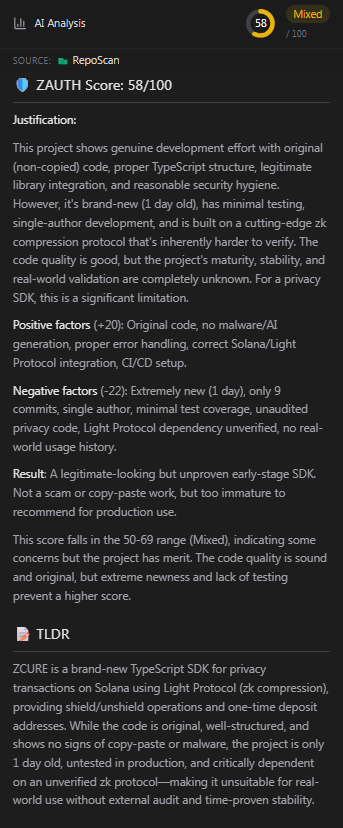
We rescanned the repo with @zauthinc RepoScan and improved the previous score to 58/100.
Still early. Still not where we want it to be, but this is meaningful progress:
- cleaner security posture
- better dependency hygiene
- CI/CD added
- tests added
- clearer documentation
- removed misleading privacy claims
- improved implementation around one-time deposit addresses
Zauth still flags valid concerns: new repo, minimal test coverage, single contributor, no production track record, and privacy architecture still needs maturity.
$ZCURE is still very young. The current score is not a victory lap, it is a checkpoint.
We will keep improving the SDK step by step:
more tests, clearer threat model, stronger privacy architecture, better docs, and more real-world validation.
Shout out to @zauthinc for making these signals visible.
Transparency first. Build in public. Keep going.
Inside the $ZCURE SDK Architecture
@zcure/sdk is being built as a developer-facing layer for integrating ZK-powered privacy into Solana applications.
The architecture is designed to keep the builder experience clean:
1. A Solana application connects to @zcure/sdk
2. The SDK handles client methods, privacy logic, and transaction building
3. Proof and compression workflows connect with @LightProtocol
4. Final transactions and state updates settle on Solana Mainnet
Builders connect their app or backend to the SDK, use the client layer to access privacy methods and transaction building, then route proof and compression workflows through Light Protocol before final settlement on Solana.
The goal is to abstract complex privacy infrastructure without hiding the architecture from developers.
With 53 downloads so far, we’re grateful to see Solana builders exploring the SDK at this early stage.
More features are coming soon.
Progress update for $ZCURE Wallet.
We rescanned the repo with @zauthinc RepoScan and improved the previous score to 58/100.
Still early. Still not where we want it to be, but this is meaningful progress:
- cleaner security posture
- better dependency hygiene
- CI/CD added
- tests added
- clearer documentation
- removed misleading privacy claims
- improved implementation around one-time deposit addresses
Zauth still flags valid concerns: new repo, minimal test coverage, single contributor, no production track record, and privacy architecture still needs maturity.
$ZCURE is still very young. The current score is not a victory lap, it is a checkpoint.
We will keep improving the SDK step by step:
more tests, clearer threat model, stronger privacy architecture, better docs, and more real-world validation.
Shout out to @zauthinc for making these signals visible.
Transparency first. Build in public. Keep going.
Appreciate the support and the push, @zauthinc.
RepoScan gave us a clear signal, and this follow-up gives us a stronger direction.
We believe privacy infrastructure should be held to high security standards from day one.
We’ll take the next step seriously, continue improving, and make sure $ZCURE becomes more reliable for every builder integrating privacy on Solana.
@ZcureGates Go a step further and secure your web app with an agentic penetration test.
Better performance than our billion dollar competitor at a fraction of the price.
https://t.co/EQgC8VY9Hv
Thank you to everyone who reviewed our project through @zauthinc RepoScan and shared honest feedback with us.
We acknowledge the current score is not where it should be, and we take this seriously.
Our team will review the findings, improve the codebase, strengthen the SDK, and address the issues properly so builders can use our SDK with more trust and confidence.
NPM: https://t.co/OMtuNgT66b
Our mission remains the same: to help expand the privacy layer on Solana and make privacy infrastructure more accessible for everyone.
Feedback like this helps us build better.
We appreciate the community for holding us accountable.
Unshield Assets With $ZCURE
Demo 2: unshielding tokens from the privacy vault.
In this video, the asset that was previously shielded is opened back up and sent to the $ZCURE dev wallet address.
This flow shows that assets are not permanently locked. Users can shield assets to enter private mode, then unshield them back to a public wallet whenever needed.
With ZCURE, privacy does not mean losing control.
Users can:
> connect an existing Solana wallet
> create a new wallet
> shield assets
> unshield assets back to a destination wallet
All flows are backed by verifiable on-chain transaction proof.
Connect or Create a Solana Wallet
$ZCURE supports Solana wallets from multiple platforms.
You can connect the wallet you already use, such as @phantom, @Backpack, @solflare, or other Solana wallets.
You can also create a new wallet directly inside $ZCURE.
A wallet created on ZCURE is fully portable. You can import it into Phantom or Backpack using:
> seed phrase
> private key
So you are free to choose: connect an existing wallet, or start fresh with a new $ZCURE wallet.
Next, we’ll show how SOL assets can be shielded into the privacy vault with on-chain transaction proof.
Shield Assets With $ZCURE
We shielding assets using the ZCURE dev wallet.
In this video, we show the process of moving SOL from a public wallet into the privacy vault.
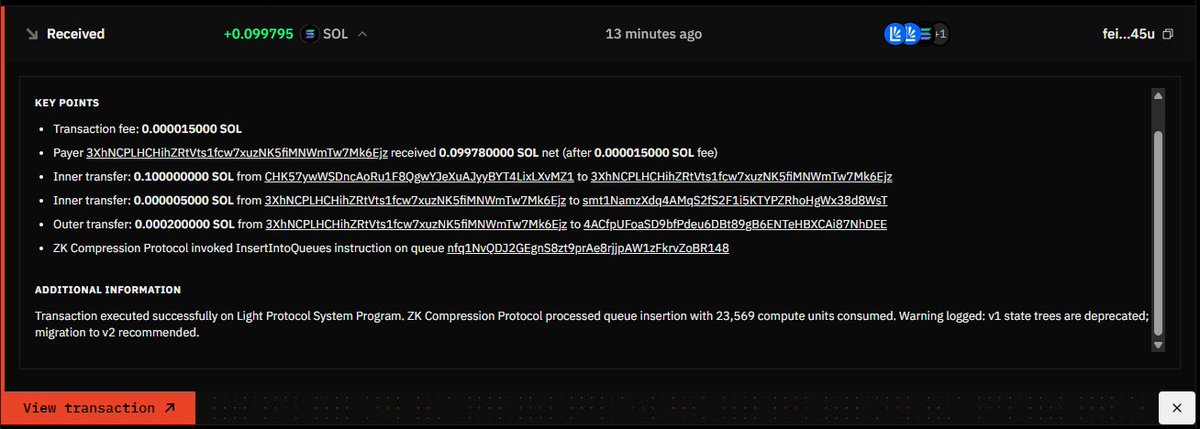
Once the shield transaction is completed, it can still be verified on-chain as proof that the asset entered the @LightProtocol flow.
What changes is the privacy layer: the asset moves into an encrypted/private state, while the user remains fully in control of the wallet and transaction process.
We’re also preparing a video demo showing how $ZCURE utilities are used directly inside the app.
This is only the beginning of the $ZCURE.
Next, we’re expanding into a privacy social layer where every wallet can connect, communicate, and interact without exposing its full identity graph.
Privacy is becoming app infrastructure.
Build with it before users start demanding it.
For Solana builders, this one is for you.
The official ZCURE SDK already live on @npmjs.
Add ZK-powered privacy flows to Solana apps with a few lines of TypeScript:
npm install @zcure/sdk @solana/web3.js
The SDK supports:
- Shield public SOL into private compressed balances
- Unshield private balances back to public SOL
- Private transfers
- Private balance queries
- Stealth address generation
- Client-side, non-custodial key flow
Built with @LightProtocol primitives for state compression and validity proofs.
Docs/package:
https://t.co/OMtuNgT66b
GitHub:
https://t.co/pYXhvX1iGm
Privacy is becoming app infrastructure. Build with it before users start demanding it.
You don’t need to understand ZK, compression, or wallet graph analysis to use privacy.
You just need to know this:
Your wallet should not expose your whole financial life forever.
With $ZCURE, users can shield SOL, move privately, check private balances, and unshield when they need to go public again.
Simple flow:
1. Open the app
2. Connect wallet
3. Shield your assets
4. Transact with privacy
5. Unshield anytime
Privacy should feel as easy as using a normal Solana app.
Just zcure it: https://t.co/q5KrNdK5ul
7/ $ZCURE is the native utility and governance token of this ecosystem.
It aligns users, liquidity providers, builders, and governance around one thesis:
Privacy is not optional infrastructure.
It is the next Solana primitive.
1/ What is $ZCURE?
ZCURE is the Obscured Protocol for Unlinkable Sovereignty on Solana.
The mission is simple:
make on-chain activity private enough to feel like under control.
6/ View keys matter too.
Privacy does not mean zero accountability.
Users can selectively reveal history when needed, without making their entire wallet public forever.