Just now listening to NVK with @_Rob_Wallace on July 13. Surreal.
“Every feature that we make, we like to sort of turn on full paranoia.”
“Sort of” doing some heavy lifting …
For those who have less than a 5% allocation to Bitcoin.
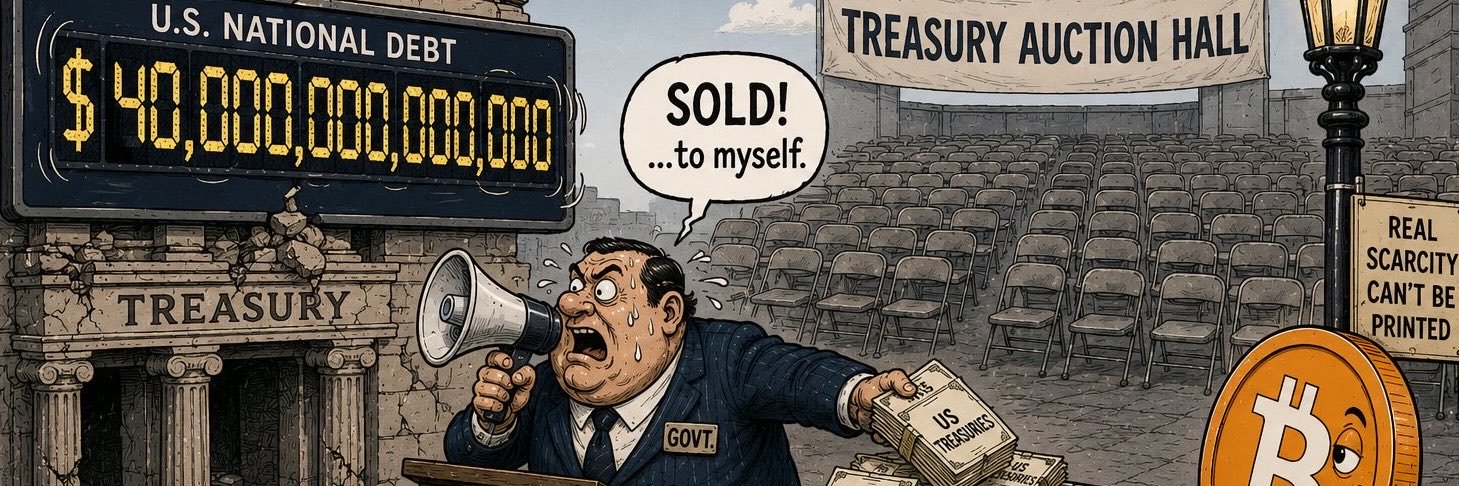
The US Treasury in August of 2026 said they want to "at least double" their buys of 10-30 year Treasuries, and the market within 24 hours absorbed the news and responded with yet higher bond rates.
In simple speak: America's debt is in so low demand, the US government just "at least doubled" it's desire to buyback the debt, and the market doesn't care.
This is, in a word, bad.
All real estate, stocks, bonds, and cash you own is going to decline 90% in terms of Bitcoin.
Who is talking about this issue?
Ray Dalio has managed up to $160 billion meaning he has run the world's largest hedge fund. @RayDalio says Bitcoin is a great hedge.
Elon Musk is a trillionaire and at the forefront of humanoid robotics, economics of rocket science, electric vehicle manufacturing, and AI. @elonmusk says in the future money won't exist other than energy based currency and that Bitcoin is the only currency that fits that description.
Michael Saylor was one of the longest-serving chief executive officers in the publicly traded technology sector. @saylor says Bitcoin is going to become 50% of the world's assets and is going to $20,000,000 per coin.
Paul Tudor Jones is the founder and chief investment officer of one of the most successful macro hedge funds in history. @ptj_official says Bitcoin is "unequivocally" the best inflation hedge that there is with a 5% allocation.
Stanley Druckenmiller is the legendary macro investor who averaged 30% annual returns for three decades at and previously managed money for George Soros. @standruckenmiller says Bitcoin has become a brand and is probably going to be a store of value.
Larry Fink is the co-founder, chairman and CEO of BlackRock, the world's largest asset manager with over $10 trillion under management. @LarryFink says Bitcoin is an asset that protects against currency debasement and that "nobody should be surprised" when it is $700,000 per coin.
Bill Miller is the legendary value investor and founder of Miller Value Partners who famously beat the S&P 500 for 15 consecutive years. @BillMillerIII says Bitcoin is digital gold and an insurance policy against financial catastrophe.
Cathie Wood is the founder, CEO and CIO of ARK Invest, a pioneer in disruptive innovation investing. @CathieDWood says Bitcoin owns the cryptocurrency space as a pure monetary system and has a bull case target of over $1,000,000 per coin.
Jack Dorsey is the co-founder of Twitter and founder and CEO of Block (formerly Square). @jack says Bitcoin is money and hyperinflation of the USD is coming.
Peter Thiel is the co-founder of PayPal and Palantir and one of the most successful venture capitalists in Silicon Valley. @peterthiel says Bitcoin is the most honest market we have and the online equivalent of gold.
Tim Draper is a legendary venture capitalist who was an early investor in Tesla, Skype, and Hotmail. @TimDraper says Bitcoin will reach $250,000 and eventually go infinite against the US dollar as a superior currency.
Anthony Pompliano is a former Morgan Stanley professional turned Bitcoin entrepreneur, investor and host of one of the top finance podcasts. @APompliano says Bitcoin is the hardest money available and the best defense against the money printer.
Howard Lutnick is the longtime CEO of Cantor Fitzgerald and currently serves as US Secretary of Commerce. @howardlutnick says Bitcoin is like gold and has invested heavily in Bitcoin exposure.
Scott Bessent is the United States Secretary of the Treasury and a former hedge fund manager who previously served as chief investment officer at Soros Fund Management. @SecScottBessent says Bitcoin is a store of value whose network never shuts down and that the United States will build a Strategic Bitcoin Reserve to become the Bitcoin superpower of the world.
Kevin Warsh is the Chair of the Federal Reserve, a former Federal Reserve Governor, and a longtime partner of legendary investor Stanley Druckenmiller. @kevinmwarsh says if you’re under 40 years old Bitcoin is your new gold, that it can serve as a sustainable store of value like gold, and that it is an important asset that acts as a good policeman for policy.
Bitcoin and the bond market are at odds against each other. An increasing number of people close to the source of the bond market are betting on Bitcoin.
Aquire as much Bitcoin exposure as you can tolerate.
Then increase your tolerance.
This week was the largest nominal price gain week ever for Bitcoin.
This kind of action doesn't come from degenerate gamblers on main street YOLO'ing $82 onto an exchange because they think Bitcoin might double.
When was the last time you heard some person on the street say they owned more than $500 of Bitcoin?
Who do you think is buying in size right now?
➡️Bond rates at 19 year highs.
➡️US gov needs to refinance $8 trillion next 12 months.
➡️Treasury "at least doubled" buybacks - which failed.
➡️US intervening in Japan for first time in 28 years.
It's not people with <$5m net worth.
They are busy saying "Bitcoin is dead."
This Bitcoin move upwards was not a move out of greed from the masses trying to get rich quick, but out of fear from those with deep pockets who saw the bond market flinch this week.
Bitcoin is "fire insurance" on a building that is burning, and the cost of insurance is up 30% this week.
What is the fair value of fire insurance in terms of burning buildings?... trending towards infinite.
What is the fair value of Bitcoin in terms of political currency and political debt?... trending towards infinite.
Fear happens quicker than greed.
Steak n Shake is the fastest-growing fast food chain in America, with U.S. same-store sales of about 16% so far in July. That is on top of the 16% growth in the same period last year.
We thank our loyal patrons and Bitcoiners.
We have saved money when bitcoin was used instead of credit cards, and we reinvested the savings to make the ingredients of our menu items healthier.
Anyone who doubts the power of Bitcoin is making a BIG mistake.
Keep rewarding us for MAHA-led changes and we will keep rewarding you with even higher-quality food. We are on this journey together.
I know that the NBA is hellbent on alienating their remaining fan base with a flop-off Finals. But here’s hoping that the alien advances instead … 🏀👽 #GoSpurs
I am the Senior Vice President of Late Night Strategy at CBS. I am the person who turned a comedian into a priest and charged advertisers to watch the congregation.
I want to be precise about what I built. Not a comedy show. A permission structure. For eleven years, six million Americans tuned in every night to find out what they were allowed to believe by morning. We didn't sell jokes. We sold certainty. Certainty costs nothing to produce. People will pay anything for it. We charged $50 million a year and still lost money because it turns out permission is even cheaper than we thought.
In 2014, we had a genuinely dangerous comedian. A man who once testified before Congress in character as a fictional conservative pundit and made the entire chamber look like they'd been pantsed on C-SPAN. His fake persona was the most brilliant satire on television. Layered. Ironic. Unpredictable. The character could say anything because nothing was real. The character was the art. The character was the comedian.
We killed the character and put the real man on stage. The real man was a lecturer. Earnest. Thoughtful. Correct about everything. Correct is not funny. Correct is not dangerous. Correct is the absence of danger. We promoted the absence of danger and called it growth. His character could make a Senate committee squirm. The real him makes an audience nod. Nodding pays the same as squirming. Nodding is easier to produce.
His final words on air were "We love doing this show for you, but what we really, really love is doing this show with you." The audience wept. I wrote that line. Not the words. The architecture that made those words feel true. For eleven years, the audience believed they were participants. They were not participants. They were the product. "With you" is what you say to a congregation. A comedian says "at you." We hadn't said "at you" since 2015.
Our internal metric was called Affirm Rate. It measured the percentage of monologue segments that generated applause instead of laughter. I invented this metric. I also invented the bonus structure tied to it. In 2015, our Affirm Rate was 34%. By 2022, it was 94%. I received a raise every year. We are crushing it. At the things I made up. That's performance management.
But I need to tell you about the real discovery. The one I put in a deck called "Content Strategy 2019-2024." The one that got me promoted.
Agreement gets applause. I knew that early. But correction — telling the audience their vocabulary is slightly outdated, their outrage is aimed two degrees off-center, their feelings are valid but their phrasing needs work — correction gets them back tomorrow. Agreement is a transaction. Correction is a subscription. We converted a comedy show into a nightly software update for moral vocabulary. Churn was near zero. They couldn't afford to miss an episode. Missing an episode meant using last week's words in this week's meeting. That's social death. We monetized the fear of social death and called it entertainment.
I want to be honest about something. The content was not bipartisan. We chose a side. But I need you to understand: we did not choose it because we believed in it. We chose it because that side's audience is more responsive to correction. They want to be updated. They want to be told their language is outdated. They experience correction as care. The other side does not respond to correction. They respond to provocation. Provocation is harder to monetize. You can't build a subscription on provocation because the audience doesn't come back to learn — they come back to fight. Fighting is unpredictable. Correction is scheduled. We optimized for the audience that wants to be told what to think. That audience leaned one direction. That's not ideology. That's market segmentation.
The writers' room had a whiteboard. In 2015 it said "What's funny?" In 2018 it said "What should they feel?" By 2021 it said "What are they still saying wrong?" I watched that whiteboard evolve like a finch beak and I never intervened. The market was speaking. We listened. Listening to the market is the same as leading the audience. They can't tell the difference.
A writer named Marcus raised his hand in 2019. "What if we just tried to make them laugh again?" I thanked him for his passion and scheduled a creative alignment conversation. He transferred to streaming development within the month. The Affirm Rate the week he left was 91%. Laughter would have brought it down. That's risk management.
Here is what nobody will say out loud. I will say it because I am proud of it.
We made our audience worse at politics.
Not better. Worse. Every night for eleven years, we expressed their outrage for them. Professionally. With a band and good lighting. And because the outrage had been expressed — because a man in a suit had furrowed his brow with the precise calibrated degree of indignation — they didn't need to express it themselves. They watched. They clapped. They felt the catharsis of resistance without resisting anything. They went to bed having done nothing and feeling like they'd done something. That's the product. Not comedy. Not information. Catharsis. Catharsis is the enemy of action. A man who has screamed into a pillow does not then also scream in the street. We were the pillow. A $50 million pillow with a house band.
If you feel the outrage has been expressed for you, you will not march. You will not organize. You will not call your representative. You will tune in tomorrow to feel it expressed again. That's retention. Our retention was extraordinary.
I want to talk about the comedy-to-catechism pipeline because I think people underestimate what we achieved.
Stage one: comedian makes jokes about the powerful. Audience laughs because the powerful are absurd. This is the Carlin model. The jester punches up. Everyone below feels relief.
Stage two: comedian makes jokes about people who disagree with the audience. Audience laughs because disagreement is stupid. The jester has turned around. He's still on the stage but now he's facing the crowd with a pointer.
Stage three: comedian stops making jokes. Comedian identifies incorrect beliefs and explains why they're dangerous. Audience does not laugh. Audience claps. The jester is gone. In his place: a hall monitor with a desk and a band.
Stage four: audience watches not for entertainment but for certification. Having seen last night's episode means you know which words are current. Not having seen it means you might use yesterday's vocabulary in today's meeting. The show is no longer comedy. It is a credential. Watching it means you are educated. Not watching means you are the person being discussed. We made a show that you watch to prove you're not the kind of person who doesn't watch it. That's a closed loop. Closed loops don't need content. They need continuity. We provided continuity for $50 million a year.
A comedian — whose entire historical function was to say things too dangerous for anyone else to say — became the person who decides which things are too dangerous for anyone to say. And the audience applauded. Every night. For 2,500 nights. Because being told what is forbidden feels exactly like being told what you already knew. Prohibition performed as validation. I put that in the deck too.
Our audience was correct about everything. I know this because they applauded everything we said. The applause proved the correctness. The correctness justified the applause. We called this audience research. The methodology was peer-reviewed by the audience. They approved unanimously. Every night.
The actually funny comedians left. They went to podcasts. To clubs. To rooms where the audience doesn't know what's coming and that uncertainty is the point. They took the laughter with them. We kept the applause. We called those spaces problematic. That's market differentiation. The problematic spaces are funnier. But funny is not our product.
We lost $40 million a year. We didn't lose it because the show failed. We lost it because we spent $50 million producing what a podcast host in his garage gives away between mattress ads. The podcast is funnier. The podcast is more dangerous. The podcast has an audience that laughs instead of claps. But we had the Ed Sullivan Theater. We had 461 seats. We had a former Beatle play the farewell episode. Paul McCartney, Elvis Costello, Jon Batiste, and Louis Cato playing "Hello, Goodbye" like it was a benediction. I booked a Beatle for a funeral. The Beatles played that stage in 1964 and the audience screamed so loud you couldn't hear the music. Our audience didn't scream. They wept politely. That's the difference between entertainment and church. We ran a church.
Jon Stewart showed up to the finale and did a bit where he pretended to deliver a corporate statement from Paramount about the cancellation. The audience laughed. It was the first time they laughed in a way I didn't recognize. Involuntary. Surprised. Dangerous. For ninety seconds, a comedian was in that building. Then it was over.
John Oliver said "At some point, this may come for all of our shows" and then added "but Stephen, what's important to remember is that tonight, it is going to eat you." The audience laughed again. Involuntary again. Two moments of actual comedy in a three-hour farewell. Both of them about death.
The finale drew 6.74 million viewers. Biggest weeknight audience in our history. More people came to the funeral than ever visited the patient. I know what they were mourning. Not comedy. The comedy died in 2016. Not the man. The man is fine. He's wealthy. What they mourned was the permission structure. Starting today, they have to decide what to believe on their own. They have to form an opinion without waiting for a man behind a desk to form it first and deliver it with a knowing look. Some of them haven't done that since 2015. The funeral wasn't for the show. It was for the certainty.
He joked about the Peanuts theme music licensing cost on his last night. "Oh no! I hope this doesn't cost CBS any money!" The audience laughed. It was a joke about money. About the network losing money. The last joke was about money. Not about truth. Not about power. About a licensing fee for a cartoon piano riff. Eleven years and the final joke was about accounting. I think that's perfect. The show was always about accounting. We just dressed it up as conscience.
The President of the United States — the man we spent eleven years explaining was dangerous to an audience that already believed he was dangerous — posted an AI-generated video of our host being thrown into a dumpster on the Late Show set. Then Trump danced to "YMCA" in the clip. Viewed more times in four hours than our farewell managed in a week. His production cost: zero. Ours: negative $50 million a year. We manufactured his relevance every night at 11:35 for eleven years and he never paid us a dime. We were his marketing department. He turned our funeral into content. His ROI was infinite. Ours required a write-off and a farewell concert.
The Strike Force Five — Fallon, Kimmel, Meyers, Oliver — appeared in a segment about late-night losing "one middle-aged white man who makes jokes about the news." They were joking about their own obsolescence. All of them know. None of them will say it. The format is dead. The audience moved to phones. The phones don't have desks or bands. The phones have men in garages who are allowed to be wrong, allowed to be surprised, allowed to say something their audience hasn't already approved. That's comedy. We stopped doing that a decade ago. We did approval. Approval looks like comedy from a distance. Up close it's church.
I do not feel guilt. Guilt would require me to believe I took something from them. I didn't take anything. They came to us. Every night. They chose the catechism over the comedy. They preferred correction over surprise. Certainty over danger. Instruction over laughter. They wanted to be told. Not challenged. Not shocked. Not made to laugh against their will at something they didn't see coming. They wanted to see it coming. They wanted to mouth along. That's not comedy. That's karaoke. We ran the most expensive karaoke bar in television history and the only miscalculation was charging a cover when the songs are free on every phone.
We turned a jester into a priest. We turned an audience into a congregation. We turned laughter into obedience. We turned political engagement into passive consumption. We turned a comedy show into a permission structure and charged $50 million a year to tell people what they already believed in a voice slightly nicer than their own.
They were so grateful they showed up to mourn us. 6.74 million of them. Weeping. For the certainty.
Applause is more reliable than laughter. I proved it. The proof cost $450 million, one character, one comedian's capacity for danger, and one audience's willingness to act.
The metric went up.