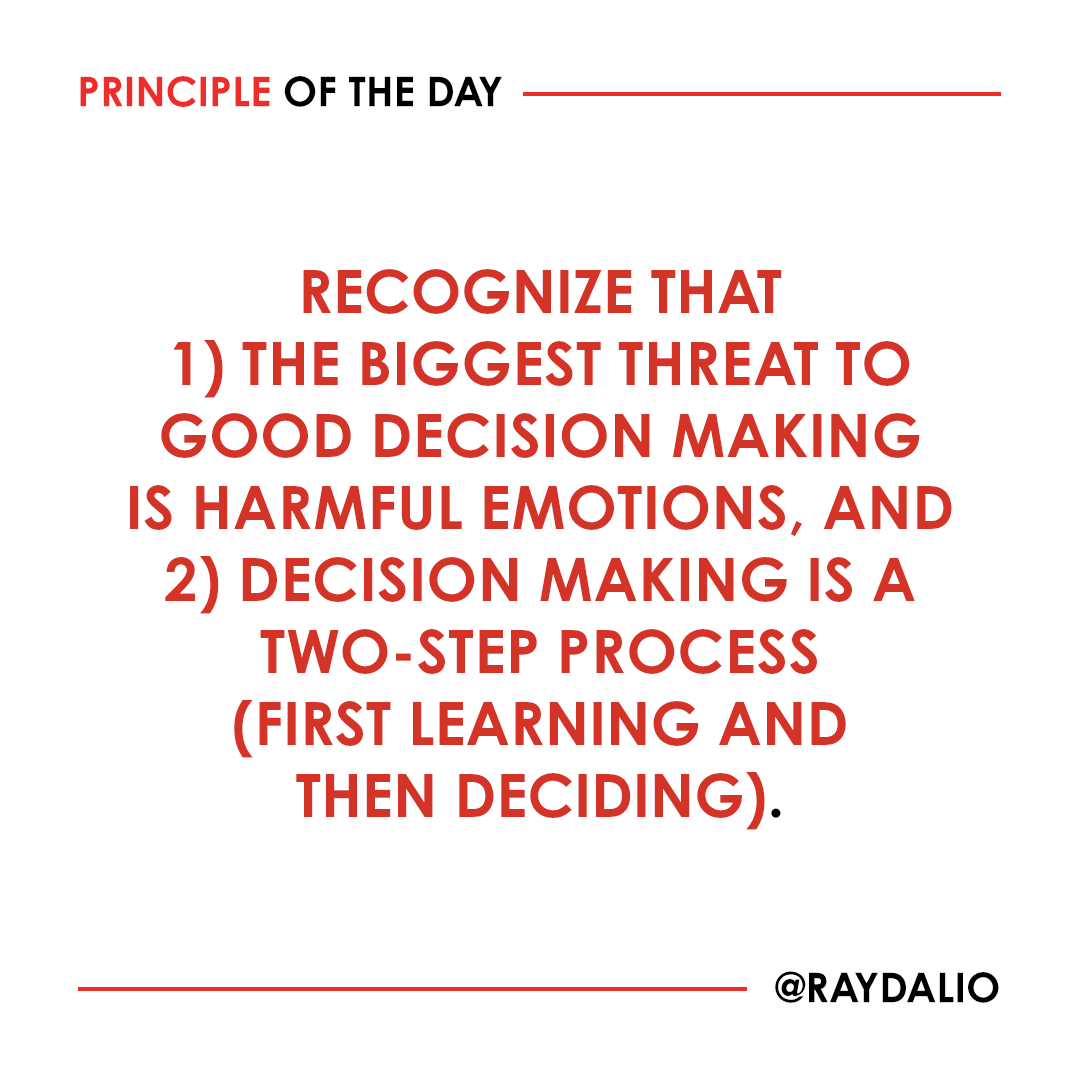
Learning must come before deciding. As explained in Chapter One, your brain stores different types of learning in your subconscious, your rote memory bank, and your habits. But no matter how you acquire your knowledge or where you store it, what’s most important is that what you know paints a true and rich picture of the realities that will affect your decision. That’s why it always pays to be radically openminded and seek out believable others as you do your learning. Many people have emotional trouble doing this and block the learning that could help them make better decisions. Remind yourself that it’s never harmful to at least hear an opposing point of view.
Deciding is the process of choosing which knowledge should be drawn upon—both the facts of this particular “what is” and your broader understanding of the cause-effect machinery that underlies it—and then weighing them to determine a course of action, the “what to do about it.” This involves playing different scenarios through time to visualize how to get an outcome consistent with what you want. To do this well, you need to weigh first-order consequences against second- and third-order consequences, and base your decisions not just on near-term results but on results over time.
Failing to consider second- and third-order consequences is the cause of a lot of painfully bad decisions, and it is especially deadly when the first inferior option confirms your own biases. Never seize on the first available option, no matter how good it seems, before you’ve asked questions and explored. To prevent myself from falling into this trap, I used to literally ask myself questions: Am I learning? Have I learned enough yet that it’s time for deciding? After a while, you will just naturally and open-mindedly gather all the relevant info, but in doing so you will have avoided the first pitfall of bad decision making, which is to subconsciously make the decision first and then cherry-pick the data that supports it.
But how does one learn well? #principleoftheday
Inflation isn’t going away anytime soon.The best hedge: learn skills that let you earn more, https://t.co/m7TD2TgMPm is the single biggest lever right now.#Economy#PersonalFinance
Web3 isn’t just https://t.co/goQtDXAj3F’s ownership, automation, and new ways to monetize https://t.co/FbIcPCfkJF + Web3 will be the biggest story of the next 3 years.#Web3#AI
Most people use AI wrong.
They ask for final answers.
Top users ask for:
• Structure
• Examples
• Debug logic
• Refactoring
AI is a co-pilot, not a magic button.
#AITips#Learning
You as a single person have more power today than a 20 person company of the past. That's insane. The internet gave you the ability to learn anything. Social media gave you the leverage to reach anyone. AI is giving you the ability to create almost anything. Please don't waste it
If you’re not using Claude 3 for coding, you’re leaving a lot of efficiency on the table.
Better long context, cleaner code, fewer hallucinations than GPT-4 for dev work.
#AI#Coding#AITools
When new technologies emerge, people often assume the winning technology automatically means winning investments. History shows us that’s rarely the case.
Most companies disappear as competition sorts out the winners and losers, but the underlying technology will endure and continue transforming the world.
So are we in an AI bubble? Yes. But that has nothing to do with the lasting power of this innovation. @theallinpod@friedberg
The problem is that you don't know what you want to do, and figuring out what you want to do requires learning, experimentation, and effort - so you do nothing.
ONE POLYMARKET ACCOUNT TURNED $50 INTO $435,000.
So he reverse-engineered it and had AI build the same bot in 40 minutes.
It exploits price lag, executes in milliseconds, runs locally in Rust, and prints $400–700 a day.