I think MDR on UPI was probably inevitable at some point, especially given how widespread UPI adoption has become. It could also lead to more competition, instead of just three apps accounting for more than 95% of the market.
That being said, there are some use cases, like investing and broking, where the proposed MDR structure doesn’t really make sense.
The problem with broking is that there is no guarantee that money transferred to a broker will actually result in a transaction.
As brokers, we can’t force a customer to trade after transferring money. And if we can’t pass the UPI charge on to the customer, there is essentially no limit to the cost a customer can impose on a broker without generating any revenue.
Just as an example, 10,000 customers could each make 50 UPI transfers of ₹2 lakh in a month without executing a single trade. At the proposed MDR, this could potentially cost the broker around ₹2 crore, without generating any business.
What makes this even more challenging is quarterly settlement (QS). This is a SEBI regulation that requires brokers to send unused funds back to clients every month or quarter.
Most customers then transfer these funds back to their broking accounts, with more than half of these transfers happening through UPI. So regulation essentially forces this movement of money every month or quarter, and the broker could end up bearing the cost when the money comes back, without any incremental benefit or revenue.
By the way, we currently don’t charge brokerage on equity delivery trades because the economics allow us to offer them for free. But if every UPI transfer starts carrying an additional cost, irrespective of whether the customer actually trades, I don’t see how we can absorb this indefinitely.
I think having an MDR is okay. It still doesn’t solve the problem of customers transferring money without transacting, but something like 0.02% with a cap of ₹5 or ₹10 per transaction seems much more reasonable for broking, instead of a cap as high as ₹300.
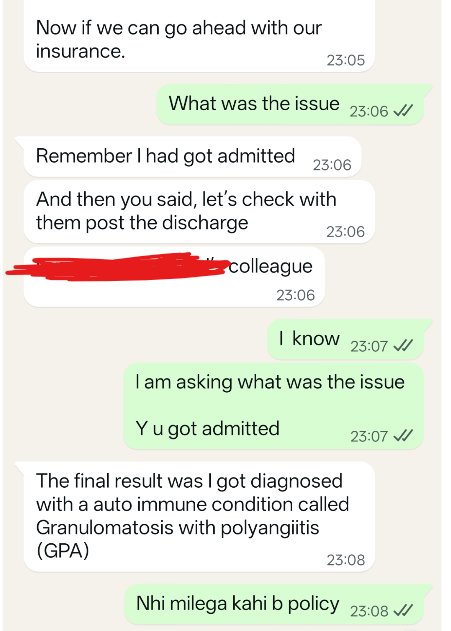
🚨 He was 32. Healthy. Earning ₹25L/year.
He thought health insurance could wait.
It couldn't.
6 months ago,
He approached us to buy a policy.
We explained everything.
He kept delaying:
“I’m only 32. What will happen to me?”
“I already have corporate insurance.”
Then last month:
🩺Severe fever.
🩺Chest pain.
🩺Fluid in the lungs.
🩺Autoimmune disease.
10 days in the hospital.
Bill: ₹8 lakh.
After discharge, he came back to us.
“I want to buy health insurance now.”
But now, it was too late.
Because of his newly diagnosed autoimmune condition, getting comprehensive health insurance became extremely difficult and could involve exclusions or rejection depending on underwriting.
The irony?
The policy he had delayed cost him only ~₹20,000/year.
He earns ₹25 lakh/year.
It wasn't that he could not afford insurance,
He simply thought he wouldn't need it.
That's the biggest mistake people make with health insurance.
You don't buy it because you're sick.
You buy it because you're healthy.
Once a serious illness arrives, the question isn't:
“Which policy should I buy?”
The question may become:
“Will anyone insure me now?”
Don't wait for a ₹8 lakh hospital bill to teach you this lesson.
Buy health insurance while you still have the choice.
I made a website that plays bangers from indian barbershops
before you became fancy and started visiting salons. you once went to a 'saloon'. ₹20 haircuts. simple hairstyles with music that could fix your soul.
https://t.co/j3E8VfwiUU
@airtelindia@Airtel_Presence My mobile network suddenly stopped working.. After restart, stays for couple of mins snd the says No SIM.. Started couple of hours ago
Well done team India 🇮🇳🔥
The Indian team chose not to receive the individual awards or the Asia Cup trophy while Mohsin Naqvi was present on stage.#INDvPAK