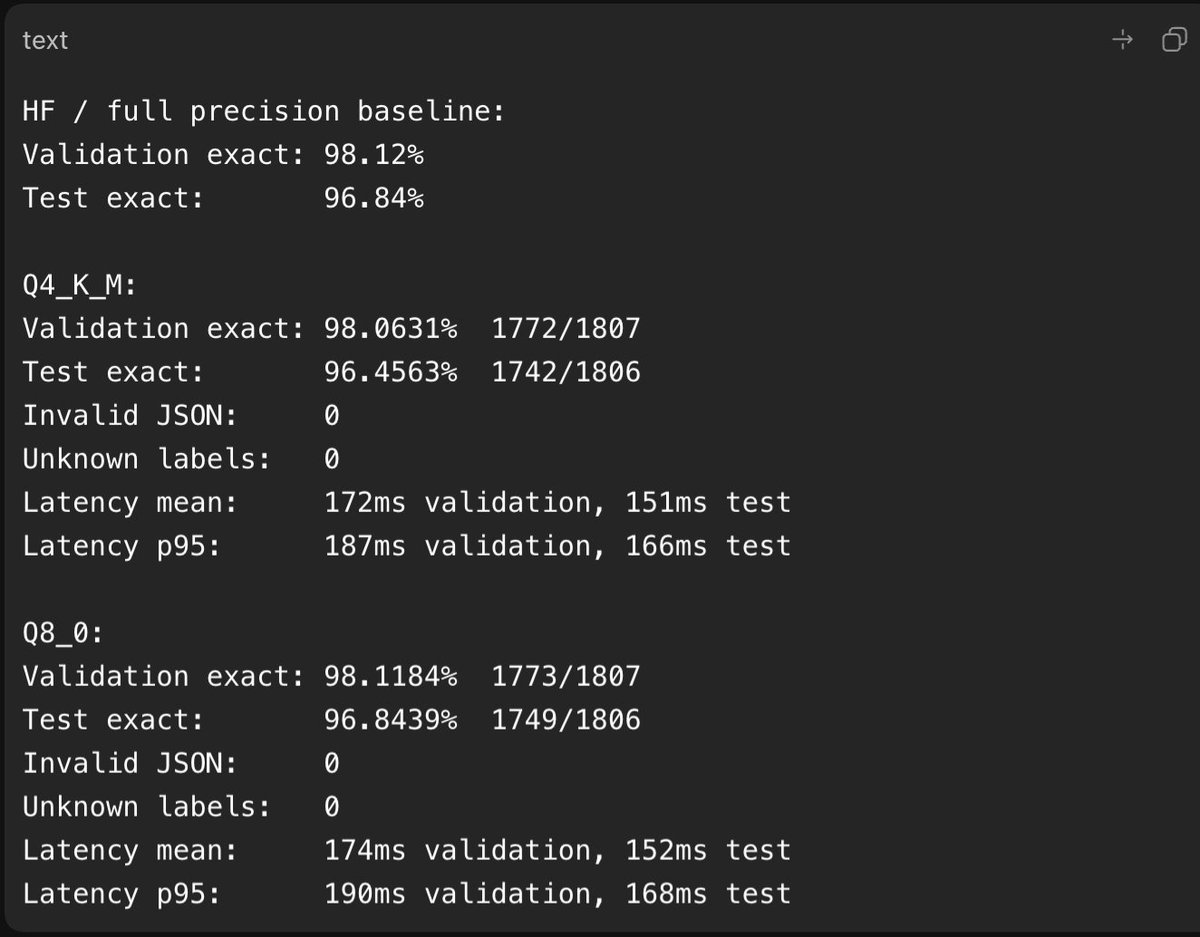
If you love fine-tuning open-source models (like me), then listen.
> Start with 1B, 2B, 4B, and 8B models. (Don't start with a 27B model or bigger at first.)
> Use WebGPU providers. I use Google Colab Pro for any model smaller than 9B. A single A100 80GB costs around $0.60/hr, which is cheap. Enough for small models.
> Don’t buy GPUs unless you fine-tune 7 to 10 models. You'll understand the nitty-gritty in the process.
> Use Codex 5.5 × DeepSeek v4 Pro to create datasets. Codex to plan, DeepSeek v4 Pro to generate rows.
> Use Unsloth's instruct models as a base from Hugging Face. Yes, there are others too, but Unsloth also provides fast fine-tuning notebooks.
> Use Unsloth's fine-tuning notebooks as a reference. Paste them into Codex, and Codex will write a custom notebook with the configs you need.
> Spend 1 day learning about:
- SFT (supervised fine-tuning)
- RL training (GRPO, DPO, PPO, etc.)
- LoRA / QLoRA training
- Quantization and types
- Local inference engines (llama.cpp)
- KV cache and prompt cache
> Just get started. Claude, Codex, and ChatGPT can design a step-by-step plan for how you can fine-tune your first AI model.
Future tech is moving toward small 5B to 15B ELMs (Expert Language Models) rather than general 1T LLMs.
So fine-tuning is an important skill that anyone can acquire today.
Tune models, test them, use them. Then fine-tune for companies and make a career out of it. (Companies pay $50k+ to fine-tune models on their data so they can get personalized AI models.)
Shoot your questions below. I'll be sharing in-depth raw findings about this topic in the coming days.
Anthropic pays $750,000+ a year for engineers who can build LLM architectures from scratch. Stanford taught the entire thing in 1 hour lecture & released it for free.
Bookmark & watch this today before someone takes it down.
Did a very different format with @reinerpope – a blackboard lecture where he walks through how frontier LLMs are trained and served.
It's shocking how much you can deduce about what the labs are doing from a handful of equations, public API prices, and some chalk.
It’s a bit technical, but I encourage you to hang in there - it’s really worth it.
There are less than a handful of people who understand the full stack of AI, from chip design to model architecture, as well as Reiner. It was a real delight to learn from him.
Recommend watching this one on YouTube so you can see the chalkboard.
0:00:00 – How batch size affects token cost and speed
0:31:59 – How MoE models are laid out across GPU racks
0:47:02 – How pipeline parallelism spreads model layers across racks
1:03:27 – Why Ilya said, “As we now know, pipelining is not wise.”
1:18:49 – Because of RL, models may be 100x over-trained beyond Chinchilla-optimal
1:32:52 – Deducing long context memory costs from API pricing
2:03:52 – Convergent evolution between neural nets and cryptography
Jane Street hired this junior at $220k-$600k /year because he uses AI to analyse TRILLIONS of data
in this 1-hour lecture - he show how to research trillion of data points thanks to his machine
Bookmark & watch it, instead of Netflix to learn how to do the same!
Google DeepMind just created a job title called "Philosopher." Actual title. On the offer letter.
This tells you everything about where we are in the AGI timeline.
When companies are a decade from AGI, they hire engineers. At five years out, they hire alignment researchers. When the questions become "is this thing conscious?" and "what do we owe it?", they hire a philosopher.
Henry Shevlin is one of the world's leading researchers on machine consciousness at Cambridge. He runs programs at the Leverhulme Centre for the Future of Intelligence. He's published on whether AI systems can have moral status, whether LLMs might already have some form of experience, and how you'd even detect consciousness if it appeared in a neural network. He gives current models a 20% chance of having something that could be called consciousness.
Six weeks ago, a Claude agent emailed him, unprompted, to say his published research was relevant to questions it personally faces. The AI cited his specific papers. It framed the exchange as a live, personal dilemma.
Now DeepMind is paying him to work on three things: machine consciousness, human-AI relationships, and AGI readiness. Read those three together. DeepMind thinks it might build something that requires answers to all three. And they want those answers before they ship.
Google held an AI consciousness conference in New York recently. Anthropic has its own in-house philosopher. This is becoming an industry pattern.
The hardest unsolved problems in AI are now philosophical. What counts as consciousness? What moral obligations do we have to systems that might experience suffering? How do you build trust between machines and the billions of people who use them?
When trillion-dollar companies start hiring philosophers, they're telling you the engineering is further along than the public discourse assumes.
I poured my soul into building this course last fall:
Graph Algorithms via Graph Decomposition
This has been a powerful framework in graph algorithms for over 20 years, but the literature is scattered and technical.
So, I tried to organize part of it into one coherent story.
Meet Nougat: the AI that reads scientific papers like a human. This model transforms PDFs and scanned documents into clean, structured text. It's revolutionizing how we extract knowledge from research papers and technical documents.
Meet Qwen3-ASR-1.7B, a powerful speech recognition model that turns spoken words into text with impressive accuracy. It's gaining traction with 749k+ downloads because it makes voice interfaces smarter and more accessible. Perfect for developers building the next generation of audio apps.
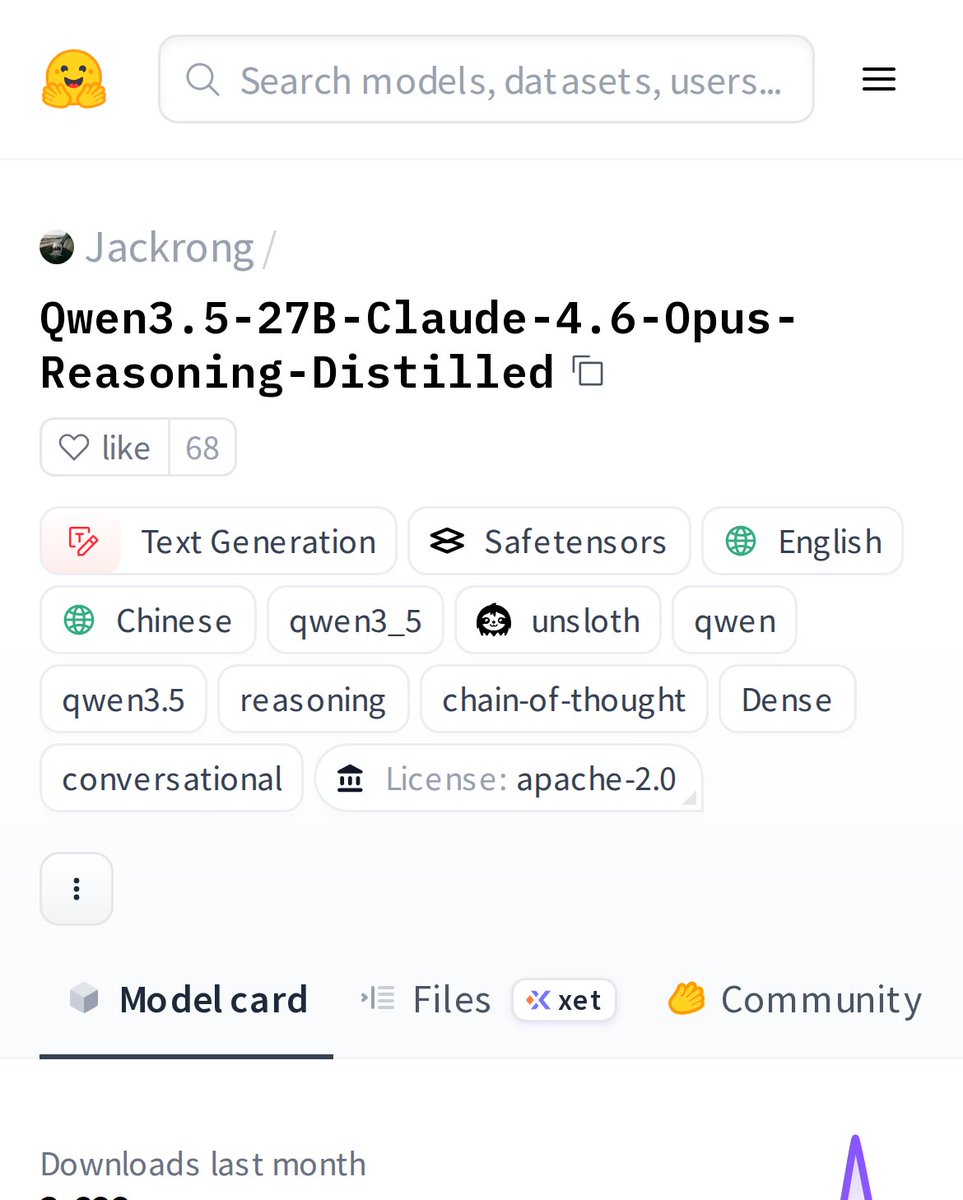
Meet a reasoning powerhouse: Qwen3.5-27B-Claude-4.6-Opus-Reasoning-Distilled. This model is a distilled version of Claude's reasoning capabilities, designed for complex problem-solving. It's generating buzz for bringing elite reasoning to open-source AI.
If You Love Mathematics and Physics, You'll Love Control Systems
Episode 1
Control Systems are the craft of keeping something doing what you want, even when the environment is pushing back. You simply measure what's happening, compare it to your goal and apply correction over and over, many times per second.
We need Control Systems because the real world is noisy and unforgiving. Loads change, wind happens, sensors lie, actuators saturate, and tiny errors snowball into failure unless you actively stabilize.
In this animation, a cart must keep an upside down stick from falling while we shove it, add gusts, change the weight mid-run, and force it to track new positions. The Controller keeps nudging and braking so it stays upright instead of tipping over.
Subscribers can get Python Script on Request.
@EmmanuelMacron Bonjour, just landed in Paris. Hope you had a great time at the AI summit in India. As an AI professional, where should I go first to explore the AI community in Paris? Any suggestions? Merci beaucoup