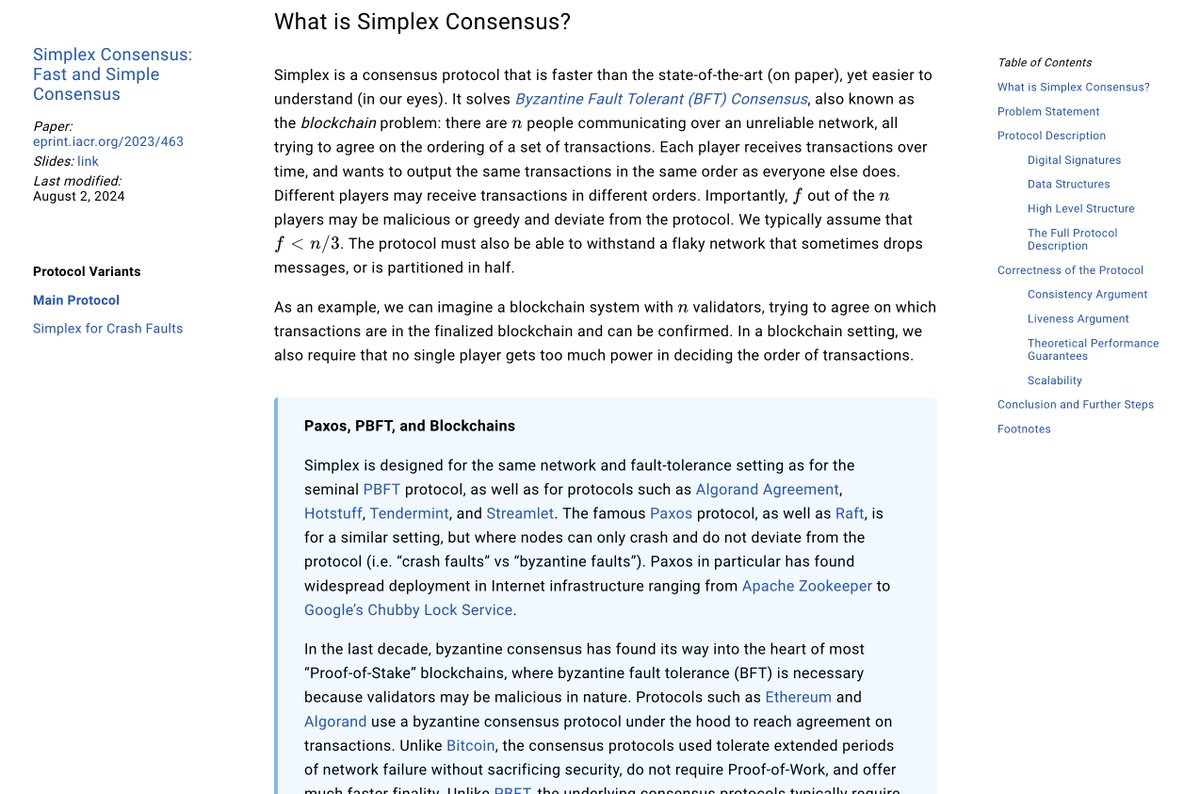
Lambda is working on a few blog post that will explain different consensus algorithms. From Raft and Paxos to Tendermint, Hotstuff and Simplex.
I highly recommend you read about Simplex. It's simple and clear.
TRUSTLESS ROLLUP INTEROPERABILITY
This article, co-authored with @_weidai, is meant to serve as a source of truth for builders and users interested in exploring trustless rollup interoperability.
1/10
How + why we rewrote Circom in Rust 🦀
Jolt uses R1CS to constrain a subset of the VM's functionality to ensure that the virtual CPU's fetch-decode-execute loop is constrained to the RISC-V spec.
For example, we must ensure the 32-bit ELF row decodes correctly. Each 32-bit RV32I R-type instruction decodes to a tuple (rd, opcode, rs1, rs2). Jolt uses the unpacked versions of each of these in other constraints, so we'll need to constrain
instruction = rd || opcode || rs1 || rs2
In total we have around 30 individual constraints of similar format.
Constraints are expressed as a combination of degree-1 polynomials Az * Bz - Cz = 0. For example we might want to express that 4 8-bit field elements [Q_0, Q_1, Q_2, Q_3] pack into a 32-bit field element R, based on a condition S. In other words:
if (S) R == Q_0 || Q_1 || Q_2 || Q_3
In R1CS format:
Az = S
Bz = Q_0 + 2^8 * Q_1 + 2^16 * Q_2 + 2^24 * Q_3
Cz = R
Our full constraint: S * (Q_0 + 2^8 * Q_1 + 2^16 * Q_2 + 2^24 * Q_3 ) - R == 0
If S is one, R must be Q_0 || Q_1 || Q_2 || Q_3. We describe this state as the circuit being "satisfied".
Back to Jolt. Jolt is a multilinear SNARK so we'll need a multilinear prover. We started with Srinath Setty's Spartan as it was the fastest implemented multilinear SNARK. We started by using Circom to express all of the constraints described above.
But it was too slow! Jolt has 30 constraints per cycle of the CPU. At 2^24 steps the total number of constraints blows up to 2^29. The A, B, C matrices have dimensions:
- COLS = NUM_CYCLES * NUM_INPUTS
- ROWS = NUM_CYCLES * NUM_CONSTRAINTS
So the prover costs are increasing as a square of NUM_CYCLES... alarming.
@moodlezoup likes to say the only real optimization tool is taking advantage of repeated structure. Here we have 2^24 repeats of exactly the same fairly small computation. But we were outsourcing the load to Circom's libraries and improperly amortizing costs across these repeated cycles. To take full advantage of the structure, we knew we'd have to vertically integrate Circom.
Circom fundamentally performs two discrete functions for us:
1. DSL for describing linear combinations over the input variables
2. Computation of the witness z
Simple Symbolic DSL
For Jolt we defined a JoltIn enum of all the inputs to the circuit, then defined std::ops::{Add, Subtract, Multiply} over the enum and i64 constants. These aggregate into a LinearCombination struct which stores a vector of Term: (i64, JoltIn).
- JoltIn::A + JoltIn::B -> LinearCombination = [(1, JoltIn::A), (1, JoltIn::B)]
- 12i64 * JoltIn::A -> LinearCombination = [(12, JoltIn::A)]
- 10i64 * LinearCombination - 12 -> LinearCombination = [(120, JoltIn::A), (-12, JoltIn::Constant)]
You can view this arithmetic as symbolic arithmetic in the variables JoltIn.
Now we can define constraints in natural language.
let packed == JoltIn::Q_0 + 2^8 * JoltIn::Q_1 + 2^16 * JoltIn::Q_2 + 2^24 + JoltIn::Q_3;
cs.constrain_eq(packed, JoltIn::R);
Witness Computation
We can now compute the witness vector 'z' directly, using the relevant linear combinations.
let lc = vec![(120, JoltIn::A), (-12, JoltIn::Constant)];
let z_i = 120*JoltIn::A - 12;
By vertically integrating all of this logic we were able to take full advantage of the structure, accelerating key bottlenecks and increasing the readability of our constraint system (~100 LOC).
My advisor Alessandro Chiesa released a book, together with Eylon Yogev!
It covers *all* there is to know to build SNARGs and STARKs in the (pure) random oracle model, with explicit bounds and parameter-setting guidance.
Available (with source code!) at https://t.co/LiSi0920VI 🧵
Our team is developing a new solution that enables gas-free stablecoin transfers. In other words, transfers can be made without paying any gas tokens, with the fees being entirely covered by the stablecoins themselves.
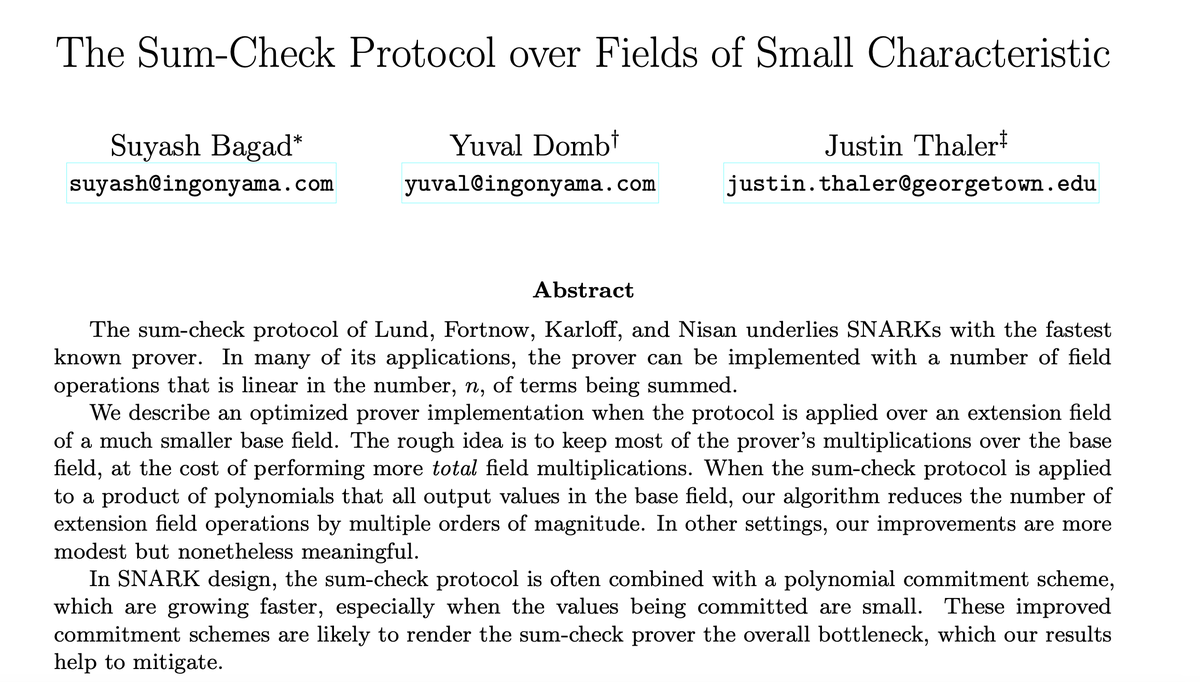
🥁New paper🥁
The Sum-Check Protocol over Fields of Small Characteristic, Joint with @SuccinctJT, links below.
Paper: https://t.co/eD1O60Z8cW
Blog: Sumcheck and Open-Binius: https://t.co/o0RDqqDVKh
Code: Smallfield-super-sumcheck: https://t.co/qsus8nGYlP
Why aren’t more DeFi protocols using ZK co processors?
It seems like you could implement more complex pricing functions and better risk management with lower gas costs.
We just verified 100k bitcoin blocks using nova on optimism:
https://t.co/EJ9l6nicrj
Total costs (c6i.4xlarge instance + txs): 27,55$ 😎
Repo: https://t.co/HMlIRfc7E7
cc @arnaucube
Zero knowledge tech is making rapid progress in the crypto world. You can look onchain to see who's using ZK.
Since Ethereum's launch, the # of unique contracts on mainnet Ethereum calling ZK related precompiles every month has grown steadily.
Let's dig in to the data!
What if… verifying the execution of pairings inside SNARKs can be done much faster than already known?
@AndrijaNovakov6 and @LiamEagen have just published a paper on this!
Let’s explore this below 🧵
1/13
Now, we are providing the GPU version of rapidsnark from @identhree by leveraging the ICICLE lib from @Ingo_zk to the ZK community, the proof generation time of Plonky2 recursion circuit is now from 41.757s to 8.443s, if you want to know more:
https://t.co/h4425b4JXL
Say hello to STIR 🥣!
STIR is an IOPP for RS which, compared to FRI, has shorter arguments (~2x) and a faster verifier (~1.2x) that performs fewer hashes (~2x).
Joint work with Gal Arnon, Alessandro Chiesa and Eylon Yogev.
https://t.co/WiZkb7c17s - https://t.co/M8Opk3kACm
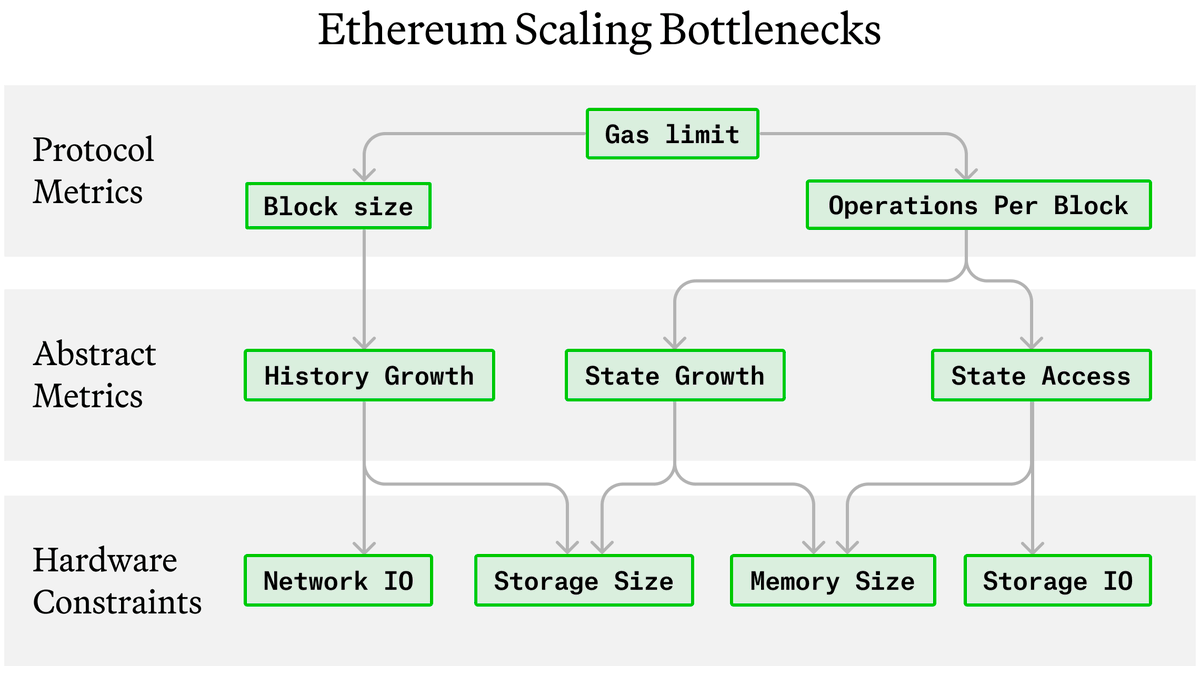
NEW @paradigm RESEARCH! ⛽⛽⛽
Today is an incredibly exciting day as we finally publish our detailed data-driven research on how to think about the growth of Ethereum's gas limit in the coming years.
Read on & share feedback with us.




![samrags_'s tweet photo. How + why we rewrote Circom in Rust 🦀
Jolt uses R1CS to constrain a subset of the VM's functionality to ensure that the virtual CPU's fetch-decode-execute loop is constrained to the RISC-V spec.
For example, we must ensure the 32-bit ELF row decodes correctly. Each 32-bit RV32I R-type instruction decodes to a tuple (rd, opcode, rs1, rs2). Jolt uses the unpacked versions of each of these in other constraints, so we'll need to constrain
instruction = rd || opcode || rs1 || rs2
In total we have around 30 individual constraints of similar format.
Constraints are expressed as a combination of degree-1 polynomials Az * Bz - Cz = 0. For example we might want to express that 4 8-bit field elements [Q_0, Q_1, Q_2, Q_3] pack into a 32-bit field element R, based on a condition S. In other words:
if (S) R == Q_0 || Q_1 || Q_2 || Q_3
In R1CS format:
Az = S
Bz = Q_0 + 2^8 * Q_1 + 2^16 * Q_2 + 2^24 * Q_3
Cz = R
Our full constraint: S * (Q_0 + 2^8 * Q_1 + 2^16 * Q_2 + 2^24 * Q_3 ) - R == 0
If S is one, R must be Q_0 || Q_1 || Q_2 || Q_3. We describe this state as the circuit being "satisfied".
Back to Jolt. Jolt is a multilinear SNARK so we'll need a multilinear prover. We started with Srinath Setty's Spartan as it was the fastest implemented multilinear SNARK. We started by using Circom to express all of the constraints described above.
But it was too slow! Jolt has 30 constraints per cycle of the CPU. At 2^24 steps the total number of constraints blows up to 2^29. The A, B, C matrices have dimensions:
- COLS = NUM_CYCLES * NUM_INPUTS
- ROWS = NUM_CYCLES * NUM_CONSTRAINTS
So the prover costs are increasing as a square of NUM_CYCLES... alarming.
@moodlezoup likes to say the only real optimization tool is taking advantage of repeated structure. Here we have 2^24 repeats of exactly the same fairly small computation. But we were outsourcing the load to Circom's libraries and improperly amortizing costs across these repeated cycles. To take full advantage of the structure, we knew we'd have to vertically integrate Circom.
Circom fundamentally performs two discrete functions for us:
1. DSL for describing linear combinations over the input variables
2. Computation of the witness z
Simple Symbolic DSL
For Jolt we defined a JoltIn enum of all the inputs to the circuit, then defined std::ops::{Add, Subtract, Multiply} over the enum and i64 constants. These aggregate into a LinearCombination struct which stores a vector of Term: (i64, JoltIn).
- JoltIn::A + JoltIn::B -> LinearCombination = [(1, JoltIn::A), (1, JoltIn::B)]
- 12i64 * JoltIn::A -> LinearCombination = [(12, JoltIn::A)]
- 10i64 * LinearCombination - 12 -> LinearCombination = [(120, JoltIn::A), (-12, JoltIn::Constant)]
You can view this arithmetic as symbolic arithmetic in the variables JoltIn.
Now we can define constraints in natural language.
let packed == JoltIn::Q_0 + 2^8 * JoltIn::Q_1 + 2^16 * JoltIn::Q_2 + 2^24 + JoltIn::Q_3;
cs.constrain_eq(packed, JoltIn::R);
Witness Computation
We can now compute the witness vector 'z' directly, using the relevant linear combinations.
let lc = vec![(120, JoltIn::A), (-12, JoltIn::Constant)];
let z_i = 120*JoltIn::A - 12;
By vertically integrating all of this logic we were able to take full advantage of the structure, accelerating key bottlenecks and increasing the readability of our constraint system (~100 LOC).](https://pbs.twimg.com/media/GUNzkUSXkAAJnf6.jpg)