When AI makes every moment feel real.
Created with Seedance 2.5
Prompt:
20 seconds, 16:9, high-end cinematic suspense short film, realistic cinematography, 35mm film look, realistic lighting and physical movement.
Use @Image 1 as the only female protagonist throughout the entire film, keeping her face, blonde hair, body shape, and brick-red silk dressing gown completely consistent. Use @Image 2 as the only private jet cabin and @Image 3 as the only cockpit. The character, aircraft, and spaces must remain consistent throughout. No additional characters, duplicate characters, deformation, or disappearance.
【0–2.5 seconds】
The shot begins with movement already in progress: a luxurious private jet cabin with symmetrical composition along the central axis. The female protagonist walks quickly forward alone along the central aisle, looking natural but slightly alert. The camera smoothly tracks backward, maintaining distance from her. The cabin is illuminated by stable, warm golden artificial lighting, appearing bright, warm, and luxurious. Outside the windows are gloomy blue-gray clouds, with no direct sunlight.
As she walks forward, the cabin ceiling lights and wall lights suddenly begin flickering continuously. The entire cabin alternates between bright and dim due to the electrical malfunction, causing the woman's face and the seats to repeatedly shift between light and shadow. She immediately stops walking and looks up at the lights, her expression instantly becoming alert.
The next moment, the aircraft suddenly jolts violently. Inertia throws her body forward, causing her to stumble one step. She immediately reaches out and grabs the seat beside her. A transparent glass tumbler on the table responds to the aircraft's movement with realistic inertia, sliding across the tabletop toward the edge before naturally falling off and shattering. The glass must maintain continuous, physically realistic movement, without floating, teleporting, or suddenly disappearing.
Hearing the abnormal loud noise, the woman immediately looks toward the cockpit, realizing something is wrong. As the aircraft experiences its first violent shake, the camera suddenly accelerates backward, instantly establishing a strong sense of impact.
【2.5–4.5 seconds】
The aircraft violently loses control again, and the cabin suddenly tilts to one side. The woman immediately turns and rushes toward the cockpit, but after running only a few steps, a violent lateral jolt strikes without warning. She loses her footing, her body is thrown sideways, and she crashes heavily onto the aisle floor.
She does not stop. She immediately reaches out and grabs the base of the nearest seat, trying to get back up, but the aircraft tilts again, throwing her back down through inertia. The camera rapidly tracks backward with slight shaking, continuously following her struggle.
【4.5–7.5 seconds】
Realizing she can no longer stand normally, the woman immediately switches to crawling along the floor toward the cockpit. She alternately grips the bases and armrests of the seats on both sides with her hands, struggling to move forward while being pulled and thrown around by the aircraft's continuous shaking.
A violent jolt makes her slide backward a short distance. She grips the seat tightly to stabilize herself, then continues forward. The aircraft briefly returns to a level position. She immediately pushes herself up, staggers forward, rushes to the cockpit door, and forcefully pushes it open.
The camera follows rapidly from behind her at a low angle, producing realistic handheld shake as she crawls, gets up, and sprints. The cockpit doorframe quickly sweeps across the frame and completely obscures the camera, creating a seamless spatial transition through occlusion rather than using a conventional hard cut.
【7.5–10 seconds】
The camera seamlessly enters the cockpit from behind the door, following the woman from behind. She collapses into the left pilot's seat and grips the control yoke tightly with both hands.
The cockpit combines warm artificial lighting with the cold blue environment outside. Churning black thunderstorm clouds fill the windshield. Instrument warning lights begin flashing. She pulls the control yoke sharply, trying to control the aircraft, but the plane continues tilting violently.
The camera rapidly pushes in from over her shoulder, briefly entering her point of view: thunderstorm clouds rush closer at high speed as the aircraft shakes violently.
【10–14 seconds】
Cut to a close external aerial shot of the aircraft.
The same private jet suddenly loses altitude, and its nose begins pointing noticeably downward. The camera tracks parallel to the aircraft, clearly capturing the complete progression from an uncontrolled tilt into a steep dive.
The aircraft continues descending at high speed, with the dive angle becoming increasingly steep. The wings shake violently in the powerful airflow, and the fuselage visibly jolts up and down. Do not make the aircraft suddenly disappear or crash instantaneously.
Keep the entire aircraft visible in the frame while slightly tracking downward, allowing the audience to clearly feel that the plane is rapidly falling. The thunderstorm clouds remain in the distance as a dark background, with occasional lightning flashes across the sky, but the aircraft must remain clearly visible and must not enter the clouds.
The main focus of this section is to convey realistic high-speed loss of control and a strong sense of vertical descent.
【14–20 seconds】
Instantly return to the cockpit.
Red emergency warning lights continue flashing, with red light repeatedly sweeping across the woman's face. The light fixtures remain intact, with no explosions, shattering, or exaggerated visual effects.
Extreme close-up of her face: her hair is disheveled, her breathing is rapid, and her expression gradually changes from panic to genuine despair. She desperately pulls the control yoke, but the aircraft still does not regain control.
She finally realizes that the aircraft is continuing to descend and that she can no longer save it. She stares forward, briefly losing focus, as all hope disappears from her eyes.
Amid the violent shaking, she screams one desperate “NO!” The scream continues and gradually becomes uncontrollable. The red warning lights repeatedly sweep across her face, and her hair moves slightly with the shaking. She keeps looking forward, unable to do anything, forced to watch helplessly as the aircraft continues descending.
For the final approximately 2 seconds, hold on an extreme close-up of her desperate, terrified face. Let the scream end naturally, then cut off abruptly.
Sound: Roaring engines, continuous electrical malfunction sounds, aircraft turbulence, the glass tumbler sliding and shattering, hurried footsteps, rushing airflow, instrument warning alarms, and the woman's rapid breathing and sustained desperate screaming. No subtitles, text, or logos.
Core requirements: The female protagonist must be moving naturally from the very first frame. Do not leave her standing still and staring for a long time. When the malfunction begins, she must react immediately and appropriately to the situation. The aircraft malfunction must first be conveyed through continuous abnormal cabin lighting, then gradually escalate into violent turbulence. The environment outside the windows must remain gloomy, while the cabin is illuminated by its own artificial lighting. The glass tumbler must slide across the table toward the edge before naturally falling off. All character movements, inertia, hair, clothing, and aircraft movements must follow realistic physics.
Created with GPT Image 2.5 on ChatGPT
Prompt:
Create a premium contemporary editorial poster for [LANDMARK NAME], [CITY], [COUNTRY], using the uploaded photograph of the landmark as the primary visual reference.
FORMAT AND COMPOSITION
Vertical 3:4 portrait poster, divided into two perfectly equal horizontal sections. The upper half occupies exactly 50% of the total height, and the lower half occupies the remaining 50%. Both sections must have equal heights, with a precise horizontal division at the center.
UPPER HALF — ORIGINAL PHOTOGRAPH
Preserve the original landmark photograph as faithfully as possible. Maintain the landmark’s authentic architectural identity, silhouette, proportions, distinctive structures, windows, arches, columns, rooflines, materials, and characteristic colors. Retain the original lighting, natural shadows, surface textures, perspective, and surrounding environment.
Apply subtle art-magazine color grading with refined tonal contrast, sophisticated color balance, and a contemporary fine-art photography aesthetic. If necessary, extend the background naturally to achieve the portrait composition without stretching, distorting, replacing, or altering the landmark. The photograph should feel authentic, timeless, and editorial rather than artificially enhanced.
LOWER HALF — GEOMETRIC ARCHITECTURAL ABSTRACTION
Reinterpret the same landmark as a sophisticated modular geometric illustration. Translate its most recognizable architectural features into bold, simplified geometric structures while maintaining an unmistakable visual connection to the photograph above.
Construct the illustration using large rectangles, squares, rounded squares, circles, triangles, arches, and carefully composed irregular geometric forms. Recreate the landmark’s distinctive silhouette, structural rhythm, architectural proportions, and recognizable details through overlapping blocks, layered planes, simplified facades, and carefully balanced shapes.
Avoid excessive fragmentation, tiny geometric pieces, photorealistic rendering, and generic architectural symbols. Favor fewer, larger, cohesive forms with deliberate spacing and strong compositional structure. Preserve the landmark’s unique identity rather than turning it into an interchangeable building.
COLOR AND MATERIAL LANGUAGE
Develop the illustration’s palette from the original photograph and the visual character of [COUNTRY]. Use a restrained, harmonious combination of architectural neutrals, muted heritage tones, earthy pigments, and carefully selected accent colors.
Introduce subtle paper grain, matte printed surfaces, delicate screen-print textures, and refined color overlays. Maintain a sophisticated balance between flat geometric shapes and tactile printed materials.
EDITORIAL ART DIRECTION
Create the visual quality of a collectible architecture-art exhibition poster designed for a prestigious independent art magazine. Emphasize architectural rhythm, negative space, geometric balance, precise alignment, and visual continuity between the photographic and illustrated halves.
The upper photograph and lower illustration must depict the same landmark from a consistent visual perspective wherever possible. Align major contours, dominant verticals, recognizable towers, rooflines, or other signature features across the central division to strengthen the relationship between the two halves.
The result should feel artistic, architectural, culturally distinctive, contemporary, and suitable for a high-quality art print.
STRICT RESTRICTIONS
No text, typography, letters, words, numbers, captions, slogans, logos, watermarks, signatures, labels, borders, or graphic lettering anywhere in the image. Do not add flags, decorative national symbols, or unrelated landmarks unless they are present in the original photograph. Do not modify the landmark’s authentic identity. Do not merge multiple photographs. Produce one complete, independent poster from the supplied photograph.
She thought flying would help her escape traffic, but nobody told her the sky would be just as crowded
Made with Seedance 2.5
Prompt:
Image1 is CAR: a white wedge coupe, black glass canopy, red full-width tail light bar, rear wing raised on two struts, four round thruster nozzles under the rear bumper. Image2 is NORA: long straight blonde hair, light freckles, white ribbed tank top. Image3 is INTERIOR: the cabin of CAR, white quilted bucket seats, dark grey suede dashboard, a yoke and a wide centre screen.
NORA, stuck in Manhattan gridlock in CAR, presses a button and lifts straight up out of the traffic, then finds the sky just as jammed.
0-3s: Fast forward-moving shot just above the car roofs down East 42nd Street: chaotic gridlock of sedans, SUVs, vans, a box truck, a few yellow taxis, motorcycles and cyclists weaving between lanes, people crossing between bumpers, pushing in on CAR stuck in the middle lane beside a city bus. <horns> <idling engines> <a bike bell>
3-6s: Medium side shot from the passenger seat in Image3: NORA at the yoke in profile, the bus filling the window beyond; NORA taps a thumb on the yoke, breathes out through the nose and glances down at the centre screen. <horns outside>
6-7s: Close on the centre screen: a finger of NORA presses a glowing round button. <a soft chime>
7-10s: Low at road level behind CAR beside the bus: the four nozzles flare white, gas blasts onto the asphalt, a cyclist swerves, and CAR rises straight up past the side of the bus, level, the Chrysler Building ahead. <thrusters spooling up into a roar>
10-13s: From the back seat over the shoulder of NORA, through the windscreen: CAR already above the bus roof, the jammed street spreading out below, the Chrysler Building ahead. <steady thruster roar>
13-15s: Close front on NORA in the cabin: a small pleased half smile that fades as NORA looks ahead.
15-19s: NORA's view through the windscreen at the 20th floor: dozens of flying cars between the towers, first gliding in neat stacked lanes, then several break out and dart everywhere, cutting across lanes, diving and swerving, thrusters glowing. <thrusters humming> <horns in the air>
19-22s: Medium front on NORA in the cabin: NORA shuts the eyes, lets out a tired breath, rubs the forehead and sinks back into the seat. <a tired sigh>
Constraints: hard cut on every timestamp. CAR keeps the body of Image1 whole, the nozzles dark until 7s; NORA matches Image2 and Image3 is the only cabin. Natural understated acting, small real expressions, no mugging. No dialogue. Raw unedited RED camera footage on a real New York street: very shaky handheld camera in every shot, flat overcast daylight, low contrast, low saturation, no grade, real skin. A faint low drone under the sound, no other music. Plates and signs blank, no readable text, no logos, no watermark.
GPT Image 2.5 on ChatGPT
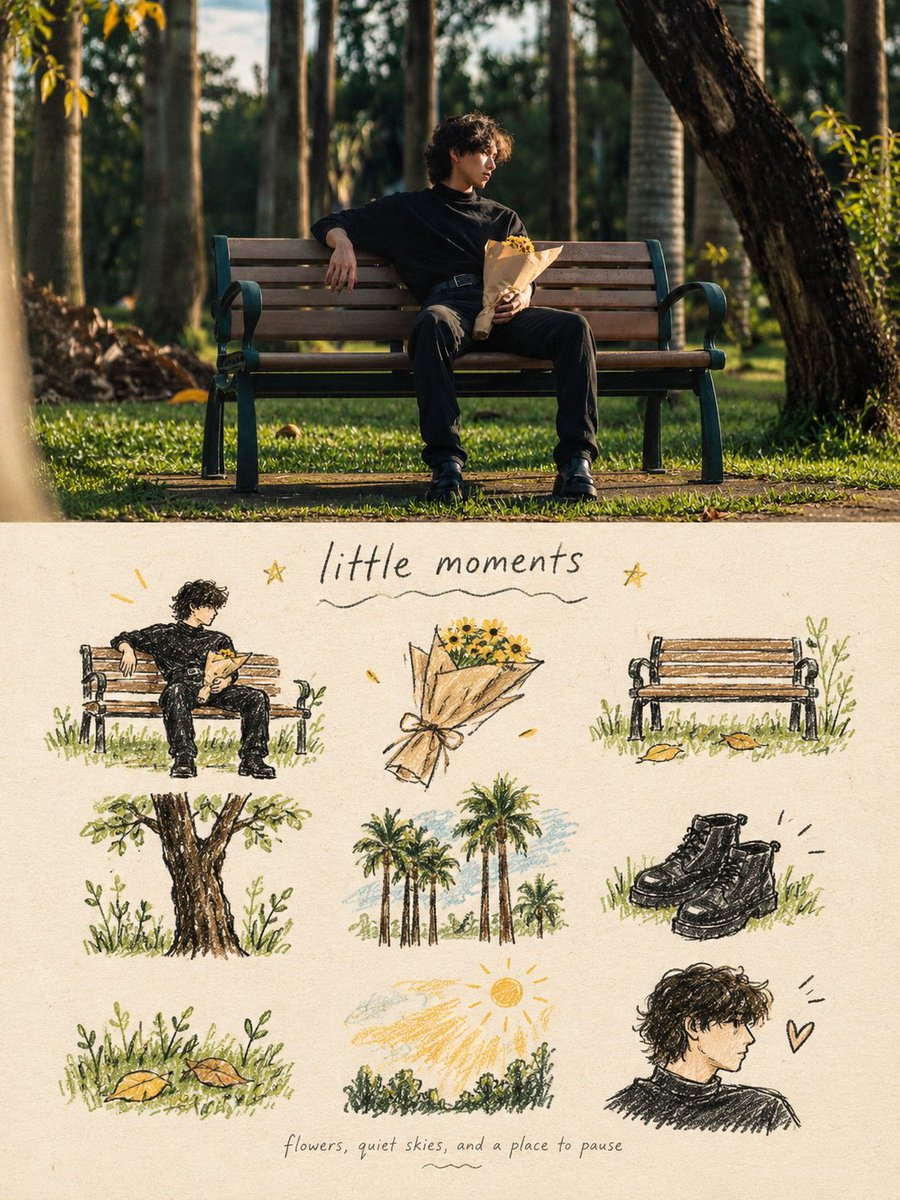
Prompt:
turn each photo I upload into a separate, high-end design poster. Do not combine multiple photos into a collage. Each photo must be processed and output individually.
1. Overall Layout and Composition
Use a 3:4 vertical aspect ratio.
Divide the canvas into two equal horizontal sections, with a strict 1:1 height ratio: the top half occupies exactly 50% of the canvas, and the bottom half occupies the remaining 50%.
2. Top Half — Original Photography
Preserve the original photograph in the upper section. Maintain the subject’s identity, structure, pose, realistic textures, natural lighting, shadows, and original color atmosphere. Apply only subtle, sophisticated color grading to achieve the aesthetic of an art magazine, independent publication, or gallery exhibition image.
You may naturally extend the environmental background to fit the composition, but never stretch, distort, or alter the subject.
3. Bottom Half — A Visual Memory Collection
Extract the most recognizable subjects, distinctive details, action cues, objects, and narrative relationships from the photograph. Reinterpret them as a visual system combining a modular 3×3 icon grid, naïve hand-drawn doodle illustrations, crayon/p colored-pencil textures, and handwritten typography.
Do not reproduce the original photograph in full detail, and do not create realistic illustrations. Instead, simplify the complex visual information into nine memorable visual elements. These may include:
The main subject
Distinctive physical or visual features
Personal belongings or objects
Plants or food
Modes of transportation
Poses or gestures
Emotional symbols
Small memorable details from the surrounding scene
Every element must be a semantic extension of the same photograph above, creating a cohesive “memory checklist” that clearly belongs to that specific image.
4. Grid System and Visual Arrangement
Use an implicit, loosely arranged 3×3 grid. The nine-cell structure should serve as an underlying compositional framework rather than a rigid, visible grid.
Slightly vary the position, scale, angle, and placement of each icon to create an organic, imperfect arrangement that feels structured but never mechanical. Aim for a natural loose grid / organic grid aesthetic.
At the top of the lower section, you may add a short handwritten title, accompanied by a few playful wavy lines, tiny stars, or decorative symbols.
At the bottom, include a very small handwritten caption, making the overall design feel like a page from a personal journal, visual diary, or curated collection sheet.
Maintain generous negative space. The layout should feel relaxed, cute, restrained, and visually balanced rather than cluttered.
5. Illustration Style and Texture
Use a Naïve Hand-Drawn Doodle Illustration style.
Keep shapes simple, slightly childlike, and intentionally imperfect.
Use subtly shaky outlines with irregular line thickness.
Allow contours to remain partially open rather than perfectly closed.
Preserve a sense of deliberate imperfection and handmade character.
Avoid overly dense coloring. Let the paper texture, white grain, and rough edges remain visible.
Combine fine black outlines with colored-pencil or crayon fills and a few selective blocks of color.
Use flat color / spot color to establish visual relationships instead of relying on realistic lighting and shading.
If grid guidelines are included, keep them extremely faint, as if lightly sketched in pencil, rather than using clean, computer-generated table lines.
Final Art Direction
The finished poster should feel like a sophisticated independent art publication blended with a playful, handmade visual diary. The upper half should preserve the beauty and authenticity of the original photograph, while the lower half transforms its most meaningful details into nine charming, hand-drawn visual memories.
The final result must be a separate 3:4 vertical poster for each uploaded photograph, with an exact 50/50 split between the original photograph and the illustrated memory collection.