ATTENTION FARMERS: PRESIDENTIAL INPUTS ARE NOT FOR SALE! Receive them. Use them. Grow your harvest. Protect our national food security.
Seed, fertiliser and other agricultural inputs distributed under Government programmes are intended to support agricultural production, not for resale or exchange.
Beneficiaries are encouraged to use these inputs for their intended purpose, follow recommended agronomic practices and work with Agritex officers to maximise productivity.
Let every input count. Let every farmer contribute to food security! @obertjiri@AgritexS
Chinese Lithium Investors Contribute Over US$400 Million in Taxes to Zimbabwe.
Chinese Ambassador Zhou Ding revealed that Chinese lithium investors paid over US$400 million in export-linked taxes during January–September 2026.
The taxes include 10% export tax, 7% royalties, 3% community development levy and 1% @MineralsMarket1 marketing fee.
Chinese companies also invested over US$100 million in community development projects.
Ambassador Zhou Ding:
“Some reports tend to magnify individual, isolated incidents and paint a distorted picture of the overall situation.”
He urged balanced reporting on China–Zimbabwe mining cooperation.
@China_Amb_Zim
Bilboes Gold Project to Generate US$6 Billion in Forex and US$1.425 Billion in Taxes.
Caledonia Mining Corporation’s US$600 million Bilboes Gold Project in Zimbabwe is projected to deliver significant economic benefits over nearly 11 years.
🟢Forex earnings: US$6 billion+
🟢Corporate income tax: US$975 million
🟢Royalties: US$300 million
🟢Payroll and withholding taxes: US$150 million
🟢Gold production: 48 tonnes (1.55 million ounces)
🟢Construction jobs: 1,200
🟢Permanent jobs: 500
🟢Funding secured: US$300 million
🟢First gold: October 2028
🟢Full production: 2029
Projections are based on an illustrative gold price of US$4,000 per ounce.
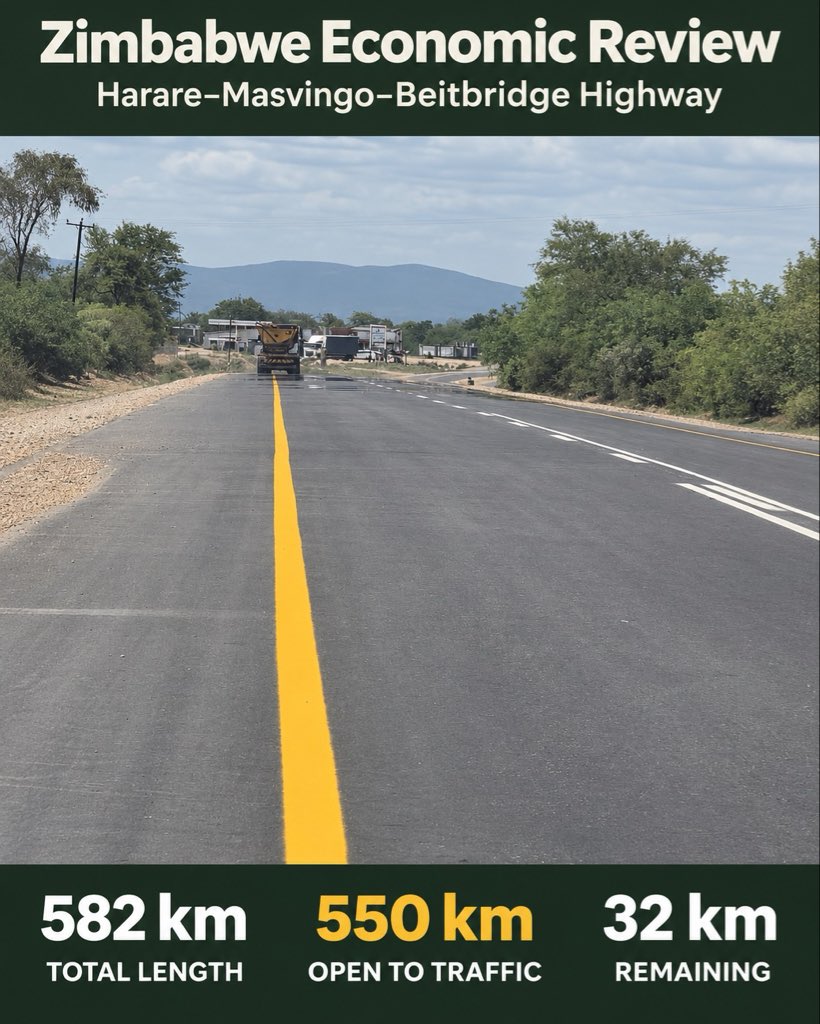
Harare–Beitbridge Highway Nears Completion as 550 km Opens to Traffic.
Zimbabwe has upgraded and opened 550 km of the 582 km Harare–Masvingo–Beitbridge Highway, leaving 32 km to complete. Work continues near the Chibi turn-off, and a new interchange is under construction in Masvingo.
Transport Deputy Minister Joshua Sacco said the government is also prioritising the Harare–Chirundu and Bulawayo–Victoria Falls highways.
Zimbabwe Owes US$22.17 Billion in Public Debt.
As at 30 September 2026, Zimbabwe owed US$12.36 billion to foreign creditors and US$9.81 billion domestically.
Bilateral debt stood at US$6.998 billion. Zimbabwe owed:
🟢China US$2.115 billion,
🟢Germany US$1.137 billion,
🟢France US$1.070 billion,
🟢United Kingdom US$477 million,
🟢United States US$358 million and
🟢Japan US$355 million.
🟢Other bilateral creditors accounted for US$1.486 billion.
Multilateral debt stood at US$4.878 billion. Zimbabwe owed the:
✳️World Bank Group US$1.719 billion,
✳️Afreximbank US$1.010 billion,
✳️African Development Bank Group US$852 million,
✳️Trade and Development Bank US$782 million,
✳️European Investment Bank US$438 million
✳️Other multilateral creditors US$77 million.
Equatorial Guinea US$483 million.
Treasury paid US$242.1 million towards external debt between January and September 2026.
Government aims to clear US$2.96 billion in arrears to international lenders by March 2027.
Zimbabwe Climate Change Management Act Sent to President for Assent.
Zimbabwe’s Parliament submitted the Climate Change Management Act (No. 8 of 2026) to President Emmerson Mnangagwa for assent and signature on 12 November 2026, in accordance with Section 131(5)(b) of the Constitution.
The submission was confirmed by Clerk of Parliament Kennedy Chokuda under General Notice 2229 of 2026.
Zimbabwe Owes US$22.17 Billion in Public Debt.
As at 30 September 2026, Zimbabwe owed US$12.36 billion to foreign creditors and US$9.81 billion domestically.
Bilateral debt stood at US$6.998 billion. Zimbabwe owed:
🟢China US$2.115 billion,
🟢Germany US$1.137 billion,
🟢France US$1.070 billion,
🟢United Kingdom US$477 million,
🟢United States US$358 million and
🟢Japan US$355 million.
🟢Other bilateral creditors accounted for US$1.486 billion.
Multilateral debt stood at US$4.878 billion. Zimbabwe owed the:
✳️World Bank Group US$1.719 billion,
✳️Afreximbank US$1.010 billion,
✳️African Development Bank Group US$852 million,
✳️Trade and Development Bank US$782 million,
✳️European Investment Bank US$438 million
✳️Other multilateral creditors US$77 million.
Equatorial Guinea US$483 million.
Treasury paid US$242.1 million towards external debt between January and September 2026.
Government aims to clear US$2.96 billion in arrears to international lenders by March 2027.
Harare–Beitbridge Highway Nears Completion as 550 km Opens to Traffic.
Zimbabwe has upgraded and opened 550 km of the 582 km Harare–Masvingo–Beitbridge Highway, leaving 32 km to complete. Work continues near the Chibi turn-off, and a new interchange is under construction in Masvingo.
Transport Deputy Minister Joshua Sacco said the government is also prioritising the Harare–Chirundu and Bulawayo–Victoria Falls highways.
Zimbabwe to Require Mines to Source 15% of Inputs from Local Manufacturers.
Finance Minister Mthuli Ncube announced in the 2027 National Budget that mines will be required to source at least 15% of their inputs from Zimbabwean manufacturers from 1 January 2027. The implementation framework is expected by 31 March 2027.
Mines spend US$3.4 billion a year on goods and services. About 70% goes through local suppliers, while only US$410 million (12%) goes to goods made in Zimbabwe. If the 15% requirement applies to total procurement spending, it could lift annual demand for locally made goods to US$510 million, an increase of US$100 million.
Zimbabwe Deputy Ministers to Engage Diaspora Youth in London.
Deputy Ministers Kudakwashe Mupamhanga (Youth) and Benjamin Kabikira (Local Government) will engage Zimbabwean youths on empowerment, investment and business opportunities.
📅 21 November 2026 | 11am–5pm
📍 Zimbabwe House, 429 Strand, London.
No One Left Behind!
Zimbabwe Revenue Authority to Gain Powers to Restrict Property Transfers Over Unpaid Taxes.
Under the proposed tax compliance measures in the 2027 National Budget, the Commissioner of the Zimbabwe Revenue Authority (ZIMRA) will be empowered to place a caveat on immovable property, preventing its sale or transfer before outstanding tax debts are settled.
What does this mean?
A caveat is a legal restriction registered against a property, such as a house, commercial building or land, to prevent its transfer until certain conditions are satisfied.
For example, if a taxpayer owns a house worth US$100,000 but owes ZIMRA US$15,000 in unpaid taxes, ZIMRA could register a caveat against the property. This would prevent the owner from transferring the property to another person until the tax debt is resolved.
The proposal also seeks to extend liens to cover all taxes, strengthening ZIMRA's ability to secure outstanding tax obligations against taxpayers' assets.
Implications: Property owners with outstanding tax debts could face restrictions when selling or transferring property. The measure is intended to prevent taxpayers from disposing of assets before settling their tax obligations and improve tax collection.
These are proposed measures, and their practical application will depend on the final legislation.
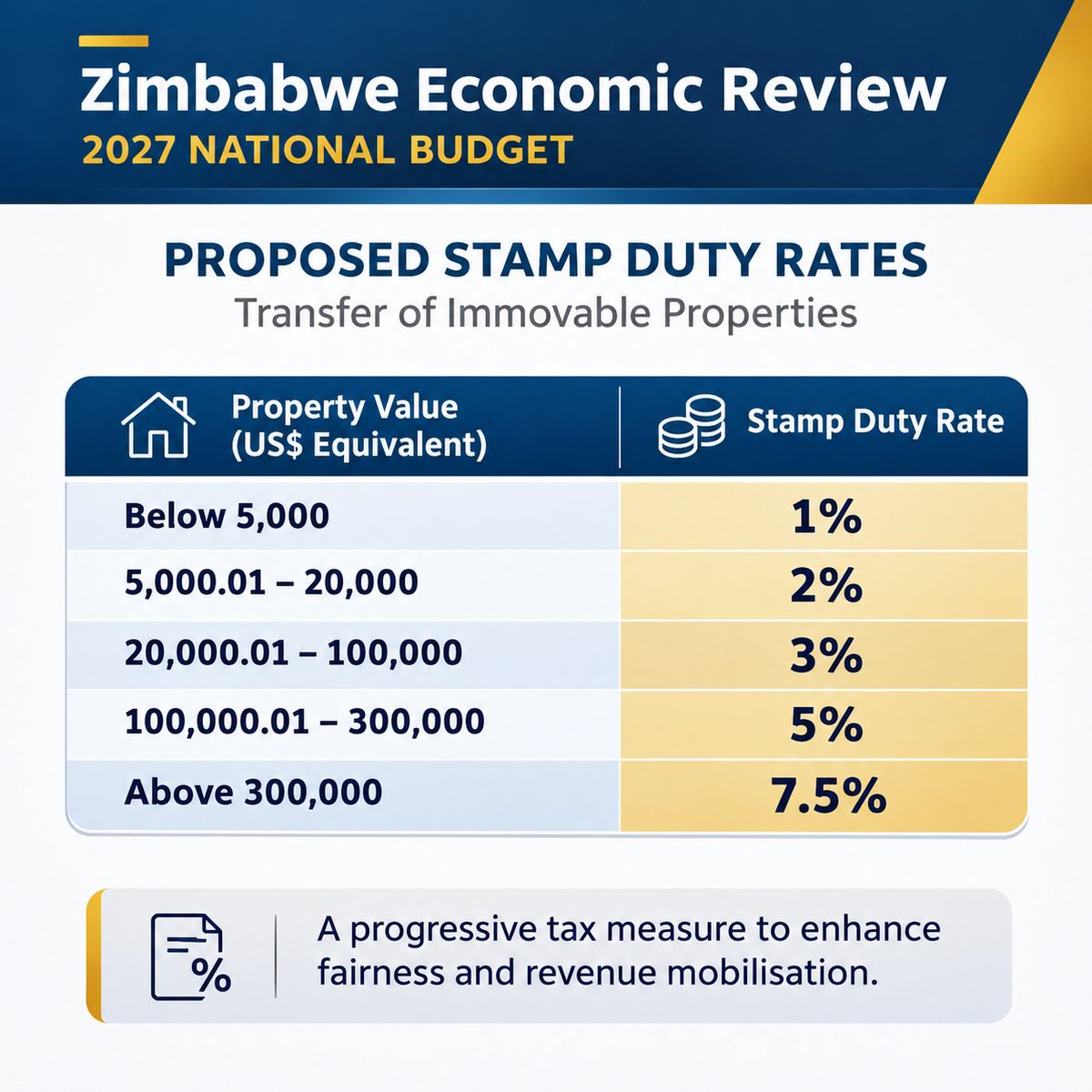
Zimbabwe Proposes Progressive Stamp Duty Rates on Property Transfers.
Finance Minister @MthuliNcube has proposed new progressive Stamp Duty rates on the transfer of immovable property, ranging from 1% to 7.5%, depending on property value.
Proposed Stamp Duty Rates:
🟢Below US$5,000: 1%
🟢US$5,000.01–US$20,000: 2%
🟢US$20,000.01–US$100,000: 3%
🟢US$100,000.01–US$300,000: 5%
🟢Above US$300,000: 7.5%
The proposed changes aim to enhance tax progressivity, with higher-value property transactions attracting higher Stamp Duty rates.
Zimbabwe to Tax Lithium Concentrate Exports on Their Potential Sulphate Value.
Finance Minister Mthuli Ncube told Parliament in his 2027 National Budget speech that Zimbabwe will calculate the export tax on lithium concentrate using the fair market value of the lithium sulphate that could be produced from each shipment.
For benchmark-grade 6% lithium concentrate, Treasury will use a 5-to-1 conversion ratio. This means a shipment of 100 tonnes of concentrate will be taxed on the market value of 20 tonnes of lithium sulphate. Ncube said the approach would help Zimbabwe capture more of the value generated through further processing.
Exports of lithium sulphate will continue to attract zero export tax, supporting local processing. Ncube left open whether the planned January 2027 ban on concentrate exports would proceed as scheduled after producers requested a delay to July 2027.