@MubarizM @allkhaki_ The 1911 photo has an original description below written in pre-reform Russian spelling. The reform took place after Bolshevik revolution in 1917. So the pic had to be taken before that ;) Just one of many many hints.
@AzerbaijanRuins@algalitsky Also the crosses are on big pointed proper domes, totally different from the obviously decapitated top of Shusha cathedral.
@AzerbaijanRuins@algalitsky Perfect examples, thank you. There are 2 typical types of Russian orthodox crosses: with 3 crossbeams or with a bottom crescent. Both types are on these pics, none of them fits your narrative.
@AliSadikhovich @khojalygen0cide @bcaron64 Different parts of dna have specific mutation rates so the genetic distance can be also used as a proxy for time. Combination with radiocarbon dating of tissues the dna is extracted gives can give even more accurate results.
@AzerbaijanRuins@algalitsky 2) According to Russian imperial sources, 770 🇦🇲 families (~45% population) lived in Shusha in 1847. In 1886 it was 15000 🇦🇲s, but only 21 🇷🇺s. So nope - 🇦🇲s lived in Shusha way before the church was built 🙃
@AzerbaijanRuins@algalitsky 3) Construction was financed by 🇦🇲s (Khandamiriants family), the architect was 🇦🇲 (Simon Ter-Hakobiants), founding inscription is in 🇦🇲 language (if 🇦🇿 hasn’t destroyed it yet) and parish members were 🇦🇲s. Still it’s good mental gymnastics to claim it’s Russian orthodox 🤣🤣🤣
@AzerbaijanRuins@algalitsky 1) Both these photos were taken after 1920 antiarmenian pogrom, when 🇦🇲 quarter was in ruins and the church dome was destroyed. So nope - not the original look 😜
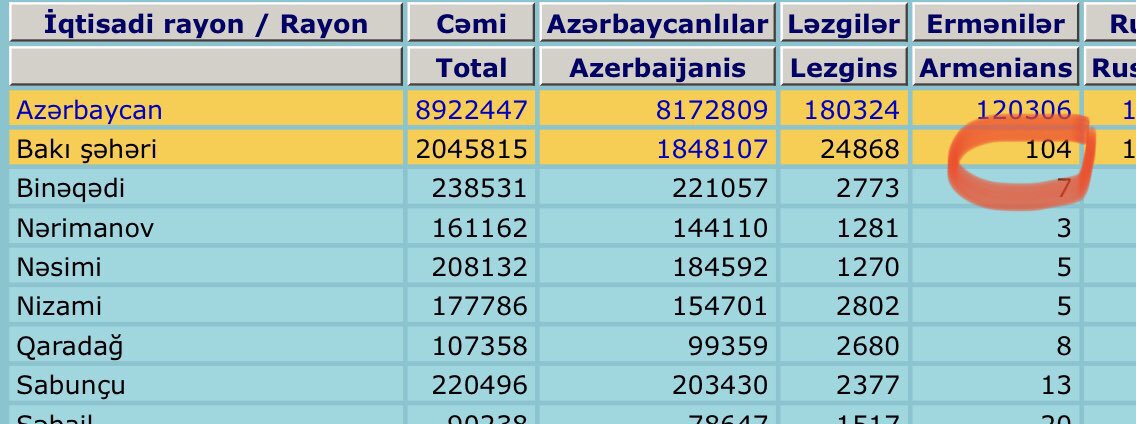
@toghrulmammadli@vartan84 Alas, be careful! With this rate, Armenians will overpopulate you very soon, as your official 2009 census gives the number 104 for Baku! (The rest is NK).
@ElshanMustafay5@simonforco@aniboghoss Interesting. Still, many questions :) There’s no punctuation under “b”. Why can’t it be “i” then? Is the name Shahbenzer documented anywhere else? And why can’t Shahbenzer and Shahik be the same person? Using language versions of one’s name was a common practice.
@ElshanMustafay5@simonforco@aniboghoss I see شاهکزر. Plus one extra dot, so maybe kaf+nun are merged together: شاهکنزر. Shahik Nazar maybe (?) Anyway, no letter B ب there.
So I don’t really get your shahbenzer hypothesis.
🤥🚨
Raffi Kortoshian @ Research on Armenian Architecture (RAA) has exposed the tweet below to be a lie https://t.co/sbhq0EW2KO
The photo of the cross posted by 🇦🇿’s Minister of Culture is from Georgia’s Akhaltsikhe castle that did originally have a khachkar until 2011 repairs
@mcojsov @vartan84 2) If you go through the list in the Russian sources, you’ll notice that majority is described as “clay mosques” (земленная мечеть), i.e. a non-durable architecture, likely not much different from ordinary peasant houses.
@mcojsov @vartan84 Just a note about the statistics: 1) the number of mosques is given for Yerevan gubernia, which included Nakhichevan and Surmalu districts, which are not part of Armenia today. Thus the number of mosques on the territory of Arm. would be lower. +
I appreciate that @RusifHuseynov2 publishes an #Azerbaijan|i perspective on #nationalism in the Southern Caucasus. If this is a widely accepted AZ narrative (which I don't know), it worries me a lot, as find the entire thread incredibly dangerous.
(1/?)