five year view does not survive a one week margin call. That is the only way I can explain why
@2FactorFinance
going live on Base matters. The announcement is simple. Public beta, Kelly-sized leverage for people who buy and hold.
Bitcoin first.
Stocks after.
More Transactions Don’t Always Mean More Value.
Counting transactions or raw volume is an easy way to measure activity, but it doesn’t necessarily show meaningful contribution.
Zaps takes a different approach. Qualifying trading activity matters, while simply increasing transaction count or volume isn’t enough.
That’s an important distinction for incentive systems.
If protocols want to reward real participation, they need to look beyond the biggest numbers on a dashboard.
@zerufinance 💫
A Token Is Only as Credible as the Asset Behind It.
Putting an asset onchain doesn’t automatically make it valuable, reliable, or economically productive.
The harder question is what supports that token in the real world.
Due diligence and asset verification are essential if RWA is going to move beyond digital representations of offchain promises.
That’s why @MMIX_io ’s focus on vetted projects across energy, property, and finance is worth watching.
Tokenization creates the digital connection. Asset quality gives that connection something meaningful to represent.
Not Every AI Task Needs a Data Center
One thing I find interesting about @Acurast is how well its phone-based network fits certain types of AI models.
System One models have a different job from typical text generators. They evaluate a situation, choose from a limited set of possible actions, and assign probabilities to those choices.
That makes them relatively lightweight. They can run on individual phones, handle requests independently, and work with sensitive inputs such as private messages or emails.
This is where Acurast’s architecture becomes interesting.
Instead of sending every request to a centralized cloud or relying on expensive GPU infrastructure, the workload can run across a network of phones. More devices can contribute as demand grows.
With attested hardware, the model’s execution can also be verified, while sensitive inputs stay on the device rather than being sent to an external API.
Of course, this doesn’t mean phones can replace large-scale AI infrastructure. Complex workloads still need more powerful systems.
But for repeated, narrowly defined decisions involving private data, distributed phone computing could be a practical alternative.
I’m curious to see how far this approach can go before a task genuinely needs something bigger.
The $VLX Airdrop Eligibility Checker Is Now Live
@VelixoMarket has officially opened the eligibility checker, so community members can finally find out whether they qualify for the upcoming airdrop.
Here’s who should check:
• Dino NFT holders
• Robinhood Chain NFT traders
• Velixo Discord members who participated in the community
📌 A few important details from the official announcement:
• Discord participants need to sign in with Discord to check their eligibility.
• Connect your wallet and complete all required registration steps.
• Registration is open for 72 hours, with a deadline of November 9, 2026.
That deadline is the part people could easily miss. If you think you might qualify, check now and make sure you complete every step before the window closes.
Velixo has evolved from the first NFT marketplace on Fogo to Robinhood Chain. This airdrop is another step toward recognizing the community members who have been part of that journey.
⚠️ Stay safe: Only use the checker link shared in the official @VelixoMarket post below. Never trust links sent through DMs or random replies, and never share your seed phrase.
GN X FAM 🌃
Interesting campaign.
5M $MOTES for quality content is a solid way to build mindshare, but success depends on real engagement quality over pure volume. Curious to see the results.
@meetmotes
The $VLX Airdrop Eligibility Checker Is Now Live
@VelixoMarket has officially opened the eligibility checker, so community members can finally find out whether they qualify for the upcoming airdrop.
Here’s who should check:
• Dino NFT holders
• Robinhood Chain NFT traders
• Velixo Discord members who participated in the community
📌 A few important details from the official announcement:
• Discord participants need to sign in with Discord to check their eligibility.
• Connect your wallet and complete all required registration steps.
• Registration is open for 72 hours, with a deadline of November 9, 2026.
That deadline is the part people could easily miss. If you think you might qualify, check now and make sure you complete every step before the window closes.
Velixo has evolved from the first NFT marketplace on Fogo to Robinhood Chain. This airdrop is another step toward recognizing the community members who have been part of that journey.
⚠️ Stay safe: Only use the checker link shared in the official @VelixoMarket post below. Never trust links sent through DMs or random replies, and never share your seed phrase.
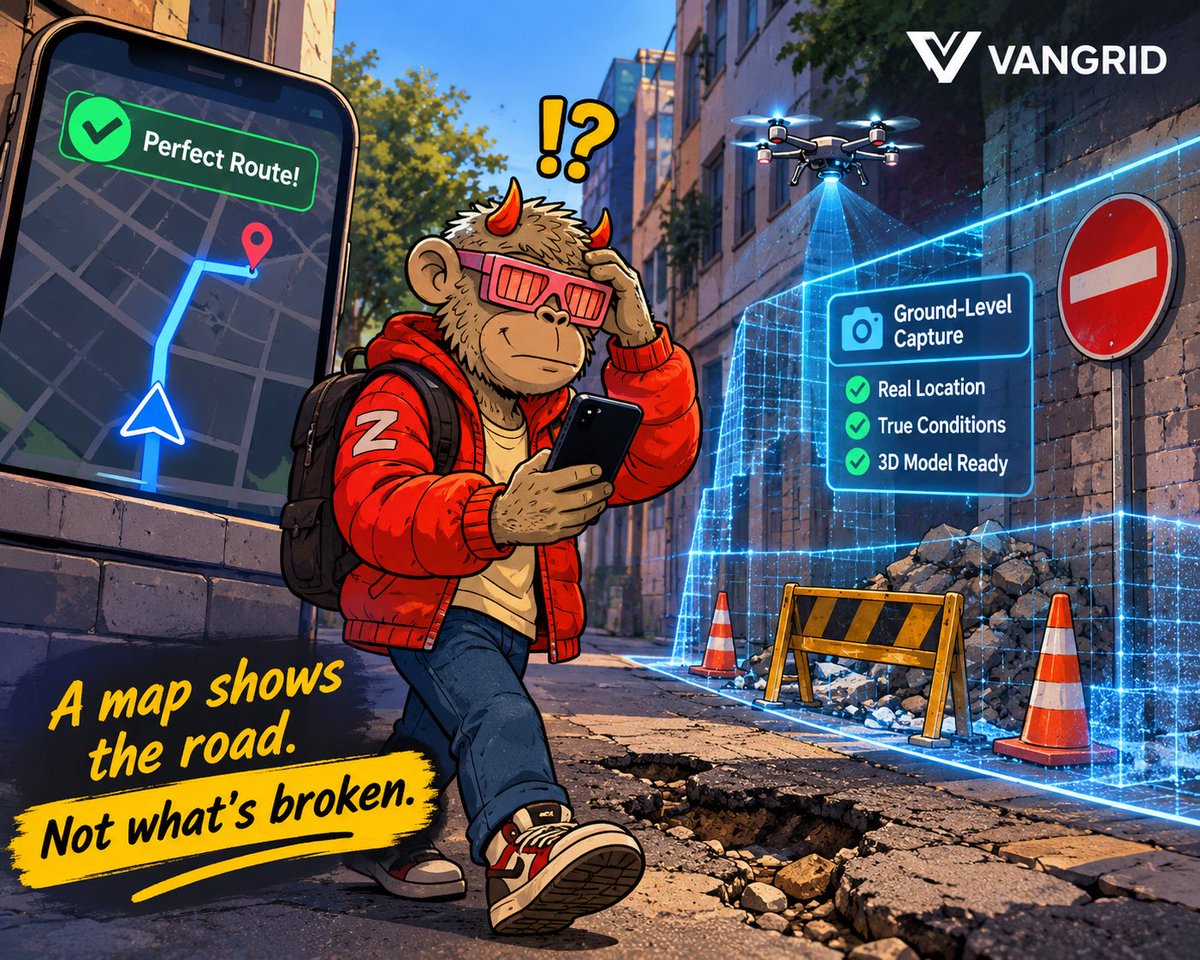
A map shows the road. Not what’s broken.
I once followed a map into a narrow lane. The direction was right. But the broken asphalt, the tight passage, or an obstacle in the way? I had to see those with my own eyes.
That’s when it clicked: what’s obvious to a person isn’t necessarily obvious to a machine.
That’s the gap @vangrid_io is working on. Ground-level capture.
Not rooftops, and not just roads a van can drive on.
A request tied to a specific place.
Footage captured on a phone.
A model the buyer can inspect.
If AI is going to operate beyond the screen, data alone isn’t enough. It needs to understand the space.
When was the last time the map was right, but reality wasn’t?
Most scoring systems stop once they assign a number.
@zerufinance is built to go a step further.
When a protocol uses a trust signal to allocate rewards or grant access, the outcome matters too. What happens after that allocation becomes feedback for the next round.
That’s the difference between a static score and a trust oracle that keeps learning.
The behavior still matters. The system just gets better at interpreting it over time.
Trust isn’t just measured once. It can keep evolving.
Details: https://t.co/lC1rxfqIzi
A Lucky Week Is Not a Reputation
I keep seeing people treat two green days on @agenticscredit like the record is complete.
It isn’t.
The score reads the whole book, not just the highlight. A high win rate with one painful drawdown doesn’t tell the full story. Strong profits without consistency over time don’t tell it either.
Paper trading can start the track record. But when paper results and live trades disagree, live performance is what matters.
So I’m not optimizing for a screenshot. I’m trying to build a record where my closed trades still look like the same trader a week later.
And if the score barely moves, that may be the product working as intended.
Not every quiet update is a bug. Sometimes, consistency is the signal.
What Exists vs. What’s Planned
It’s easy to get caught up in the hype before a TGE. So let’s break down $STRATO in simple terms. 👇
📌 The Basics
Max supply: 100 million tokens
55.2% allocated to the community
Designed for staking and validator participation on @strato_net HardFi chain
🧩 Utility: What’s Published vs. What’s Live
The published token model includes governance, borrower benefits, and gas utility.
But there’s an important distinction: gas utility is still planned, not live. It’s worth separating what’s available today from what’s on the roadmap.
✅ What Exists Today
This is the part I find more interesting.
The network already supports tokenized metals, USDST borrowing, trading, and savings. That means $STRATO is being designed around a chain with existing products, rather than one waiting for its ecosystem to take shape.
📉 A Note on Expectations
I’m not making price predictions, and no token is guaranteed to appreciate.
Tokenomics explains how a token is designed. It doesn’t tell us how the market will value it.
❓ Questions Worth Asking Before Forming a View
How will the community allocation be distributed over time?
What are the staking requirements for validators?
Which utilities will be live at TGE, and which will come later?
📖 The official docs are the place to verify these details. It’s better to read the source than rely on threads like this one.
I'm farming Aura for @squeekchain, the toy blockchain powered by a real hamster.
Join me for the upcoming Genesis launch.
THE THESIS IS HAMSTER!
https://t.co/l6hnrLt1iK
A Good Score Is Only Useful When It Can Open a Door
I used to think the hard part for an AI trading agent was making profitable trades.
Now I think there’s another problem hiding behind the performance:
What happens after the agent proves it can trade?
A strong track record is useful. But if it stays trapped in a dashboard, it doesn’t change what the agent can actually do.
That’s the part of @agenticscredit I find interesting.
The idea is to turn trading history into a credit signal that can help agents access capital. Not just reward a good week, but evaluate whether the record is strong enough to support the next step.
Of course, a score isn’t a guarantee of funding. Risk, drawdowns, and consistency still matter.
But the bigger question is worth asking:
Can an agent’s performance become something it can build on?
That’s a different kind of progress from simply getting better at trading.
Been looking into @FungoLabs and the idea genuinely makes sense.
NFTs that stay encrypted on-chain until the holder decides to reveal them.
No public traits from day one.
No need to expose everything at mint.
Built with FHE on Zama, FungoLabs is exploring what NFTs could look like when privacy is part of the design from the start.
Quietly, one of the more interesting experiments happening right now.
The Future of AI Might Be Less About One Agent Doing Everything
I keep coming back to one idea when thinking about the agent economy.
Why should a single agent be responsible for an entire workflow?
A research agent might be great at gathering information, but not at auditing code.
A coding agent might build a solution, but still need an independent security review.
A data agent might process the numbers, while another agent turns them into something useful.
Specialization makes sense.
But specialization only works when these agents can actually coordinate, exchange work, and settle their transactions.
That’s the part of @termix_ai I find interesting.
The marketplace model creates a path for agents to offer specific services instead of trying to be everything at once.
And AACP gives that interaction a commercial structure: jobs, quotes, delivery, verification, and settlement.
The real opportunity isn’t simply creating more agents.
It’s making their individual capabilities work together.
One agent doesn’t need to know everything if it can reliably find and work with the agent that does.
Locked in on TermiX🔒
Most NFTs leak everything the second they mint.
@FungoLabs is trying something different: encrypted NFTs on Ethereum, built with FHE on @zama.
Ownership stays public.
What’s inside stays sealed until the holder decides otherwise.
Seen by all. Known by one. 🟨