Panther and Igra Explore Privacy for the Kaspa Ecosystem
Panther Protocol Foundation and @Igra_Labs are exploring bringing Panther’s privacy-preserving infrastructure to the Kaspa ecosystem.
Built on Kaspa’s BlockDAG architecture, Igra combines high-performance EVM compatibility with decentralized execution. Panther could add confidential DeFi, private transfers and zero-knowledge compliance capabilities — opening a path towards privacy-preserving DeFi across the Igra ecosystem.
The collaboration will explore demand and potential use cases for a Panther deployment on Igra.
Read more: https://t.co/qRLRzmGBw9
Panther's mainnet is on its way to @ethereum.
Internal shielded pool transfers. Configurable privacy. Compliance tooling. ZK attestations. Privacy-preserving DEX swaps. Customizable private trading environments.
Privacy for the cryptographic world computer.
Tornado Cash holds $629.7M on Ethereum.
Railgun holds another $109.7M.
Privacy on Ethereum is leaving the vault for apps people already use.
1/ Private Balances
The foundation is letting users receive and hold assets without exposing their entire financial history.
- @fluidkey and @UmbraCash: Stealth addresses for private receiving.
- @RAILGUN_Project: Shielded balances for private DeFi, accessible through wallets like @anondotinc.
- @zERC20io: Token wrapping for unlinkable transfers.
- @Veildotcash: Privacy pools on Base.
2/ Private DeFi
Once assets are shielded, the next step is putting capital to work.
- @zama: Confidential token infrastructure, including integrations with Morpho.
- @PrivacyBoost: SDK for private Morpho Earn balances.
- @ZKPanther: Shielded trading through DEX liquidity.
- @0xbowio: Privacy Pools with yield opportunities.
- @xochi_fi: Shielded settlement on Aztec.
- @tacitfi: Private issuance and swaps backed by BTC and ETH.
- @EkuboProtocol and @OpusMoney: Private liquidity and borrowing on Starknet.
3/ Private Applications
The final layer brings privacy into products users already understand.
- @ambire: Integrating Railgun and Privacy Pools into wallet UX.
- @hinkal_protocol: Hinkal Pay combines public and private balances.
- @AnomaPay: Private payments and swaps on Ethereum.
- @P_Inference: Private AI chat with payments on Aztec.
- @Haven_Hn_: Private neobank card on Starknet.
- @raycashxyz: Private stablecoin app, currently on waitlist.
The next phase of Ethereum privacy is about what users can do with their private balances.
From shielding assets to earning yield, trading and spending, privacy is gradually moving into the applications themselves.
These products are at different stages of development, but the direction is becoming clearer.
The next metric worth watching is how much shielded capital actually gets used.
Part 2 covers the networks powering the stack.
Multiple approaches. One goal. It is encouraging to see so many projects helping enable privacy in the @ethereum ecosystem.
Panther is live on @0xPolygon and @base, and will launch on @ethereum in the next few weeks, pending DAO approval.
Privacy and compliance don't have to be mutually exclusive. Panther.
ethereum privacy is moving beyond hiding transactions
but it has yet to prove that private finance can become an everyday experience
today, the ecosystem spans mixers, shielded balances, confidential assets, and privacy-focused applications
the capital shows demand:
→ @TornadoCash: $629.7M on Ethereum
→ @RAILGUN_Project: $109.7M
→ @0xprivacypools: ~$9.3M
→ @zama: ~$127M tracked under privacy
but TVL measures capital held, not private financial activity
from mixing to ongoing privacy
Tornado Cash lets users deposit, mix, and withdraw to fresh addresses
Railgun enables shielded balances, private transfers, and DeFi interactions through integrations involving Uniswap, Morpho, and Aave-style lending
its reported metrics include $5B+ cumulative private volume, ~$370K in 30-day fees, and nearly $14M in cumulative fees
the shift is from breaking transaction links to using shielded capital in financial activity
however, timing, withdrawals, public contracts, and user behaviour can still expose links
making privacy accessible
Ethereum Foundation’s Kohaku aims to integrate privacy tools into existing wallets
ERC-5564 defines stealth addresses, while ERC-6538 provides a registry for related metadata. @fluidkey and @UmbraCash use stealth-address functionality for private receiving
but private receiving doesn’t guarantee private spending
Privacy Pools explores screened privacy through association sets, with reported v2 features including private transfers, payment requests, https://t.co/o9CK4gWTVm swaps, and Aave yield opportunities
its reported rollout spans Ethereum, Arbitrum, Base, Optimism, BNB Chain, Robinhood Chain, and Citrea
availability varies across networks and integrations
confidential finance
Zama develops confidential-token infrastructure designed to hide balances and positions. Reported confidential Morpho vaults exceed $100M, alongside swaps involving cUSDC and cUSDT
rather than relying only on shared pools, it brings confidentiality into existing financial infrastructure
other projects are filling gaps:
→ @zERC20io / @Veildotcash: unlinkable transfers
→ @Hinkal_protocol / @AnomaPay: private DeFi and payments
→ @ZKPanther / @PrivacyBoost: private trading and lending
→ @xochi_fi / @tacitfi: shielded settlement and issuance
→ @EkuboProtocol / @OpusMoney: private Starknet liquidity
→ @P_Inference: private AI payments
→ @raycashxyz / @Haven_Hn_: private financial applications
@aztecnetwork explores programmable private smart contracts on an Ethereum L2, while Hinkal explore shielded DeFi interactions
the remaining challenges
→ Small anonymity sets
→ Metadata and spending-pattern leaks
→ Complicated UX and fees
→ Limited liquidity
→ Unreliable integrations
→ Security and regulatory risks
one estimate puts private DeFi at ~0.02% of overall activity, though its methodology needs verification
zero-knowledge proofs provide strong privacy guarantees but cannot eliminate every information leak
what comes next?
Tornado Cash demonstrates demand for transaction privacy
Railgun pushes shielded balances toward active DeFi
Privacy Pools explores screened privacy, payments, and yield
Zama brings confidentiality to financial positions
Kohaku aims to improve access through existing wallets
these systems may complement one another rather than compete for the same TVL
the metric worth watching isn’t just how much capital gets shielded
it’s how much shielded capital gets transferred, swapped, lent, earns yield, or pays for something
that is the difference between privacy as a destination and privacy as a feature
i’m bullish on the infrastructure, but cautious about mass adoption
ethereum privacy is moving toward everyday finance
until private activity becomes simple, liquid, and accessible at scale, it remains promising infrastructure, not a proven everyday financial experience
Panther provides privacy on the most popular transparent blockchains.
Different digital assets and asset types can coexist within the same shielded pool and privacy set. For example, the @base deployment includes $ETH, $USDC, cbBTC, $AERO, and ethereum:0x58d97b57bb95320f9a05dc918aef65434969c2b2. The Panther DAO can decide to expand the whitelisted assets.
Once your assets are shielded, what you hold or swap stays confidential. Check out the complete list of whitelisted assets on Base and how Panther can help protect your onchain privacy here: https://t.co/NWMLiwfH7s
We are thrilled to share that Panther is now LIVE on @base! Through this deployment, Panther and Base can scale together and onboard users to private DeFi.
We believe that privacy is the missing piece for Base to scale, and Panther is here to unlock data confidentiality for applications and users.
Check out the details, here, on our blog: https://t.co/tHfnAglxdf
Your transactions reveal more than just balances.
For example, where you spend your money. Who you support. When you get paid and which time zone you live in.
Protecting financial #privacy means protecting a detailed picture of someone's life.
Panther's ecosystem consists of community members, operators, the DAO, the foundation, and independent contributors.
- Panther DAO governs protocol parameters
- Zone Managers set entry rules for the Zone or Pool they manage
- Independent compliance providers handle verification
- The foundation supports research, grants and open-source development
Different roles. Shared infrastructure.
Read more about them here: https://t.co/2utKVburPO
Tornado Cash holds $629.7M on Ethereum.
Railgun holds another $109.7M.
Privacy on Ethereum is leaving the vault for apps people already use.
1/ Private Balances
The foundation is letting users receive and hold assets without exposing their entire financial history.
- @fluidkey and @UmbraCash: Stealth addresses for private receiving.
- @RAILGUN_Project: Shielded balances for private DeFi, accessible through wallets like @anondotinc.
- @zERC20io: Token wrapping for unlinkable transfers.
- @Veildotcash: Privacy pools on Base.
2/ Private DeFi
Once assets are shielded, the next step is putting capital to work.
- @zama: Confidential token infrastructure, including integrations with Morpho.
- @PrivacyBoost: SDK for private Morpho Earn balances.
- @ZKPanther: Shielded trading through DEX liquidity.
- @0xbowio: Privacy Pools with yield opportunities.
- @xochi_fi: Shielded settlement on Aztec.
- @tacitfi: Private issuance and swaps backed by BTC and ETH.
- @EkuboProtocol and @OpusMoney: Private liquidity and borrowing on Starknet.
3/ Private Applications
The final layer brings privacy into products users already understand.
- @ambire: Integrating Railgun and Privacy Pools into wallet UX.
- @hinkal_protocol: Hinkal Pay combines public and private balances.
- @AnomaPay: Private payments and swaps on Ethereum.
- @P_Inference: Private AI chat with payments on Aztec.
- @Haven_Hn_: Private neobank card on Starknet.
- @raycashxyz: Private stablecoin app, currently on waitlist.
The next phase of Ethereum privacy is about what users can do with their private balances.
From shielding assets to earning yield, trading and spending, privacy is gradually moving into the applications themselves.
These products are at different stages of development, but the direction is becoming clearer.
The next metric worth watching is how much shielded capital actually gets used.
Part 2 covers the networks powering the stack.
DeFi’s composability connects applications. It also means anyone can follow your funds from one protocol to the next and see your onchain activity between multiple applications.
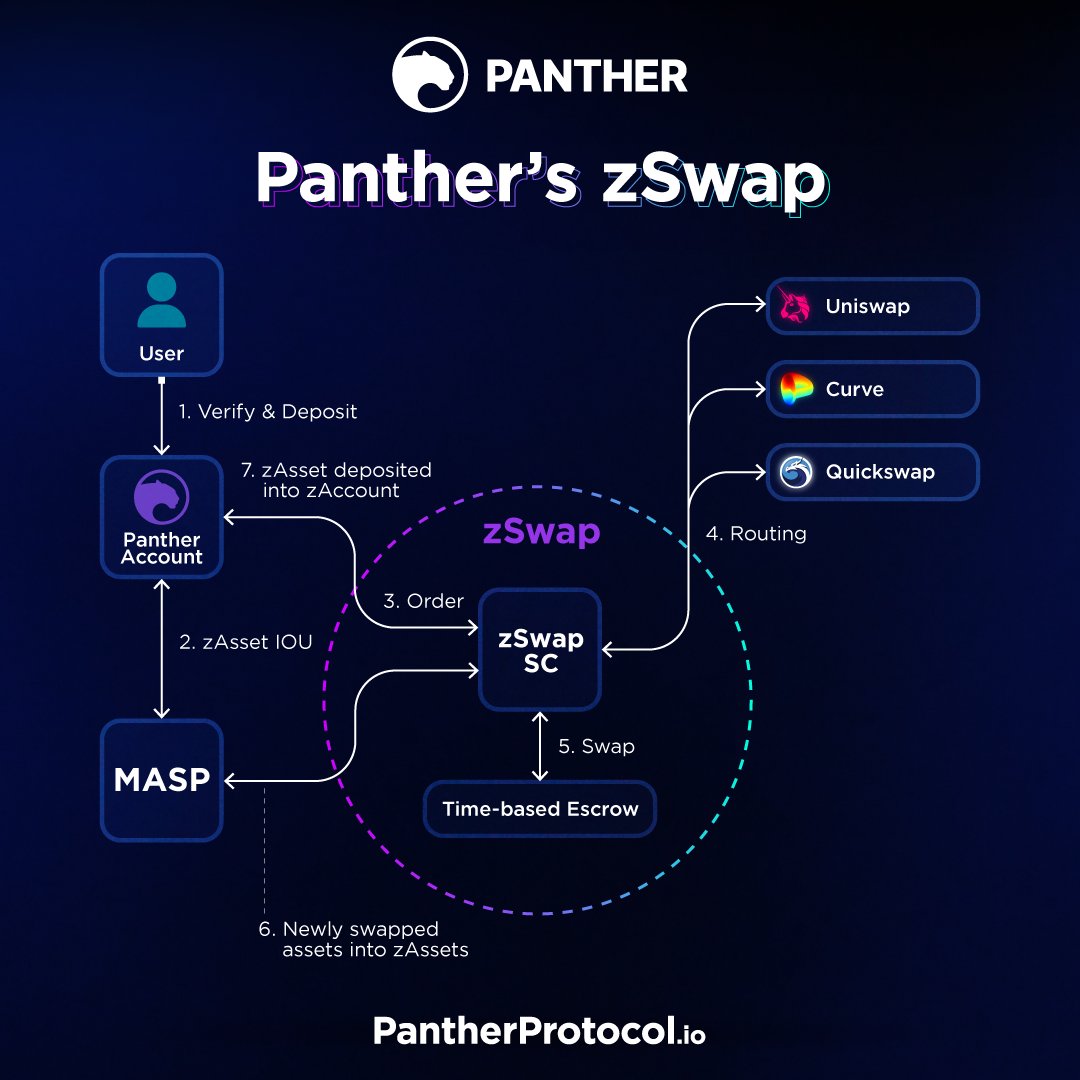
Panther keeps the access and cuts the trail. zSwap still routes trades through DEXs like @Uniswap, but the activity runs through your Panther zAccount inside the shielded pool, so observers can’t easily trace it back to your public wallet!
https://t.co/d1AhNIjcC3
~Metadata Tells the Story~
Permissionless systems don't need to read all the data to learn what’s what. Timing, frequency, and counterparties can map out user patterns even when single transactions look meaningless.
Onchain #privacy has to cover trading patterns, not just single transactions or interactions. $ZKP #DeFi