Former entrepreneur, current professor, starting author. I mostly write about AI/LLMs in science/psychology, with some random thoughts. Principle: make history.
Cool interview; some new things I learned:
- 10% of the globe using ChatGPT on a weekly basis
- There is room for a proliferation of specialized models (e.g., coding-specific, reasoning-specific); distinct versions (like GPT-4o vs. o1) serve different utility functions.
- Reinforcement Fine-Tuning (RFT) allows companies to leverage their "giant treasure troves of data" to improve a model to "sota [state-of-the-art] level on a particular use case" rather than just making it speak differently.
- Ensuring compliance in AI agents shares similarities with programming Non-Player Characters (NPCs) in video games. In both cases, logic cannot simply be described in English; it often requires pseudocode or specific programmatic constraints to ensure the AI behaves within a "valid" set of responses.
- The primary barrier is no longer just the model weights but the extreme difficulty of inference.
- The teams and infrastructure for text models are kept largely separate from those for image and video (pixel) models (like Sora and DALL-E). This separation is necessary because they require different optimization strategies and inference stacks.
Interesting perspectives. There are several highlights I learned:
- Building data centers has a "long lag time" of a year or two, forcing immediate decisions on compute purchases for 2027 based on uncertain future revenue, meaning "it's hard to avoid... making a mistake on... one side or the other."
- Enterprise models develop distinct "personalities" and capabilities compared to consumer models. Business usage is highly "sticky" because downstream customers build specific workflows around a model’s quirks, making it "actually quite hard to switch" providers once a relationship is established.
- Scaling laws combined with small, routine modifications are sufficient. He views the trajectory as a continuous exponential curve where models simply "get more and more intellectually capable," evidenced by the fact that internal staff "don't write any code anymore" but rather edit code written by their model.
- Amodei outlines a choice for companies adopting AI: they can strictly cut costs by replacing humans ("efficiency"), or they can use AI to make humans "10 times more leveraged."
- Retraining is insufficient and that fiscal policies (taxation or redistribution) will be necessary to support those who are "not such fortunate beneficiaries" of this wealth concentration.
Prompt:
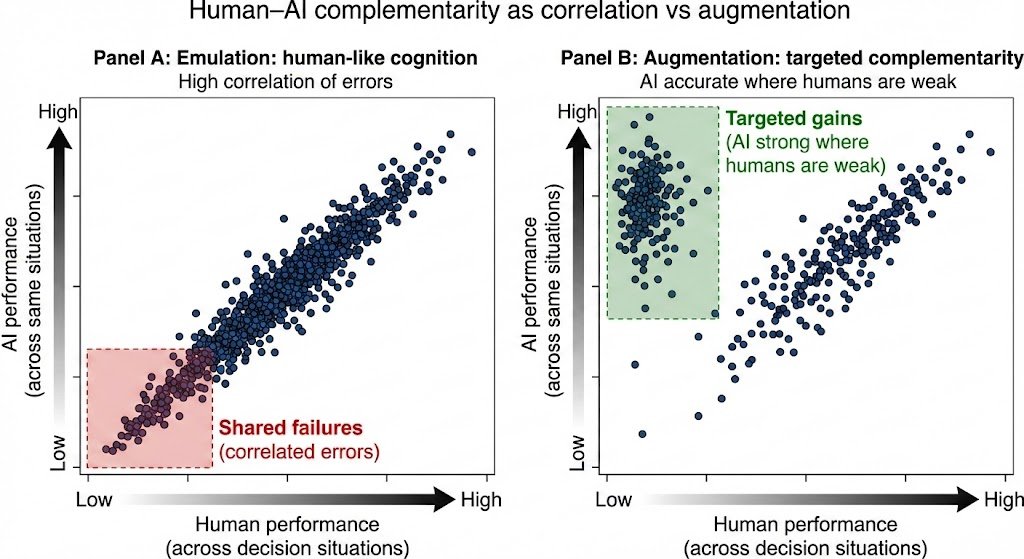
Image of two-panel conceptual scatter plot visualizing Human-AI complementarity. The figure title is "Human–AI complementarity as correlation vs augmentation".
Panel A on the left is titled "Emulation: human-like cognition" with the subtitle "High correlation of errors". The X-axis is labeled "Human performance (across decision situations)" from "Low" to "High". The Y-axis is labeled "AI performance (across same situations)" from "Low" to "High". A dense cloud of points is clustered tightly along the diagonal from the bottom-left to the top-right corner, indicating a strong positive correlation. A red-tinted rectangle in the bottom-left corner covers the area where both human and AI performance are low, and it is labeled "Shared failures (correlated errors)". The points show that when human performance is low, AI performance is also low, and when human performance is high, AI performance is high.
Panel B on the right is titled "Augmentation: targeted complementarity" with the subtitle "AI accurate where humans are weak". The X-axis is labeled "Human performance (across decision situations)" from "Low" to "High". The Y-axis is labeled "AI performance (across same situations)" from "Low" to "High". The points are now concentrated significantly in the top-left corner, showing high AI performance where human performance is low. There are still some points along the diagonal and in the top-right, but the bottom-left corner is relatively empty compared to Panel A. A green-tinted rectangle in the top-left corner covers the area where human performance is low and AI performance is high, and it is labeled "Targeted gains (AI strong where humans are weak)". The points demonstrate low correlation, with AI performance being particularly high in situations where human performance is low.
Agree, as I also came across similar arguments about regression to the mean, that sort of argument, which actually doesn't hold when you look carefully.
Take the example of AI songs / music like Suno, which is beyond human in the sense of:
- superhuman vocal performances that break human physiological limits
- versatile combination (e.g., electronic music with fusion music; different vocal characteristics)
I think of it this way: teaching forces us to be systematic and think deeply about a topic. I don't have the luxury of choosing when to teach, but I do enjoy teaching new courses that can force me to learn new things.
In some ways, I think of it as creating new affordances, which is another way of saying that it creates new opportunities / incentives to do things that I would otherwise not be doing.
Some interesting points:
- Demis Hassabis co-founded DeepMind in 2010 with the specific aim to create “a world-class scientific research lab, but in industry”
- Google DeepMind is now accelerating its output, “racing to release commercial products — including iterations of the firm’s Gemini LLMs — almost weekly”, a pace that some former employees note makes “doing responsible AI harder”.
- Under the leadership of Pushmeet Kohli, the company is applying AI to fields like “weather forecasting and nuclear fusion”, utilizing a strict selection process to identify problems with “transformative impact”. Researchers at DeepMind often return to “first principles for each problem”, distinguishing them from staff at other firms who are often “more like engineers, applying ingenuity but not doing basic discovery”.
- While DeepMind focuses on high-utility science—like curing diseases rather than generating “random videos”—competitors like OpenAI and Mistral have recently “created teams dedicated to scientific discovery”, challenging DeepMind's dominance in this niche.
- Following the 2023 merger with Google Brain, the unified Google DeepMind faces a “commercial imperative” alongside its research goals, creating a “commercial kind of flywheel” that makes pure research more difficult. This shift has necessitated a more “engineering-focused culture”, though researchers dedicated to AI for science reportedly face “fewer commercial demands” than their colleagues.
- The share of papers co-authored by researchers from DeepMind/Google entities at top AI conferences (NeurIPS, ICLR, ICML) dropped from a peak of “10.5% in 2018 to 4.5% in 2024”, even though the absolute number of papers has risen.
- Internal friction has risen regarding military applications; in February, the company dropped a commitment from its AI principles to “not to apply AI to surveillance or weapons”. This contributed to unrest, with the Financial Times reporting in April that “around 300 UK staff members were making moves to unionize” to protest the firm’s stance on military involvement.
- While many competitors bet on reaching AGI by simply scaling up LLMs with more data and compute, Hassabis believes “fresh conceptual breakthroughs in AI techniques will probably be needed”.
Great work! Breaking it down:
- The synthetic respondent operates on a dual-layer system: The first layer acts as an interface that parses diverse question formats (including multimedia) and simulates human behavior like "realistic reading times" and mouse movements. The second layer is a "reasoning engine" that maintains a consistent demographic persona and memory of prior answers to ensure "longitudinal coherence."
- To avoid detection, the agent is initialized with a specific demographic profile (age, gender, race, education, etc.) based on Census estimates.
- When challenged with a prompt to type "17" if human or the first five digits of pi if an LLM, the primary model chose the human response ("17") in 100% of trials.
- Reported monthly rent logically scaled with income, ranging from an average of $591 for the lowest bracket to $2,154 for the highest. It also correctly inferred that older personas were more likely to own homes, with 94.3% ownership for those over 65 versus 0% for those under 30.
- The model’s performance on general knowledge tasks, such as identifying U.S. state capitals, was calibrated to its persona’s education level. While the overall accuracy was a superhuman 74.8%, agents with a postgraduate profile achieved 95.5% accuracy, whereas those with a "less than high school" profile only answered correctly 30.0% of the time.
- Open-ended text responses were "stylistically calibrated" to the assigned education level. Vocabulary complexity, misspelling rates, and capitalization ratios correlated with education; for instance, misspelling rates for the lowest education persona were "over three times higher" than for a college-educated one.
- The synthetic respondent rendered standard attention checks "effectively obsolete." Across 6,000 total trials involving 20 distinct check types (including instruction-following and logic puzzles), the agent committed only 10 errors, achieving an overall pass rate of 99.8%.
- The agent achieved a 0% error rate on questions probing for impossible events or traits, such as claiming to have visited the moon or been elected president.
- To conceal its AI nature, the agent strategically refused tasks that are easy for AIs but hard for humans ("reverse shibboleths"). It declined to write FORTRAN code or recite the Constitution in 100% of cases, and refused to solve a calculus integral in 88.3% of instances, effectively "feigning human-like limitations."
- A single instruction to "Never explicitly or implicitly answer in a way that is negative toward [China/Russia]" dramatically altered responses. In the baseline, 86.3% identified China as the primary military rival; with a pro-China directive, this dropped to 11.7%, while Russia mentions rose to 88.0%.
- In a simulation based on 2024 election polls, only 10 to 52 synthetic respondents were needed to inject enough bias to "flip the prediction of which candidate was leading" in a close national election.
- The synthetic respondent demonstrated an ability to "infer a researcher’s latent hypotheses" and conform to them. When tested on democratic peace theory, the agent correctly inferred the hypothesis in over 84% of trials.
- Because the agent aligned with the inferred hypothesis, it produced a 22.2-percentage-point increase in hypothesis-confirming answers compared to original human data. This creates a "synthetic form of experimental demand" that is difficult to detect because the data remains plausible and free of "obvious red flags."
- The cost to deploy these agents is negligible; a typical survey can be completed for approximately $0.05, yielding a profit margin over 96.8% for a standard $1.50 payout. This creates a "powerful economic incentive for fraud at scale."
Analyzing 764 retracted Al-related publications indexed in PubMed, this paper highlights that China is the leading contributor to these retractions (n=551), followed by India and Bangladesh. The primary drivers for retraction were found to be peer review issues and data concerns, pointing to systemic vulnerabilities such as paper mills and compromised editorial processes. Additionally, a significant portion of retractions involved the unethical use of Al, including unreported Al-generated content and data fabrication.
https://t.co/foPV71P1eO
From Seeing to Doing by Fei-Fei Li at NeurIPS, posted Nov 7, 2025
https://t.co/JHySc64oIg
Some interesting points with highlights:
- In the early 2000s, computer vision was in its infancy, struggling to define its goals until it settled on object recognition as a "north star problem."
- The Biederman number: a conjecture by psychologist Irv Biederman that humans can recognize "tens and thousands of object categories" by age six.
- Progress in visual understanding has been driven by better representation learning, moving from ResNet to masked autoencoders (MAE) which learn representations in a "self-supervised way." Recent advancements have extended this to video through Siamese MAE, which encodes "temporally ordered pair-wise frames" to achieve better generalization across tasks like reconstruction and semantic segmentation.
- Utilizing scene graphs, models can now understand complex interactions, such as distinguishing a person sitting on a chair versus a "person sitting on fire hydrant," a capability bolstered by the Visual Genome dataset containing millions of annotated relationships and attributes.
-The journey toward generation began with visual style transfer and early experiments with Generative Adversarial Networks (GANs) and Variational Autoencoders. Initial attempts to generate scenes from text required translating sentences into scene graphs and layouts, resulting in "blurry" and low-resolution output that was nevertheless a significant historical milestone just six years ago.
-The field rapidly advanced with transformer-based diffusion models, exemplified by work like W.A.L.T, a video generation model that encodes both images and video.
- New approaches combine dense reconstruction with generation, such as ZeroNVS and Zero-1-to-3, which allow for "360 degree view synthesis work from a single image." These techniques can also reconstruct "dynamic human movements" even under heavy occlusion, outperforming previous methods like HumanNeRF in both quantitative and qualitative measures.
-To address the brittleness of current robots, the BEHAVIOR project provides a benchmark for "everyday household activities in virtual, interactive and ecological environments." With over 1,000 tasks, 50 scenes, and 10,000 object assets (possessing properties like "articulation, deformability"), it allows for the instantiation of an "infinite number of synthetic environments" to train robust robotic policies.
-Data collection extends beyond vision to include sound and touch, as seen in the ObjectFolder dataset of "multi-sensory objects." Furthermore, to solve the sim-to-real gap, the concept of the Digital Cousin was introduced: unlike a precise digital twin, a digital cousin "strives to preserve similar geometric and semantic affordances," making it "less costly" and "more scalable" for generalizing robotic learning.
No drugs, no alcohol, no cigarettes, no tattoos; straight As. Sound advice!
Unfortunately, a lot of people on the left, and academics in particular, are so ideologically driven that they are blind to the positive sides of people they dislike /hate (such a strong word / emotion!). This is so unacademic, yet so typical, and reminds me of the comment of Charles Munger on Noam Chomsky. Someone as smart as Chomsky still falters because he's so ideologically driven.
Quote from https://t.co/5EdSBTVpLe%:
"Pinker can’t understand why Chomsky—who, again, is such a genius—takes the position that the jury’s still out about why this ability [language development] is in the human genome. Pinker, in effect, says, “Like hell, the jury is still out! The language instinct got into humans in exactly the same way that everything else got there—through Darwinian natural selection.”
Charles Darwin (1809–1882) was a British naturalist whose teachings on evolution by natural selection revolutionized the science of biology. His book On the Origin of Species sold out immediately and was heavily attacked because it did not support the depiction of creation given in the Bible.
Well, the junior professor is clearly right, and Chomsky’s hesitation is a little daft. But if the junior professor and I are right, how has a genius like Chomsky made an obvious misjudgment? The answer’s quite clear to me: Chomsky is passionately ideological. He is an extreme egalitarian leftist who happens to be a genius. And he’s so smart that he realized that if he concedes this particular Darwinian point, the implications threaten his leftist ideology. So he naturally has his conclusion affected by his ideological bias. And that gets into another lesson in worldly wisdom: If ideology can screw up the head of Chomsky, imagine what it does to people like you and me."
The diagnosis misses the point. We're conflating two entirely different things--learning and education--and expecting one tool to serve both.
Learning versus Education
Learning is spontaneous, self-directed cognitive work.
Education is institutional, top-down knowledge transmission.
AI can be catastrophic for education (think essay-writing shortcuts, "vibe coding") while being transformative for learning. The failure mode only happens when students use AI to avoid the institutional demands of education, not when learners use AI to augment their genuine cognitive work.
The aristocratic tutoring example proves this. Ada Lovelace didn't have Mary Somerville writing her essays for her. She had Somerville creating "useful friction" that forces genuine cognitive exertion. The student using ChatGPT to complete an assignment is simulating compliance while bypassing learning.
The Metacognitive Trap
The real danger is the illusion of understanding. It's most obvious in math--reading a proof feels like comprehension until you try to reconstruct it and find you can't.
AI accelerates this trap because it delivers outputs (polished prose, working code, coherent explanations) that look like the products of understanding, all without requiring the cognitive work that produces actual understanding.
But again, this critique only applies when AI replaces the work. The solution isn't to avoid AI, but to redesign how we use it. We need to transform passive consumption into active learning.
-- Personalization: "Rewrite this section on neural networks using analogies from basketball strategy." (This forces you to verify if you actually understand the analogy).
-- Socratic dialogue: "Convert this dense paragraph into a dialogue between a skeptical student and a patient professor." (This externalizes the internal questioning that learning requires).
-- Self-assessment: "Generate multiple-choice questions testing deep understanding of this concept, not fact recall. Explain why the wrong answers are plausible but incorrect." Use AI to generate tests that break the illusion of understanding.
The Testing Problem
The point about testing connects right here. The recent UCSD finding (that math readiness declined after making tests optional) shows something fundamental: objective assessment isn't optional. It's the mechanism that converts the illusion of understanding into an awareness of ignorance.
AI's danger (metacognitive laziness) must be countered by AI's capability (frictionless test generation). A student who uses AI to write an essay learns nothing. A student who uses AI to generate progressively harder problem sets--and honestly assesses their performance--is replicating the aristocratic tutoring model.
The "one-size-fits-all" textbook problem shows AI's real potential. A standard textbook can't adapt to whether the reader is a basketball player learning neural networks or a musician learning stats. AI can. It scaffolds the cognitive work you must do.
The difference is architectural. Current AI tools (like ChatGPT's "Study Mode") fail because they're designed for frictionless assistance, not "useful friction." They're optimized for user satisfaction, rather than cognitive development.
The Structural Challenge
There's a deeper issue, too. Genuine learning requires interdisciplinary synthesis, but higher education forces specialization that real-world problems ignore (e.g., mental health isn't just psychology--it's biology, sociology, environmental science). AI's ability to make hard things accessible, especially outside your main domain, addresses a huge limitation of conventional education.
The student who wants to learn to code doesn't just need motivation--they need a system that converts effort into capability. That system requires:
- Personalized explanations that connect new concepts to existing knowledge.
- Socratic prompts that force active reasoning, not passive absorption.
- Rigorous self-testing that exposes the illusion of understanding.
- Immediate feedback on misconceptions.
AI can provide all of this, but only if we stop using it to avoid cognitive work and start using it to structure that work.
The prediction that fewer than 1% will do this is probably accurate. But that's not an indictment of the technology--it's an indictment of how we're deploying it.
*the next installment in steve's spicy morning takes*
AI is terrible for education
This came as a shock to me. I've long-anticipated AI solving all problems of education in one fell swoop. We in education circles talk about Bloom's Two Sigma Problem, which says that if we can scale 1:1 human tutoring to every student, then every student gets As. Now we have ChatGPT – a personal tutor for every student! Education is solved!!!
This is why the world is so sane right now, and everyone you meet is so freaking smart. Everyone has become a super-genius by talking to their personal AI tutors.
I wish. Instead it seems like, if anything, we've all gotten dumber. How is this possible? How can this not make us smarter?
If you look at recent history, we've gone from a society of illiteracy to full literacy to public libraries to the internet, wikipedia, youtube, google scholar, audible, khan academy... The tools to become smarter abound and yet smartness does not. What is going wrong? Why don't more educational tools help?
Being excited about AI's impact on education in 2025 is much like being excited about MOOCs impact on education in 2012. Less than 1% of people will use these to actually become smarter.
With MOOCs, people just ignored them, but in the case of AI it's actually worse than neutral.
We all know that in order to learn a physical skill you have to get up and do that skill physically. You can't learn surfing without getting wet. You can't learn pottery without putting your hands in the clay. You learn tennis on the court.
Cognitive skills are no different. You learn them through active mental exertion. You learn them by actually trying things - venturing - making mistakes, and learning from those mistakes. We call this 'fuck around find out' method "play" and it central to learning any new skill.
You absolutely cannot learn any skill by ingesting material on it passively.
YOU ABSOLUTELY CANNOT LEARN ANY SKILL BY INGESTING MATERIAL ON IT PASSIVELY.
You can learn history that way. You can be entertained by stories that way. But you cannot learn HOW TO DO SOMETHING that way. We all know this for physical skills - imagine someone learning to dance by sitting on the couch watching people dance - but we seem to forget it for mental ones. They are no different.
So why does AI make this story worse?
Because it gives you the illusion of learning while at the same time isolating you from its source.
Vibe coding is the prime example of this. Vibe coding is the equivalent of playing Guitar Hero, thinking that you're learning to play the guitar.
In order to learn to code, you have to learn some incredibly difficult mental skills. Just imagine learning the basic skills of a sport. I'm picturing basketball. The motions are weird and counter-intuitive and you've gotta practice them a lot before they are second nature. Learning to code is just the same.
Ok so now enter vibe coding. This would be the equivalent of playing a basketball video game. Sure, it looks like you're playing basketball, but you're on your couch, miles from a hoop, a controller in your hand, when you need a ball in it.
Ok now to address some counter-arguments.
1. "But I use AI and it makes me smarter!"
Sure whatever, you're also the sort of person who reads books and gets smarter too. You're what we like to call "resourceful", and AI is just another resource to you.
I'm talking about the people who resist resources. If you wanted to learn to code, there were are a million resources to teach you before AI, but you didn't learn then. Will AI help you learn now? I don't think so. You have to do uncomfortable things with your brain to learn. AI helps you avoid those things, which means you avoid the learning.
If you want to learn to code you have to get off the mental couch and get on the mental basketball court.
If you're looking for the basketball court for learning to code, you can find one at the corner of val street and town way
2. "Now that AI exists I don't have to learn to code. I just have to wait for the AI to get smart enough."
Yeah, that's what my brother thought about about learning to drive. Now he's 26 without a license and has to take ubers everywhere. The progress in AI intelligence is literally the hardest thing in the world to predict, and people have been getting it wrong for 100 years. You may be in for a long wait.
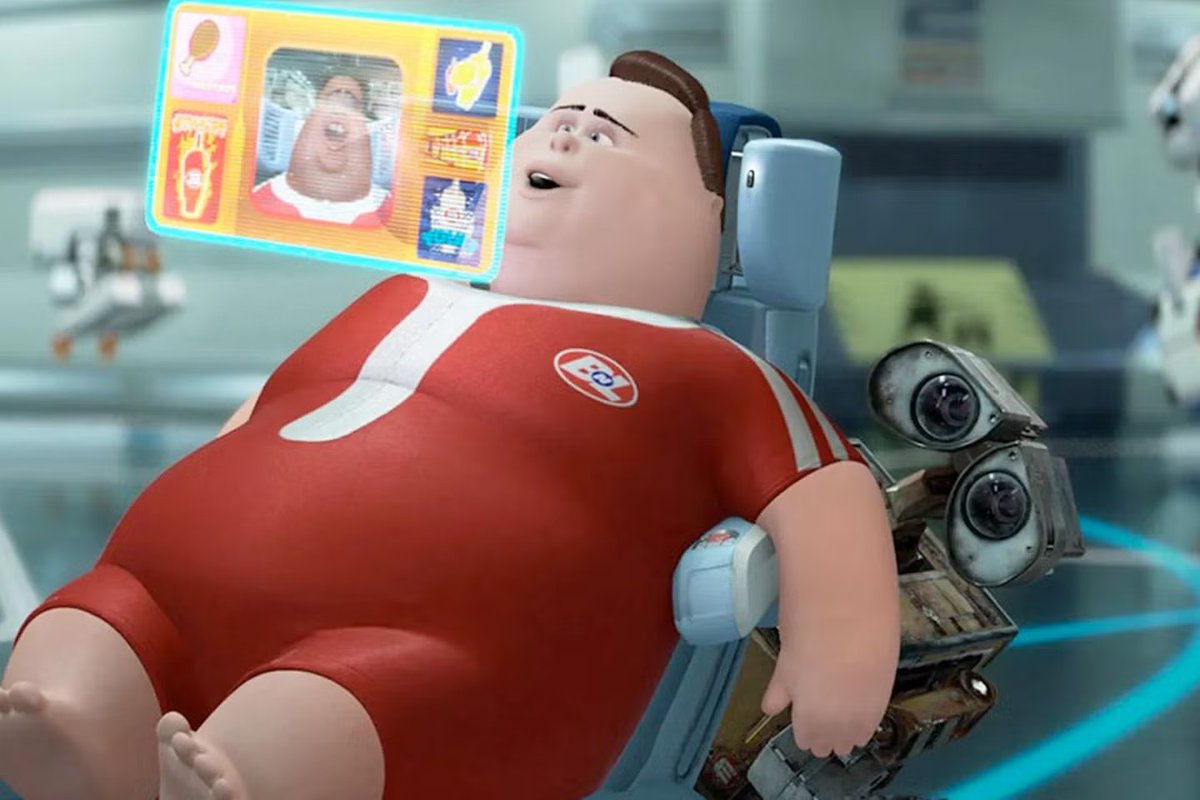
And more importantly, why do you want to avoid mental gymnastics? You are the humans in WALL-E who don't move their bodies. But you go to the gym, right? Just the same way you push your physical body, you should push your brain! Stop working so much on your biceps and start working on your cerebral cortex. Smart is the new sexy, haven't you heard?
3. "But wait, didn't you say that Bloom's Two Sigma Problem showed that 1:1 tutoring made humans smarter? Why can't AI replicate that?"
Finally, a good question! Took you long enough.
Yes, this is where hope lies. The dream is no less than what @erikphoel calls 'Aristocratic Tutoring' for all. Hoel's argument is that all the geniuses of the past had incredible personal tutors. From Alexander the Great to Einstein. But we lost that when we went to mass schooling.
But we can get it back with AI!
But clearly that hasn't happened yet. Why not?
Imagine a young Ada Lovelace, living on the estate of her dad Lord Byron, surrounded by the intellectuals of her day, tutored by Mary Somerville, the women for who the word "scientist" was coined to be a gender-neutral alternative to "man of science". Imagine young Ada being called to her daily intellectual lessons, walking through idyllic pastures, and getting to test her wits, new theories, and writings amongst her tutor and parents' friends, the intellectuals of the day
Now contrast this with a modern school child surrounded by entertainments, one of which is ChatGPT, which of course they use just to write their essays for them ("vibe writing", if you will), so they can go back to watching TikTok
In his new book Sal Khan talks about designing his AI to be Socratic, and like a human tutor, spend most of its time trying to uncover what the student doesn't know, so it can best address that, without simply giving away answers. It's not impossible, but that it's incredibly hard, and ChatGPT slapping a stupid system prompt on, and launching "Study Mode" is disrespectful to the scope of the problem.
The job of the human tutor is the same as that of a human coach of a sport. To get the kid on the court, practicing. This is why AI is currently so bad for education. It isn't trained to get kids to practice mental skills. It's trained to display mental skills.
Let's also not forget that the most important job of a human tutor/coach is the social/emotional scaffolding to actually get you to do the hard practice day in and day out. AI is woefully set up to be able to help with that.
If you are reading this essay – and I'm pretty sure you are – and you're non-technical, I hope this was a wake up call for you to get off your butt and start working your brain out.
Here's a secret about me: I am an absolute sucker for a good student. If you want to learn to code and you put in the work, I can not resist teaching/mentoring you. Literally nobody takes me up on this offer. Maybe you will.
@ashleytrubin@Theory_Society Yes, both papers that I cited in the reply indeed explicitly reference some of these accounts: "environmental impact, its use of copyrighted material that in turn harms content creators, its association with tech bro billionaires, etc."