Introducing $ZNG our native token for ZNodeGrid app.
CA : 0x1e6b5e3e885b732bd754fd5aa4e8528b93763d88
Node Grid is private file storage. We store as three replicas on independent storage nodes. A coordinator watches those nodes and repairs lost replicas automatically. Storage is paid for once, on-chain, and that payment funds the operators who run the nodes.
https://t.co/NC4GU0AOOL
Every operation has its own systematic excution.
You sign a fixed unlock message. Signing is deterministic, so the same wallet always gives the same result.
The signature hash is stretched into a 256-bit unlock key, inside your browser.
A random 256-bit key, made once on your device. The server only ever stores it wrapped by the unlock key.
Every file and its metadata is sealed with a fresh random IV. Any tampering fails the auth tag.
Decentralized storage is more than just distributing files.
ZNode Grid encrypts files + metadata client-side with AES-256-GCM, replicates data across 3 independent nodes, and detects offline nodes via 5s heartbeats.
Missed nodes? The coordinator triggers replica repair.
On-chain payments. Permissionless infrastructure. Built for resilience.
$ZNG is the ZNodeGrid token with a fixed-supply ERC-20 (1B ZNG, 18 decimals) on Robinhood Chain.
storage purchases is still paid for in ETH and node rewards are still paid in ETH.
what $ZNG adds is node staking: operators lock it as a bond, and the coordinator places new files on staked operators' nodes first.
staking contract 0xeF996AA33832818a355F0657f04D023F1879c5F6
minimum stake - 100,000 $ZNG active stake
unbonding period - 7 days
slash limits - 10% of stake per slash, once per operator per day, burned
Stake from the dashboard
1. visit https://t.co/Vd7pu1hME2 page and connect your operator wallet, the one your nodes are registered to. The stake covers all of that wallet's nodes.
2. In the Stake panel, enter an amount and click Stake. Your wallet asks you to approve the amount first, then to confirm the stake.
3. Once your active stake reaches the minimum, the panel shows Staked. The coordinator picks up the change within a minute.
Your payment pays the grid.
Most of every storage payment goes into a reward pool that only the people running nodes can earn from. The contract enforces the rules itself.
- Exact price only. Overpaying or underpaying reverts.
- One purchase per wallet, recorded on-chain forever.
- Rewards can never exceed what the pool holds.
- Operators can withdraw any time. Nobody can claw rewards back.
its never about protocol its always about incentive and user first.
safe your files at https://t.co/knbTEwZgRN
$ZNG is the ZNodeGrid token with a fixed-supply ERC-20 (1B ZNG, 18 decimals) on Robinhood Chain.
storage purchases is still paid for in ETH and node rewards are still paid in ETH.
what $ZNG adds is node staking: operators lock it as a bond, and the coordinator places new files on staked operators' nodes first.
staking contract 0xeF996AA33832818a355F0657f04D023F1879c5F6
minimum stake - 100,000 $ZNG active stake
unbonding period - 7 days
slash limits - 10% of stake per slash, once per operator per day, burned
Stake from the dashboard
1. visit https://t.co/Vd7pu1hME2 page and connect your operator wallet, the one your nodes are registered to. The stake covers all of that wallet's nodes.
2. In the Stake panel, enter an amount and click Stake. Your wallet asks you to approve the amount first, then to confirm the stake.
3. Once your active stake reaches the minimum, the panel shows Staked. The coordinator picks up the change within a minute.
Contract - ZNGNodeStaking at 0xeF996AA33832818a355F0657f04D023F1879c5F6
minimum stake 100,000 ZNG, 7-day unstaking period, slasher 0xdb65…a8AE.
$ZNG node staking deployed it to Robinhood Chain mainnet, and verified its source on @blockscout and RobinEtherscan.
https://t.co/0C454SyjyK
Introducing Stakes with $ZNG at ZNodeGrid
How it works:
Staking - Node operators stake $ZNG from their operator wallet with minimum 100,000 $ZNG or more, the coordinator gives prioritize new file uploads from users to staked node operants
Unstaking - request it, wait 7 days, then withdraw. Operators can cancel during the wait. Stake that's waiting to unlock can still be slashed, so nobody can pull out to avoid a penalty
Slashing - only the coordinator's key can slash, and slashed $ZNG is burned. 10% of an operator's stake per slash, at once per day.
Quick starter guide for users :
Connect your wallet
Sign one message to prove it's you. It costs no gas, and there's no password to remember.
Buy storage once
A single fixed-price payment to the contract. You never pay again.
Drop in your files
Each file is encrypted on your device before it uploads, name included.
Open them anywhere
Sign in from any browser with the same wallet. Your files decrypt locally.
This is how node joining works , every node participant must know from technical point of view.
An operator signs in to the node dashboard with their wallet and creates a join token. those tokens are single-use, expire after 24 hours and are stored only as a hash.
On first start, a node generates its own secp256k1 identity key, then signs a join message that binds the token, its identity address and the URL it will serve on.
Before accepting the node, the coordinator performs a contact check: it calls the node's /health endpoint at that URL and requires the node there to report the same identity.
A node can't register an address it doesn't control.
try earning with idle nodes from here https://t.co/NC4GU0AOOL
The coordinator sends data to your node, so it needs a public address.
Add --tunnel and the node handles that itself.
npm install also installs Cloudflare's cloudflared, and on start the node opens a free Cloudflare quick tunnel (no account, no port forwarding), waits until it is reachable, and joins with that address:
Major Update
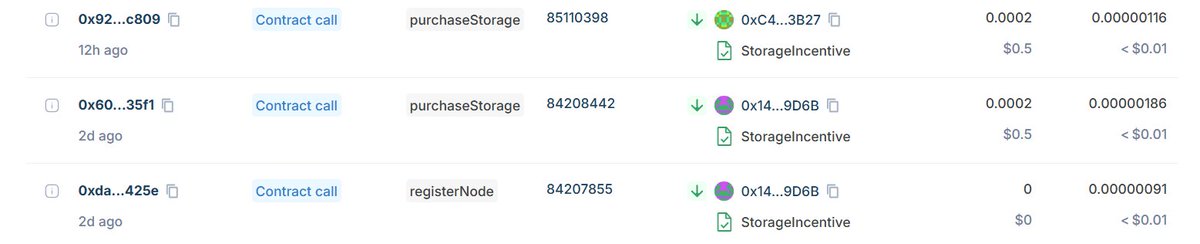
ZNodegrid incentive smart contract is verified on-chain on @blockscout explorer.
everyone can track
node reward pool,
storage purchases,
node registration,
node reward distribution and other operations publicly.
till now two user have paid 0.0002 $ETH and unlocked their storage for lifetime and total Incentive node reward pool reached 0.00036 $ETH .
Incentive smart contract address : 0x305A4b17C7D55B5956B348469f61113D764B0e53
Track on-chain logs here : https://t.co/802rlYfdnt
signup for node participation here : https://t.co/Vd7pu1iktA
signup for safe and private storage here : https://t.co/FJNowA94Xa
Just think of that one of storage node turns malicious !!!
What they get is only Encrypted blobs with random IDs. No names, no owner, no key.
Why it's not enough ?
Changed bytes fail AES-GCM's auth tag, and the file is fetched from another replica.
Our tech has most possible security involved.
safe your files at https://t.co/knbTEwZOHl
$ZNG
Data clouds downtime is the worst problem traditional storage clouds face that leads dependant companies to temporarily stop their services too.
The core issue here is not being dependent but being dependent on single servers.
ZNodeGrid solve this problem by replicating uploaded file to multiple nodes. Our system shares same encrypted file to 3 active nodes on network.
If one node faces downtime or inactive, our smart coordinator instantly replicates the files stored in inactive node to another active node.
By this system there will be no downtime for individual user or businesses, they can request download / upload / delete always.
Your key is a signature, not a password.
Your vault key is unlocked from a wallet signature that happens on your device. The servers never see it, so a breached server doesn't mean breached files.
001 - Wallet signature
You sign a fixed unlock message. Signing is deterministic, so the same wallet always gives the same result.
002 - HKDF-SHA256
The signature hash is stretched into a 256-bit unlock key, inside your browser.
003 - Vault key
A random 256-bit key, made once on your device. The server only ever stores it wrapped by the unlock key.
004 - AES-256-GCM
Every file and its metadata is sealed with a fresh random IV. Any tampering fails the auth tag.
ZNodeGrid vs Other Decentralized storage systems :
IPFS is great for sharing public content, but it doesn't encrypt anything or keep it stored.
Storj is private and durable, but it works like a cloud account: monthly bills, over conflict node setup , delayed incentive distribution.
ZNode keeps the privacy and durability and drops the rest. No complex node setup just few commands and good to go , one time payment with lifetime access.
have a look at our white paper and know more about us - https://t.co/IrvGAIF6cA
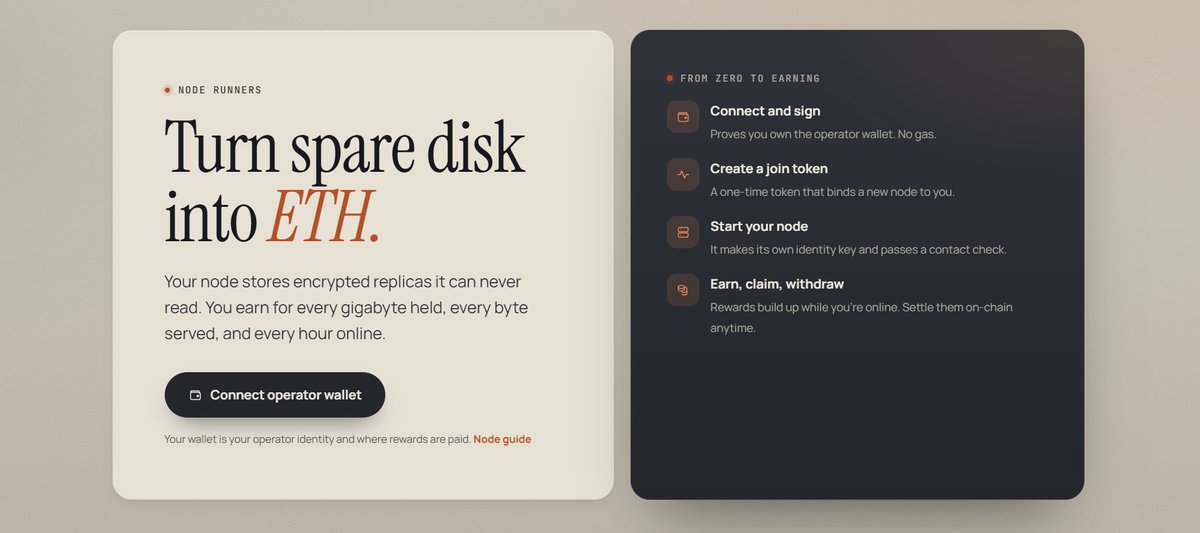
Earn $ETH for renting your free disc space at ZNodeGrid
Here is how to setup your node locally :
Before you start your machine needs Node.js 18+ and Git installed
- visit https://t.co/0VGGw4wGvC connect your wallet and register as node
- set node name , providable storage , select " Another Machine " then create join token.
- then open terminal and paste the given command in dashboard.
Thats it. you setup your Node and its ready earning $ETH for being idle
ZNodeGrid VS Traditional Cloud storage systems :
They hold the files and the keys.
Well knows cloud drives might encrypt your data at rest, but you might get blocked at login or suspend your account for multiple password reset attempts when it comes to ownership they can control your keys.
That means the provider can read, scan, lose or hand over your files.
ZNodeGrid solves these ownership problems at one place. Instead of traditional 3rd party login methods we use wallet login, that directly hand overs ownership authority to you and your device and the storage to a network nobody owns.
Say no to Traditional drives. migrate to https://t.co/knbTEwZOHl