Building a productivity app for Indian students and founders.
UPSC, CAT, NEET, JEE, Boards or startups - stay focused, beat distractions and turn your goals into action.
Join the waitlist: https://t.co/9jVWsLV5Op
#hiring for a friend, to grow a X account organically in UPSC segment. Interested candidates please comment or DM.
Remember your profiles will be checked
Anxiety is normal when Prelims results are on the way.
One thing which actually helped is thinking and planning about Plan B.
Trust this is not fear or cowardice.
This is smartness.
Don’t take on ego, accept the reality and move on.
#UPSC Intel Polity Static🚨
Day 2
Citizenship for #UPSCPrelims2026
Constitutional base:
• Articles 5–11
• Deals only with citizenship at commencement
• Parliament has full power under Article 11
Art 5 → Citizenship at commencement (domicile)
• Art 6 → Migrants from Pakistan
• Art 7 → Migrants to Pakistan, later return
• Art 8 → Indians abroad
• Art 9 → Voluntary foreign citizenship = loss of Indian citizenship
• Art 10 → Continuance of citizenship
• Art 11 → Parliament’s power to regulate citizenship
Intel traps 🚨
• Arts 5–10 deal ONLY with 26 Jan 1950 situation
• Post-commencement rules → Citizenship Act, 1955 (Art 11)
• Citizenship provisions are outside Part III
Ways to acquire Indian citizenship (Citizenship Act, 1955):
• Birth
• Descent
• Registration
• Naturalisation
• Incorporation of territory
Loss of citizenship:
• Renunciation
• Termination
• Deprivation
Citizenship by Birth (Post-1987):
• Born before 1 July 1987 → citizen by birth
• Born 1987–2004 → one parent must be Indian
• Born after 2004 → one parent Indian + other not illegal migrant
Citizenship by Descent:
• Registration at Indian mission required
• Post-2004 births → one parent Indian + declaration on other parent’s nationality
Naturalisation:
• 12-year residence rule
• Good character mandatory
• Knowledge of any one Indian language (Eighth Schedule)
Termination vs Deprivation (confused often):
• Termination → voluntary acquisition of foreign citizenship
• Deprivation → forced removal by Govt (fraud, disloyalty, etc.)
Single vs Dual citizenship:
• India → Single citizenship
• Foreigners acquiring Indian citizenship must renounce previous citizenship
• OCI ≠ dual citizenship
OCI
OCI introduced by 2005 amendment
• OCI can’t vote, contest elections, or hold constitutional offices
• OCI can own property except agricultural land
CAA
• Amendment to Citizenship Act, 1955
• Applies to Hindus, Sikhs, Buddhists, Jains, Parsis, Christians
• Countries: Afghanistan, Pakistan, Bangladesh
• Not applicable to Muslims
• Reduced naturalisation period from 11 to 5 years
• Illegal migrants included only for specified communities
• Does not affect Indian citizens
Follow for more @UpscIntel
#UPSC Prelims Intel: Polity Static
Fundamental Rights
• Contained in Part III (Articles 12–35)
• Borrowed mainly from US Constitution
• Enforceable by courts → Justiciable
• Available against the State (Art 12)
• Some FRs apply to non-citizens (Arts 14, 21, 20, 23)
• Majority of FRs apply to citizens only
State & Laws
• Art 12 → Defines State (Govt, Parliament, State Govts, Legislature, local authorities, other authorities)
• Art 13 → Laws inconsistent with FRs are void
• Pre-Constitution laws + post-Constitution laws both covered
Classification of Fundamental Rights
• Right to Equality → Arts 14–18
• Right to Freedom → Arts 19–22
• Right against Exploitation → Arts 23–24
• Freedom of Religion → Arts 25–28
• Cultural & Educational Rights → Arts 29–30
• Right to Constitutional Remedies → Arts 32–35
Nature & Limits
• FRs are not absolute
• Subject to reasonable restrictions
• Can be suspended during National Emergency
– Except Arts 20 & 21
• Automatically suspended FRs → Art 19 (Art 358)
Enforcement
• Art 32 → SC writ jurisdiction
• Art 226 → HC writ jurisdiction (wider)
• FRs are enforceable through 5 writs
Amendability
• FRs can be amended
• But cannot violate Basic Structure
• Golaknath → restricted amendment
• Kesavananda → amendment allowed with limits
#upscpreparation #UPSCPrelims2026 #India #constitution
Follow for more @UpscIntel
#UPSC Prelims Intel 🚨: Polity Static
Fundamental Rights
Article 21 — Protection of Life and Personal Liberty (Part III)
No person shall be deprived of his life or personal liberty except according to procedure established by law.
Scope
•Applies to all persons (citizens & non-citizens)
•Enforceable against the State
•Available even during National Emergency
Key Concepts
“Life”
•Means life with dignity, not mere animal existence
•Includes quality of life, health, and humane conditions
“Personal Liberty”
•Covers a wide range of individual freedoms
•Includes physical, mental, and personal autonomy
“Procedure Established by Law”
•Law must exist and be duly enacted
•Procedure must be just, fair, and reasonable
•Arbitrary or oppressive procedure violates Art 21
• Articles 14 and 19 act as checks on procedure
Exceptions /
•Deprivation allowed only by valid law
Procedure must satisfy:
•Article 14 (non-arbitrariness)
•Article 19 (reasonableness, where applicable)
Rights Covered
- expanded via judicial intervention
Life with Dignity
• Right to live with human dignity
• Right to humane working conditions
• Right to shelter
• Right to livelihood
Personal Liberty & Autonomy
• Right to personal liberty
• Right to privacy
• Right to bodily autonomy
• Right to reproductive choice
• Right to sexual autonomy
Health & Well-being
• Right to health
• Right to medical care
• Right to emergency medical aid
• Right to clean drinking water
• Right to a pollution-free environment
Justice & Legal Protection
• Right to free legal aid
• Right to speedy trial
• Right to fair investigation
• Right against illegal detention
• Right against custodial torture
Information & Expression-linked
• Right to information (life & liberty cases)
• Right to know grounds of arrest
• Right to appeal and access justice
Education & Development
• Right to education (now explicitly under Art 21A)
• Right to development
Death & End-of-Life
• Right to die with dignity
• Passive euthanasia permitted under guidelines
• No fundamental right to suicide
Environment & Safety
• Right to clean environment
• Right to protection from hazardous industries
• Right to safe living conditions
Women & Children
• Right against sexual harassment
• Right to maternal health
• Right to protection of children’s life & dignity
Emergency Protection
•Not suspended even during National Emergency
•Protected under Article 359
Important:
•Art 21 applies to foreigners as well
•“Due process of law” is not expressly mentioned, but substantively read into Art 21 by judiciary
•Preventive detention laws operate subject to Art 21
Article 21A - Right to Education
•Free and compulsory education for children 6–14 years
•Inserted by 86th Constitutional Amendment Act, 2002
•Distinct from, but related to, Article 21
Share, Save, Revise, Follow @UpscIntel
#upscpreparation #UPSCPrelims2026 #IAS #constitution
Right to Information (RTI)
Law
•Right to Information Act, 2005
•In force from 12 October 2005
Objective
•Ensure transparency and accountability in the functioning of public authorities
⸻
Who can seek information
•Any citizen of India (only citizens; not foreigners)
⸻
Public Authorities Covered (Section 2(h))
•Central & State governments
•Local bodies (Panchayats, Municipalities)
•Public Sector Undertakings
•NGOs substantially financed (directly or indirectly) by government funds
⸻
What is “Information” (Section 2(f))
•Records, documents, memos, emails
•Opinions, advices, circulars
•Data in any form (paper, electronic, samples, models)
⸻
Time Limits (Section 7)
•30 days — normal cases
•48 hours — if information concerns life or liberty
•40 days — if request routed through Assistant PIO
⸻
Fees
•Application fee prescribed by government
•Below Poverty Line (BPL): No fee
⸻
Exemptions (Section 8)
Information relating to:
•National security, sovereignty, integrity
•Strategic, scientific, economic interests of the State
•Trade secrets, fiduciary relationships
•Personal information (unless larger public interest)
⸻
Security & Intelligence Organisations (Section 24)
•Organisations in Second Schedule (e.g., IB, RAW) are exempt
•Exception: Information related to corruption or human rights violations
⸻
Authorities under RTI
•Central Information Commission (CIC)
•State Information Commissions (SICs)
⸻
Penalties (Section 20)
•₹250 per day for delay
•Maximum penalty: ₹25,000
•Disciplinary action may also be recommended
⸻
Important Legal Points
•RTI overrides the Official Secrets Act, 1923 (Section 22)
•Applicant need not give reasons (Section 6)
•Appeals lie to First Appellate Authority, then CIC/SIC
Fundamental Rights
Article 32 — Right to Constitutional Remedies (Part III)
Core Idea
The right to move the Supreme Court for enforcement of Fundamental Rights.
📌 Called the “heart and soul of the Constitution” (B.R. Ambedkar)
⸻
Article 32(1)
The right to move the Supreme Court by appropriate proceedings for the enforcement of Fundamental Rights is itself a Fundamental Right.
⸻
Article 32(2)
The Supreme Court has the power to issue directions, orders, or writs, including:
•Habeas Corpus
•Mandamus
•Prohibition
•Certiorari
•Quo Warranto
👉 Only for Fundamental Rights, not other legal rights.
⸻
Article 32(3)
Parliament may by law:
•Empower any other court to exercise powers similar to those of the Supreme Court under Article 32(2)
📌 Such courts act within limits prescribed by Parliament.
⸻
Article 32(4)
The right guaranteed by Article 32:
•Shall not be suspended,
except as otherwise provided for by the Constitution.
📌 Suspension possible only during National Emergency via Article 359.
⸻
Scope & Limits
• Article 32 is available only for FR enforcement
• Cannot be used for DPSPs or legal/statutory rights
• Applies against the State (Art 12)
• Supreme Court cannot refuse to entertain a genuine Art 32 petition
⸻
Article 32 vs Article 226
• Art 32 → Only FRs, SC
• Art 226 → FRs + other legal rights, HC
• Art 32 = Fundamental Right
• Art 226 = Constitutional power (not FR)
⸻
Emergency Position
• Article 32 can be suspended during National Emergency
• But Arts 20 & 21 remain enforceable
Writs
1️⃣ Mandamus — “We command”
Meaning
• Court commands a public authority to perform a public/legal duty
Issued When
• Authority fails or refuses to perform a duty
• Duty must be mandatory, not discretionary
Cannot be Issued Against
• Private individuals
• President / Governor (constitutional immunity)
• For enforcing private contracts
Mandamus enforces public duty, not private rights.
⸻
2️⃣ Certiorari — “To be certified”
Meaning
• Higher court quashes an order of a lower court / tribunal
Issued When
• Lack of jurisdiction
• Excess of jurisdiction
• Error apparent on face of record
• Violation of natural justice
Nature
• Corrective writ
• Issued after order is passed
Certiorari = quash what is already done.
⸻
3️⃣ Prohibition — “To forbid”
Meaning
• Higher court prevents a lower court / tribunal from continuing proceedings
Issued When
• Lower body is acting:
– Without jurisdiction
– In excess of jurisdiction
Nature
• Preventive writ
• Issued before final order
Prohibition = stop before damage.
⸻
4️⃣ Habeas Corpus — “Produce the body”
Meaning
• Court orders authority to produce a detained person
• Tests legality of detention
Issued Against
• State authorities
• Private individuals (illegal confinement)
Suspension
• Can be suspended during Emergency
• But detention violating Art 20 & 21 still challengeable
Fastest writ; protects personal liberty.
⸻
5️⃣ Quo Warranto — “By what authority?”
Meaning
• Court asks a person on what authority they hold a public office
Conditions
• Office must be:
– Public
– Created by Constitution or law
• Appointment must be illegal
Who Can File
• Any person (even without personal interest)
Only writ where locus standi is irrelevant.
#upsc #mandamus #supremecourt #justice
Fundamental Rights
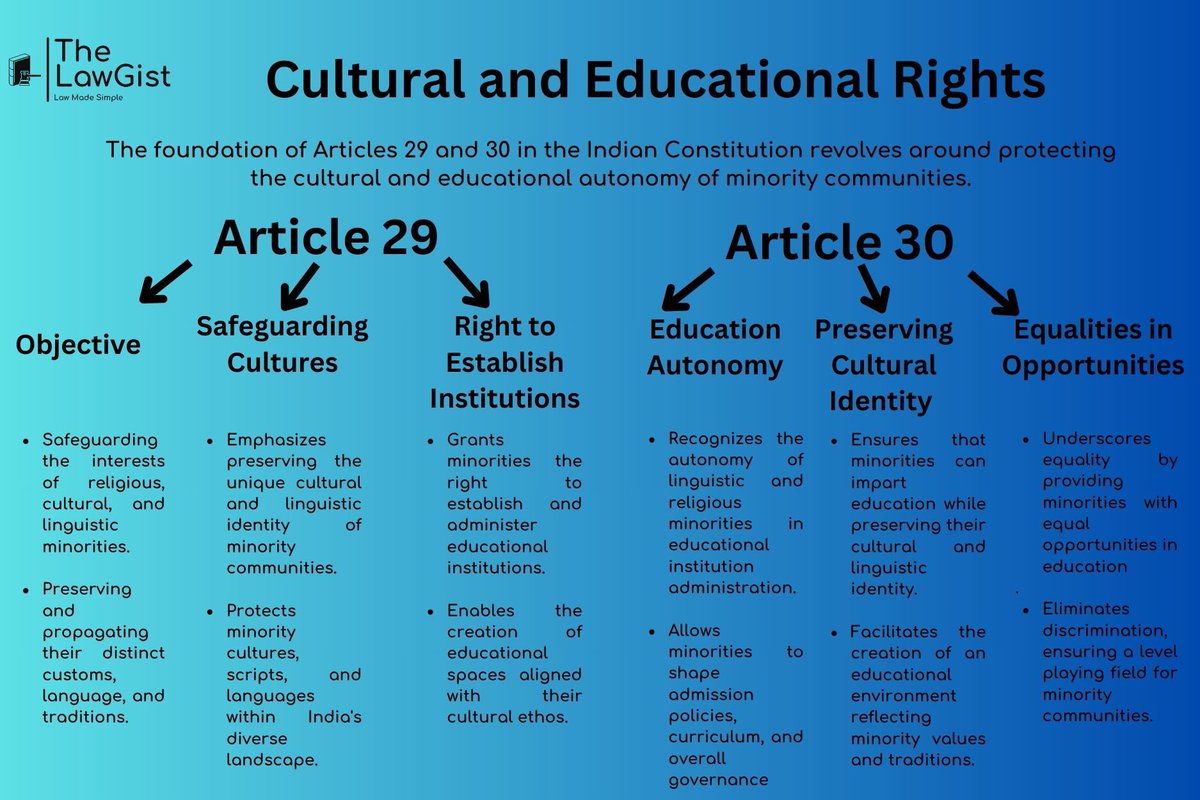
Article 29 — Protection of Interests of Minorities
Article 29(1)
Any section of the citizens having:
•A distinct language,
•Script, or
•Culture of its own,
shall have the right to conserve the same.
📌 Applies to any section of citizens (not only religious minorities).
⸻
Article 29(2)
No citizen shall be denied admission into any educational institution:
•Maintained by the State, or
•Receiving aid out of State funds,
on grounds only of:
•Religion
•Race
•Caste
•Language
•Any of them
📌 Applies to citizens only.
⸻
Article 30 — Right of Minorities to Establish and Administer Educational Institutions
Article 30(1)
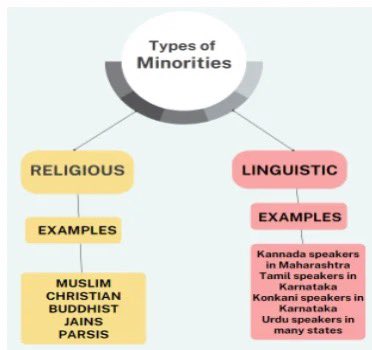
All minorities, whether based on:
•Religion, or
•Language,
shall have the right to:
•Establish, and
•Administer educational institutions of their choice.
📌 Minority status is determined state-wise, not nationally.
⸻
Article 30(1A)
In case of compulsory acquisition of property of a minority educational institution:
•Compensation shall ensure that the right under Article 30(1) is not destroyed or abrogated.
📌 Inserted by 44th Constitutional Amendment Act, 1978.
⸻
Article 30(2)
The State shall not discriminate against any educational institution:
•On the ground that it is under the management of a minority
when granting aid.
⸻
Clarifications
• Article 29 protects culture, not administration
• Article 30 protects institutions, not culture
• Article 29 applies to any section of citizens
• Article 30 applies only to minorities
• Minority institutions can receive State aid
• Rights under Art 30 are not absolute (subject to reasonable regulation)
#UPSC #IAS #upscpreparation #UPSCPrelims2026 #minority
Prelims isn’t lost on tough questions.
It’s lost on the easy static ones you were supposed to get right.
So diligently start revising static subjects
Stay away from noise and FOMO.
Right to vote and the right to be elected are statutory (legal) rights.
•They are not Fundamental Rights under the Constitution.
•They are provided by law made by Parliament, mainly:
•Representation of the People Act, 1950
•Representation of the People Act, 1951
•Article 326 of the Constitution provides the basis of adult suffrage,
but the actual right to vote and contest elections flows from statute, not directly from Part III.
🌾 Temperate Grasslands
•Prairies → North America (USA, Canada)
•Pampas → South America (Argentina, Uruguay)
•Steppes → Eurasia (Russia, Ukraine, Central Asia)
•Velds → South Africa
•Downs → Australia
•Canterbury Plains → New Zealand (often included under temperate grasslands)
Alexander Cunningham
•Known as: Father of Indian Archaeology
•Founded: Archaeological Survey of India (1861)
•Role: First Director General of ASI
•Contributions:
•Identification of ancient sites using Chinese travellers’ accounts
•Excavations at Sarnath, Sanchi, Mathura
•Focus: Buddhist sites, inscriptions, numismatics
⸻
John Marshall
•Director General, ASI: 1902–1928
•Major Contribution:
•Excavation & recognition of Harappa and Mohenjo-daro
•Established Indus Valley Civilization as Bronze Age culture
•Introduced: Systematic archaeological methods
•Also worked on: Sanchi stupa restoration
⸻
Mortimer Wheeler
•Director General, ASI: 1944–1948
•Known for:
•Introducing scientific stratigraphic excavation in India
•Key excavations:
•Harappa, Arikamedu, Brahmagiri
•Legacy: Trained first generation of Indian archaeologists
⸻
Francis Buchanan (Francis Buchanan-Hamilton)
•Profession: Physician, surveyor, naturalist
•Known for:
•Buchanan surveys of India (Mysore, Bengal, Bihar)
•Contribution:
•Early documentation of economy, agriculture, tribes, flora, fauna
•Importance: Valuable administrative & ethnographic records
🏛️ Archaeological Survey of India (ASI)
🔹 Establishment
•Founded: 1861
•Founder: Alexander Cunningham (First Director General)
⸻
🏛️ Administrative Control
•Ministry: Ministry of Culture, Government of India
•Nature: Statutory organisation
⸻
📜 Legal Framework (Acts)
•Ancient Monuments and Archaeological Sites and Remains Act, 1958
•AMASR (Amendment) Act, 2010
•Prohibits construction:
•100 m → Prohibited area
•100–300 m → Regulated area
⸻
🧭 Core Functions
•Protection & conservation of:
•Ancient monuments
•Archaeological sites
•Sculptures, inscriptions
•Conducts archaeological excavations
•Maintains centrally protected monuments
•Chemical preservation of heritage structures
•Epigraphy & numismatics studies
⸻
🏰 Monuments Under ASI
•Maintains 3,600+ centrally protected monuments
•Includes:
•UNESCO World Heritage Sites
•Temples, stupas, mosques, forts, caves
⸻
🗺️ Major Excavation Sites
•Harappan sites: Harappa, Mohenjo-daro (earlier), Dholavira, Rakhigarhi
•Buddhist sites: Sarnath, Sanchi
•Chalcolithic & Megalithic sites
⸻
🧠 Important ASI Terms
•Protected Monument
•National Importance
•Prohibited Area (100 m)
•Regulated Area (100–300 m)
⸻
🧠 Director General
•Head of ASI
•Appointed by Government of India