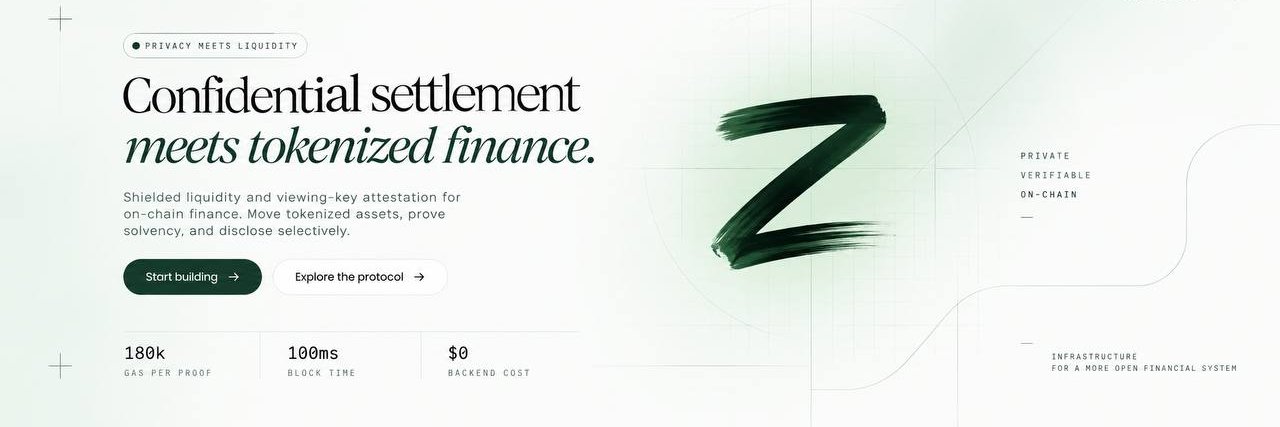
$ZRL is officially live on https://t.co/pfhtoO81c7.
Built to power the cross chain shielded settlement pipeline between $ZEC and Robinhood Chain, utilizing native Orchard primitives, viewing key verification, and private relay architectures for trust minimized state transfer.
CA: 0x0fb3d7b4ce6e3c2742c68bfdabe98e3aa2124800
Website :- https://t.co/10xKbkbdQi
By combining FROST signing with Orchard’s native nullifier verification, the relayer ring can authorize atomic cross-chain releases solely based on cryptographic proof not institutional trust.
Infrastructure grade privacy requires security that is mathematically guaranteed from the ground up.
Docs & portal: https://t.co/m2JPSvgaNq
Most cross chain architectures depend on trusted multi sig custodians to authorize transfers creating massive attack vectors and single points of failure.
To bridge shielded state securely, the pipeline replaces centralized custody with a FROST threshold signatory ring
Zero Single Point of Failure
Even if individual relay nodes go offline or act maliciously, the network cannot execute an invalid state transition unless t threshold signers agree.
Because key shares are distributed across independent validators running zero knowledge attestation engines, no single party holds custody or unilateral control over transit liquidity.
Great to see so much active engagement.
We’ve been heads down building this infrastructure together for a long time, and we aren't going anywhere. Seeing the ecosystem rally around real, technical privacy and shielded settlement only pushes us to ship faster.
Still here, still building, and focused on the work ahead. $ZRL
One of the most underutilized primitives in Zcash isn't the zero knowledge proof itself it's the 512-byte encrypted memo field inside Orchard shielded notes.
Most protocols treat memos as arbitrary user text. In a cross chain pipeline, that field functions as an encrypted on chain transport bus:
Private Execution Calldata: Routing instructions, target contracts, and relayer fee allowances are packed directly into the note's authenticated ciphertext.
Zero Mempool Exposure: Because the payload lives entirely inside the shielded pool, transaction intentions are never broadcast across public mempools or visible to front-running bots.
Delegated Decryption via IVKs: Using incoming viewing keys (IVKs), an off-chain relayer network can decrypt and validate execution instructions without ever gaining spending authority or linking the sender’s address.
Instead of passing execution logic through transparent bridges, the entire intent remains cryptographically hidden until settlement. $ZRL
As requested: the full pipeline demo.
Walkthrough of end to end shielded state transfer, intent relaying, and on-chain verification in real time.
Take a look under the hood.
Cross chain verification between Zcash and EVM environments has a massive bottleneck: Halo 2 proofs are too computationally expensive to verify natively on an EVM chain.
To bridge shielded state without breaking gas limits, the pipeline implements a recursive proof compressor:
Halo 2 to Groth16 Aggregation: Orchard state transitions proven via Halo 2 circuits are recursively wrapped and compressed into a single, compact Groth16 proof off-chain.
Low Cost On Chain Attestation: Instead of forcing the destination EVM smart contract to parse native Pallas/Vesta curve operations, it only verifies a constant-size pairing check on the BN254 curve.
Deterministic State Verification: The contract mathematically confirms note commitments and valid nullifier generation without revealing balance, sender, or destination state.
Native shielded privacy, verified efficiently on EVM execution rails. $ZRL
Website is live.
Explore the architecture powering our cross chain shielded settlement layer, viewing key verification interfaces and relay infrastructure.
Full system specs, interface routing, and protocol documentation for bridging $ZEC shielded primitives are now accessible.
https://t.co/10xKbkbLFQ
Building private settlement on transparent chains always hits the same wall: you leak state across every public mempool, or you bolt on fragile, off chain workarounds.
The real unlock isn't retrofitting privacy onto an EVM; it's treating native shielded architecture as base layer infrastructure.
Working directly with Zcash primitives changes the design space entirely:
512 byte encrypted memos as private payload carriers for intent relayers and state sync.
Halo 2 circuits enabling recursive proof attestations without trusted setups.
Viewing keys providing selective disclosure for solvency and compliance without broadcasting balances to the world.
Instead of treating zero knowledge as a novelty or an optional payment feature, the focus is building developer first plumbing: shielded cross chain intent relayers, compliant solvency oracles, and settlement APIs that keep state private by default.
Most cross chain privacy systems make developers choose between privacy, verification and complexity.
Z-Relay is being built to remove that trade off.
Robinhood Chain → Z-Relay → Zcash
A relay layer for:
- Shielded settlement
- Threshold signed execution
- ZK attestations
- Viewing key verification
- EVM native verifier contracts
The goal: abstract the Zcash cryptography and relay infrastructure behind a simple developer interface.
client.shield({ token, amount, recipientZAddress })
Build on the Robinhood. Settle privately on Zcash.
More of the stack soon.