The man in this video told me he’s never voted in his life.
Not once.
And he doesn’t plan to vote for Alberta independence either.
At first, that might sound discouraging.
But the more I thought about it, the more I realized he represents something much bigger.
In a good election year, voter turnout is often only around 60%.
That means roughly 40% of people are so disillusioned with the system that they don’t even bother participating anymore.
Why?
Because every election feels the same.
Different politicians.
Different promises.
The same system.
The same problems.
The same outcomes.
More debt.
More bureaucracy.
More crime.
More restrictions on free speech.
More economic decline.
Albertans aren’t just rejecting politicians.
We are rejecting the system itself.
That’s why Alberta independence is different.
This isn’t about choosing the next manager of a corrupt system.
It’s about deciding whether the system itself should continue.
For the first time in Alberta’s history, our vote could have consequences that last for generations.
This is not just another election.
It’s not a decision about who governs us, it a decision about how we’re governed, and what kind of future we want to build.
The real question isn’t:
“Who should run the system next?”
It’s:
“Why do we keep accepting a system that keeps producing results we don’t want?”
If you’ve stopped voting because you think nothing ever changes, this is the first vote in your lifetime that actually can change things.
Full video here: https://t.co/5QUwIVR4JD
There is only one reason the powers that be are refusing to release his name, and we all know what it is.
I can assure you that if this evil POS were named something to the tune of 'Nigel Prescott' or 'Archibald Birchwood,' they would have immediately released it.
CANADIAN PRO-LIFE VICTORY
Campaign Life Coalition (CLC) is celebrating a significant legal victory after the Ontario Superior Court of Justice ruled on June 11 that the Parliamentary Protective Service (PPS) violated the Charter-protected freedom of expression rights of CLC and one of its members by prohibiting signs expressing opposition to abortion at a 2023 Parliament Hill event.
“This is an important victory not only for Campaign Life Coalition, but for every Canadian who believes Parliament Hill must remain a place where one can speak freely on the issues that matter most—in this case, the right to life,” said Jeff Gunnarson, National President of Campaign Life Coalition.
“The Court has confirmed that government officials cannot censor political expression simply because they find the message uncomfortable, difficult, or controversial. This is a big win for life and for free-speech rights. This ruling is especially important at a time when freedom of expression and pro-life advocacy are increasingly under pressure in Canada.”
The Court held that the PPS decision infringed section 2(b) of the Canadian Charter of Rights and Freedoms and was not justified under section 1. The ruling rejected the use of broad and subjective standards to censor political expression on Parliament Hill. The judge found that abortion victim photography is not obscenity and does not promote hatred and that PPS was unreasonable to adopt a subjective standard.
The case arose from a May 2023 press conference organized by CLC ahead of the annual National March for Life. CLC planned to display signs depicting the victims of abortion at various stages of development. Before the press conference began, a PPS officer inspected the signs and prohibited their display, claiming they were too graphic to be shown on Parliament Hill.
“Abortion is not an abstract issue,” said CLC’s Maeve Gainey (then Roche) who was prevented from displaying the images. “It has real victims. The images PPS tried to censor due to a bad policy reveal the truth about what abortion does to preborn children. We do not display these images because they are pleasant. We display them because they are true.”
Gunnarson said that Parliament Hill has long been a place where Canadians gather to communicate political messages directly to lawmakers and to the public. “We are pleased that the Court recognized that constitutional freedoms cannot be restricted through subjective and unpredictable censorship.”
Campaign Life Coalition was represented by constitutional lawyer Hatim Kheir. The case was funded by the Justice Centre for Constitutional Freedoms.
Photos: CLC and staff at the 2023 National March for Life Press Conference on Parliament Hill.
@MJTruthUltra https://t.co/ofcSEM306O
The mayor is a whole ick! And
the officers seem pissed at the people standing outside trying to be first ones with the girls. This whole story made me feel weird
Pierre Poilievre came to Calgary today and acknowledged that Alberta’s grievances are real.
But acknowledging a problem is not a plan.
In my new YouTube video, I explain why Alberta independence is the only lawful path that gives Albertans real leverage and a real future.
Watch the full video below ⬇️
https://t.co/fqmeyQBHGS
I respect Poilievre & his love for Alberta. But respecting someone doesn’t mean we stop asking questions. If the answer is “just keep trying,” it’s fair to ask how that’s different from what Alberta has been trying for decades. Our kids deserve an honest conversation about this.
Wow. The editorial board of the Globe & Mail just flat out admitted that it screwed up by failing to scrutinize the false 2021 claims that “unmarked graves” had been “confirmed” at Kamloops. It’s taken five years, which is a disgrace, but give them credit for finally saying it
In 2021, Canadian media and institutions basically hallucinated the discovery of 215 children’s bodies in a mass grave near a former Catholic residential school. The evidence: radar saw soil disturbances that could have been tree roots. A wave of church arsons ensued.
People making the case for censorship often urge that destructive manias like this can be suppressed/soothed if we prevent people from communicating about them. And here was a perfect case: false information was being recklessly (or maliciously) amplified, leading to literal hate crimes. Shouldn’t the censors do something?
But the mass-grave craze infected the censorship class, so opposition got targeted instead. At least one “disinformation” NGO categorized skepticism as “hate speech,” and Canada even saw efforts to criminalize so-called “denialism” (drawing an absurd comparison to the Holocaust).
Good for the Globe and Mail to come clean.
The West Wants Out: Alberta Edges Closer to Independence from Canada
Canada’s most conservative province, Alberta, has grown increasingly frustrated with the federal government in Ottawa for decades. Now, the movement for greater autonomy—or even full independence—is gaining serious momentum.
In this Frontlines TPUSA exclusive, reporters @TaylerUSA and @kiansimone44 head west to speak with the leaders of Alberta’s independence movement. They explore what a more independent Alberta could mean for America’s energy and national security.
@TPUSA
The United States should formally cease ALL official Trade and Diplomatic relations with the nation of Canada until they bring the demonic practice of euthanizing their citizens to a COMPLETE HALT.
“I’m concerned about my children’s future.”
That’s why Alberta independence matters.
I spoke with CTV News about why more Albertans are asking whether our province would be better off making its own decisions.
Watch the interview:
Professor Bratt: I trust you will point out the error in the city councillor's proposal to have a city vote to secede from Alberta.
The claim that “if Alberta can leave Canada, then Calgary or Edmonton can leave Alberta” is not correct.
The Supreme Court of Canada’s secession decision dealt with provinces. It did not say municipalities have a right to secede.
Provinces are constitutional actors. Municipalities are not.
Calgary and Edmonton exist because Alberta law creates them. Their powers, boundaries, councils, duties and legal status all come from provincial legislation.
That is why a city is not legally comparable to a province.
A clear vote by Albertans on independence allows Alberta to become an independent country. A city council resolution would not turn Edmonton or Calgary into a separate province, country or constitutional actor.
People can support or oppose Alberta independence. That is democracy.
But we should debate the issue honestly. The “cities can leave too” argument is not law. It is fear dressed up as law.
Carney is wrong about the law.
The 1998 Secession Reference is a seminal constitutional ruling of the Supreme Court of Canada. The Clarity Act is a later federal statute.
Where the two conflict, the SCC’s constitutional ruling prevails.
The SCC held that a clear majority on a clear question would trigger a duty to negotiate. It did not hold that Parliament must pre-approve, bless, or veto a province’s referendum question before the Alberta vote is held.
That “Parliament reviews the question first” mechanism comes from the Clarity Act — not the Secession Reference.
Albertans have the right to decide their own future. The Clarity Act cannot be used to extinguish that right.
Albertans will decide. Not Ottawa.
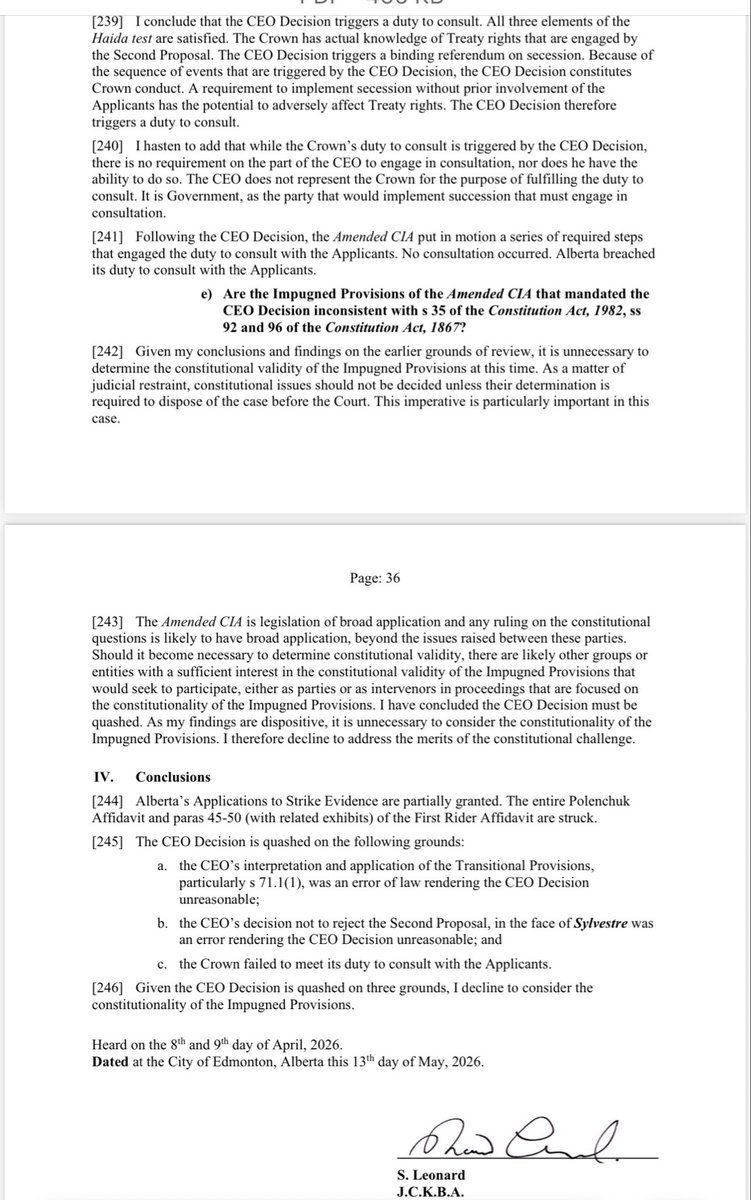
Today’s ruling by Justice Leonard essentially found that the citizen-led independence petition process cannot proceed because the government did not fulfill certain constitutional responsibilities owed to First Nations.
But here is the important point: the Alberta government did not initiate this petition process. Citizens did, through a lawful statutory mechanism created by the Legislature itself. So how does a court conclude that the government failed to fulfill duties that had not yet even arisen or been carried out, particularly when the government itself had not initiated the referendum process?
It is also important to understand that the Alberta government has always had the ability to call a referendum on independence at any time if it chose to do so. That is not in dispute, and it was not the legal question before the Court in this case. Nothing in today’s ruling prevents the Alberta government from calling the very same referendum itself tomorrow.
So think about that carefully.
A citizen-led democratic process established by law is effectively halted, not because citizens failed to follow the legislated process, but because of obligations assigned to government itself. Yet the government retains the full ability to ask the same question directly.
Courts and those in government must always have regard to the overall interests of justice, including democratic participation, the integrity of legislated statutory processes, and public confidence in lawful democratic frameworks established by the Legislature.
I figured it would be appropriate to reflect on a few words from the Supreme Court of Canada:
“…liberal democracy demands the free expression of political opinion” and political speech lies at the core of the Charter’s guarantee of freedom of expression. The Court further affirmed that freedom of expression includes “the right to attempt to persuade through peaceful interchange.” — Harper v. Canada
The Supreme Court of Canada has also held that:
“…the right of each citizen to participate in the political life of the country is one that is of fundamental importance in a free and democratic society.” — Figueroa v. Canada
And in the Reference re Secession of Quebec, the Supreme Court of Canada recognized that democracy is grounded in the participation and democratic will of the people, and that a clear expression of the will of citizens carries constitutional and political significance that cannot simply be ignored. Specifically, the Court confirmed:
“The democratic principle identified above would demand that considerable weight be given to a clear expression by the people of Quebec of their will to secede from Canada…” — Reference re Secession of Quebec
So how does any of this truly reconcile with a situation where government itself can ask citizens a question through a referendum process, but a group of citizens following a lawful statutory process established by the Legislature is not permitted to ask the question?
What message does that send when citizens engage in lawful democratic participation, comply with the very process created by government, and yet their voices are disregarded or treated as something to be feared?
Democracy is not strengthened when lawful citizen participation is restrained or silenced. In this case, it was not government stopping the process, but the Court. That reality raises profound questions about the role institutions play in democratic participation and how citizen engagement is treated when it touches controversial political issues.
After all, citizens do not hold institutional power. Their power is their voice. And if even that voice can be restrained after citizens lawfully engage in the exact democratic process created for them, what meaningful role are citizens truly left with in shaping the political future of their province and country?
What do you think? Should lawful citizen participation be encouraged, even when institutions disagree with the message?
A court has struck down one Alberta independence petition.
That does not mean the referendum is over.
The legal path to an Alberta independence referendum remains open, and Alberta’s cabinet still has the authority to put the question to voters in October.
Watch the full update below ⬇️
https://t.co/9LtIq9yvqQ
Majority of UCP voters support independence: poll
She says she is a federalist. She is not campaigning for Alberta to leave Canada — she's been clear about that. But she is also not turning around and attacking the people who are talking about it.
That is not an accident. One look at the numbers and you'll understand why Premier Danielle Smith is walking this line the way she is.
According to exclusive polling commissioned by Act For Alberta, and full disclosure, I am the point of contact for that third party advertiser, roughly 60% of United Conservative Party voters say they would vote to leave Canada.
Not think about it. Not flirt with it. They would vote to leave. That is not fringe. That is the base.
These are the people who built the party, who knocked on doors, who trusted conservative leadership to fight for Alberta.
And that brings us to disgraced former UCP premier Jason Kenney, Smith's predecessor.
Because he chose a very different path.
He calls separatists names. He mocks them as kooks and radicals and crazies, in vicious Trudeau-esque internet tirades.
He derided the very people who worked so hard to get him elected in the first place. People who gave him a chance to do it his way.
And what did that approach deliver? Nothing tangible. No meaningful reset with Ottawa. No shift in the relationship. No results that matched the promises.
So what happened? Those same voters started looking elsewhere.
Not because they suddenly changed who they were, not because they are no longer Conservatives, but because they felt ignored, dismissed, and taken for granted.
The old ways of strongly worded letters and lawsuits over jurisdiction have never worked. There are no pipelines, no control over immigration, no civil liberties the feds wouldn't crush if given a chance.
Smith is not making that mistake. She is reading the room, and when this many people are this frustrated, you do not lecture them. You do not insult them. You do not pretend they are a problem to be managed or berated.
You listen. You acknowledge where they are at, and you let the conversation happen.
This is bigger than separation. This is about trust. Trust that Alberta’s concerns are being taken seriously. Trust that political leaders are actually hearing the people who put them in power.
Smith holds her position. She says she believes Alberta is better off in Canada. But she is not trying to shut down the people who disagree.
She is not attacking her own base, because she understands something her predecessor did not.
You do not keep support by ridiculing the people who gave it to you. You respect them, let them speak, and you deal with reality as it is, not as you wish it would be.
REPORT by @SheilaGunnReid: